
Are you looking for ways to make your marketing more persuasive? Want to learn more about neuroscience and how you can influencer buying behaviour?
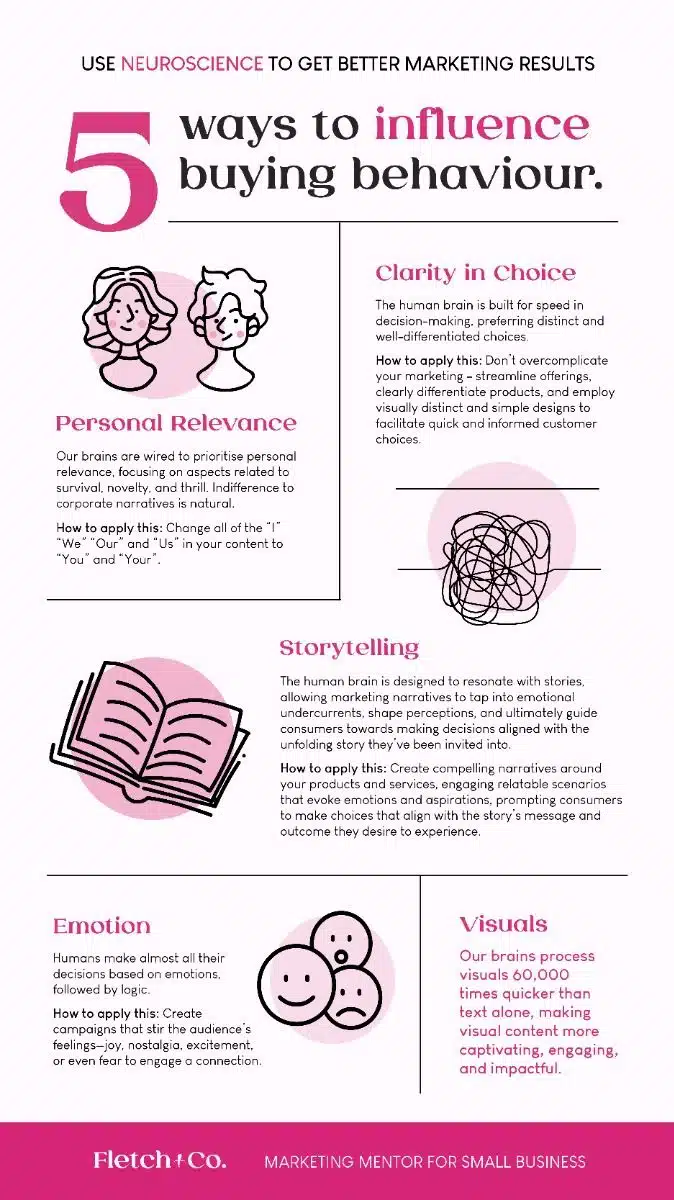
Fletch & Co shares its neuroscience marketing tips in this infographic.
Here’s a quick summary of what they cover:
- Personal relevance
- Clarity in choice
- Storytelling
- Emotion
- Visuals
Check out the infographic for more information.
Understanding how consumers make decisions is at the core of effective marketing.
While traditional strategies focus on demographics and buying patterns, neuroscience offers deeper insights into how the brain processes information, forms preferences, and ultimately makes purchasing decisions.
By applying neuroscience principles, marketers can create more compelling campaigns that tap into the subconscious drivers of behaviour.
Below, we explore five key ways to influence buying behaviour using neuroscience:
Personal Relevance
The human brain is wired to pay attention to things that feel personally relevant. Neuroscience research shows that when information aligns with a person’s interests, experiences, or immediate needs, it triggers increased activity in the medial prefrontal cortex—an area associated with self-referential thinking.
In marketing, this means that making a product or service feel personally relevant can significantly boost engagement and conversion rates.
How to Apply Personal Relevance in Marketing:
- Use Data for Personalisation: Leveraging customer data to tailor ads, emails, and website content can make marketing messages feel uniquely relevant to each individual. Personalised product recommendations based on browsing history or past purchases can create a stronger connection.
- Highlight Immediate Benefits: Instead of just listing product features, focus on how they solve a customer’s specific problem. For instance, a fitness brand targeting busy professionals might emphasise how their product fits into a hectic schedule.
- Leverage Retargeting: Consumers often need multiple touchpoints before making a purchase. Retargeting ads that remind users of products they previously viewed keep the messaging personally relevant.
By making your marketing feel personally meaningful to consumers, you increase the likelihood of them paying attention, engaging, and ultimately making a purchase.
Clarity in Choice
Too many choices can overwhelm consumers and lead to decision paralysis. A famous study by psychologists Sheena Iyengar and Mark Lepper found that people were more likely to make a purchase when offered six options rather than 24.
This is due to cognitive overload—when the brain struggles to process excessive information, it defaults to avoiding a decision altogether.
How to Improve Clarity in Marketing:
- Limit Choices: Instead of bombarding consumers with endless options, streamline choices and highlight a few best-selling or most relevant products.
- Use Clear, Simple Language: Marketing messages should be easy to understand. The brain processes straightforward, concrete language more efficiently than abstract or overly complex wording.
- Guide the Decision Process: Instead of leaving customers to sift through information on their own, structure their journey. Use product comparisons, “best for” categories, or customer testimonials to guide them toward a confident decision.
When marketing provides clarity and reduces cognitive effort, consumers feel more confident in their decisions—making them more likely to complete a purchase.
Storytelling
Humans have been wired for storytelling for thousands of years. Neuroscience reveals that stories activate multiple areas of the brain, including those responsible for sensory experiences, emotions, and memory.
This makes storytelling one of the most powerful tools in marketing.
Why Storytelling Works:
- Engages More of the Brain: Unlike raw data or statistics, which only activate specific analytical parts of the brain, stories engage multiple regions, making the message more memorable.
- Creates Emotional Connections: A well-crafted story allows consumers to see themselves in the narrative, fostering a sense of connection with the brand.
- Increases Recall: Studies show that people remember stories up to 22 times more than standalone facts. If a brand can embed its message into a compelling narrative, it becomes more likely to stick in a consumer’s mind.
How to Use Storytelling in Marketing:
- Use Customer Success Stories: Testimonials framed as stories—where the customer faces a problem, discovers the product, and achieves a positive outcome—are more impactful than generic reviews.
- Craft a Brand Narrative: Consumers resonate with brands that have a compelling mission or origin story. A brand that shares its journey, struggles, and values builds deeper trust.
- Incorporate Storytelling in Advertisements: Instead of simply listing features, frame product benefits within a relatable scenario. For example, a travel company might tell the story of a couple rediscovering their connection through an exotic getaway rather than just listing “beautiful destinations” as a selling point.
Effective storytelling captivates attention, fosters emotional connections, and makes brands more memorable.
Emotion
Emotion is one of the strongest drivers of decision-making. Neuroscientist Antonio Damasio discovered that people with damage to the emotional centers of their brain struggle to make decisions—even when presented with logical facts.
This highlights how emotion plays a crucial role in shaping consumer behaviour.
How to Leverage Emotion in Marketing:
- Evoke Positive Feelings: Happiness, excitement, nostalgia, and inspiration can all enhance brand perception. Brands like Coca-Cola use happiness-based marketing to create a strong emotional link.
- Use Fear or Urgency When Appropriate: Scarcity marketing (e.g., “Only 2 left in stock!” or “Limited-time offer!”) triggers the brain’s fear of missing out (FOMO), prompting quicker action.
- Incorporate Emotional Imagery and Music: Neuroscience shows that music and visuals can directly trigger emotional responses. The right soundtrack in an advertisement or an image that conveys warmth, trust, or excitement can influence buying behaviour.
- Align with Customer Values: Consumers feel more connected to brands that share their values. Brands that take a stand on issues their audience cares about—whether it’s sustainability, diversity, or ethical sourcing—can build stronger emotional loyalty.
When consumers feel emotionally connected to a brand, they are more likely to trust, engage with, and remain loyal to it.
Visuals
The brain processes visual information 60,000 times faster than text. Neuroscience research shows that people form first impressions in milliseconds, often based on visual cues.
In marketing, strong visuals are essential for capturing attention and conveying messages quickly.
How to Optimise Visuals in Marketing:
- Use High-Quality Imagery: Blurry, cluttered, or low-quality images can create a negative impression. Invest in professional photography or high-quality stock images.
- Leverage Colour Psychology: Different colours evoke different emotions. Red can create a sense of urgency, blue conveys trust, and green is often associated with health and sustainability.
- Make Key Information Visually Stand Out: People skim content rather than reading it word-for-word. Use bold fonts, bullet points, and contrasting colours to highlight essential information.
- Use Faces in Marketing: Neuroscience shows that people are naturally drawn to faces. Ads featuring human expressions, particularly those displaying emotions, can increase engagement and relatability.
- Optimise for Mobile Viewing: With more people browsing and shopping on their phones, ensuring that visuals are mobile-friendly is crucial for engagement.
By prioritising strong, emotionally resonant visuals, brands can capture attention quickly and create a lasting impression.
Final Thoughts
Neuroscience provides invaluable insights into how people make buying decisions, allowing marketers to craft more effective strategies.
By focusing on personal relevance, clarity in choice, storytelling, emotion, and visuals, brands can create messages that resonate on a deeper level—leading to stronger engagement, increased trust, and higher conversion rates.
As consumer behaviour continues to evolve, applying these neuroscience-backed principles can give businesses a competitive edge in an increasingly crowded marketplace.
Whether through personalised experiences, clear messaging, emotionally driven storytelling, or compelling visuals, tapping into how the brain works can make all the difference in influencing buying behaviour.

Author:
Mark Ford

10 New Year’s Marketing Resolutions to Grow a Small Business Sustainably
Are you struggling to make your marketing efforts deliver steady growth instead of short bursts of activity? Wondering how to build a marketing approach that supports your small business over the long term without constant trial and error? […]
10 Marketing Trends for 2026: What Smart Businesses Will Focus On Next
Are you looking to understand how marketing is shifting in 2026 and what today’s smartest brands are prioritising? Want to know which strategic trends will shape how businesses attract, convert, and retain customers over the next year? […]
How to Build a Marketing Technology Stack That Actually Works Together
Are you trying to figure out how to connect your marketing tools so they actually support each other instead of working in isolation? Want to understand the key steps to building a marketing technology stack that runs smoothly across your entire customer journey? […]