Do you struggle to convert your company website visitors into customers? Want to know what you can change in order to generate more sales?
For a large proportion of website owners generating visitors isn’t the most pressing issue, after all there’s tons of easy ways to increase website traffic for free, The major issue is converting your visitors into hard currency – sales.
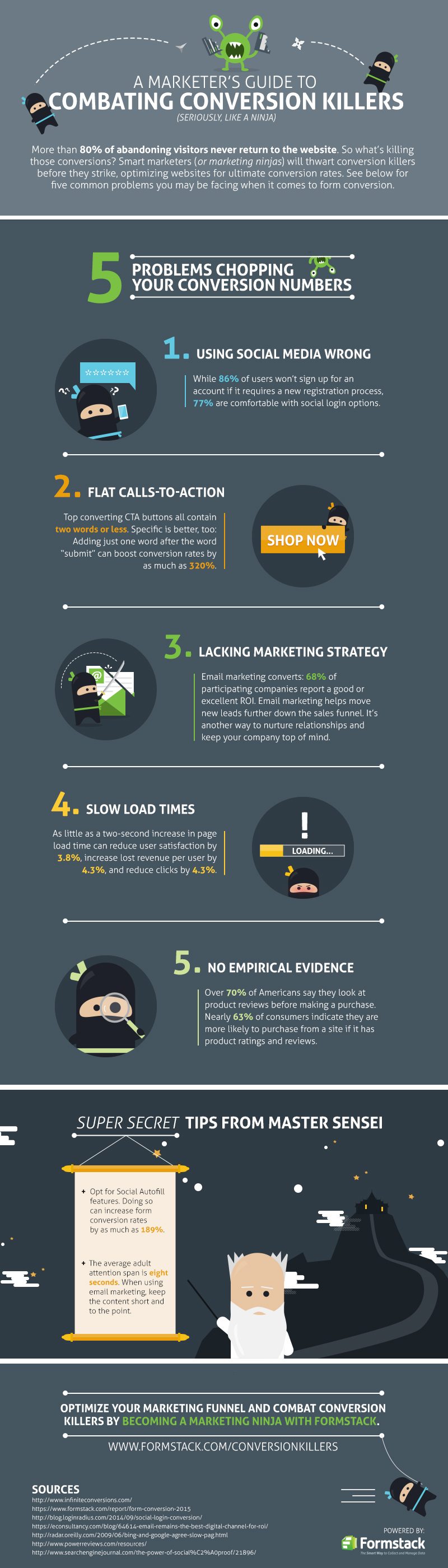
But what is actually stopping your visitors from converting? The team at Formstack have listed 5 common reasons in the infographic below.
In the digital age, having a website is no longer optional; it’s a necessity for businesses of all sizes. However, simply having a website isn’t enough to guarantee success. Your website needs to effectively convert visitors into customers or clients. If your website isn’t performing as well as you’d like in this regard, there are likely some issues that need addressing. In this blog post, we’ll explore five common website issues that can kill your conversions and offer solutions to help you turn the tide.
Issue #1: Slow Loading Times
One of the most significant conversion killers is a slow-loading website. In today’s fast-paced world, users expect websites to load quickly. According to a study by Google, 53% of mobile users will abandon a site that takes more than three seconds to load. For desktop users, the expectations are not much different.
Solution: To address slow loading times, start by optimizing your website’s images and files. Compress images and use formats that are optimized for the web. Consider using a Content Delivery Network (CDN) to distribute your site’s content across multiple servers, reducing server load and improving loading times. Finally, choose a reliable hosting provider that can handle your website’s traffic efficiently.
Issue #2: Poor Mobile Responsiveness
With the increasing use of mobile devices, having a website that doesn’t look or function well on smartphones and tablets is a significant conversion killer. If users have to pinch and zoom to read content or struggle with navigation, they’re more likely to leave your site.
Solution: Invest in responsive web design. Ensure your website adapts seamlessly to various screen sizes and orientations. Test your website on different devices to make sure it provides an excellent user experience across the board. Google also considers mobile-friendliness as a ranking factor, so this improvement can benefit your SEO efforts as well.
Issue #3: Complex and Confusing Navigation
A website with a confusing navigation structure can frustrate users and lead them to abandon their visit prematurely. If visitors can’t find what they’re looking for or have trouble understanding how to move through your site, your conversion rates will suffer.
Solution: Simplify your website’s navigation menu. Use clear and concise labels for menu items. Consider implementing a logical hierarchy with dropdown menus for subcategories. Additionally, include a search bar prominently on your site to help users find specific content quickly. User testing and feedback can also provide valuable insights into improving navigation.
Issue #4: Lack of Trust Signals
In the online world, trust is crucial for converting visitors into customers. If your website lacks trust signals, such as customer reviews, security badges, or contact information, potential customers may hesitate to take action.
Solution: Incorporate trust-building elements into your website strategically. Display customer testimonials and reviews prominently, especially on product or service pages. Ensure that your website has a secure connection (https://) and prominently display security badges or certifications. Provide clear and easily accessible contact information, including a physical address and phone number, to reassure visitors that your business is legitimate and accessible.
Issue #5: Ineffective Call to Action (CTA)
Your website’s call to action (CTA) is the gateway to conversions. If your CTAs are unclear, uninspiring, or buried beneath layers of content, visitors won’t know what action to take, and your conversion rates will suffer.
Solution: Craft compelling CTAs that are concise and action-oriented. Use action verbs that convey a sense of urgency and value, such as “Get Started,” “Subscribe Now,” or “Buy Today.” Make sure CTAs stand out visually with contrasting colors and placement on the page. Test different CTA variations to see which ones resonate best with your audience, and regularly update them to keep your site fresh.
Conclusion
Your website is often the first interaction potential customers have with your business. If it’s plagued by issues that hinder conversions, you’re missing out on valuable opportunities. By addressing common problems like slow loading times, poor mobile responsiveness, complex navigation, lack of trust signals, and ineffective CTAs, you can significantly improve your website’s performance.
Remember that website optimization is an ongoing process. Regularly monitor your site’s performance, gather user feedback, and stay informed about industry best practices to ensure your website remains an effective conversion tool. With the right adjustments, you can transform your website from a conversion killer into a conversion powerhouse, driving business growth and success.

Author:
Mark Ford

Mastering the Art of the Landing Page: Design, Copy, and Conversion in Harmony
Are you trying to design a landing page that not only looks great but actually converts visitors into customers? Want to learn how to balance design, copy, and strategy to create landing pages that work in perfect harmony? […]