
Are you struggling to turn your marketing efforts into consistent leads and sales? Want to avoid the common mistakes that drive potential customers straight to your competitors?
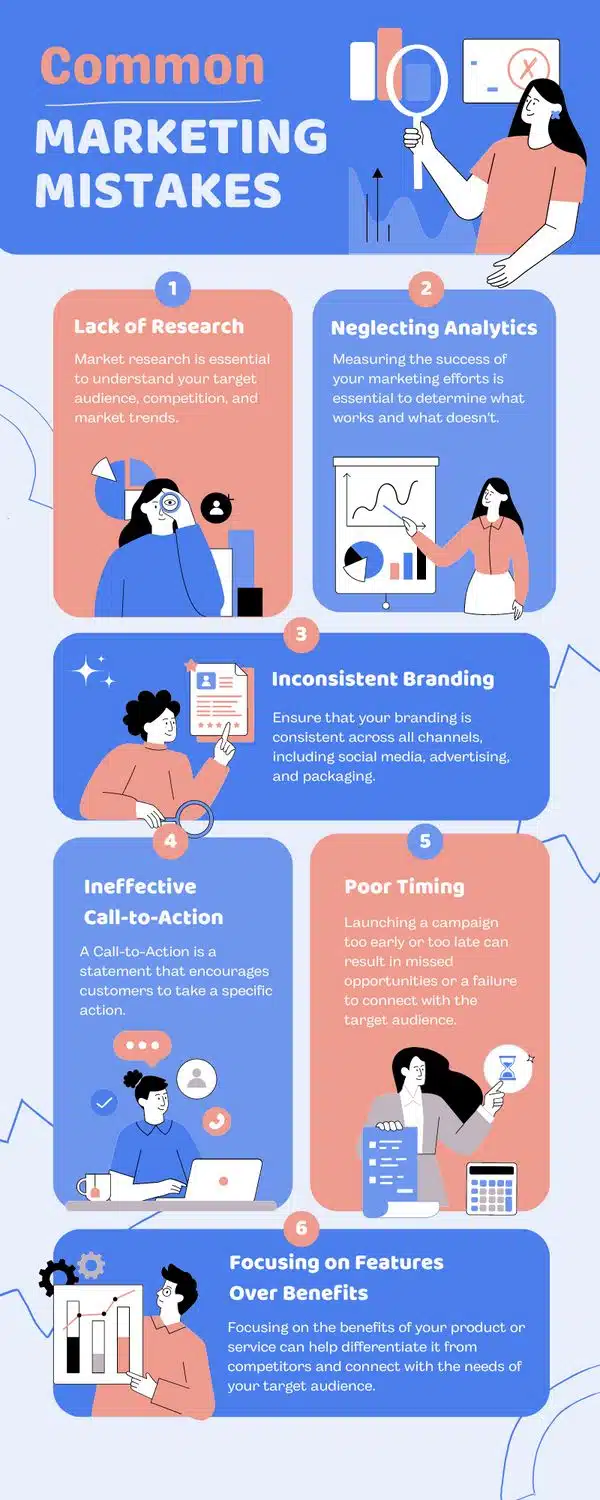
You’ll find some marketing basics in this infographic.
Here’s a summary of what’s covered:
- Lack of Research
- Neglecting Analytics
- Inconsistent Branding
- Ineffective Call-to-Action
- Poor Timing
- Focusing on Features Over Benefits
Check out the post below for more.
In a crowded and competitive digital landscape, even the smallest misstep can send potential customers straight to your competitors. Marketing is more than just putting your message out there—it’s about putting the right message in front of the right people at the right time.
Unfortunately, many businesses fall into the same traps, making preventable mistakes that undermine their success. In this blog post, we’ll explore six common marketing mistakes that could be costing you leads, conversions, and revenue—and, most importantly, how to fix them.
Lack of Research
Without proper market research, your marketing efforts are little more than guesswork. You may think you know your audience, but assumptions often lead to poor targeting, irrelevant messaging, and wasted spend. Understanding who your customers are, what they care about, and how they make decisions is critical to creating effective campaigns. Research is the foundation that ensures every other aspect of your marketing strategy is built on solid ground.
- Define Your Ideal Customer Profile (ICP): Use data from existing customers to map out demographics, needs, and buying behaviours.
- Conduct Competitor Analysis: Identify who your competitors are, what they offer, and how they position themselves to spot gaps or advantages.
- Track Market Trends: Stay up to date with changes in customer behaviour, technology, and industry shifts that could affect your strategy.
- Use Surveys and Feedback: Direct input from your audience helps validate assumptions and guides your messaging.
Neglecting Analytics
Many businesses launch marketing campaigns without properly tracking performance, missing out on valuable insights. Analytics help you understand what’s working, what’s not, and where your best opportunities lie. Without this information, you’re likely to repeat ineffective tactics while ignoring high-performing channels. Data-driven decisions are essential to getting the best return on investment.
- Set Clear KPIs: Know what success looks like before you begin—whether it’s traffic, conversions, or engagement rates.
- Use Tools Like Google Analytics: Monitor website behaviour to uncover where users drop off or which pages convert best.
- Track Campaign Performance: Analyse email open rates, click-throughs, ad spend, and conversion data regularly.
- Adjust Based on Insights: Make strategic tweaks to messaging, targeting, or design based on what the data reveals.
Inconsistent Branding
A scattered or inconsistent brand presence can confuse your audience and reduce trust. Whether it’s mismatched colours, shifting tones of voice, or disjointed visuals, inconsistent branding suggests a lack of professionalism. Consistency across all channels reinforces who you are and what you stand for, making it easier for people to recognise—and remember—your business.
- Create Brand Guidelines: Include visual elements (colours, fonts, logos) and tone of voice rules to ensure consistency.
- Audit Your Assets: Review all marketing materials, from social media to packaging, to spot discrepancies.
- Train Your Team: Ensure everyone involved in content creation understands and applies your branding consistently.
- Use Templates and Tools: Systems like Canva or Adobe Libraries help maintain visual consistency across formats.
Ineffective Call-to-Action
A marketing campaign without a strong call-to-action (CTA) is like a sales pitch that never asks for the sale. Your CTA tells your audience what to do next—click, buy, subscribe, learn more—but if it’s weak, unclear, or missing altogether, you’ll lose conversions. A well-crafted CTA is essential to guiding users through the funnel and turning interest into action.
- Be Clear and Specific: Tell the user exactly what to do—“Download the Guide” is stronger than “Learn More.”
- Create Urgency or Value: Use phrases like “Limited Offer” or “Get Your Free Trial Today” to encourage immediate action.
- Match CTA to Intent: Ensure the CTA fits the user’s journey—don’t ask for a big commitment too early.
- Test and Refine: Run A/B tests to compare variations and optimise for the best-performing versions.
Poor Timing
Even the best campaign can fail if it’s launched at the wrong time. Timing affects visibility, relevance, and response rates. Whether it’s seasonal trends, consumer buying cycles, or newsworthy events, your marketing needs to hit when your audience is most receptive. Poor timing leads to missed opportunities and lower engagement.
- Use a Marketing Calendar: Plan campaigns around known buying cycles, industry events, or customer milestones.
- Study Engagement Patterns: Look at when your audience opens emails, visits your site, or interacts with posts.
- Avoid Conflicting Events: Don’t launch during holidays, global events, or times when your audience is distracted.
- Consider the Funnel Stage: Time your message based on where the user is in the decision-making process.
Focusing on Features Over Benefits
It’s easy to fall into the trap of listing all the impressive features your product or service offers. But customers care more about what those features do for them. Highlighting benefits—how your product improves life, solves a problem, or delivers a result—makes your message more compelling. People don’t buy features; they buy solutions.
- Use “So What?” Testing: After each feature, ask “so what?” to uncover the underlying benefit it provides.
- Speak Your Customer’s Language: Translate technical specs into outcomes your audience values.
- Showcase Real Results: Use testimonials, case studies, or scenarios that demonstrate benefits in action.
- Lead with Value: Start your messaging with the biggest customer gain, not the internal tech spec.
Conclusion
The line between successful marketing and wasted effort is often determined by the ability to avoid these six critical mistakes. Whether it’s skipping research, neglecting data, presenting an inconsistent brand, failing to prompt action, launching at the wrong time, or focusing on features instead of benefits—each of these errors can push customers away.
But the good news? Every single one is fixable. By being strategic, data-driven, and customer-focused, you can turn these pitfalls into powerful opportunities for growth. Stay informed, stay aligned with your audience, and make every campaign count.

Author:
Mark Ford