In the vast digital landscape of the internet, where information overload is the norm, making your blog posts stand out is essential. One of the most effective ways to do this is by ensuring that your blog posts are easy to read.
When your content is easily digestible, you not only engage your readers but also encourage them to stay longer on your site, potentially leading to increased traffic and conversions.
In this blog post, we will explore six key strategies to make your blog posts more reader-friendly.
Infographic by Twelveskip.
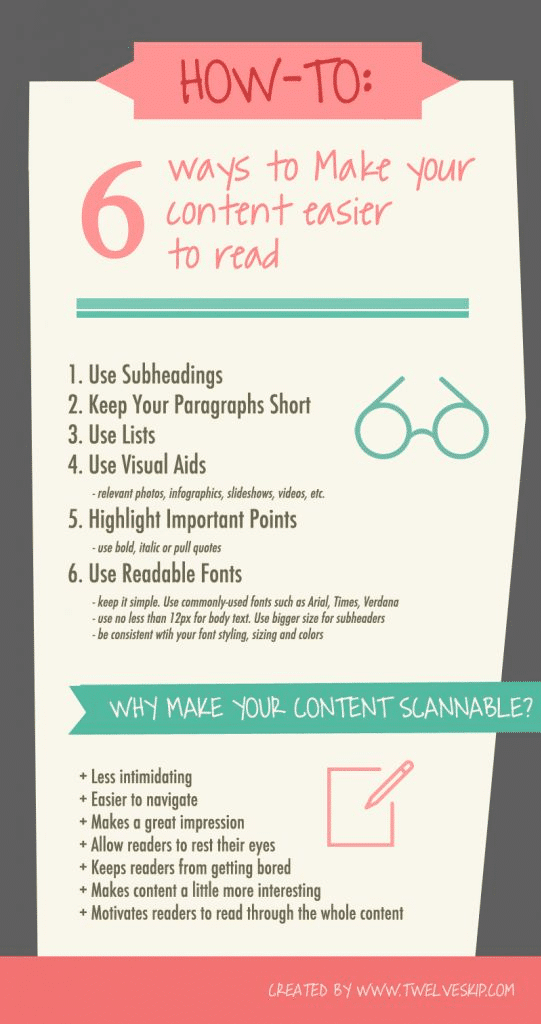
1. Write Clear and Concise Sentences
The foundation of any readable blog post is clear and concise writing. Long, convoluted sentences can confuse readers and make them lose interest quickly. To improve readability, follow these tips:
- Keep it Short: Aim for an average sentence length of 15-20 words. Shorter sentences are easier to understand.
- Use Simple Language: Avoid jargon and complex vocabulary when simpler words can convey your message effectively.
- Break up Long Sentences: If you find yourself writing a lengthy sentence, consider breaking it into two or more shorter ones.
For example, instead of writing: “Utilizing comprehensive strategies to optimize user experience and enhance engagement, it is important to consider various factors like website design, content structure, and navigation.
You could write: “To improve user experience and engagement, consider factors such as website design, content structure, and navigation.
2. Organize Your Content with Headings and Subheadings
Proper organization is key to readability. Headings and subheadings act as signposts, guiding readers through your content and making it easier for them to scan and find the information they need. Here’s how to effectively use headings and subheadings:
- Hierarchy: Use a clear hierarchy of headings. Typically, the main title is an H1, followed by H2, H3, and so on. Each level should represent a subtopic or section of your content.
- Conciseness: Keep your headings short and descriptive. They should give readers a clear idea of the content that follows.
- Consistency: Maintain a consistent style throughout your blog post. Use the same formatting for all headings and subheadings.
By using headings and subheadings, you break your content into digestible chunks, making it more accessible and scannable.
3. Incorporate Bullet Points and Lists
Lists and bullet points are powerful tools for improving the readability of your blog posts. They help you present information in a structured and concise manner. Here’s how to use them effectively:
- Lists: Use numbered lists for sequences or steps and bulleted lists for items without a particular order.
- Consistency: Keep the formatting consistent within lists. If you start with a complete sentence, continue with complete sentences throughout the list.
- Parallelism: Ensure that the items in your list are parallel in structure, making it easier for readers to process.
For instance, compare these two ways of presenting tips for better time management:
Non-parallel:
- To manage your time effectively.
- Prioritizing tasks.
- Avoid procrastination.
Parallel:
- Effective time management.
- Task prioritization.
- Procrastination avoidance.
The parallel structure improves readability and comprehension.
4. Use Engaging Visuals
Incorporating visuals into your blog posts can significantly enhance readability and engagement. Visuals break up the text, making your content less intimidating and more appealing. Here are some ways to use visuals effectively:
- Images and Infographics: Use relevant images and infographics to illustrate key points or data. Ensure they are of high quality and properly credited.
- Captions: Provide captions for images to offer context and enhance understanding.
- White Space: Leave enough white space around visuals to avoid clutter and maintain a clean layout.
Visuals not only make your blog posts more visually appealing but also cater to different learning styles, accommodating both visual and textual learners.
5. Implement a Consistent Typography
Typography plays a crucial role in the readability of your blog posts. Consistency in font choices, sizes, and styles enhances the overall reading experience. Here are some typography best practices:
- Font Choice: Select a legible font for your body text. Sans-serif fonts like Arial or Helvetica are often preferred for digital content.
- Font Size: Ensure your text is of an appropriate size, typically between 12-16 points for body text. Headings should be larger and appropriately scaled.
- Line Spacing: Use sufficient line spacing (line height or leading) to prevent text from appearing cramped.
- Color Contrast: Ensure a high contrast between text and background colors for readability. Black text on a white background is a classic choice.
Consistent typography creates a cohesive and professional appearance, making your content more inviting to readers.
6. Proofread and Edit
No matter how well you implement the previous strategies, errors in grammar, spelling, and punctuation can disrupt the flow of your blog post and diminish its credibility. Here’s how to ensure error-free content:
- Proofreading: After writing your post, take a break and then return to proofread it. Look for grammar and spelling mistakes, awkward sentences, and inconsistencies.
- Editing: Consider seeking professional editing services for your blog posts. Editors can provide valuable feedback on content structure, tone, and overall quality.
- Grammar and Spell Checkers: Use digital tools like Grammarly or Microsoft Word’s built-in grammar and spell check to catch basic errors.
Correcting mistakes and refining your content demonstrates your commitment to providing quality information to your readers.
Conclusion
In the competitive world of blogging, making your content easy to read is a fundamental strategy for success. By following these six techniques, you can improve the readability of your blog posts, attract and retain more readers, and ultimately drive more traffic to your site. Remember that readability is not just about words but also about visual appeal and organization. Strive for clarity, simplicity, and consistency in your blog posts, and your audience will thank you with their continued attention and engagement.

Author:
Mark Ford