It’s fairly obvious that driving traffic to your website is one of the most important and powerful techniques any small business owner can use to build their business. What happens once visitors have landed on your site though? They don’t just magically turn into customers.
Marketing is the lifeblood of any business, and for small business owners, it can be the key to success or failure. In today’s competitive marketplace, it’s essential for small business owners to utilize effective marketing techniques to stand out from the crowd, attract customers, and build a strong brand presence.
In this blog post, we’ll explore seven marketing techniques that every small business owner must use to thrive in the modern business landscape.
The infographic below from InfusionSoft gives what they call the “Big 7”. It all starts with driving traffic to your website, what are you doing to master the techniques listed after that?
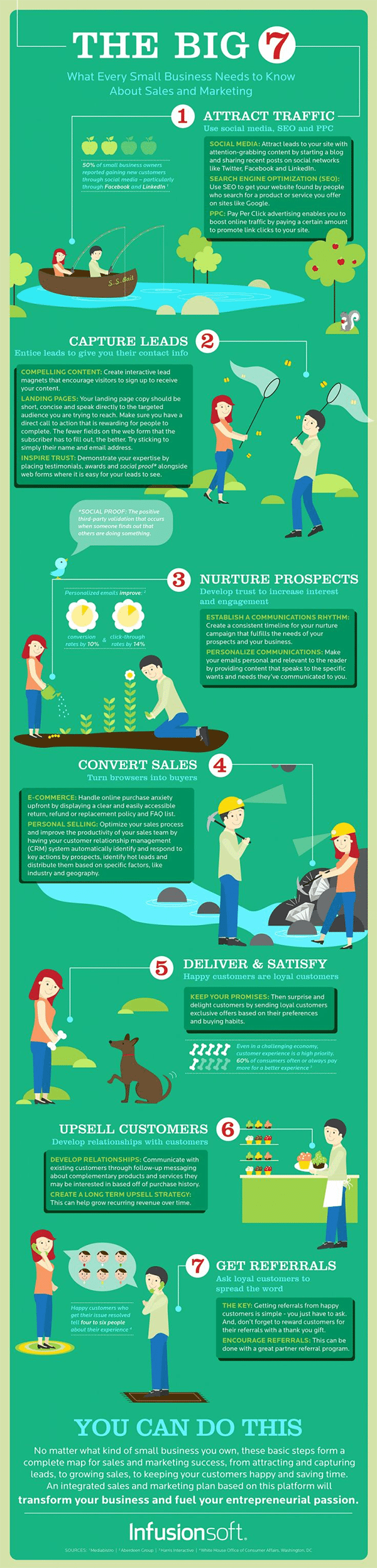
- Create a Strong Online Presence
In the digital age, having a strong online presence is non-negotiable. Small businesses must establish and maintain an engaging website that provides valuable information about their products or services. A well-designed website not only serves as an online storefront but also as a platform to showcase your brand’s personality and connect with your audience.
Furthermore, consider investing in search engine optimization (SEO) to improve your website’s visibility on search engines like Google. This will help potential customers find your business when they search for relevant keywords. Additionally, having active social media profiles on platforms like Facebook, Instagram, Twitter, and LinkedIn can help you reach a broader audience and engage with your customers directly.
- Leverage Content Marketing
Content marketing is a powerful strategy for small businesses to establish authority in their industry and connect with their target audience. Create valuable and informative content that addresses the pain points and questions of your potential customers. This content can take various forms, including blog posts, videos, infographics, and podcasts.
Consistency is key in content marketing. Regularly publish high-quality content that resonates with your audience, and use relevant keywords to improve your search engine rankings. Over time, this will help drive organic traffic to your website and position your business as an industry leader.
- Email Marketing
Email marketing remains one of the most effective ways to nurture leads, retain customers, and drive sales. Start by building a mailing list of interested subscribers. You can collect email addresses through your website, social media, or in-store promotions. Once you have a list, segment your subscribers based on their preferences and behavior to send them targeted and personalized emails.
Use email marketing to share valuable content, promotions, and updates with your subscribers. Be sure to craft compelling subject lines and create visually appealing emails that encourage recipients to open and engage with your messages. Additionally, monitor email metrics such as open rates, click-through rates, and conversion rates to refine your email marketing strategy over time.
- Social Media Advertising
While organic social media posts are valuable for building a community and engaging with your audience, social media advertising can give your small business an extra boost. Platforms like Facebook, Instagram, and LinkedIn offer robust advertising tools that allow you to target specific demographics, interests, and behaviors.
Investing in paid social media advertising can help you reach a wider audience and drive traffic to your website or physical store. You can create various types of ads, including image ads, video ads, and carousel ads, depending on your campaign goals. Monitor the performance of your ads and adjust your strategy as needed to maximize your return on investment.
- Google Ads
Google Ads (formerly known as Google AdWords) is a pay-per-click (PPC) advertising platform that allows small businesses to display their ads on Google’s search engine results pages and across the Google Display Network. This can be a highly effective way to reach potential customers who are actively searching for products or services like yours.
To get started with Google Ads, conduct thorough keyword research to identify the most relevant and cost-effective keywords for your business. Create compelling ad copy and choose the right bidding strategy to maximize your budget. Regularly monitor and optimize your campaigns to improve their performance over time. Google Ads provides valuable data and insights that can help you refine your marketing strategy and drive better results.
- Influencer Marketing
Influencer marketing is a strategy where you partner with individuals who have a significant following and influence within your target audience. These influencers can help you promote your products or services authentically and reach a wider audience.
To get started with influencer marketing, identify influencers in your niche or industry who align with your brand values and target audience. Reach out to them with a proposal for collaboration, outlining how your partnership can benefit both parties. Be sure to establish clear expectations, compensation terms, and a content schedule. When executed well, influencer marketing can help your small business gain credibility and trust among potential customers.
- Customer Reviews and Testimonials
Word-of-mouth marketing is still a powerful tool, especially for small businesses. Encourage your satisfied customers to leave reviews and testimonials on platforms like Google My Business, Yelp, and your website. Positive reviews can build trust and credibility with potential customers and improve your local search rankings.
Respond promptly to both positive and negative reviews. Thank customers for their feedback and address any concerns or issues they may have. This shows that you value customer opinions and are committed to providing excellent service. Over time, a collection of positive reviews can become a valuable asset for your small business.
Conclusion
Marketing is an ongoing process that requires careful planning, execution, and adaptation. Small business owners must embrace these seven marketing techniques to stay competitive and grow their businesses. By establishing a strong online presence, leveraging content marketing, utilizing email marketing, exploring social media advertising and Google Ads, engaging in influencer marketing, and actively managing customer reviews, you can build brand awareness, attract new customers, and foster loyalty among your existing customer base. Remember that marketing is an investment in the long-term success of your small business, and the effort you put into it can yield significant rewards.

Author:
Mark Ford

The Essential Marketing Toolkit: 19 Tools Every Modern Marketer Should Know About
Are you looking for the most effective tools to streamline your marketing, boost creativity, and save time? Want to discover the must-have platforms that every modern marketer should be using to stay ahead of the competition? […]