
Are you looking for a clear framework to make your marketing more consistent and effective? Want to learn how to turn your ideas into a structured process that delivers real business results?
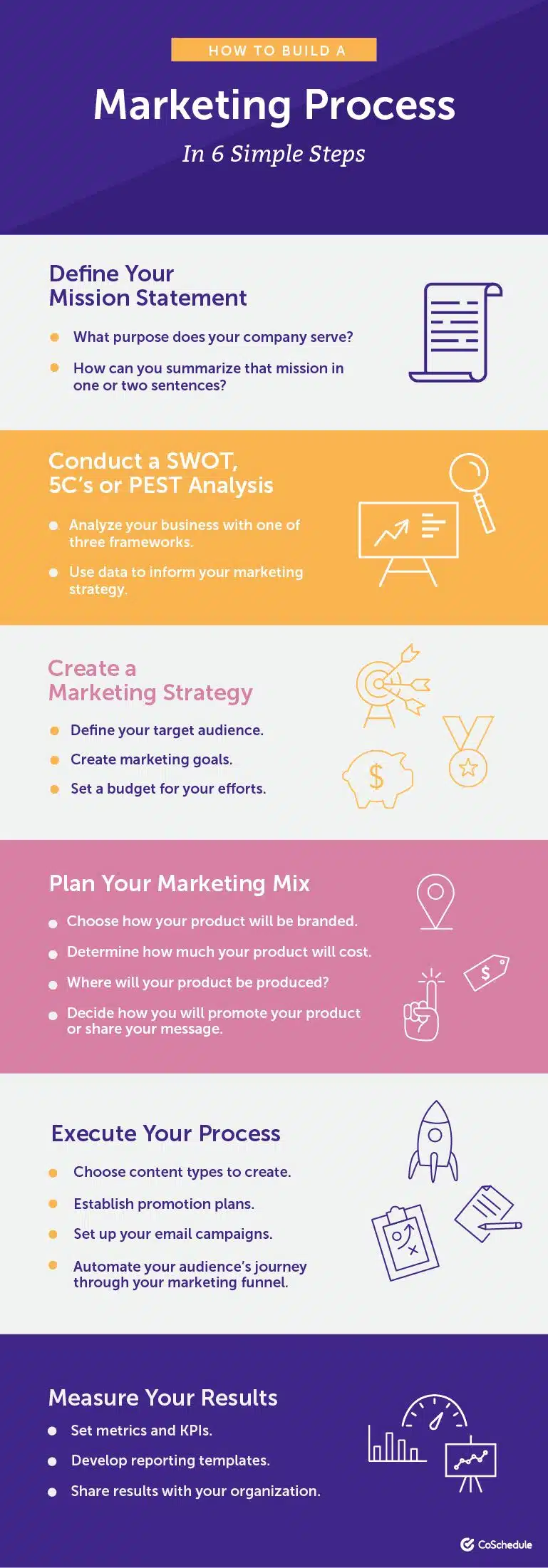
You’ll find a complete breakdown of the six key steps to building an effective marketing process in this infographic.
Here’s a summary of what’s covered:
- Define Your Mission Statement
- Conduct a SWOT, 5Cs or PEST Analysis
- Create a Marketing Strategy
- Plan Your Marketing Mix
- Execute Your Process
- Measure Your Results
Check out the post below for more.
A strong marketing process isn’t about random campaigns or chasing trends — it’s about building a structured path that consistently turns strategy into measurable success. When you have a clear process in place, every message, advert, and decision contributes to a larger business goal.
For business owners, this means less wasted time and more predictable growth. The following six steps will help you build an effective marketing process that keeps your brand focused, efficient, and results-driven.
Define Your Mission Statement
Every successful marketing process begins with a clear sense of purpose. Your mission statement sets the tone for everything your business communicates — it’s the “why” behind what you do. Without this foundation, your marketing can feel scattered or inconsistent. Defining your mission helps your audience understand your values and makes decision-making easier across every campaign.
- Reflect on your company’s core purpose — why does your business exist beyond profit?
- Write your mission in one or two concise sentences that anyone can understand.
- Align all marketing messages and visuals with this central mission.
- Revisit and refine your statement as your business evolves to stay authentic and relevant.
Conduct a SWOT, 5Cs or PEST Analysis
Before launching any marketing campaign, you need to understand your business environment. Conducting a SWOT, 5Cs, or PEST analysis gives you a structured way to assess your position, strengths, and potential challenges. These frameworks transform vague assumptions into actionable insights that can shape a smarter, more competitive strategy.
- Use a SWOT analysis to examine internal Strengths and Weaknesses, plus external Opportunities and Threats.
- Apply the 5Cs (Company, Customers, Competitors, Collaborators, and Context) for a broad business overview.
- Try a PEST analysis to evaluate Political, Economic, Social, and Technological factors that impact your market.
- Translate your findings into clear priorities and tactics that guide your next marketing steps.
Create a Marketing Strategy
A marketing strategy bridges the gap between where you are and where you want to be. It defines who you’re speaking to, what message you’ll deliver, and how you’ll reach your goals. A good strategy balances ambition with practicality — it focuses resources on the actions that will make the biggest impact. This step ensures that your marketing process supports long-term business growth, not just short-term visibility.
- Identify your ideal target audience through customer data, demographics, and behaviour patterns.
- Set SMART goals (Specific, Measurable, Achievable, Relevant, Time-bound) for your marketing efforts.
- Develop key messages that speak directly to your audience’s needs and motivations.
- Assign realistic budgets and allocate resources to maximise your return on investment.
Plan Your Marketing Mix
Once your strategy is clear, it’s time to design the tactical elements — what’s often called the “marketing mix.” This mix defines how your product, price, place, and promotion interact to create a consistent brand experience. By carefully balancing these elements, you can align your offer with what your audience truly values and how they prefer to buy.
- Decide how your product or service will be positioned and branded in the market.
- Establish pricing strategies that reflect both value and competitiveness.
- Choose where and how your product will be distributed or delivered to customers.
- Plan how you’ll promote your offer through advertising, PR, digital campaigns, or partnerships.
Execute Your Process
Execution turns planning into measurable action. This stage involves creating content, launching campaigns, and ensuring that every channel works together to move your audience through the marketing funnel. Consistent execution helps build trust, reinforce your brand identity, and generate the momentum that drives sales over time.
- Choose which types of content to create, from blog posts and videos to social media and email campaigns.
- Develop clear promotion plans that align with seasonal trends, events, or product launches.
- Set up automation tools for emails, social posts, and lead nurturing to save time and maintain consistency.
- Coordinate your campaigns across platforms to create a seamless experience from first contact to conversion.
Measure Your Results
A marketing process is only effective if it produces measurable outcomes. Tracking your results ensures you know what’s working — and what’s not. By defining key performance indicators (KPIs) early on, you can make data-driven adjustments that continually improve your campaigns. Regular measurement also helps demonstrate value to stakeholders and keeps your team accountable for performance.
- Identify KPIs that reflect your goals, such as leads generated, conversion rates, or brand reach.
- Use analytics tools to collect reliable data from your website, ads, and social platforms.
- Develop simple reporting templates to monitor results and share insights across your organisation.
- Review and refine your marketing process regularly to build on what works best.
Conclusion
Building an effective marketing process isn’t a one-time task — it’s an evolving framework that grows with your business. When each stage flows naturally into the next, your marketing becomes more efficient, cohesive, and purposeful.
From defining your mission to measuring results, every decision contributes to a cycle of improvement and clarity. For business owners, this process provides not just direction, but confidence — a clear path for turning ambition into sustainable success.

Author:
Mark Ford

10 New Year’s Marketing Resolutions to Grow a Small Business Sustainably
Are you struggling to make your marketing efforts deliver steady growth instead of short bursts of activity? Wondering how to build a marketing approach that supports your small business over the long term without constant trial and error? […]
10 Marketing Trends for 2026: What Smart Businesses Will Focus On Next
Are you looking to understand how marketing is shifting in 2026 and what today’s smartest brands are prioritising? Want to know which strategic trends will shape how businesses attract, convert, and retain customers over the next year? […]
How to Build a Marketing Technology Stack That Actually Works Together
Are you trying to figure out how to connect your marketing tools so they actually support each other instead of working in isolation? Want to understand the key steps to building a marketing technology stack that runs smoothly across your entire customer journey? […]