In today’s digital age, having a strong online presence is crucial for businesses of all sizes. Whether you run a small local shop or a multinational corporation, optimizing your website for search engines is a key strategy to attract potential customers.
Local SEO (Search Engine Optimization) is a specialized branch of SEO that focuses on improving your visibility in local search results. When done right, local SEO can drive more foot traffic to your physical store and increase online sales.
In this blog post, we’ll explore eight quick tips that can help you achieve explosive local SEO results.
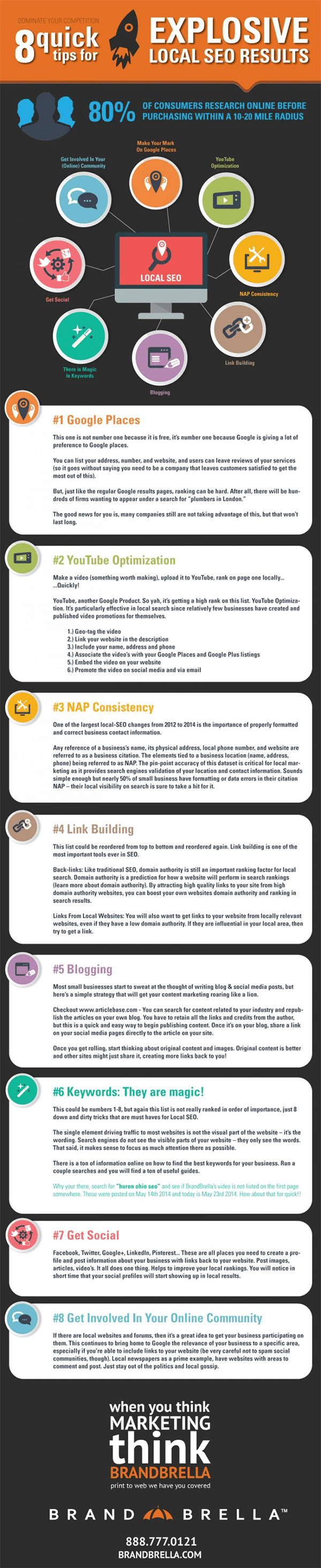
Infographic by Brand Brella.
1. Claim and Optimize Your Google My Business Listing
Google My Business (GMB) is a powerful tool for local businesses. It allows you to create and manage your business profile on Google, which includes essential information such as your business name, address, phone number, and operating hours. To get started with GMB:
- Claim your listing if it’s not already claimed.
- Ensure that your business details are accurate and up-to-date.
- Select relevant categories for your business.
- Write a compelling business description.
- Add high-quality photos of your products, services, and premises.
By optimizing your GMB listing, you increase your chances of appearing in the coveted “Local Pack” results when people search for businesses like yours in their area.
2. NAP Consistency Is Key
NAP stands for Name, Address, and Phone number. Consistency in your NAP information across all online platforms is vital for local SEO. Google and other search engines use this information to verify the legitimacy of your business. Here’s what you should do:
- Ensure that your NAP information is consistent on your website, GMB profile, and other online directories.
- Use the same format and style for your business name, address, and phone number.
- Check for any discrepancies or outdated information and correct them promptly.
Consistent NAP information builds trust with search engines and potential customers, improving your local SEO rankings.
3. Optimize for Local Keywords
Keyword research is the foundation of SEO, and local SEO is no exception. Identify relevant local keywords that potential customers might use to find businesses like yours. This often includes terms like “near me” or the name of your city or neighborhood.
Here are some tips for optimizing for local keywords:
- Use these keywords naturally in your website content, including headings, meta titles, and descriptions.
- Create location-specific pages or content that cater to different areas you serve.
- Include local keywords in your GMB description and posts.
By incorporating local keywords into your content, you increase your chances of ranking higher in local search results.
4. Encourage Customer Reviews
Online reviews play a significant role in local SEO. Positive reviews can boost your credibility and visibility in local search results. Encourage your satisfied customers to leave reviews on platforms like Google, Yelp, and Facebook. Responding to reviews, both positive and negative, also shows that you care about your customers’ feedback.
Here are some ways to encourage customer reviews:
- Provide excellent products or services that leave customers satisfied.
- Politely ask customers to leave a review after a positive experience.
- Make it easy for customers to leave reviews by providing links and clear instructions.
Remember that while you should encourage reviews, never pay for or fake them, as this can have serious consequences for your online reputation and local SEO.
5. Optimize for Mobile
As more people use mobile devices to search for local businesses, having a mobile-friendly website is crucial for local SEO. Google considers mobile-friendliness as a ranking factor, so if your website isn’t optimized for mobile, you could be missing out on potential customers.
To optimize your website for mobile:
- Choose a responsive web design that adapts to different screen sizes.
- Ensure that all website elements, including images and buttons, are easily clickable and readable on mobile devices.
- Test your website’s loading speed on mobile and make improvements if necessary.
A mobile-friendly website not only improves your local SEO but also enhances the user experience, which can lead to higher conversion rates.
6. Create High-Quality, Localized Content
Content is king in the world of SEO, and creating high-quality, localized content can give you a competitive edge in local search results. Consider creating blog posts, articles, or videos that address local topics, events, or issues relevant to your audience.
Here are some content ideas:
- Write about local events or news related to your industry.
- Create “how-to” guides that help customers solve common problems related to your products or services.
- Feature local customer success stories or case studies.
Localized content not only helps with SEO but also connects you with your community and positions your business as an authority in your niche.
7. Build High-Quality Backlinks
Backlinks, or links from other websites to yours, are a crucial factor in SEO. Quality matters more than quantity when it comes to backlinks. Building high-quality, local backlinks can boost your local SEO efforts.
Here’s how to build local backlinks:
- Partner with local organizations or charities and ask for a link on their websites.
- Sponsor local events or teams and request a mention and link.
- Connect with local bloggers or influencers who can feature your business in their content.
Remember that backlinks should be natural and relevant to your business. Avoid spammy or low-quality backlink schemes, as they can harm your SEO efforts.
8. Monitor and Analyze Your Performance
Last but not least, regularly monitor and analyze your local SEO performance to make data-driven improvements. Use tools like Google Analytics and Google Search Console to track key metrics such as website traffic, click-through rates, and conversion rates.
Here’s what you should do:
- Set up Google Analytics and Search Console for your website.
- Review your performance data to identify trends and areas for improvement.
- Adjust your local SEO strategy based on your findings.
By continuously optimizing your local SEO efforts, you can stay competitive and achieve explosive results over time.
Conclusion
Explosive local SEO results don’t happen overnight, but by following these eight quick tips, you can lay the foundation for long-term success. Claim and optimize your Google My Business listing, maintain NAP consistency, and focus on local keywords. Encourage customer reviews, optimize your website for mobile, and create high-quality, localized content. Build high-quality backlinks, and regularly monitor and analyze your performance to make data-driven improvements. With dedication and the right strategies, your business can rise to the top of local search results and attract more customers to your doorstep.

Author:
Mark Ford