Are you trying to understand what your audience really wants when they search online? Want to learn how to align your content with user intent so every page attracts the right visitors?
You’ll find a complete breakdown of keyword intent in this guide.
Here’s a summary of what’s covered:
- Informational Intent
- Navigational Intent
- Commercial Intent
- Transactional Intent
Check out the post below for more.
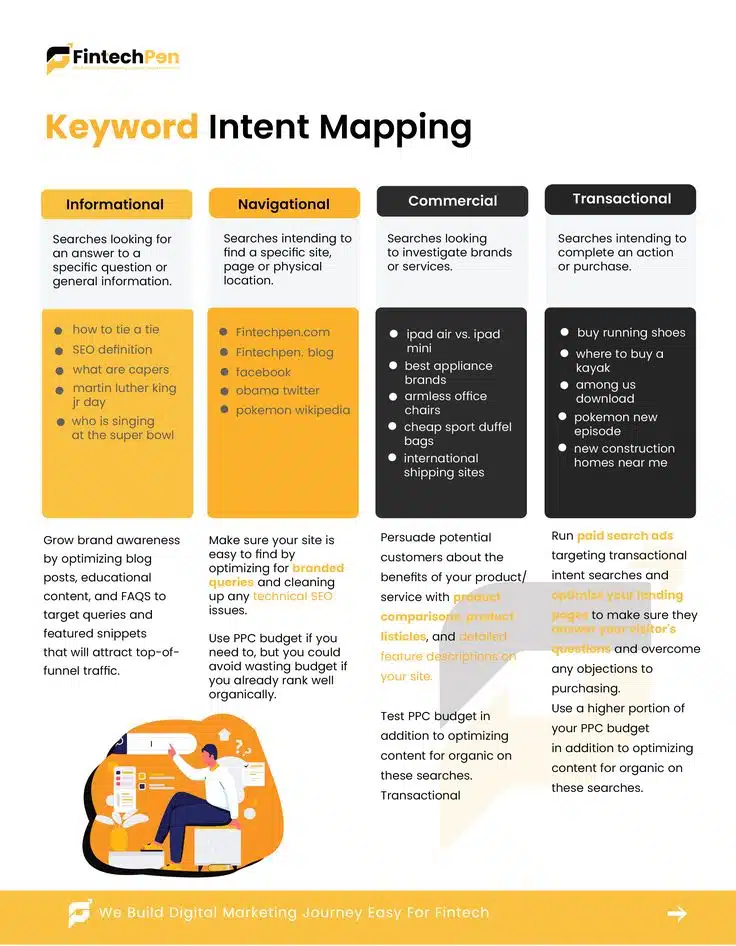
Understanding what people type into search engines is only half the job. The real power lies in understanding why they’re searching. Keyword intent reveals the motivation behind a query, showing whether someone wants information, a specific website, a product comparison, or to complete a purchase. When you align your content with that intent, you stop fighting algorithms and start working with them.
This guide breaks down the four core types of search intent and explains how to create content that satisfies each one. By mapping your keyword strategy to user behaviour, you can improve rankings, reduce wasted ad spend, increase conversions, and build a clearer, more effective customer journey. Whether you focus on SEO, PPC, content marketing, or all three, intent-based optimisation is what brings it all together.
Informational Intent
People using informational queries are at the earliest stage of their journey, seeking answers, clarity, or general knowledge. They are not ready to buy, but they are forming opinions and building trust with any brand that helps them learn. Creating content that speaks directly to their questions ensures you show up early and begin nurturing a long-term relationship.
These searches can take the form of how-to guides, definitions, explanations, news-related questions, or curiosity-driven topics. They are broad and often high-volume, attracting a wide range of users with varied needs. By serving these queries well, you build authority that supports rankings across your entire website. This is where brand awareness begins and where visitors first encounter your expertise.
To capture informational intent effectively, your content must be simple, helpful, and structured around clear answers that search engines can feature at the top of results. These queries fuel top-of-funnel traffic and can introduce thousands of new readers to your brand over time.
- Create educational blog posts targeting common questions users ask in your industry.
- Build FAQs around recurring support queries to capture quick, answer-seeking traffic.
- Use featured-snippet-ready formats such as definitions, lists, and concise explanations.
- Optimise for long-tail and question-based queries that reveal early-stage curiosity.
Navigational Intent
Navigational queries come from users who already know exactly where they want to go. They have a destination in mind, whether it’s a brand’s homepage, a blog, a social media profile, or a trusted source of information. These searches indicate familiarity and intent to find a specific place rather than to explore multiple options.
When you optimise for navigational intent, you’re ensuring that your audience can reach the correct page quickly and without confusion. Even a small amount of friction during this phase can result in lost traffic, as users expect search engines to guide them instantly to the right location. Dominating your own branded search is essential for credibility, visibility, and trust.
Optimising for navigational intent is not just about ranking for your business name. It also involves ensuring your website structure, technical SEO, and page naming conventions reinforce clarity and accessibility. When users want to find you, your job is simply to make the journey effortless.
- Optimise your site for branded queries so users can reach the correct pages immediately.
- Improve technical SEO so search engines can crawl, index, and prioritise your key pages.
- Use PPC bidding strategically for branded searches only when competitors are targeting them.
- Avoid wasting paid budget where your site already ranks strongly and naturally.
Commercial Intent
Commercial intent sits in the middle of the funnel, where users are researching options but not yet ready to buy. They are comparing products, weighing up alternatives, and gathering the details they need before making a decision. This stage is about persuasion, clarity, and presenting the information people need to feel confident moving forward.
Visitors with commercial intent want to explore comparisons, reviews, lists, and deeper product or service details. They may be debating features, pricing, quality, or brand differences. Any content that helps them evaluate their options can influence their direction and move them closer to conversion. This is where your authority and credibility can significantly shape outcomes.
Brands that succeed with commercial intent are the ones that create rich, transparent content that feels genuinely helpful. Rather than pushing users to buy, you present everything they need to choose the solution that best fits their needs. This is where you demonstrate expertise and build trust that supports future conversions.
- Create comparison content that outlines differences between products, services, or solutions.
- Publish product lists that help users evaluate categories or explore alternatives.
- Write detailed feature descriptions that highlight clarity, transparency, and value.
- Use PPC alongside organic content to capture users during high-value research phases.
Transactional Intent
Transactional intent represents the moment users are ready to take action. They want to buy something, sign up for something, download a file, or locate a nearby service provider. These are the highest-value searches, and they indicate readiness to convert if barriers are kept minimal and the path is made clear.
Visitors at this stage want speed, certainty, and reduced friction. They have already done their research and are looking for a solution that feels safe, trustworthy, and easy to complete. This is where landing pages, checkout processes, and clear calls to action become critical. If your website falters here, the user will simply choose a competitor.
Optimising for transactional intent means thinking carefully about what final concerns a customer might have and addressing them immediately. Removing doubts, strengthening your value proposition, and providing reassurance can make the difference between a conversion and an abandoned session.
- Run paid search ads targeting high-intent queries to capture ready-to-buy users.
- Optimise landing pages to answer final questions and eliminate objections to purchasing.
- Create clear, trustworthy content that streamlines the decision-making process.
- Allocate a larger percentage of your PPC budget to transactional queries where ROI is highest.
Conclusion
Keyword intent is the foundation of modern SEO and PPC strategy. When you understand the motivation behind a search query, you can create content and campaigns that meet users exactly where they are in their journey. Informational content builds awareness, navigational optimisation ensures accessibility, commercial content supports decision-making, and transactional optimisation drives conversions where they matter most.
By mapping each query to the right stage and shaping your content accordingly, you create a seamless experience that feels natural, intuitive, and aligned with user behaviour. Search engines reward this clarity because it helps people find what they want more quickly. Businesses benefit because it reduces wasted spend, increases engagement, and builds long-term trust.
Mastering keyword intent isn’t about chasing algorithms. It’s about understanding people. When you match your content to what users truly want, you build a stronger, more resilient digital presence that performs consistently and delivers real, measurable results.

Author:
Mark Ford