Are you struggling to decide which SEO tools are actually worth your time and money? Want to learn how to streamline your optimisation process without getting lost in unnecessary complexity?
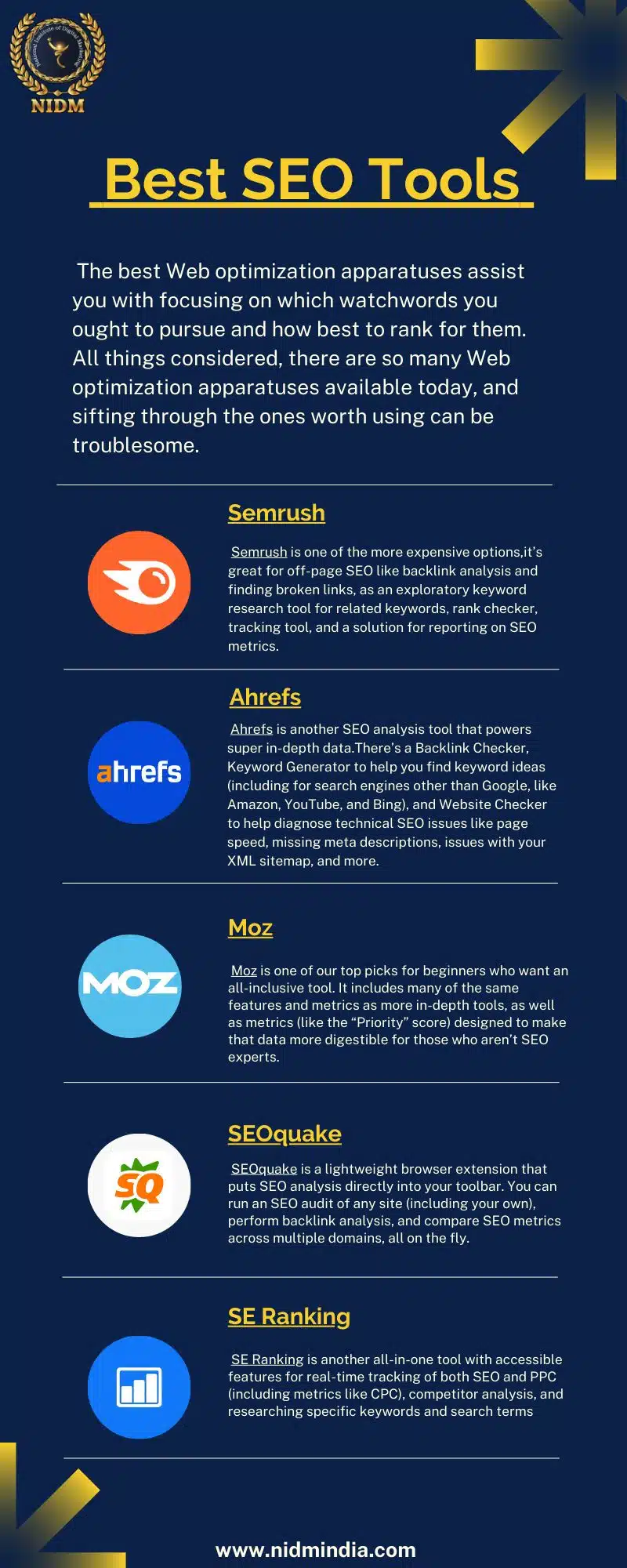
You’ll find a clear breakdown of the best SEO tools and how to use them effectively in this infographic.
Here’s a summary of what’s covered:
- Semrush
- Ahrefs
- Moz
- SEOquake
- SE Ranking
Check out the post below for more.
Search Engine Optimisation (SEO) can feel overwhelming with so many platforms, metrics, and updates to manage. But the truth is, you don’t need every tool on the market—you just need the right combination for your goals. The key is to understand what each tool does best, how they fit together, and which ones simplify your workflow instead of adding more noise.
In this guide, we’ll explore some of the most trusted SEO tools available and show you how to use them effectively without overcomplicating your strategy.
Semrush
Semrush is one of the most comprehensive SEO platforms on the market, offering an all-in-one suite for digital marketers and businesses. It’s particularly useful for off-page optimisation, competitive research, and monitoring keyword performance. While it’s one of the pricier options, its depth of insight can quickly pay for itself when used strategically.
- Use Semrush’s Keyword Magic Tool to uncover related search terms and long-tail opportunities for your content.
- Run a backlink audit to identify low-quality or spammy links that could hurt your rankings.
- Track your position changes across multiple search engines to measure your campaign’s impact over time.
- Leverage SEO reports and dashboards to share progress with clients or internal teams in a clear, data-driven way.
Ahrefs
Ahrefs is another heavyweight in the SEO world, known for its robust backlink database and in-depth analytics. It’s ideal for technical audits, competitor analysis, and discovering new keyword opportunities. Whether you’re managing content for your own business or clients, Ahrefs provides actionable data to guide smarter optimisation decisions.
- Use the Site Explorer feature to analyse competitor websites and see which pages attract the most backlinks.
- Run a content gap analysis to uncover topics your competitors rank for but you don’t.
- Check your site’s health score with Ahrefs’ site audit to identify crawl issues, broken links, or slow pages.
- Explore the Keyword Generator to find ideas for multiple platforms including Google, YouTube, and Amazon.
Moz
Moz is a great choice for marketers who want simplicity without sacrificing quality insights. It’s particularly beginner-friendly and provides an approachable way to learn SEO fundamentals. The platform includes keyword tracking, link analysis, and a range of metrics that help make sense of your site’s performance at a glance.
- Monitor your Domain Authority (DA) to understand your website’s overall credibility in search rankings.
- Use the Keyword Explorer to evaluate search volume, competition, and click-through potential.
- Take advantage of the Page Optimisation tool to assess how well your content matches search intent.
- Review your link profile regularly to identify opportunities for new outreach or link building.
SEOquake
SEOquake is a lightweight browser extension that delivers instant SEO data as you browse. Instead of logging into a separate platform, it lets you evaluate key SEO metrics directly from your toolbar. It’s ideal for quick audits, competitor comparisons, or assessing a page’s SEO health in real time.
- Install the SEOquake extension on Chrome, Firefox, or Opera for quick access to metrics like page rank and keyword density.
- Use the diagnostics feature to check for meta tag issues, page titles, and internal link structure.
- Run a comparison report between multiple domains to benchmark performance.
- Export data directly to CSV to include in your broader SEO analysis or client reports.
SE Ranking
SE Ranking combines SEO and PPC data in one easy-to-use platform, making it perfect for businesses that want a holistic view of their online performance. It’s user-friendly, affordable, and provides features for keyword tracking, competitor analysis, and campaign monitoring. If you want real-time data without a steep learning curve, SE Ranking is a strong option.
- Track keyword positions daily to see how your visibility changes over time.
- Use the competitor research tool to analyse rival campaigns and refine your approach.
- Integrate Google Analytics and Search Console to create unified performance reports.
- Explore page audits to spot missing meta tags, duplicate content, or broken links quickly.
Why Choosing the Right Tools Matters
The SEO landscape changes constantly, and not every tool will suit your needs or budget. Investing in the right set of tools helps streamline your workflow and ensures you’re focusing on data that genuinely moves the needle. It’s about finding balance—enough information to make smart decisions, but not so much that it slows down progress.
- Avoid using too many overlapping tools that provide similar metrics—it can create confusion.
- Evaluate each tool’s return on investment by tracking how it improves rankings or saves time.
- Look for platforms with scalable pricing so your toolkit can grow with your business.
- Choose tools that offer integrations with your existing software, such as Google Analytics or CRM systems.
How to Combine SEO Tools Effectively
You don’t need to commit to a single platform; instead, use a mix that complements your workflow. Many marketers use two or three tools together to cover all bases—keyword research, backlinks, and technical analysis. The trick is to ensure that each one adds unique value rather than duplicating the same data.
- Pair Semrush or Ahrefs for research with SEOquake for quick checks and real-time insights.
- Use Moz for tracking domain metrics and SE Ranking for affordable day-to-day monitoring.
- Cross-check keyword data between platforms to validate accuracy before making strategic decisions.
- Set up automated reports across your chosen tools to keep your team aligned and informed.
Simplifying Your SEO Workflow
It’s easy to fall into the trap of over-analysing when you have access to endless data. The most effective SEO practitioners use tools to simplify, not complicate, their process. Focus on a few key metrics—visibility, traffic, and conversions—and let your chosen tools automate the rest.
- Define core KPIs before diving into any tool, so you’re measuring what matters most.
- Schedule regular but limited audits—monthly or quarterly—to avoid getting bogged down in details.
- Use automation and alerts to monitor sudden ranking changes instead of checking manually.
- Keep your reporting simple and visual so stakeholders can quickly grasp performance results.
Common Mistakes When Choosing SEO Tools
Many businesses make the mistake of chasing trends or investing in tools without a clear purpose. The best SEO tools aren’t necessarily the most expensive—they’re the ones you’ll actually use consistently. A strategic, minimalist approach often produces better results than an overloaded toolkit.
- Avoid signing up for multiple tools that perform the same task, such as rank tracking or backlink audits.
- Don’t ignore the learning curve—some platforms require time to master before showing value.
- Steer clear of tools that promise “instant results” or “guaranteed rankings”; SEO is a long-term process.
- Always test free trials first to ensure the tool aligns with your specific goals and workflow.
Building a Sustainable SEO Strategy
Choosing the right tools is just the start—what matters most is how you apply the insights they provide. SEO is about consistency, adaptability, and continual learning. When you use your tools strategically, they become an extension of your marketing process, not a distraction from it.
- Use tool insights to create actionable plans, such as updating content or improving site structure.
- Revisit your data regularly to adjust campaigns based on new trends or algorithm updates.
- Document your findings and results so you can replicate success across different projects.
- Combine SEO insights with broader marketing data for a complete picture of online performance.
Conclusion
The right SEO tools can transform your marketing—from guesswork to measurable growth. Instead of trying to master every platform available, focus on those that provide clarity, efficiency, and real insight.
Whether it’s Semrush for in-depth analysis, Ahrefs for backlink intelligence, or SEOquake for quick audits, your toolkit should work with you, not against you. When you simplify your approach and choose wisely, SEO becomes less about complexity and more about consistent, strategic progress.

Author:
Mark Ford