
Are you struggling to understand why your website isn’t showing up where it should on Google? Want to uncover the hidden SEO mistakes that could be quietly damaging your rankings and visibility?
You’ll find the most common ranking errors, and how to fix them, in this infographic.
Here’s a summary of what’s covered:
- Low-Quality Backlinks
- Duplicate Content
- Changed Internal Linking
- Copyright Violations
- Mobile Unfriendliness
- Updated Meta Titles or Tags
- Google Algorithm Updates
- Site Security Issues
- Increased Competition
- Content Changes
Check out the post below for more.
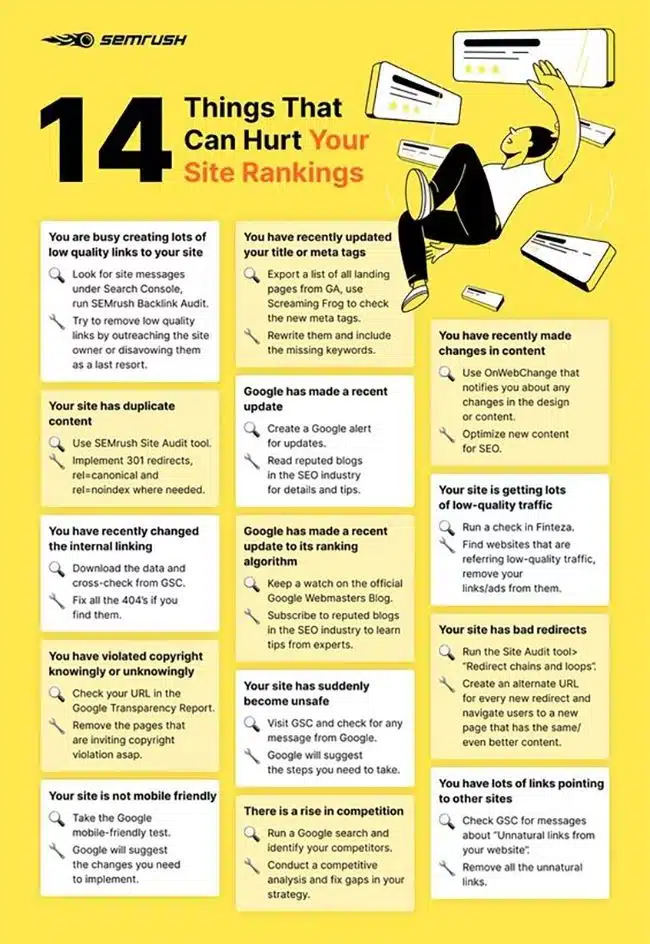
When your website isn’t performing as expected in search results, it can feel like you’re doing everything right but still not seeing the rewards. The truth is, even small SEO errors can have a major impact on how search engines view and rank your site. From poor-quality backlinks to technical missteps, a range of hidden issues can quietly undermine your visibility and traffic.
In this guide, we’ll explore 14 of the most common SEO mistakes that might be holding your site back—and how to fix them effectively.
Low-Quality Backlinks
Backlinks play a crucial role in your site’s authority, but not all links are beneficial. Low-quality, spammy, or irrelevant links can do more harm than good, sending negative signals to Google. Regular backlink audits are essential to maintain a clean and credible link profile. The goal is quality over quantity when it comes to link building.
- Use tools like Google Search Console or SEMrush to identify toxic backlinks.
- Disavow spammy or irrelevant links that could harm your ranking.
- Focus on earning links from reputable and contextually relevant websites.
- Avoid link farms, paid backlinks, and automated link exchanges.
Duplicate Content
Duplicate content confuses search engines and dilutes the authority of your pages. When multiple URLs show similar or identical text, Google struggles to determine which version to prioritise. This can lead to ranking drops or even deindexing. Regularly auditing for duplicate pages ensures your site stays clean and consistent.
- Use SEO audit tools like SEMrush or Screaming Frog to detect duplicate pages.
- Implement 301 redirects or canonical tags to point to your preferred version.
- Consolidate overlapping content into a single, valuable page.
- Avoid copying manufacturer or competitor text without unique rewriting.
Changed Internal Linking
Internal links help search engines understand your site structure and context. When you change them—whether through a redesign or content update—it can cause broken paths and lost authority flow. Fixing and optimising your internal links keeps your site healthy and easy for both users and crawlers to navigate.
- Run a crawl report to identify broken internal links.
- Update any outdated or redirected URLs within your content.
- Maintain a logical internal linking structure that supports key pages.
- Use descriptive anchor text to strengthen SEO signals.
Copyright Violations
Using copyrighted content without permission can lead to penalties, content removal, or ranking losses. Google takes copyright infringement seriously and may demote or delist infringing pages. Protecting your website’s integrity starts with respecting intellectual property and creating original content.
- Check your domain in the Google Transparency Report for copyright notices.
- Remove or replace any content that infringes on another’s rights.
- Always use royalty-free or licensed images and media.
- Develop unique written content that reflects your own brand voice.
Mobile Unfriendliness
With mobile devices driving the majority of web traffic, a non-mobile-friendly site will struggle to rank well. Google’s mobile-first indexing means your mobile version is prioritised in search results. Ensuring smooth usability across all screen sizes is now essential, not optional.
- Use Google’s Mobile-Friendly Test to identify usability issues.
- Ensure fonts, buttons, and menus scale properly on smaller screens.
- Optimise page speed for mobile users by compressing images and scripts.
- Avoid intrusive pop-ups that interrupt the mobile experience.
Updated Meta Titles or Tags
Meta titles and descriptions are small but mighty ranking factors. When these are changed carelessly, you risk losing keyword relevance or click appeal. It’s important to re-optimise them thoughtfully to preserve visibility and engagement.
- Keep track of meta changes and test them for SEO performance.
- Ensure key phrases remain in both titles and descriptions.
- Write meta tags that encourage clicks while staying under character limits.
- Use SEO tools to check for missing or duplicated tags across your site.
Google Algorithm Updates
Google regularly updates its algorithms to improve search quality, and these updates can affect your rankings overnight. Sites that rely on outdated tactics or thin content often feel the impact most. Staying informed about changes helps you adapt your strategy quickly and protect your performance.
- Follow Google Search Central and Webmaster Blog for algorithm news.
- Audit your site regularly for quality, relevance, and technical health.
- Avoid manipulative tactics like keyword stuffing or cloaking.
- Focus on building long-term, user-first SEO practices.
Site Security Issues
If your website becomes unsafe—due to malware, expired SSL certificates, or hacking—it can vanish from search results entirely. Google prioritises user safety, so even small security lapses can cost you valuable traffic. Monitoring your site’s health is key to maintaining trust and rankings.
- Check Google Search Console for security warnings or hacked content.
- Ensure your site uses a valid SSL certificate (HTTPS).
- Update plugins, themes, and CMS software regularly.
- Use a reliable security plugin or service to prevent future breaches.
Increased Competition
Sometimes, your ranking drop isn’t caused by your mistakes but by others improving theirs. A surge in competition can displace your site, especially if rivals invest in content, backlinks, or local SEO. Competitive monitoring helps you adapt and maintain your edge.
- Conduct keyword research to spot new competitors in your niche.
- Analyse their backlink strategies for opportunities and gaps.
- Refresh and expand your own content to stay relevant.
- Invest in long-term authority building rather than quick wins.
Content Changes
Updating content is important, but doing it without SEO consideration can lead to ranking loss. Major edits can remove vital keywords or disrupt on-page optimisation. The best approach is to refresh content strategically while maintaining search relevance.
- Track page performance before and after making updates.
- Retain key phrases that previously attracted search traffic.
- Re-optimise headings, meta tags, and internal links post-update.
- Avoid deleting high-performing pages without redirecting them properly.
Low-Quality Traffic Sources
Not all traffic benefits your SEO. Low-quality or spammy referral visits can skew analytics and lower engagement metrics like time on page or bounce rate. Cleaning up traffic sources ensures accurate data and better performance signals.
- Identify spam referrals using Google Analytics filters.
- Block or disavow sites sending irrelevant or fake traffic.
- Build partnerships with high-authority, relevant domains.
- Improve user intent targeting to attract quality visitors.
Bad Redirects
Redirects are useful for site restructuring, but when done incorrectly, they create loops or dead ends. These technical errors frustrate users and confuse search engines. A clean redirect setup preserves your link equity and user experience.
- Use 301 redirects for permanent URL changes.
- Avoid redirect chains that send users through multiple pages.
- Check for broken or incorrect redirect targets regularly.
- Create a redirect map before launching new site structures.
Excessive External Links
Linking to other sites can add value, but overdoing it can weaken your own authority. Excessive outbound links—especially to irrelevant or low-quality sources—can signal poor judgement to search engines. A balanced linking strategy protects your site’s credibility.
- Audit your outbound links quarterly using tools like Screaming Frog.
- Link only to trustworthy and contextually relevant websites.
- Use “nofollow” tags for sponsored or affiliate links.
- Ensure your own content outweighs external references.
Low-Quality Link Building
Building links remains a cornerstone of SEO, but shortcuts often lead to penalties. Search engines can easily detect manipulative link schemes and may demote sites that use them. Ethical, quality-driven link building is the only sustainable strategy.
- Focus on earning backlinks through guest posts, PR, and valuable content.
- Avoid private blog networks (PBNs) and link exchange programmes.
- Build relationships with industry-relevant sites and influencers.
- Diversify your backlink profile across trusted, authoritative sources.
Conclusion
If your website isn’t ranking as well as it should, chances are one or more of these issues are to blame. SEO success depends on ongoing attention, careful optimisation, and constant adaptation to Google’s evolving standards.
By auditing your backlinks, fixing technical errors, monitoring competition, and focusing on user experience, you can strengthen your rankings and regain lost visibility. In SEO, small improvements add up—and every fix brings you closer to the results your business deserves.

Author:
Mark Ford