

Are you considering investing in pay per click ads? Want to understand how Google & Facebook decide which ads to show on their platforms?
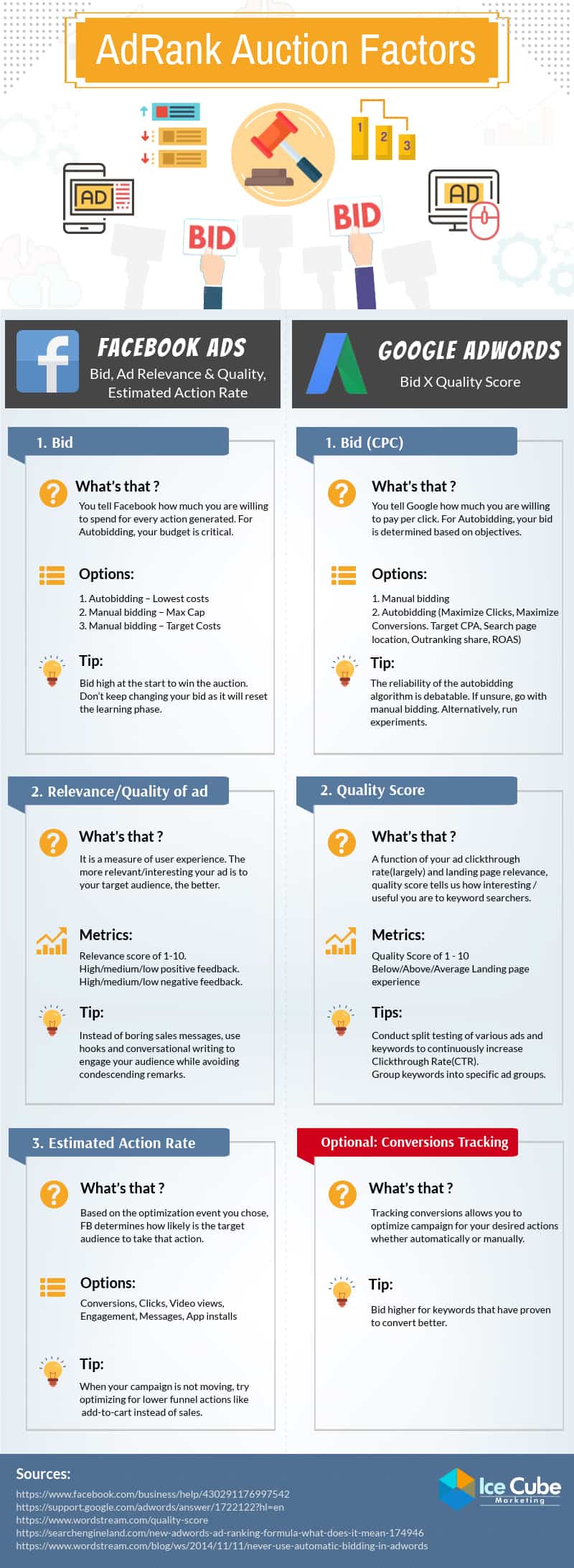
Ice Cube Marketing share their guide to Facebook and Google Ads in this infographic.
Here are the Facebook Ads factors to consider:
- Bid
- Relevance / quality of ad
- Estimated action rate
And here are the Google Ads factors to consider:
- Bid (CPC)
- Quality score
- Optional: Conversions tracking
Check out the infographic for more detail.
In the world of online advertising, understanding how platforms like Google and Facebook determine which ads to display can be the key to success. Both platforms utilize ad auction systems that take several factors into account to ensure that the most relevant and valuable ads reach their intended audiences. In this post, we’ll delve into the critical components of these ad auctions, including bids, relevance, estimated action rates, cost-per-click (CPC), quality scores, and conversions tracking.
Bid
Bidding is a crucial aspect of online advertising, especially for small businesses aiming to maximize their visibility without overspending. Understanding the bidding landscape and implementing effective strategies can significantly enhance your ad performance. Below, we’ll explore various bidding strategies, tips for managing bids, and how to make the most of your advertising budget.
Understanding Bidding Strategies
- Manual Bidding:
- What It Is: Manual bidding allows advertisers to set their maximum bids for specific keywords or ad placements. This strategy gives you full control over how much you’re willing to pay for each click or impression.
- When to Use: Manual bidding is ideal for small businesses that have a clear understanding of their audience and specific goals for each ad campaign.
- Tips:
- Start with a moderate bid based on industry benchmarks.
- Monitor your ad performance regularly and adjust bids based on which ads are driving traffic or conversions.
- Use tools like Google’s Keyword Planner to gauge the competitiveness and average CPC of keywords in your niche.
- Automated Bidding:
- What It Is: Automated bidding strategies adjust your bids in real-time based on your campaign goals. For example, Google Ads offers options like Target CPA (cost per acquisition) and Target ROAS (return on ad spend).
- When to Use: Automated bidding can be beneficial for small businesses with limited time or resources to manage bids manually.
- Tips:
- Choose an automated strategy that aligns with your business objectives. For instance, if your goal is to drive sales, consider using Target ROAS.
- Set clear conversion tracking to ensure that the bidding algorithm has enough data to optimize effectively.
- Be patient; automated bidding strategies often require some time to learn and adjust to your specific market conditions.
Setting Your Budget and Bids
- Define Your Budget:
- Determine a realistic daily or monthly budget for your ad campaigns. Consider factors like your overall marketing budget, the cost of goods sold, and expected profit margins.
- Start with a smaller budget to test various strategies, then scale up as you identify what works.
- Calculate Your Maximum CPC:
- Understanding how much you can afford to pay per click is crucial. A common formula is: Maximum CPC=Target Conversion Rate×Target Profit per Sale\text{Maximum CPC} = \text{Target Conversion Rate} \times \text{Target Profit per Sale}Maximum CPC=Target Conversion Rate×Target Profit per Sale
- For example, if you expect to convert 5% of clicks into sales and you make $50 profit per sale, your maximum CPC should be: Maximum CPC=0.05×50=2.5\text{Maximum CPC} = 0.05 \times 50 = 2.5Maximum CPC=0.05×50=2.5
- Adjust this amount based on your campaign goals and competition levels.
- Use Bid Adjustments:
- Both Google and Facebook allow for bid adjustments based on factors such as device, location, and time of day. For example, if your data shows that mobile users convert better, consider increasing your bids for mobile placements.
- Test different adjustments to optimize ad performance based on user behavior and trends.
Monitoring and Adjusting Bids
- Regular Performance Analysis:
- Use analytics tools provided by Google Ads and Facebook Ads to monitor key metrics such as CTR (click-through rate), conversion rate, and CPC. Analyze which ads and keywords are performing well and which are underperforming.
- Set a regular schedule for reviewing your ad performance (e.g., weekly or bi-weekly) and make adjustments based on your findings.
- Pause or Remove Underperforming Ads:
- Identify ads or keywords that are consistently underperforming and consider pausing or removing them to reallocate your budget to more effective campaigns.
- Testing new ad creatives or keywords can help in improving overall performance.
- Use A/B Testing:
- A/B testing allows you to compare different ad variations, targeting strategies, or bidding approaches. Create two versions of an ad and measure their performance over time to identify which performs better.
- Apply learnings from A/B tests to refine your bidding strategies and ad creatives continuously.
Leveraging Competitor Insights
- Conduct Competitive Analysis:
- Analyze your competitors’ advertising strategies, including their bidding tactics. Tools like SEMrush, Ahrefs, or SpyFu can provide insights into competitor keyword strategies and ad spending.
- Look for gaps in their strategies that you can capitalize on, such as targeting underserved keywords or demographics.
- Adjust Bids Based on Competition:
- If you notice that your competitors are bidding aggressively for specific keywords, consider adjusting your bids or focusing on long-tail keywords that may have less competition and lower CPC.
Final Thoughts on Bidding Strategies for Small Businesses
Bidding is not a one-size-fits-all approach; it requires ongoing analysis and adjustment based on performance data and market dynamics. By understanding different bidding strategies, setting realistic budgets, and regularly monitoring ad performance, small businesses can maximize their advertising investment. Focus on optimizing bids to enhance ad visibility and reach while keeping an eye on the overall return on investment. With the right approach, your bidding strategy can significantly impact your business’s growth and online presence.
Relevance / Quality of Ad
When it comes to online advertising, the relevance and quality of your ads are paramount. These factors not only influence your ad placements but also affect your costs and the overall effectiveness of your marketing campaigns. A high-quality ad is more likely to be shown to users, engage them, and convert them into customers. Here’s how small businesses can enhance their ad relevance and quality to achieve better performance.
Understanding Ad Relevance
- What Is Ad Relevance?
- Ad relevance refers to how closely your ad matches the search intent or interests of your target audience. A relevant ad is one that provides a suitable solution or answer to what users are searching for or what they are interested in at that moment.
- Platforms like Google and Facebook evaluate the relevance of your ads based on various factors, including keywords, targeting, and user engagement.
- Why Is It Important?
- Higher relevance can lead to better ad placements, lower costs per click (CPC), and improved overall campaign performance. When users find your ads relevant, they are more likely to click on them, leading to higher conversion rates.
Enhancing Ad Quality
- Create Compelling Ad Copy:
- Be Clear and Concise: Your ad copy should clearly communicate what you offer and why users should be interested. Avoid jargon and be straightforward.
- Highlight Unique Selling Propositions (USPs): Identify what sets your product or service apart from competitors and make sure to include this in your ad. This could be special offers, unique features, or exceptional customer service.
- Use Strong Call-to-Actions (CTAs): Include action-oriented language that encourages users to take the next step, whether it’s “Shop Now,” “Learn More,” or “Get a Free Quote.”
- Leverage Keywords Effectively:
- Keyword Research: Conduct thorough keyword research to identify relevant terms and phrases that your target audience is using. Utilize tools like Google Keyword Planner, SEMrush, or Ubersuggest.
- Match Types: Use different keyword match types (broad, phrase, exact) to control who sees your ads. For instance, broad match keywords may increase reach, while exact match keywords improve relevance.
- Incorporate Keywords Naturally: Integrate primary keywords into your ad copy and headlines without compromising readability. This will help your ads show up for relevant searches.
- Design Eye-Catching Visuals:
- High-Quality Images: Use high-resolution images that represent your brand and resonate with your audience. Poor-quality visuals can negatively impact perceived ad quality.
- Consistent Branding: Ensure that your visuals align with your brand identity, including colors, fonts, and overall aesthetics. Consistency fosters brand recognition and trust.
- Test Different Formats: Experiment with different ad formats, such as carousel ads, video ads, and slideshow ads, to see which engages your audience the most.
Targeting the Right Audience
- Define Your Target Audience:
- Create Buyer Personas: Develop detailed buyer personas that outline the demographics, interests, and pain points of your ideal customers. This will help you craft ads that resonate with them.
- Segment Your Audience: Use segmentation to tailor your messaging and offers. For example, create different ads for first-time customers compared to returning customers.
- Utilize Targeting Options:
- Geographic Targeting: If your business operates locally, target your ads to specific locations. This will ensure your ads reach users who can actually use your services.
- Interest and Behavioral Targeting: Platforms like Facebook allow you to target users based on their interests and behaviors. Take advantage of this feature to reach potential customers who are more likely to engage with your brand.
Engaging Users and Building Trust
- Foster Engagement:
- Use Interactive Elements: Incorporate interactive elements, such as polls or questions, in your ads to engage users. The more users interact with your ads, the higher their relevance score will be.
- Encourage User-Generated Content: Encourage your customers to share their experiences with your products or services. This can increase trust and relevance, as potential customers see real-world applications of your offerings.
- Build Trust with Social Proof:
- Showcase Testimonials and Reviews: Include positive customer reviews or testimonials in your ad copy or visuals. Social proof can significantly enhance credibility and encourage users to click on your ads.
- Highlight Awards or Certifications: If your business has received any accolades or certifications, prominently display these in your ads to reinforce trust.
Monitoring and Optimizing Ad Performance
- Regularly Analyze Ad Performance:
- Use analytics tools provided by advertising platforms to monitor key metrics such as click-through rates (CTR), conversion rates, and engagement levels. Regularly assess how well your ads resonate with your audience.
- Look for trends and patterns in ad performance. If certain ads are underperforming, investigate possible reasons (e.g., irrelevant targeting, weak copy, or low-quality visuals).
- A/B Testing for Continuous Improvement:
- Conduct A/B tests on various elements of your ads, such as copy, visuals, and CTAs. Testing different variations can help identify what resonates best with your audience.
- Use the insights gained from A/B testing to refine and optimize your ad campaigns continually.
Conclusion
The relevance and quality of your ads play a vital role in determining their success. By creating compelling ad copy, using targeted keywords, designing engaging visuals, and continuously monitoring performance, small businesses can significantly enhance their ad relevance. Remember, a relevant ad not only improves your chances of being shown but also increases user engagement and conversion rates, leading to a more effective and efficient advertising strategy. By focusing on these areas, small businesses can maximize their advertising investments and achieve better results in their campaigns.
Estimated Action Rate
The estimated action rate is a key metric that advertising platforms like Google and Facebook use to predict how likely it is that users will take a desired action after seeing your ad. This metric plays a significant role in determining your ad’s relevance and placement. For small businesses, understanding and optimizing for the estimated action rate can lead to more effective ad campaigns and improved ROI. Here’s a deeper look into what estimated action rate is, why it matters, and how to enhance it.
Understanding Estimated Action Rate
- What Is Estimated Action Rate?
- The estimated action rate is a predictive score that represents the likelihood of users taking a specific action after engaging with your ad. Actions could include clicks, conversions, or other valuable engagements (like signing up for a newsletter).
- Platforms calculate this rate using historical data from your ads, including user interactions and conversion rates, as well as broader trends within your industry.
- Why Is It Important?
- A higher estimated action rate indicates that your ad is relevant to your audience and aligns well with their interests or needs. Ads with high estimated action rates are often prioritized in auctions, leading to better placements and lower costs per click (CPC).
- By focusing on improving this metric, small businesses can maximize their ad effectiveness and drive higher engagement and conversions.
Enhancing Your Estimated Action Rate
- Crafting Targeted Ad Copy:
- Know Your Audience: Conduct thorough research to understand the pain points, interests, and needs of your target audience. Tailor your ad copy to speak directly to these aspects.
- Use Action-Oriented Language: Use language that encourages users to take action. Phrases like “Join Now,” “Get Started,” or “Limited Time Offer” can create a sense of urgency and motivate users to engage.
- Highlight Benefits: Clearly communicate the benefits of your product or service. Explain how it can solve problems or enhance the lives of your potential customers.
- Optimizing Visual Elements:
- Use High-Quality Images or Videos: Visuals are often the first thing users notice. Using eye-catching and high-quality images or videos can grab attention and lead to higher engagement.
- Incorporate Branding: Ensure that your visuals are consistent with your brand identity. This helps in building recognition and trust, making users more likely to take action.
- Utilizing Effective Targeting:
- Refine Audience Segmentation: Use audience segmentation to create more targeted ads. Tailor your messaging to different segments based on demographics, interests, and behaviors. This helps to ensure that your ads are shown to the right people.
- Leverage Retargeting: Implement retargeting strategies to reach users who have previously engaged with your brand. These users are often more likely to take action since they are already familiar with your offerings.
- Enhancing Landing Pages:
- Create Relevant Landing Pages: Ensure that your landing pages are directly relevant to your ads. If users click on an ad about a specific product, they should be directed to a landing page that features that product.
- Optimize for User Experience: Design landing pages that load quickly, are mobile-friendly, and provide a seamless user experience. A well-designed landing page can significantly improve conversion rates.
- Include Strong CTAs: Your landing pages should have clear and compelling calls to action. Make it easy for users to know what to do next, whether it’s signing up, purchasing, or learning more.
- Using Social Proof and Trust Signals:
- Incorporate Reviews and Testimonials: Displaying positive customer reviews and testimonials can enhance credibility and encourage users to take action. Social proof is a powerful motivator for potential customers.
- Showcase Certifications or Awards: If your business has received any relevant certifications or awards, prominently display these on your landing pages and ads. This can help build trust and encourage engagement.
Monitoring and Analyzing Performance
- Track Key Metrics:
- Use analytics tools to monitor key metrics associated with your estimated action rate, such as click-through rates (CTR), conversion rates, and engagement levels. This data can provide insights into how well your ads are performing.
- Regularly analyze this data to identify patterns and trends, helping you understand which ads are resonating with your audience.
- A/B Testing:
- Conduct A/B tests to compare different variations of your ads, including different headlines, visuals, and CTAs. This testing can help you identify what elements lead to higher action rates.
- Use the results to refine your ad strategy continuously, focusing on what resonates most with your target audience.
- Iterate and Optimize:
- Based on your analysis and A/B testing results, make necessary adjustments to your ad copy, targeting, and landing pages. Continuous optimization is key to improving your estimated action rate over time.
Conclusion
The estimated action rate is a critical metric that can significantly influence the success of your advertising campaigns. By understanding what it is and implementing strategies to enhance it, small businesses can improve their ad relevance, increase engagement, and drive more conversions. Focus on crafting targeted ad copy, optimizing visuals and landing pages, and utilizing effective targeting strategies. Regularly monitor performance and iterate on your campaigns to achieve sustained success in your advertising efforts. By prioritizing the estimated action rate, you can maximize the effectiveness of your advertising budget and drive meaningful results for your business.
Bid (CPC)
Cost Per Click (CPC) bidding is a fundamental aspect of online advertising that allows businesses to pay only when a user clicks on their ad. Understanding how to set and optimize your CPC bids is crucial for small businesses looking to maximize their advertising budgets while effectively reaching their target audience. This section will provide detailed insights into CPC bidding, strategies for managing your bids, and tips for achieving better results.
Understanding CPC Bidding
- What Is CPC Bidding?
- CPC bidding is an auction-based pricing model where advertisers bid on the amount they are willing to pay for each click on their ads. This model is commonly used on platforms like Google Ads and Facebook Ads.
- The bid amount influences where and how often your ad appears, but it is not the only factor. Ad quality, relevance, and estimated action rate also play significant roles in determining your ad’s placement.
- Why Is CPC Important?
- Managing CPC is crucial for small businesses to ensure that they do not overspend on advertising while still reaching their desired audience effectively. Proper CPC management can lead to improved ROI and better ad performance.
Setting Your CPC Bids
- Determine Your Budget:
- Establish a Monthly Budget: Before setting bids, determine how much you can afford to spend on advertising each month. This will help you allocate your budget effectively across campaigns.
- Consider Daily Spending Limits: Set daily spending limits to ensure that you do not exceed your budget over a shorter time frame. This approach allows for better cash flow management.
- Research Competitor Bids:
- Conduct Competitive Analysis: Use tools like SEMrush or SpyFu to analyze competitor CPCs and ad strategies. Understanding how much competitors are willing to bid can inform your own bidding strategy.
- Benchmark Against Industry Averages: Familiarize yourself with industry benchmarks for CPC rates to help set realistic bid amounts.
- Use CPC Bid Strategies:
- Manual Bidding: If you prefer to have full control over your bids, manual bidding allows you to set specific CPC amounts for each keyword or ad group. This approach is suitable for advertisers with experience and specific targeting needs.
- Automated Bidding: Automated bidding strategies, such as Target CPA (Cost Per Acquisition) or Target ROAS (Return on Ad Spend), allow platforms to adjust bids dynamically based on your goals. This method can save time and optimize bidding for better performance.
Optimizing Your CPC Bids
- Regularly Monitor Performance:
- Track Key Metrics: Continuously monitor metrics like CTR, conversion rates, and CPC costs to assess the performance of your ads. Use analytics tools to identify which keywords and campaigns deliver the best results.
- Identify Underperforming Keywords: If certain keywords have high CPCs but low conversion rates, consider lowering bids or pausing those keywords altogether. This will free up budget for more effective ads.
- Adjust Bids Based on Performance:
- Increase Bids for High-Performing Keywords: If certain keywords consistently generate clicks and conversions, consider increasing your bids for these keywords to capture more traffic.
- Lower Bids for Low-Performing Keywords: Conversely, if certain keywords are not performing well, reduce your bids or eliminate them to optimize your budget allocation.
- Leverage Bid Adjustments:
- Device Bid Adjustments: Different devices (desktop, mobile, tablet) can yield varying performance levels. If mobile users convert better for your business, consider increasing bids for mobile traffic.
- Geographic Bid Adjustments: If your business operates in specific regions, use geographic bid adjustments to allocate more budget to areas where you see higher engagement and conversions.
Tips for Small Businesses
- Start Small and Scale:
- Begin with a conservative CPC bid to test the waters. As you gather data on which ads and keywords perform well, gradually increase your bids to maximize your reach.
- Monitor performance closely during this initial phase to avoid overspending and to identify the most effective strategies.
- Use Negative Keywords:
- Implement negative keywords to prevent your ads from showing for irrelevant searches. This can help reduce unnecessary clicks and improve your CPC efficiency.
- Regularly review search term reports to identify terms that are leading to clicks but not conversions, and add them as negative keywords.
- Focus on Ad Quality:
- Remember that a higher CPC bid does not guarantee better ad placement. Focus on improving the quality and relevance of your ads to boost their performance.
- High-quality ads can lead to better click-through rates (CTR), which in turn can lower your overall CPC over time due to increased ad quality scores.
- Utilize A/B Testing:
- Conduct A/B testing on different ad variations to identify which elements (headlines, visuals, CTAs) yield better performance. Use the insights gained to refine your ads and improve click-through rates.
- Testing different bidding strategies can also provide valuable insights into what works best for your business.
- Stay Informed:
- Keep up with changes in bidding strategies and algorithms on platforms like Google and Facebook. Regular updates may introduce new bidding options or strategies that can enhance your campaigns.
- Join online communities or forums related to digital marketing to learn from other advertisers’ experiences and insights.
Conclusion
Managing CPC bids effectively is crucial for small businesses looking to maximize their advertising efforts. By understanding the nuances of CPC bidding, setting realistic bids, optimizing performance, and continuously monitoring key metrics, you can achieve better ad placements, improve click-through rates, and ultimately drive more conversions. With a strategic approach to CPC bidding, small businesses can ensure they are getting the most value from their advertising budgets while effectively reaching their target audiences.
Quality Score
Quality Score is a vital metric used by Google Ads to determine the relevance and quality of your ads, keywords, and landing pages. A higher Quality Score can lead to lower CPCs and better ad placements, making it essential for small businesses to understand and optimize this score. In this section, we’ll explore what Quality Score is, its components, why it’s important, and strategies to improve it effectively.
Understanding Quality Score
- What Is Quality Score?
- Quality Score is a numerical rating (on a scale of 1 to 10) that Google assigns to your ads based on their relevance to the keywords you are targeting, the expected click-through rate (CTR), and the quality of your landing page.
- It helps Google ensure that users receive relevant ads when they perform searches, thereby enhancing user experience on the platform.
- Components of Quality Score:
- Expected Click-Through Rate (CTR): This is an estimate of how likely your ad is to be clicked based on its relevance to the user’s query and its historical performance. A higher expected CTR indicates a more compelling ad.
- Ad Relevance: This measures how closely your ad copy matches the keywords you’re targeting. The more relevant your ad is to the user’s search intent, the higher the score.
- Landing Page Experience: Google evaluates the quality and relevance of your landing page in relation to the ad. Factors include load time, ease of navigation, and the relevance of the content to the user’s search.
Why Is Quality Score Important?
- Cost Efficiency:
- A higher Quality Score often leads to lower CPCs, meaning you pay less for each click. This is crucial for small businesses with limited budgets, allowing them to stretch their advertising dollars further.
- Higher Quality Scores can also lead to better ad positions at lower costs, giving your ads increased visibility without significant expenditure.
- Ad Positioning:
- Quality Score directly impacts your ad rank, which determines the position of your ad on the search results page. Ads with higher Quality Scores can achieve better positions even with lower bids.
- This improved visibility can lead to higher click-through rates and more traffic to your website.
- Enhanced User Experience:
- Focusing on improving Quality Score leads to creating more relevant and valuable ads for users. This not only enhances user experience but also reflects positively on your brand.
Strategies to Improve Quality Score
- Keyword Research and Selection:
- Choose Relevant Keywords: Conduct thorough keyword research to identify keywords that are relevant to your business and closely aligned with the intent of your target audience.
- Use Long-Tail Keywords: Long-tail keywords may have lower search volumes but tend to be more specific and relevant, leading to higher CTR and Quality Scores.
- Optimize Ad Copy:
- Align Ad Copy with Keywords: Ensure that your ad copy includes the targeted keywords. This increases relevance and can improve expected CTR.
- Create Compelling Headlines: Craft engaging and informative headlines that address the needs or pain points of your audience. The more appealing your ad, the higher the likelihood of clicks.
- Highlight Unique Selling Propositions (USPs): Clearly communicate what makes your product or service unique, encouraging users to click on your ad over competitors’.
- Improve Landing Page Quality:
- Ensure Relevance: The content on your landing page should directly relate to the ad and keywords. A seamless experience from ad click to landing page improves user satisfaction and boosts Quality Score.
- Enhance User Experience: Optimize landing pages for mobile responsiveness, fast loading times, and intuitive navigation. A good user experience reduces bounce rates and increases conversions.
- Include Clear CTAs: Your landing page should have clear calls to action that guide users toward the next steps, whether it’s making a purchase, signing up, or contacting you.
- Monitor and Adjust:
- Use Analytics Tools: Regularly analyze your Quality Score and its components using tools like Google Ads and Google Analytics. Identify areas that need improvement and take action accordingly.
- A/B Testing: Conduct A/B tests on different ad copies, keywords, and landing pages to see what resonates best with your audience. Use the insights gained to refine your ads and enhance their performance.
- Utilize Ad Extensions:
- Implement Ad Extensions: Use ad extensions to provide additional information and value in your ads. Sitelinks, callouts, and structured snippets can increase the visibility of your ads and improve CTR.
- Enhance User Experience: Ad extensions can make your ad more informative and appealing, leading to higher engagement rates.
- Leverage Negative Keywords:
- Implement Negative Keywords: Use negative keywords to filter out irrelevant traffic and ensure your ads are only shown to users who are genuinely interested in your offerings. This can help improve CTR and overall Quality Score.
- Regularly Review and Update: Continually analyze search term reports to identify new negative keywords that should be added to improve relevance.
Conclusion
Improving your Quality Score is essential for small businesses looking to optimize their online advertising efforts. By understanding the components of Quality Score and implementing strategies to enhance ad relevance, click-through rates, and landing page experience, you can achieve better ad placements and lower CPCs. Focusing on Quality Score not only improves your advertising performance but also leads to a better experience for users, ultimately driving more traffic and conversions for your business. Through continuous monitoring and optimization, small businesses can effectively leverage Quality Score to maximize their advertising success.
Optional: Conversions Tracking
Conversion tracking is a crucial aspect of online advertising that enables small businesses to measure the effectiveness of their marketing efforts. By tracking conversions, businesses can gain valuable insights into user behavior, optimize their campaigns, and ultimately increase ROI. In this section, we’ll explore what conversion tracking is, its importance, how to set it up, and strategies for utilizing the data effectively.
Understanding Conversion Tracking
- What Is Conversion Tracking?
- Conversion tracking is the process of monitoring and recording specific actions that users take on your website after interacting with your ads. These actions, or conversions, can include purchases, form submissions, newsletter sign-ups, and more.
- Different platforms, such as Google Ads and Facebook Ads, offer their own conversion tracking tools to help businesses understand how their ads are performing.
- Types of Conversions:
- Macro Conversions: These are the primary goals of your business, such as sales or completed registrations. Tracking macro conversions helps determine the overall effectiveness of your marketing efforts.
- Micro Conversions: These are smaller, supportive actions that indicate user engagement, such as downloading a resource, watching a video, or adding items to a cart. While not the main goal, tracking micro conversions provides insights into user behavior and can help optimize the conversion path.
Why Is Conversion Tracking Important?
- Measuring ROI:
- By tracking conversions, businesses can determine how much revenue each advertising campaign generates, allowing for more accurate ROI calculations. This data helps in allocating budgets more effectively.
- Understanding the cost per conversion enables small businesses to optimize their ad spend and focus on the most profitable channels.
- Optimizing Campaigns:
- Conversion tracking provides insights into which ads, keywords, and landing pages drive the most conversions. This information is invaluable for optimizing campaigns for better performance.
- By analyzing conversion data, businesses can identify areas for improvement, such as tweaking ad copy or adjusting bidding strategies.
- Enhancing Targeting:
- Understanding user behavior through conversion tracking helps small businesses refine their audience targeting. Businesses can identify the demographics and interests of users who convert, allowing for more tailored advertising strategies.
- This information can also inform future ad campaigns, helping businesses focus their efforts on the most valuable customer segments.
Setting Up Conversion Tracking
- Choose a Tracking Method:
- Depending on the platform you’re using, you can choose from various tracking methods:
- Google Ads: Use the Google Ads conversion tracking tool to set up and monitor conversions.
- Facebook Ads: Utilize the Facebook Pixel to track conversions from Facebook ads.
- Google Analytics: Implement conversion tracking through Google Analytics to gain insights into user behavior across your website.
- Depending on the platform you’re using, you can choose from various tracking methods:
- Define Conversion Actions:
- Identify Key Conversions: Determine which actions on your website are most valuable to your business and should be tracked. Common conversions include:
- Completed purchases
- Form submissions (contact inquiries, newsletter sign-ups)
- Downloads (e-books, whitepapers)
- Set Up Goals: In platforms like Google Analytics, set up specific goals corresponding to the identified conversion actions. This allows you to track performance more effectively.
- Identify Key Conversions: Determine which actions on your website are most valuable to your business and should be tracked. Common conversions include:
- Implement Tracking Codes:
- Add Tracking Codes: Once you’ve defined your conversions, you will need to add tracking codes to your website. This may involve:
- Inserting conversion tracking tags into the HTML of specific pages (e.g., a “thank you” page after a purchase).
- Using Google Tag Manager to manage and deploy tracking codes efficiently without altering the website’s code directly.
- Test Tracking Codes: After implementing tracking codes, ensure they are working correctly. Use tools like Google Tag Assistant to verify that the codes are firing as expected.
- Add Tracking Codes: Once you’ve defined your conversions, you will need to add tracking codes to your website. This may involve:
Analyzing Conversion Data
- Monitor Conversion Metrics:
- Use your chosen advertising platform or analytics tool to regularly monitor key conversion metrics, including:
- Total conversions
- Conversion rate (the percentage of users who convert after clicking on an ad)
- Cost per conversion
- Regularly reviewing these metrics allows for timely adjustments to campaigns based on performance.
- Use your chosen advertising platform or analytics tool to regularly monitor key conversion metrics, including:
- Segment Your Data:
- Break down conversion data by various segments such as:
- Source/medium (e.g., organic search, paid ads, social media)
- Device (desktop, mobile, tablet)
- Demographics (age, gender, location)
- Segmenting your data helps identify patterns and trends, allowing for more targeted marketing strategies.
- Break down conversion data by various segments such as:
- Perform A/B Testing:
- Use A/B testing to experiment with different ad creatives, landing pages, and calls to action (CTAs). Monitor which variations lead to higher conversion rates.
- Implementing changes based on A/B testing results can significantly improve conversion performance over time.
Strategies for Utilizing Conversion Tracking Data
- Refine Ad Targeting:
- Leverage conversion data to improve targeting for your ads. Focus on the demographics, interests, and behaviors of users who are converting and adjust your targeting parameters accordingly.
- Consider creating lookalike audiences based on your existing customers to reach new potential clients who are similar to those who have already converted.
- Optimize Landing Pages:
- Analyze landing page performance by tracking which pages lead to the most conversions. Use insights from conversion tracking to make data-driven decisions on optimizing landing page design, content, and layout.
- Ensure that landing pages align with the messaging of your ads to provide a seamless experience for users.
- Adjust Bidding Strategies:
- Use conversion data to inform your bidding strategies. For example, if certain keywords or ads are driving high conversion rates, consider increasing bids for those campaigns to capture more traffic.
- On the other hand, if certain campaigns have high costs with low conversions, it may be time to reallocate the budget to more effective strategies.
- Set Up Conversion Tracking for Retargeting:
- Use conversion data to create retargeting campaigns. This involves targeting users who have previously visited your site but did not convert. By showing them tailored ads, you can encourage them to return and complete the desired action.
Conclusion
Conversion tracking is an essential tool for small businesses looking to optimize their advertising efforts and improve ROI. By accurately measuring and analyzing conversions, businesses can make informed decisions about their marketing strategies, enhance targeting, and allocate budgets more effectively. Setting up robust conversion tracking allows small businesses to gather valuable insights, ultimately leading to better campaign performance and increased sales. Through continuous monitoring and optimization based on conversion data, small businesses can achieve long-term success in their online marketing endeavors.
Final Thoughts
In the competitive world of online advertising, understanding the factors that influence ad auctions on platforms like Google and Facebook is crucial for success. By effectively managing bids, ensuring ad relevance, monitoring estimated action rates, optimizing CPC and Quality Score, and implementing conversions tracking, advertisers can significantly improve their chances of reaching their target audiences and achieving their advertising goals. By continually analyzing and refining these factors, businesses can maximize their return on investment and drive growth through strategic advertising efforts.

Author:
Mark Ford