
Are you struggling to get real results from your marketing campaigns? Want to find out which rookie mistakes could be holding your strategy back?
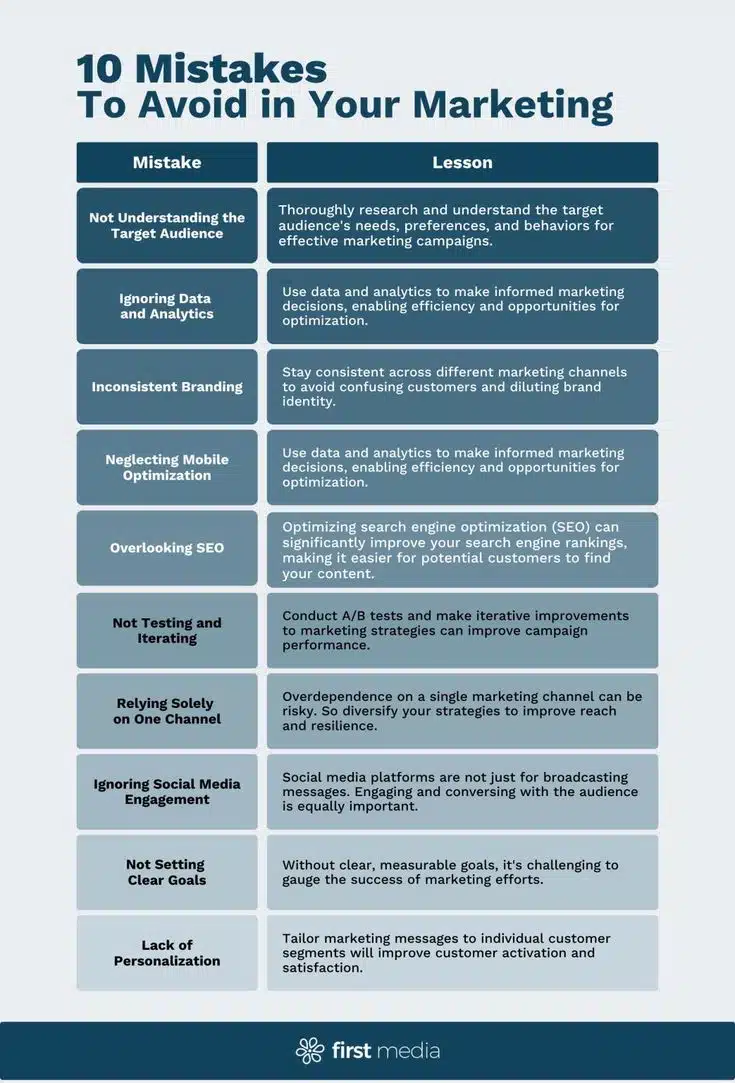
You’ll find some marketing basics in this infographic.
Here’s a summary of what’s covered:
- Not Understanding the Target Audience
- Ignoring Data and Analytics
- Inconsistent Branding
- Neglecting Mobile Optimisation
- Overlooking SEO
- Not Testing and Iterating
- Relying Solely on One Channel
- Ignoring Social Media Engagement
- Not Setting Clear Goals
- Lack of Personalisation
Check out the post below for more.
Marketing can be a powerful growth engine—but only if it’s executed correctly. Too many businesses pour time and money into campaigns that fall flat, not because their product isn’t good, but because they’re making avoidable errors.
Whether you’re a startup or an established business trying to refine your strategy, understanding what not to do is just as important as knowing what works. In this post, we’ll explore the top rookie marketing mistakes and how to fix them before they damage your brand or waste your budget.
Not Understanding the Target Audience
You can’t market effectively to people you don’t understand. One of the most common rookie mistakes is launching campaigns based on assumptions rather than real data about your customers. Without knowing their problems, preferences, and behaviours, even the best marketing ideas are doomed to fail. Success starts with deep audience insight.
- Create detailed customer personas using demographic and psychographic data.
- Use surveys, interviews, and focus groups to uncover real customer motivations.
- Analyse behaviour patterns using website analytics and social media insights.
- Monitor customer feedback and reviews to spot recurring needs and expectations.
Ignoring Data and Analytics
Marketing isn’t guesswork—it’s a data-driven discipline. Rookies often rely too much on intuition or follow trends without checking the numbers. By ignoring performance data, you miss opportunities to improve what works and fix what doesn’t. Data gives you the clarity to make smarter decisions at every stage.
- Track campaign performance with tools like Google Analytics or built-in platform insights.
- Set clear KPIs for each campaign and monitor progress in real time.
- Use A/B testing to compare versions of ads, emails, or landing pages.
- Review and refine targeting based on audience behaviour and conversion trends.
Inconsistent Branding
Your brand should be instantly recognisable across every touchpoint. But many new businesses send mixed messages through inconsistent visuals, language, or tone. This not only confuses customers—it undermines trust. Strong branding requires consistency in how you show up everywhere.
- Use a brand style guide to align colours, fonts, and messaging across platforms.
- Maintain the same tone of voice in ads, emails, blogs, and social content.
- Ensure all team members and partners stick to branding guidelines.
- Review your customer touchpoints regularly for alignment and cohesion.
Neglecting Mobile Optimisation
Most users interact with brands on their phones, not desktops. If your website or marketing content isn’t optimised for mobile, you’re creating unnecessary friction. Slow load times, poor layouts, and hard-to-read content will cause potential customers to bounce. Mobile optimisation is no longer optional—it’s essential.
- Use responsive design to ensure content adjusts smoothly across devices.
- Compress images and streamline code to reduce mobile load times.
- Test forms, buttons, and navigation for usability on small screens.
- Preview and adapt your email campaigns for mobile compatibility.
Overlooking SEO
You can create amazing content—but it won’t matter if nobody finds it. Ignoring SEO means you’re missing out on organic traffic that could bring in long-term leads. Search engine optimisation isn’t just for tech experts; it’s a vital skill every marketer needs to grasp.
- Research and use relevant keywords your audience is searching for.
- Optimise page titles, meta descriptions, and URLs for better visibility.
- Create high-quality, valuable content that answers user questions.
- Build backlinks and improve internal linking to boost authority and rankings.
Not Testing and Iterating
No marketing strategy works perfectly from the start. Yet many rookies set up a campaign, cross their fingers, and wait. The reality is that the best marketers test constantly and adapt quickly. Without iteration, you’re stuck guessing—and missing out on easy wins.
- Run A/B tests on headlines, images, call-to-actions, and layouts.
- Analyse test results to identify clear performance patterns.
- Apply learnings quickly and retest new variations to improve further.
- Keep a record of successful changes to inform future campaigns.
Relying Solely on One Channel
It’s tempting to double down on one platform that seems to work—until it doesn’t. Algorithms change, costs rise, and audiences shift. If you’re relying on a single channel, you’re putting your entire strategy at risk. A balanced, multi-channel approach builds resilience and reach.
- Spread your budget across multiple platforms (e.g., email, social, search).
- Tailor content to suit each channel’s format and audience expectations.
- Use retargeting to reconnect with users across various touchpoints.
- Monitor performance by channel to allocate budget more effectively.
Ignoring Social Media Engagement
Many new marketers treat social media like a digital billboard—one-way communication that simply broadcasts messages. But that’s not how social media works. Engagement is the key to community building, brand loyalty, and algorithm favour. Without interaction, you’re just adding to the noise.
- Respond to comments and messages promptly to build rapport.
- Ask questions and run polls to encourage participation.
- Share user-generated content to boost trust and visibility.
- Monitor mentions and hashtags to join relevant conversations.
Not Setting Clear Goals
If you don’t know what success looks like, how can you reach it? Too many campaigns start with vague intentions and end with unclear results. Goal-setting gives your marketing purpose, structure, and measurable benchmarks. Without it, you’re just spinning your wheels.
- Define specific goals for each campaign (e.g., leads, clicks, conversions).
- Use SMART criteria—goals should be Specific, Measurable, Achievable, Relevant, and Time-bound.
- Align goals with your wider business objectives and customer journey.
- Track progress regularly and adjust tactics based on performance.
Lack of Personalisation
Modern consumers expect personal experiences—not generic blasts. If your messaging doesn’t feel relevant, it won’t resonate. Personalisation shows your audience that you understand and value them, making them more likely to engage and convert.
- Use segmentation to send targeted emails based on user behaviour or interests.
- Personalise subject lines and content with names or location data.
- Recommend products or content based on past interactions.
- Create dynamic website content that adapts to user preferences.
Conclusion
Marketing isn’t just about being creative—it’s about being strategic, consistent, and customer-focused. Avoiding these rookie mistakes will not only save you from wasted budget and effort but also put you on a stronger path to achieving meaningful results.
Whether you’re planning your first campaign or refining your approach, remember: every great marketing strategy is built on clarity, data, and connection. Get those fundamentals right, and success will follow.

Author:
Mark Ford