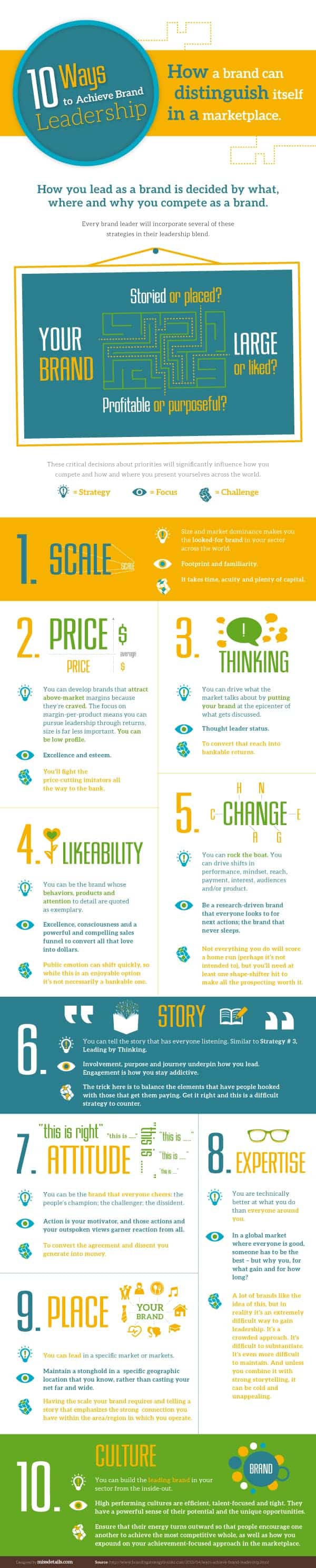
Are you looking for ways to distinguish your brand in your marketplace? Want to stand out as the leader in your field and get ahead of your competition?
Miss Details Design share their 10 ways to achieve brand leadership in this infographic.
Here’s a quick summary:
- Scale
- Price
- Thinking
- Likeability
- Change
- Story
- Attitude
- Expertise
- Place
- Culture
Check out the infographic for more detail.
The digital world is crowded with brands competing for attention, trust, and loyalty. Standing out and rising above the noise to become a brand leader requires a strategic blend of innovation, customer focus, and adaptability. In this blog, we’ll explore ten essential ways to achieve brand leadership in a highly competitive online environment.
Scale
Scaling a business is one of the most critical stages of growth for small businesses. While it’s a necessary step for achieving brand leadership, it can be particularly challenging because it requires not only growth but sustainable and manageable growth. Many small businesses find themselves stuck at a plateau, unsure how to expand without compromising quality or overextending resources. Here are in-depth tips and strategies for scaling your small business effectively in a competitive online environment.
- Automate Key Processes
As your business grows, manual operations can become time-consuming and inefficient. Automation is one of the most effective ways to scale without drastically increasing costs. This involves identifying repetitive tasks and integrating tools or systems that can handle them automatically.
- Customer Relationship Management (CRM): A CRM tool like HubSpot, Salesforce, or Zoho can help you manage customer interactions, track leads, and automate email follow-ups.
- Marketing Automation: Platforms like Mailchimp or ActiveCampaign allow you to schedule email marketing campaigns, segment your audience, and automate customer journeys.
- Inventory Management: Tools like TradeGecko or Cin7 can automate inventory tracking, reordering, and fulfillment processes, saving time and reducing human error.
By automating these key areas, small businesses can handle larger volumes of work without needing to dramatically increase staff or resources.
- Leverage Outsourcing and Freelance Talent
As a small business, hiring full-time employees may not be feasible when trying to scale, especially if you’re not yet sure what your long-term needs will be. Outsourcing specific tasks or projects to freelancers or agencies can help bridge the gap without the commitment and overhead associated with permanent hires.
Areas you might consider outsourcing include:
- Digital marketing: Freelance marketers or agencies can handle SEO, content creation, social media management, and paid advertising.
- Graphic design: Websites like Upwork or Fiverr allow you to access talented designers for branding, web design, and promotional materials.
- Customer support: Outsourcing customer service to agencies or using virtual assistants can help maintain the quality of service as your customer base grows.
Outsourcing allows small businesses to tap into specialized skills on an as-needed basis, helping to scale while keeping costs under control.
- Optimize Your Technology Stack
A scalable business needs a strong technological foundation. Optimizing your technology stack ensures that as you grow, your systems can handle increased customer demand and operational complexity. This means investing in the right software and tools that integrate well and are built for scale.
- Cloud computing: Using cloud-based software such as Google Cloud or AWS ensures that your systems can scale easily with demand. It also enables remote work, which can be essential as your team grows.
- E-commerce platforms: If you run an online store, consider using scalable e-commerce platforms like Shopify, BigCommerce, or WooCommerce. These platforms are built for growth, offering robust integrations and the ability to handle higher traffic volumes.
- Data and analytics: Invest in analytics tools like Google Analytics, Hotjar, or Kissmetrics to track customer behavior, measure marketing efforts, and make data-driven decisions. Scalable analytics platforms will grow with you and help ensure you’re making informed choices as you expand.
Your technology stack should be future-proof, meaning it can grow with you and adapt to your needs as they evolve.
- Focus on Repeatable and Scalable Revenue Streams
When considering growth, businesses should focus on repeatable and scalable revenue models. This means emphasizing product lines or services that can generate consistent, predictable income and are not overly dependent on custom work or limited resources.
Some strategies include:
- Subscription services: Recurring revenue from subscription models is predictable and scalable. Whether you’re offering digital products, software-as-a-service (SaaS), or even physical goods (like subscription boxes), this model ensures a steady stream of income as you scale.
- Digital products: Offering digital goods such as courses, eBooks, or memberships allows for growth without the limitations of inventory or fulfillment constraints.
- Licensing: If your business has unique intellectual property (IP) or a proprietary process, consider licensing it to others. This can generate revenue without requiring you to manufacture or sell the product yourself.
By focusing on products and services that can be scaled up without requiring a direct one-to-one increase in costs, small businesses can achieve growth more efficiently.
- Build Strong Strategic Partnerships
Strategic partnerships allow small businesses to tap into new markets and audiences without investing heavily in marketing or product development. By forming alliances with complementary businesses, you can reach new customers, expand your offerings, and enhance your brand credibility.
Tips for forming effective partnerships:
- Look for complementary products or services: Partner with companies that offer products or services that complement your own but don’t directly compete. For example, if you sell outdoor gear, partnering with a company that sells adventure travel packages can benefit both businesses.
- Co-market: Work together with partners to share marketing efforts, such as running joint promotions, creating co-branded content, or sharing each other’s audiences through email marketing and social media.
- Leverage affiliate marketing: Create an affiliate program that incentivizes other businesses or individuals to promote your products in exchange for a commission. This not only increases your reach but does so with minimal upfront costs.
Partnerships allow you to leverage the strengths of others while minimizing the resources needed for growth, making it a smart strategy for scaling.
- Focus on Customer Retention and Referrals
Acquiring new customers can be costly, especially when scaling. It’s often more efficient to focus on retaining existing customers and encouraging them to refer others. Retention and referrals are powerful drivers of growth because they rely on maximizing the value of your current customer base.
- Loyalty programs: Implement loyalty programs that reward customers for repeat purchases. This not only encourages them to return but also increases their lifetime value to your business.
- Referral incentives: Encourage satisfied customers to refer friends and family by offering incentives such as discounts, free products, or bonuses for every successful referral.
- Personalized customer service: As you scale, personalized customer service can become more challenging but remains crucial. Use CRM tools to personalize interactions, follow up with customers post-purchase, and solve their issues quickly. Happy customers are more likely to become loyal advocates.
Investing in customer retention can fuel sustainable growth and reduce the pressure to constantly acquire new customers.
- Refine Your Branding and Positioning
As you scale, your brand needs to become more distinct and recognizable to stand out in a crowded online marketplace. Refining your brand messaging and positioning is crucial to establishing yourself as a leader in your industry.
- Clarify your unique value proposition (UVP): What sets you apart from competitors? As you grow, ensure your UVP is crystal clear and communicated across all touchpoints, from your website to your social media.
- Evolve your brand story: Your brand story should evolve as your company scales. Ensure that it remains aligned with your growth and resonates with your expanding customer base.
- Consistency across platforms: As you expand your reach across different platforms and channels, consistency is key. Ensure that your brand’s voice, visual identity, and messaging are uniform across all customer touchpoints.
Strong branding reinforces trust, which is critical for businesses trying to scale in competitive online spaces. By maintaining a clear, consistent, and compelling brand identity, you can differentiate yourself and build loyalty as you grow.
- Expand Your Distribution Channels
Small businesses can often become overly dependent on a single distribution channel. As you scale, it’s essential to diversify and expand your distribution channels to reach new customers and reduce the risk of being too reliant on one revenue stream.
Consider the following ways to diversify:
- E-commerce marketplaces: If you’re primarily selling through your own website, consider expanding to third-party platforms like Amazon, Etsy, or eBay. These platforms can expose your brand to a larger audience.
- Wholesale: If your product can be sold in bulk, consider partnering with retailers or offering wholesale options to businesses that want to carry your products.
- International markets: As you scale, it might be time to consider expanding internationally. Using services like Shopify or BigCommerce allows you to sell globally with ease. Be mindful of local regulations and customer preferences in new markets.
Expanding your distribution channels provides multiple avenues for growth, allowing you to reach new customer segments and increase revenue without overburdening any single channel.
Final Thoughts on Scaling for Small Businesses
Scaling a small business requires careful planning, a focus on efficiency, and the ability to adapt to new challenges. By automating processes, leveraging partnerships, expanding your distribution channels, and refining your brand, you can achieve sustainable growth without overwhelming your resources. As you scale, remember that maintaining the quality and customer experience that got you this far is crucial to long-term success.
Price
Setting the right price is crucial for small businesses, particularly in a competitive online environment. Price directly impacts how customers perceive your brand, affects your profit margins, and influences your market position. A well-thought-out pricing strategy can mean the difference between success and failure. Below, we explore in-depth tips and strategies that small businesses can use to develop a smart, scalable pricing model.
- Understand Your Costs
The first and most fundamental step in pricing is ensuring you cover your costs. For many small businesses, it’s easy to underestimate the real costs of producing a product or delivering a service. Make sure you factor in both fixed costs (e.g., rent, salaries, software subscriptions) and variable costs (e.g., production materials, shipping, transaction fees).
- Break-even analysis: Determine your break-even point by calculating how many units you need to sell at a particular price to cover all costs. This helps you ensure that every sale contributes to your profitability.
- Include hidden costs: Don’t forget to include often-overlooked expenses such as payment gateway fees (PayPal, Stripe), packaging, returns processing, or even customer service costs in your calculations.
- Factor in profit margins: After covering your costs, build in a reasonable margin for profit. For example, many small businesses aim for a profit margin between 20% to 50%, depending on the industry.
Accurately understanding your cost structure prevents you from setting a price that undervalues your product or leaves you with narrow margins that may not sustain growth.
- Know Your Market and Competitors
In a competitive online environment, small businesses must study the market to understand what customers are willing to pay. Start by researching how your competitors price similar products or services, and analyze where your offering fits within the broader landscape.
- Competitor pricing: Identify whether your competitors use cost leadership (low pricing), premium pricing (high pricing for high-value products), or somewhere in between. Understand their positioning to decide whether you’ll match, undercut, or exceed their prices.
- Value comparison: Consider the value you offer compared to your competitors. If your product has superior features or service benefits, you may be able to charge a higher price. However, if your product is less differentiated, pricing lower may help you compete.
- Benchmark against industry standards: Some industries have standard pricing structures. For instance, in digital services like web design or SEO, pricing tiers are relatively common. Understanding these standards can help you price appropriately while remaining competitive.
By researching your competitors, you’ll gain insights into how to position your pricing strategy effectively while ensuring it resonates with your target audience.
- Choose the Right Pricing Strategy
There are several common pricing strategies small businesses can adopt based on their target market, business goals, and competitive positioning. Choosing the right strategy can help you maximize profit and better align your pricing with customer expectations.
Here are a few popular pricing strategies:
- Cost-plus pricing: This involves adding a fixed percentage (markup) to the cost of producing your product. It’s a simple method but doesn’t take into account what customers are willing to pay or competitor prices. It works best when costs are predictable and competition is low.
- Value-based pricing: This strategy sets prices based on the perceived value to the customer rather than your costs. If your product or service provides high value, you can charge more. For instance, luxury brands like Apple use value-based pricing to justify their premium price points.
- Penetration pricing: This involves setting a low price initially to attract customers and gain market share quickly, then gradually raising prices as your customer base grows. Penetration pricing can be useful in competitive markets, but it may impact profitability in the short term.
- Skimming pricing: This is the opposite of penetration pricing. It involves starting with a high price for a new product and gradually lowering it as the product becomes more widely available. This works well if you have an innovative or unique offering that early adopters will pay more for.
- Dynamic pricing: This involves adjusting prices based on demand, competitor pricing, and market conditions. Dynamic pricing is common in industries like travel and hospitality but is also used in e-commerce through algorithms that change prices in real-time based on customer behavior.
Selecting the right pricing strategy is essential to aligning your business goals with your customer base and industry standards. You may also experiment with hybrid approaches, adjusting your strategy as your business evolves.
- Consider Psychological Pricing Tactics
Psychological pricing leverages consumer behavior and psychology to make prices more attractive without necessarily lowering the actual price. Here are some common techniques you can use:
- Charm pricing (ending prices in .99): Prices like $19.99 tend to perform better than round numbers like $20. This is because consumers perceive the former as a significantly lower price, even though the difference is minimal.
- Bundling: Offering products or services as a bundle at a slightly discounted rate encourages customers to buy more. For example, a digital marketing agency might offer website design and SEO services together at a reduced price compared to purchasing them separately.
- Anchor pricing: Displaying a more expensive option next to your product makes your offering seem more affordable in comparison. For instance, displaying a $150 package next to a $300 option makes the $150 option look like a great deal, even if it’s still relatively expensive.
- Decoy pricing: This is when you offer a third, less attractive pricing option that makes your preferred option seem like better value. For example, you might offer small, medium, and large packages, where the medium package is priced to look like the best value compared to the small and large options.
These subtle shifts in how you present prices can have a significant impact on conversion rates and the overall perceived value of your offerings.
- Test and Adjust Your Pricing
Small businesses should not be afraid to test and refine their pricing strategies as they grow. Pricing isn’t a static decision; it requires ongoing evaluation and adjustment based on customer feedback, competitor movements, and market changes.
- A/B testing: In e-commerce, you can run A/B tests to see which price point results in higher conversion rates. This can be especially useful when experimenting with new products or price ranges. Test different price levels for the same product to determine which generates more sales.
- Customer feedback: Directly ask your customers for feedback on pricing through surveys or reviews. This can provide insight into whether customers feel they’re getting good value for money, or if prices are too high or too low.
- Monitor sales data: Keep an eye on how price changes affect sales volume and profit margins. If a price increase results in significantly fewer sales, it might be worth reconsidering. Conversely, if a higher price has little effect on volume, you may have room to increase prices further.
Constantly testing and iterating on your pricing strategy ensures that it remains optimal as your business scales and market conditions change.
- Use Discounts and Promotions Strategically
Discounts and promotions are common tactics to increase sales, but they need to be used strategically to avoid devaluing your brand. Offering too many discounts can condition customers to expect lower prices, which may harm long-term profitability.
To use discounts effectively:
- Seasonal promotions: Tie your discounts to specific holidays, seasons, or events. This creates a sense of urgency and excitement around the promotion while keeping discounting in check.
- First-time buyer discounts: Offer discounts to new customers as an incentive to try your product or service. For example, many e-commerce sites offer 10-15% off for new email subscribers.
- Loyalty discounts: Reward loyal customers with special offers or discounts. This can help retain them and increase their lifetime value without impacting your margins too heavily.
- Flash sales: A limited-time sale can create urgency and encourage customers to buy now rather than later. Flash sales should be rare and well-timed to create maximum impact.
The key to successful discounting is to use it sparingly and strategically to drive sales, without creating an expectation that customers will never have to pay full price.
- Communicate Value, Not Just Price
Small businesses often make the mistake of competing on price alone, which can lead to a race to the bottom. Instead, focus on communicating the value of your product or service. Customers are often willing to pay more if they believe they’re getting good value in return.
- Highlight benefits over features: Focus on how your product improves the customer’s life or solves a problem, rather than just listing features. Emotional appeals often justify higher price points.
- Social proof: Use testimonials, reviews, and case studies to show the results others have achieved using your product or service. This builds trust and justifies your pricing.
- Quality assurance: Emphasize the quality, craftsmanship, or durability of your product. Customers are more willing to pay a premium for products that last longer or are more reliable.
When you position your product as high-value, customers are more likely to see the price as justified and less likely to shop around based on price alone.
Final Thoughts on Pricing for Small Businesses
Pricing is one of the most critical decisions a small business can make, especially in the context of scaling and competing online. By understanding your costs, choosing the right pricing strategy, and communicating the value of your product, you can set a price that maximizes both customer satisfaction and profitability. It’s important to remember that pricing should be flexible and adjusted as your business evolves, allowing you to adapt to changing market conditions while maintaining a competitive edge.
Thinking
The way you approach challenges and opportunities can make or break your success as a small business. In a competitive online environment, how you think about your business—your mindset, strategy, and problem-solving skills—determines your ability to adapt, innovate, and thrive. Developing a growth mindset and fostering strategic thinking are essential components of business leadership. Below are in-depth tips to help small businesses think strategically and approach problems creatively.
- Adopt a Growth Mindset
A growth mindset, a concept popularized by psychologist Carol Dweck, refers to the belief that abilities and intelligence can be developed over time. This is in contrast to a fixed mindset, where people believe their abilities are static. For small businesses, adopting a growth mindset means being open to learning, embracing challenges, and understanding that failure is part of the growth process.
- Embrace challenges: Don’t shy away from difficult problems. View them as opportunities to grow and improve your business. The willingness to face challenges head-on is crucial in the fast-changing online marketplace.
- Learn from feedback: Be open to feedback, both positive and negative. It’s important to listen to customers, employees, and even competitors to understand where you can improve.
- Cultivate persistence: A growth mindset requires persistence. Not every strategy or idea will work the first time, but learning from each attempt and continuously refining your approach will lead to long-term success.
By fostering a growth mindset, you position your business to continually evolve and stay competitive, even in crowded markets.
- Think Long-Term, but Act in the Short-Term
One of the key traits of strategic thinking is the ability to balance long-term goals with short-term actions. Successful small businesses plan for the future, but they also recognize the importance of making incremental progress toward those goals. This approach allows you to stay agile while working toward a bigger vision.
- Set a clear vision: Establish a long-term vision for your business that outlines where you want to be in 5 or 10 years. This vision should be ambitious yet achievable and serve as the guiding principle for decision-making.
- Break it down into short-term goals: While having a long-term vision is crucial, it’s the small, consistent actions that will help you achieve it. Break your long-term goals into smaller, actionable tasks that can be achieved in the short term. This makes the journey manageable and keeps your team motivated.
- Review and adjust: The business landscape changes quickly, especially online. Regularly review your progress toward long-term goals and be willing to adjust your short-term actions based on new information, customer feedback, or changes in the market.
By maintaining a balance between your long-term vision and short-term actions, you can stay focused on growth without getting overwhelmed by day-to-day operations.
- Use Data-Driven Decision Making
Making informed decisions based on data is essential in today’s competitive environment. Data-driven thinking allows you to make objective, measurable decisions that are grounded in facts rather than assumptions. This approach reduces risk and increases the likelihood of success.
- Track key performance indicators (KPIs): Identify the most important metrics for your business, such as customer acquisition cost (CAC), lifetime value (LTV), conversion rate, and churn rate. Regularly monitor these KPIs to track the health of your business and identify areas for improvement.
- Leverage analytics tools: Use tools like Google Analytics, Hotjar, or SEMrush to gather insights into customer behavior, website traffic, and marketing performance. These tools provide invaluable data on how people are interacting with your business online.
- Test and iterate: Data-driven thinking also means being willing to experiment and test different approaches. Whether it’s pricing, marketing tactics, or product offerings, use A/B testing to see what works best. Then iterate based on the results.
Making decisions grounded in data helps small businesses reduce guesswork and make choices that are more likely to yield positive outcomes.
- Be Customer-Centric
Thinking strategically means putting your customer at the center of every decision. Understanding your customers’ needs, preferences, and pain points allows you to tailor your products, services, and marketing efforts to better serve them. In turn, this leads to greater loyalty, higher sales, and a stronger brand.
- Create customer personas: Develop detailed profiles of your ideal customers, including their demographics, interests, challenges, and buying behaviors. This allows you to think from their perspective when making business decisions.
- Listen to customer feedback: Encourage feedback through surveys, reviews, and direct communication. Use this feedback to improve your product offerings, customer service, and overall business approach.
- Deliver personalized experiences: The more you understand your customers, the better you can personalize their experiences. Personalization can include targeted marketing campaigns, customized product recommendations, or tailored customer service.
By adopting a customer-centric approach, you ensure that every strategic decision you make is aligned with delivering value to your customers, which ultimately leads to business growth.
- Innovate Continuously
To succeed in a competitive online environment, small businesses must continually innovate. Innovation isn’t just about introducing new products; it’s about thinking creatively to improve processes, customer experiences, and business models.
- Encourage creativity: Foster a culture where new ideas are welcomed and encouraged. Encourage employees to think creatively and bring fresh ideas to the table, even if they seem unconventional.
- Look for incremental improvements: Innovation doesn’t always have to be groundbreaking. Small improvements to your products, processes, or services can add up to significant gains over time.
- Stay on top of trends: Keep an eye on industry trends, emerging technologies, and changing customer behaviors. For example, the rise of AI and automation is transforming many industries, and staying ahead of these trends can give your business a competitive advantage.
Thinking innovatively is crucial to staying relevant and ahead of the competition, especially in industries where the pace of change is rapid.
- Embrace Problem-Solving as a Core Skill
No business can escape challenges, but how you approach them can set you apart from competitors. Developing a problem-solving mindset allows you to navigate obstacles with confidence and agility.
- Define the problem clearly: When faced with a challenge, take the time to clearly define the problem before jumping to solutions. Understanding the root cause helps ensure you address the underlying issue rather than just treating symptoms.
- Generate multiple solutions: Don’t settle for the first solution that comes to mind. Brainstorm multiple possible solutions and weigh the pros and cons of each. This increases your chances of finding the best possible approach.
- Involve your team: Collaborative problem-solving often yields better results than going it alone. Involve your team in discussions to get diverse perspectives and ideas. This can lead to more creative solutions and greater buy-in from your staff.
Being an effective problem solver gives your business a competitive edge by allowing you to quickly adapt to and overcome obstacles.
- Develop Strategic Partnerships
Collaborating with other businesses can help you think more strategically about your growth and expansion. Strategic partnerships can open up new opportunities and provide resources or expertise that would be difficult to access on your own.
- Identify complementary businesses: Look for businesses that serve the same audience but offer different products or services. These types of partnerships allow you to create mutually beneficial opportunities that expand your reach.
- Leverage co-marketing efforts: Partner with other businesses to share marketing efforts, such as co-branded campaigns, joint events, or product bundles. This can help you reach new customers while sharing the costs of marketing initiatives.
- Access new markets: Strategic partnerships can help you enter new geographic or demographic markets. By partnering with a business that already has a presence in a market you want to enter, you can expand more quickly and effectively.
Strategic thinking in terms of partnerships helps small businesses access new resources and grow faster than they might on their own.
- Plan for Scalability
A key element of strategic thinking is to plan for growth and scalability from the beginning. Many small businesses face challenges when they grow too quickly without the infrastructure or processes in place to handle that growth.
- Streamline processes early: Identify bottlenecks or inefficiencies in your current processes and address them before they become major issues. For example, investing in automation tools for inventory management, customer service, or accounting can free up time and resources as you scale.
- Invest in scalable technology: Choose software, platforms, and systems that can grow with your business. Cloud-based solutions, for example, are often more scalable than traditional systems, allowing you to add more users or features as needed.
- Anticipate future needs: Think about what your business will need as it grows—whether that’s additional staff, new suppliers, or a more robust customer support system. By anticipating these needs, you can prepare in advance and avoid being caught off guard.
Thinking ahead and planning for scalability ensures that your business can grow smoothly and sustainably.
- Be Adaptable and Agile
In today’s fast-paced business environment, adaptability is one of the most important traits for small businesses. A strategic thinker recognizes that plans may need to change quickly and is prepared to pivot when necessary.
- Stay flexible: While it’s important to have a strategy, it’s equally important to stay flexible and adapt to changes in the market, customer behavior, or technology. Be willing to revise your strategy as new information becomes available.
- Embrace experimentation: Strategic thinking doesn’t always mean sticking to a set plan. It involves being open to experimentation and trying new ideas to see what works best. If a particular marketing strategy isn’t delivering results, be prepared to try a different approach.
By staying adaptable, you can quickly respond to changing circumstances and seize new opportunities as they arise.
Final Thoughts on Strategic Thinking for Small Businesses
Thinking strategically is about more than just planning for the future. It involves adopting a growth mindset, making data-driven decisions, staying customer-focused, and embracing innovation. By continuously refining your problem-solving abilities and planning for growth, you’ll be better equipped to navigate challenges and stay ahead in a competitive online environment.
Likeability
In the digital era, likeability plays a critical role in shaping how customers perceive and interact with a brand. While factors like price and product quality are essential, people are more likely to do business with brands they like, trust, and connect with on a personal level. Building likeability is especially important for small businesses, where personal relationships and customer loyalty can provide a significant competitive advantage. Here are in-depth tips and strategies to help small businesses improve their likeability in a competitive online environment.
- Develop a Strong Brand Personality
Your brand’s personality is how your business “feels” to customers. It’s conveyed through your tone, voice, and the way you communicate, and it plays a significant role in making your business likeable. Customers tend to be drawn to brands with personalities they can relate to or admire.
- Define your brand’s character: Is your brand friendly, fun, and approachable? Or is it professional, authoritative, and trustworthy? Knowing who your brand is will help you create a consistent persona that resonates with your target audience.
- Maintain a consistent voice: Whether it’s on your website, social media, or email communications, consistency in your brand’s tone of voice is key. A brand that is friendly and approachable in one area but cold and distant in another can confuse customers and diminish likeability.
- Show authenticity: People connect with authenticity, so be genuine in your messaging. Share your story, your values, and the challenges you’ve overcome as a small business. Let customers see the human side of your brand, which builds trust and relatability.
A relatable and authentic brand personality fosters a deeper emotional connection with your audience, making your business more likeable and memorable.
- Engage in Active, Meaningful Communication
Communication is one of the most effective ways to build likeability. Customers appreciate brands that are responsive, transparent, and engaged. The key is to communicate in a way that shows you value your customers and care about their experience.
- Respond promptly: Whether it’s a question on social media, a customer service inquiry, or a review, responding quickly makes customers feel heard and appreciated. Timely responses show that your business values its customers’ time and feedback.
- Personalize your communication: Personalizing communication goes beyond addressing customers by their first name. Reference their past purchases, thank them for their loyalty, or ask for their feedback on a specific interaction. Personalized communication shows customers that they are not just another number to your business.
- Engage proactively: Don’t wait for customers to reach out. Be proactive in engaging with them. Ask for feedback, run polls on social media, or send follow-up emails after a purchase. This shows that you’re interested in their experience and want to build a relationship.
Effective communication fosters trust and makes your customers feel valued, both of which are crucial to improving likeability.
- Show Empathy and Understanding
Small businesses have a unique advantage when it comes to building personal relationships with their customers. One way to strengthen these relationships and build likeability is by showing genuine empathy and understanding for your customers’ needs and experiences.
- Listen to customer concerns: Empathy starts with listening. Whether through surveys, reviews, or direct feedback, ensure you’re actively listening to what your customers are saying. Acknowledge their pain points and demonstrate that you understand their concerns.
- Go above and beyond to resolve issues: When problems arise, customers remember how you handle the situation more than the issue itself. Resolving problems quickly, offering sincere apologies, and going the extra mile to fix the issue will show your business cares about customer satisfaction.
- Anticipate needs: Proactive empathy is even better than reactive responses. Anticipate what your customers might need before they have to ask. For instance, if you notice a common issue or question, provide resources or solutions ahead of time.
Showing empathy helps create a positive emotional connection with customers, making them more likely to like and trust your brand.
- Be Transparent and Honest
Transparency and honesty are critical components of likeability. Customers appreciate businesses that are open about their processes, values, and even their mistakes. In the long run, transparency builds trust and strengthens relationships.
- Be open about pricing and policies: Make your pricing, return policies, and terms of service easy to find and understand. Hidden fees, confusing policies, or unclear terms can frustrate customers and damage your reputation.
- Admit mistakes and take responsibility: If your business makes a mistake, acknowledge it openly and take responsibility. Customers are generally forgiving if they see a brand being honest about its shortcomings and taking steps to correct them. For example, if there’s a delay in order fulfillment, inform customers immediately and offer a solution, such as a discount or expedited shipping.
- Share behind-the-scenes insights: Transparency isn’t just about admitting mistakes; it’s also about sharing your journey. Take your customers behind the scenes and show them how your products are made, how you run your business, or what values you prioritize. This level of openness creates a deeper connection and humanizes your brand.
Being transparent fosters trust and encourages customers to feel confident in choosing your business, making your brand more likeable.
- Cultivate a Positive Social Media Presence
In a highly competitive online environment, social media plays a key role in building your business’s likeability. How you interact with followers and present your brand online can significantly impact how likeable your business appears.
- Engage with followers regularly: Don’t just post content and walk away. Engage with your followers by responding to comments, liking their posts, and sharing user-generated content. When customers feel a personal connection with your brand on social media, they are more likely to like and support your business.
- Use humor and lighthearted content: Humor can make your brand more approachable and enjoyable to engage with. Share lighthearted, fun content that reflects your brand’s personality and brings a smile to your customers’ faces. Just ensure that your humor aligns with your brand values and audience.
- Highlight customer stories: Showcasing your customers’ experiences and stories is a powerful way to build likeability. Share customer testimonials, user-generated content, or case studies. When customers see real people benefiting from your products or services, it humanizes your brand and makes you more relatable.
A positive, engaging social media presence can significantly boost your brand’s likeability and create lasting customer connections.
- Offer Exceptional Customer Service
Great customer service is one of the most important factors in determining a brand’s likeability. Customers remember how you make them feel during their interactions with your business, and providing exceptional service can turn casual buyers into loyal advocates.
- Be available and accessible: Ensure your customers can easily reach you through multiple channels, whether it’s phone, email, live chat, or social media. Quick and easy access to support demonstrates that you care about their experience.
- Train your team in customer empathy: Equip your customer service team with the skills and mindset to handle issues with empathy and patience. Customers appreciate businesses that treat them with kindness and understanding, especially when problems arise.
- Surprise and delight your customers: Going the extra mile for your customers can significantly improve their perception of your brand. This could be something as simple as sending a handwritten thank-you note, offering a discount after a negative experience, or giving loyal customers early access to new products.
Exceptional customer service not only enhances your likeability but also fosters long-term loyalty and word-of-mouth referrals.
- Showcase Your Brand Values
Customers, especially those from younger generations, are more likely to support businesses that share their values. Showcasing your commitment to causes and principles that resonate with your audience can greatly improve your likeability.
- Support meaningful causes: Partner with charitable organizations, participate in community events, or donate a portion of your profits to causes your business cares about. Ensure these causes align with the values of your customers to create a deeper emotional connection.
- Show your commitment to sustainability: If your business prioritizes sustainability, let customers know about it. Highlight the steps you’re taking to reduce your environmental impact, whether it’s using eco-friendly materials, reducing waste, or supporting ethical suppliers.
- Incorporate values into your marketing: Whether it’s through storytelling, social media posts, or campaigns, emphasize the values that guide your business. Customers appreciate brands that stand for something, and this can make your business more likeable and trustworthy.
Aligning your business with shared values makes customers feel good about supporting you, which improves your brand’s overall likeability.
- Build a Community Around Your Brand
Brands that foster a sense of community create a deeper bond with their customers, which leads to increased likeability and loyalty. A strong community creates a sense of belonging, and customers are more likely to support brands that make them feel part of something special.
- Encourage user-generated content: Invite your customers to share their experiences with your products or services on social media. Create branded hashtags, run contests, or offer incentives for customers who create content. This not only fosters engagement but also creates a sense of community around your brand.
- Host events or webinars: Whether in-person or virtual, hosting events can help build stronger relationships with your customers. Events allow you to connect with your audience in a more personal way and provide value beyond your product or service.
- Create a loyalty program: Reward loyal customers with exclusive perks, discounts, or early access to products. A well-structured loyalty program makes customers feel valued and appreciated, enhancing your brand’s likeability.
Building a strong community around your brand fosters loyalty, trust, and long-term relationships, all of which contribute to likeability.
- Keep Your Promises
Lastly, reliability is a key component of likeability. Customers need to trust that your business will deliver on its promises. Consistently meeting or exceeding expectations builds trust and makes your brand more likeable.
- Deliver on time: Whether it’s shipping products, delivering services, or responding to inquiries, make sure you stick to your timelines. Reliability shows that you respect your customers’ time and trust.
- Be clear about what you can and cannot do: Set realistic expectations with your customers from the start. Avoid making promises that you can’t keep, and be upfront about any potential limitations or delays.
- Exceed expectations when possible: Going above and beyond what customers expect is a great way to build loyalty and improve likeability. Whether it’s offering an unexpected upgrade or providing additional value, these small gestures leave a lasting impression.
Consistency in keeping your promises and delivering on expectations strengthens your reputation and enhances your likeability as a brand.
Final Thoughts on Likeability for Small Businesses
In the competitive online environment, likeability is a crucial factor in building strong relationships with customers. By developing a relatable brand personality, engaging in meaningful communication, providing exceptional customer service, and demonstrating transparency, your business can foster likeability that drives customer loyalty, positive reviews, and long-term success.
Change
In today’s fast-paced digital marketplace, the ability to embrace change is crucial for success. As a small business, navigating change—whether it’s adapting to new technologies, shifting market trends, or evolving customer expectations—can be both challenging and rewarding. Companies that can anticipate, adapt to, and capitalize on change often find themselves leading in their industries.
For small businesses, change presents an opportunity for growth and innovation. Here’s how you can embrace change, stay ahead of the competition, and position your brand for long-term success.
- Cultivate a Flexible Mindset
To thrive in a constantly changing environment, it’s essential to foster a culture of adaptability within your business. This starts with cultivating a flexible mindset at both the leadership and team levels.
- Encourage a growth mindset: Encourage your team to view change as an opportunity for growth, not as a disruption. A growth mindset helps employees see challenges as chances to learn and improve, which is essential when adapting to new technologies, market trends, or customer needs.
- Be open to new ideas: Emphasize the importance of innovation and experimentation within your business. When employees feel empowered to propose new ideas or suggest improvements, they are more likely to embrace change.
- Lead by example: As a business leader, your attitude toward change sets the tone for your entire organization. Show your team that you’re willing to adapt by embracing new strategies, tools, and processes, and they’ll be more likely to follow your lead.
A flexible mindset creates a positive attitude toward change, allowing your business to respond quickly to shifts in the market and make strategic decisions with confidence.
- Stay Informed on Industry Trends
Staying ahead of industry trends is critical for remaining competitive and responsive to change. The digital landscape evolves rapidly, and businesses must be proactive in keeping up with these shifts to stay relevant.
- Follow industry news and reports: Regularly monitor industry publications, blogs, and market reports to stay updated on the latest trends, emerging technologies, and shifting consumer preferences. This will help you anticipate changes and adjust your strategy accordingly.
- Leverage data and analytics: Use analytics tools to track trends in customer behavior, sales performance, and market conditions. By gathering data on what’s working and what’s not, you can make informed decisions and pivot your strategy when necessary.
- Join industry groups and networks: Engage with industry peers through professional associations, networking events, and online forums. These connections can provide valuable insights into upcoming changes, opportunities, and potential challenges in your field.
By keeping a close eye on industry trends, your small business can stay ahead of the curve and take advantage of new opportunities as they arise.
- Adopt New Technologies
Technology is one of the biggest drivers of change in the modern business world. Embracing the right tools and platforms can help your small business operate more efficiently, improve customer experiences, and scale effectively.
- Automate repetitive tasks: Automation tools can help streamline tasks like email marketing, social media management, and customer service. By automating routine processes, you free up time for more strategic work and increase overall efficiency.
- Leverage digital tools for collaboration: Remote work and virtual collaboration have become integral to many businesses. Tools like Slack, Asana, or Zoom can enhance team communication and collaboration, even if your team is spread across different locations.
- Invest in e-commerce platforms: If you haven’t already, adopting an e-commerce platform can help your business reach a wider audience and improve the customer experience. Make sure your platform is mobile-friendly, easy to navigate, and integrates with payment and shipping providers.
Adopting new technologies not only helps you stay competitive but also prepares your business to scale and adapt to future changes.
- Implement Change Management Processes
Managing change effectively requires having a structured process in place to ensure smooth transitions. Whether you’re introducing new technology, launching a new product, or restructuring your business, a well-thought-out change management plan can reduce resistance and ensure successful implementation.
- Create a clear change strategy: Outline the goals and reasons for the change, and communicate them clearly to your team. Let employees know what to expect, why the change is happening, and how it will benefit the business in the long run.
- Involve your team early: Employees are more likely to embrace change if they feel involved in the process. Solicit input and feedback from your team early on, and involve them in decision-making where appropriate.
- Provide training and support: Offer training and resources to help your team adapt to new systems, tools, or processes. Make sure they have access to ongoing support, whether through online resources, workshops, or one-on-one coaching.
- Monitor and adjust: After implementing a change, monitor the results and gather feedback. If challenges arise, be prepared to make adjustments to your plan. Flexibility is key when navigating change, and being open to feedback will help you fine-tune your approach.
Having a change management process in place helps minimize disruptions, reduce employee resistance, and ensure that transitions are smooth and successful.
- Encourage a Culture of Continuous Learning
In a rapidly evolving business environment, businesses must prioritize continuous learning to stay competitive. Encouraging your team to constantly develop new skills and knowledge is a crucial way to prepare for change.
- Invest in employee development: Offer regular training opportunities, workshops, or access to online courses that help your employees stay up to date with industry trends, new technologies, and best practices. This not only helps your team stay competitive but also boosts employee satisfaction and retention.
- Foster a learning culture: Promote a culture where learning and professional development are prioritized. Encourage employees to share new ideas, attend industry conferences, and stay curious about emerging trends.
- Reward innovation and initiative: Recognize employees who take the initiative to learn new skills, embrace change, and propose innovative solutions. By rewarding these behaviors, you create a culture that values adaptability and encourages others to follow suit.
Continuous learning ensures that your team is always equipped with the knowledge and skills they need to adapt to change and innovate within the business.
- Stay Customer-Centric During Change
When adapting to change, it’s crucial to keep your customers at the center of your decision-making process. Whether you’re introducing new products, implementing new technologies, or changing your pricing strategy, consider how these changes will impact your customers.
- Communicate changes clearly: When making changes that affect your customers, such as updating policies or launching new products, communicate the changes early and clearly. Provide transparent explanations of what’s happening, why, and how it will benefit them.
- Gather customer feedback: Regularly solicit feedback from your customers to understand their needs, preferences, and pain points. Use this feedback to guide your business decisions and ensure that any changes you implement are aligned with your customers’ expectations.
- Prioritize customer experience: Even during periods of change, make sure the customer experience remains a top priority. Whether you’re transitioning to a new system or expanding your product line, maintaining a high level of customer service and responsiveness is essential to keeping your customers happy and loyal.
By staying customer-focused, you can ensure that changes are implemented in a way that enhances the customer experience and strengthens relationships with your audience.
- Be Ready to Pivot When Necessary
In the digital marketplace, things can change rapidly. New competitors enter the field, customer preferences shift, and economic conditions evolve. For small businesses, the ability to pivot quickly and effectively is often the difference between thriving and struggling.
- Recognize when a pivot is needed: Stay attuned to signs that your current strategy may no longer be working. Declining sales, customer feedback, or emerging market trends may signal the need for a shift in focus or direction.
- Develop contingency plans: Prepare for potential pivots by having contingency plans in place. Whether it’s diversifying your product offerings, exploring new revenue streams, or changing your target market, having a backup plan ensures you can pivot quickly when needed.
- Stay agile and nimble: As a small business, you have the advantage of agility. Larger corporations often struggle with the complexities of change due to their size, but small businesses can pivot more easily. Use this to your advantage by staying flexible and being willing to make swift decisions when needed.
Being prepared to pivot ensures that your business can adapt to unexpected challenges and continue growing in a competitive environment.
- Embrace Innovation
Embracing change often means embracing innovation. Businesses that are willing to innovate, experiment, and try new approaches are better positioned to stay competitive and meet evolving customer demands.
- Encourage creative problem-solving: Foster a culture where employees feel empowered to think creatively and propose innovative solutions. Encourage brainstorming sessions and reward employees who come up with fresh, outside-the-box ideas.
- Experiment with new offerings: Test out new product or service ideas on a small scale before fully committing. This allows you to gauge customer interest, gather feedback, and adjust before launching on a larger scale.
- Embrace new business models: As markets and customer preferences evolve, consider whether new business models could offer growth opportunities. For example, subscription-based services, freemium models, or on-demand offerings may align with changing consumer behaviors.
Innovating not only helps your business stand out in a crowded market but also ensures you’re continually improving and staying relevant to your customers.
Final Thoughts on Embracing Change for Small Businesses
Change is inevitable, especially in the fast-moving online environment. For small businesses, the ability to embrace change and adapt to new circumstances is critical to long-term success. By fostering a flexible mindset, staying informed on industry trends, adopting new technologies, and maintaining a customer-centric approach, you can position your business to not only survive but thrive in an ever-evolving market.
Story
In the crowded and competitive online environment, storytelling can be a powerful tool for small businesses to connect with their audience, build a memorable brand, and differentiate themselves from competitors. A compelling story goes beyond just selling products or services; it creates an emotional connection with customers and fosters loyalty.
Here’s how small businesses can effectively leverage storytelling to enhance their brand and engage with their audience:
- Define Your Brand’s Core Story
Your brand’s core story is the foundation of your storytelling efforts. It encompasses your business’s origins, mission, values, and the unique aspects that set you apart. A well-defined core story helps create a consistent and authentic narrative across all your marketing channels.
- Identify your origin story: Share how your business started—why you founded it, what challenges you faced, and what motivated you to pursue this venture. This personal touch helps humanize your brand and makes it relatable to your audience.
- Clarify your mission and values: Articulate what your business stands for and the values that drive your decisions and actions. This could include your commitment to sustainability, customer satisfaction, innovation, or community involvement.
- Highlight your unique selling proposition (USP): What makes your business different from others in your industry? Whether it’s a unique product feature, exceptional customer service, or a distinctive approach, make sure your core story emphasizes these differentiators.
A well-crafted core story provides a strong foundation for all your storytelling efforts, ensuring that your brand message is clear and consistent.
- Craft a Compelling Brand Narrative
Once you have your core story, the next step is to craft a compelling brand narrative. This narrative should be engaging, relatable, and designed to resonate with your target audience.
- Use storytelling techniques: Structure your narrative like a story with a beginning, middle, and end. Introduce characters (such as the founders or customers), present a challenge or conflict, and highlight how your business provides a solution or resolution.
- Focus on emotional connection: Appeal to your audience’s emotions by sharing stories that evoke feelings of happiness, empathy, or inspiration. Emotional connections are more likely to lead to brand loyalty and advocacy.
- Incorporate real-life examples: Use testimonials, case studies, or customer success stories to illustrate your brand’s impact. Real-life examples make your narrative more relatable and credible.
A compelling brand narrative captures your audience’s attention, engages them emotionally, and helps them form a connection with your brand.
- Utilize Different Storytelling Formats
To effectively reach your audience, use various storytelling formats that align with their preferences and the platforms you use. Different formats can help you tell your story in diverse and engaging ways.
- Written content: Blog posts, articles, and website copy can provide in-depth stories about your brand, products, or customers. Use these formats to share detailed narratives, behind-the-scenes insights, and thought leadership pieces.
- Visual content: Infographics, images, and videos can bring your story to life visually. Create compelling visuals that illustrate your brand’s journey, showcase your products in action, or highlight customer testimonials.
- Social media: Use social media platforms to share bite-sized stories and updates. Leverage features like Instagram Stories, Facebook Live, and Twitter threads to engage with your audience in real-time and provide a glimpse into your brand’s personality.
- Email marketing: Share stories through email newsletters or drip campaigns. Use storytelling to provide value to your subscribers, such as sharing industry insights, offering behind-the-scenes looks, or highlighting special offers.
By utilizing a mix of storytelling formats, you can reach your audience through their preferred channels and keep your brand narrative fresh and engaging.
- Integrate Your Story into Your Brand Identity
Your brand story should be seamlessly integrated into all aspects of your brand identity, from your visual branding to your customer interactions.
- Consistent messaging: Ensure that your brand story is reflected in your messaging across all touchpoints. Whether it’s on your website, social media, packaging, or customer service, your story should be consistently communicated to reinforce your brand’s identity.
- Visual branding: Incorporate elements of your story into your visual branding, such as your logo, color scheme, and design elements. For example, if your story emphasizes sustainability, use eco-friendly colors and imagery that reflect your commitment.
- Customer experience: Infuse your brand story into the customer experience by aligning your service approach with your narrative. If your story emphasizes personalized service, ensure that your customer interactions are tailored and attentive.
Integrating your story into your brand identity helps create a cohesive and authentic brand experience that resonates with your audience.
- Engage with Your Audience Through Interactive Storytelling
Interactive storytelling can deepen your audience’s engagement by allowing them to actively participate in your brand’s narrative. This approach creates a more immersive and personalized experience for your audience.
- Create interactive content: Develop quizzes, polls, or interactive infographics that invite your audience to engage with your story. For example, a quiz that helps users discover their “ideal” product from your brand can be both fun and informative.
- Host live events: Organize webinars, live Q&A sessions, or virtual tours where your audience can interact with you in real-time. Use these events to share your brand’s story, answer questions, and build relationships with your audience.
- Encourage user-generated content: Invite your audience to share their own stories related to your brand. For example, you can run a contest where customers share their experiences with your products, or ask them to use a branded hashtag to showcase their stories.
Interactive storytelling engages your audience on a deeper level, making your brand’s story more memorable and impactful.
- Leverage Your Team’s Stories
Your employees can be powerful storytellers who bring your brand narrative to life through their personal experiences and perspectives. Highlighting your team’s stories can humanize your brand and showcase the people behind your business.
- Share employee spotlights: Feature profiles or interviews with team members on your website, blog, or social media. Let them share their personal stories, roles within the company, and what they love about working for your brand.
- Highlight team achievements: Celebrate milestones, accomplishments, or innovative projects led by your team. Recognizing your employees’ contributions reinforces your brand’s values and fosters a sense of pride and connection.
- Involve your team in storytelling: Encourage team members to contribute to your brand’s content, whether through guest blog posts, social media takeovers, or video appearances. Their unique perspectives add authenticity to your brand story.
Leveraging your team’s stories adds depth and authenticity to your brand narrative, making your business more relatable and engaging.
- Use Storytelling to Address Challenges
Storytelling isn’t just about celebrating successes; it can also be used to address and overcome challenges. Sharing how your business has faced and navigated difficulties can build credibility and trust with your audience.
- Be transparent about challenges: Share stories about the obstacles your business has encountered and how you’ve overcome them. Whether it’s a financial struggle, operational hurdle, or market challenge, transparency shows resilience and authenticity.
- Highlight lessons learned: Focus on the lessons you’ve learned from overcoming challenges and how they’ve contributed to your growth. This demonstrates your ability to adapt and evolve, and it can inspire and resonate with your audience.
- Showcase problem-solving: Use storytelling to illustrate how your business has solved specific problems for customers. Share case studies or success stories that highlight your solutions and the positive outcomes achieved.
Addressing challenges through storytelling enhances your brand’s credibility and reinforces your ability to navigate adversity effectively.
- Measure the Impact of Your Storytelling
To ensure your storytelling efforts are effective, it’s important to measure their impact and make data-driven decisions. Analyze how well your stories resonate with your audience and contribute to your business goals.
- Track engagement metrics: Monitor metrics such as likes, shares, comments, and click-through rates to gauge how well your stories are being received. High engagement indicates that your storytelling is resonating with your audience.
- Analyze conversion rates: Measure how your storytelling efforts impact conversions, such as sign-ups, purchases, or inquiries. Assess whether your stories are driving desired actions and contributing to your business objectives.
- Gather feedback: Solicit feedback from your audience to understand their perception of your brand’s story. Conduct surveys, review comments, or engage in direct conversations to gather insights and make improvements.
Measuring the impact of your storytelling allows you to refine your approach, enhance engagement, and better align your narrative with your audience’s preferences.
Final Thoughts on Storytelling for Small Businesses
Storytelling is a powerful tool for small businesses to build a strong brand identity, connect with their audience, and differentiate themselves from competitors. By defining your brand’s core story, crafting a compelling narrative, utilizing various storytelling formats, and integrating your story into your brand identity, you can create a memorable and engaging brand presence. Embrace storytelling as a strategic tool to foster deeper connections with your audience, inspire loyalty, and drive long-term success.
Attitude
Attitude plays a crucial role in shaping your brand’s identity and influencing how customers perceive and interact with your business. A positive, proactive, and customer-centric attitude can set your business apart in a competitive online environment. It affects everything from customer service to brand messaging, and it directly impacts customer satisfaction and loyalty.
Here’s a comprehensive guide on how small businesses can cultivate and leverage a positive attitude to enhance their brand and achieve success:
- Adopt a Customer-Centric Mindset
A customer-centric attitude means putting your customers at the heart of everything you do. Understanding their needs, preferences, and pain points helps you provide exceptional service and create a positive experience.
- Prioritize customer needs: Regularly assess and understand your customers’ needs through surveys, feedback forms, and direct interactions. Use this information to tailor your products, services, and communications to better meet their expectations.
- Be proactive in problem-solving: Anticipate potential issues and address them before they escalate. For example, if you notice a common question or concern among customers, create a FAQ section or guide to address it.
- Show empathy and understanding: When interacting with customers, demonstrate empathy and understanding. Acknowledge their concerns and show that you genuinely care about their experience and satisfaction.
A customer-centric attitude fosters trust and loyalty, leading to positive word-of-mouth and repeat business.
- Foster a Positive Work Environment
The attitude of your team is a reflection of your business’s overall attitude. Creating a positive work environment can enhance employee satisfaction, productivity, and the quality of customer interactions.
- Promote a supportive culture: Encourage open communication, teamwork, and mutual respect among employees. Recognize and celebrate achievements to boost morale and create a supportive atmosphere.
- Invest in employee development: Provide opportunities for professional growth and training. Empowering your team with new skills and knowledge enhances their confidence and ability to provide excellent customer service.
- Lead by example: As a business leader, your attitude sets the tone for your team. Demonstrate positivity, professionalism, and a proactive approach in your interactions and decision-making.
A positive work environment translates into better customer interactions and a more cohesive team, ultimately benefiting your business’s reputation and success.
- Communicate with Confidence and Clarity
Effective communication is a key aspect of a positive attitude. Communicating with confidence and clarity helps build trust and ensures that your messages are understood and well-received.
- Be clear and transparent: Provide clear information about your products, services, and policies. Avoid jargon and ensure that your communication is easily understandable.
- Express confidence in your offerings: Communicate your value proposition confidently. Highlight the benefits of your products or services and why they are the best choice for your customers.
- Respond promptly and professionally: Address customer inquiries, complaints, and feedback in a timely and professional manner. Prompt responses show that you value your customers’ time and concerns.
Confident and clear communication enhances your brand’s credibility and fosters positive relationships with your customers.
- Embrace a Solution-Oriented Approach
A solution-oriented attitude involves focusing on finding effective solutions to problems rather than dwelling on obstacles. This proactive approach can significantly enhance customer satisfaction and drive positive outcomes.
- Focus on solutions, not problems: When faced with challenges, concentrate on finding practical and effective solutions. For example, if a customer encounters an issue with a product, offer a replacement, refund, or alternative solution promptly.
- Empower your team to solve problems: Provide your employees with the authority and resources to address customer issues independently. Empowered employees are more likely to take initiative and resolve problems efficiently.
- Learn from feedback: Use customer feedback as an opportunity to improve. Analyze feedback to identify recurring issues and implement changes to prevent similar problems in the future.
A solution-oriented approach demonstrates your commitment to customer satisfaction and enhances your brand’s reputation for reliability and effectiveness.
- Maintain a Positive Online Presence
Your online presence is a reflection of your brand’s attitude and can significantly impact customer perceptions. A positive online presence helps attract and retain customers and builds a strong brand image.
- Create engaging and positive content: Share content that reflects your brand’s values and engages your audience in a positive way. Use social media, blog posts, and other channels to share helpful tips, success stories, and positive updates.
- Handle negative feedback gracefully: Address negative comments or reviews professionally and constructively. Acknowledge any issues, apologize if necessary, and offer a solution. Handling criticism gracefully shows that you value customer feedback and are committed to improving.
- Showcase customer success stories: Highlight positive experiences and testimonials from satisfied customers. Sharing these stories not only reinforces your brand’s credibility but also demonstrates your positive impact on customers.
A positive online presence helps build trust, attract new customers, and enhance your brand’s overall reputation.
- Cultivate a Resilient Attitude
Resilience is an essential aspect of a positive attitude. The ability to bounce back from setbacks and stay motivated in the face of challenges helps your business adapt and thrive in a competitive environment.
- Stay focused on long-term goals: Keep your long-term objectives in mind, even when facing short-term challenges. A resilient attitude helps you stay motivated and navigate difficulties without losing sight of your overall vision.
- Learn from setbacks: Use setbacks as learning opportunities. Analyze what went wrong, identify lessons learned, and apply those insights to improve your strategies and processes.
- Encourage a growth mindset: Foster a culture of resilience by promoting a growth mindset among your team. Encourage employees to view challenges as opportunities for growth and innovation.
A resilient attitude helps your business adapt to changes, overcome obstacles, and maintain a positive outlook even in difficult times.
- Demonstrate Authenticity and Integrity
Authenticity and integrity are key components of a positive attitude. Being genuine and honest in your interactions builds trust and strengthens your brand’s reputation.
- Be transparent in your communications: Share accurate and honest information about your products, services, and business practices. Transparency helps build trust and credibility with your audience.
- Honor your commitments: Follow through on promises and commitments. If you make a guarantee or offer, ensure that you deliver on it. Integrity in fulfilling your promises reinforces your brand’s reliability.
- Maintain consistency in values: Align your business practices with your stated values and principles. Consistency between your actions and your brand’s values enhances authenticity and strengthens customer trust.
Authenticity and integrity contribute to a positive brand image and foster long-term relationships with your customers.
- Encourage a Culture of Positivity and Support
A positive and supportive culture within your business can enhance employee satisfaction and productivity, which in turn benefits your customers.
- Recognize and reward positive behavior: Acknowledge and reward employees who demonstrate a positive attitude, exceptional customer service, and a commitment to the brand’s values. Recognition motivates employees and reinforces desired behaviors.
- Foster teamwork and collaboration: Create opportunities for employees to collaborate and support each other. Team-building activities and collaborative projects enhance a positive work environment and strengthen relationships among team members.
- Promote work-life balance: Encourage employees to maintain a healthy work-life balance. A supportive approach to work-life balance helps prevent burnout and ensures that employees remain motivated and positive.
A culture of positivity and support enhances overall employee morale and contributes to a better customer experience.
Final Thoughts on Attitude for Small Businesses
A positive attitude is a powerful asset for small businesses, influencing customer interactions, brand perception, and overall success. By adopting a customer-centric mindset, fostering a positive work environment, communicating with confidence, and demonstrating authenticity, you can create a brand that stands out for its exceptional attitude. Embracing these strategies helps build strong customer relationships, enhance your brand’s reputation, and drive long-term success in a competitive online environment.
Expertise
In a competitive online environment, expertise can be a significant differentiator for small businesses. Demonstrating your knowledge and skills not only builds credibility but also establishes your brand as a trusted authority in your industry. Expertise can help attract and retain customers, enhance your reputation, and drive growth.
Here’s a detailed guide on how small businesses can effectively showcase and leverage their expertise:
- Develop a Deep Understanding of Your Industry
To position yourself as an expert, you need a comprehensive understanding of your industry, market trends, and customer needs.
- Conduct market research: Regularly gather information about industry trends, competitor activities, and consumer behavior. Use this data to stay ahead of trends and make informed business decisions.
- Stay updated with industry news: Follow industry publications, blogs, and thought leaders to keep up with the latest developments. Subscribe to newsletters, attend webinars, and participate in industry forums to stay informed.
- Identify emerging trends: Be proactive in recognizing and adapting to emerging trends. Understanding future directions in your industry allows you to position your business as forward-thinking and innovative.
A deep understanding of your industry helps you provide valuable insights and solutions, reinforcing your position as an expert.
- Build and Share Your Knowledge
Showcasing your expertise involves actively sharing your knowledge with your audience. This not only demonstrates your authority but also provides value to your customers.
- Create informative content: Develop blog posts, articles, and whitepapers that offer valuable insights, tips, and solutions related to your industry. Share your knowledge on topics relevant to your audience’s interests and needs.
- Offer educational resources: Provide resources such as e-books, guides, and tutorials that help your audience understand complex topics or solve specific problems. Make these resources easily accessible on your website.
- Host webinars and workshops: Organize webinars, workshops, or training sessions where you can share your expertise with a live audience. These events provide an interactive platform for demonstrating your knowledge and engaging with participants.
Sharing your knowledge through various content formats enhances your credibility and positions your business as a go-to resource for industry-related information.
- Leverage Thought Leadership
Thought leadership involves establishing yourself as a leading authority in your field. By sharing innovative ideas and unique perspectives, you can influence industry conversations and build a strong reputation.
- Publish guest articles: Write guest posts for reputable industry publications or blogs. This expands your reach and exposes your expertise to a broader audience.
- Speak at industry events: Seek opportunities to speak at conferences, panels, or industry events. Public speaking engagements provide a platform to showcase your expertise and connect with industry peers and potential customers.
- Engage on social media: Share your insights and opinions on social media platforms. Participate in relevant discussions, comment on industry news, and contribute valuable content to establish your presence as a thought leader.
Thought leadership helps build authority, attract media attention, and position your business as a leader in your industry.
- Showcase Your Expertise Through Case Studies and Success Stories
Case studies and success stories are powerful tools for demonstrating your expertise and illustrating the impact of your solutions.
- Develop detailed case studies: Create case studies that highlight how your products or services have solved specific problems for clients. Include measurable results, customer testimonials, and detailed descriptions of the solutions provided.
- Feature customer success stories: Share stories of customers who have achieved significant results using your offerings. These stories provide social proof and validate your expertise.
- Use before-and-after comparisons: Show how your solutions have transformed clients’ situations by presenting before-and-after comparisons. This visual representation helps convey the effectiveness of your expertise.
Case studies and success stories provide tangible evidence of your expertise and build credibility with potential customers.
- Invest in Professional Development
Continuously investing in your professional development ensures that your expertise remains current and relevant.
- Pursue relevant certifications: Obtain certifications related to your industry or field. Certifications validate your skills and knowledge, enhancing your credibility and expertise.
- Attend industry training: Participate in training programs, workshops, and courses to stay updated with the latest practices and technologies. Ongoing education helps you maintain a competitive edge.
- Join professional organizations: Become a member of industry associations and networks. Engaging with these organizations provides access to resources, networking opportunities, and industry insights.
Investing in professional development demonstrates your commitment to maintaining and enhancing your expertise.
- Encourage and Leverage Client Testimonials and Reviews
Client testimonials and reviews are valuable indicators of your expertise and the quality of your services.
- Collect and showcase testimonials: Request testimonials from satisfied clients and prominently display them on your website and marketing materials. Genuine feedback from clients adds credibility to your expertise.
- Respond to reviews: Engage with reviews on platforms like Google My Business or Yelp. Address positive feedback with gratitude and respond to negative reviews professionally, demonstrating your commitment to resolving issues.
- Use reviews in your marketing: Incorporate positive reviews and testimonials into your marketing materials and case studies. This reinforces your reputation as an expert and builds trust with potential customers.
Client testimonials and reviews provide social proof of your expertise and enhance your brand’s credibility.
- Collaborate with Industry Experts and Influencers
Partnering with industry experts and influencers can help amplify your expertise and reach a larger audience.
- Seek collaboration opportunities: Collaborate with industry experts on joint projects, such as co-authoring articles, hosting webinars, or participating in panel discussions. These collaborations enhance your visibility and credibility.
- Engage with influencers: Connect with industry influencers who have a strong following in your niche. Engage with their content, share their insights, and explore opportunities for cross-promotion.
- Participate in industry panels: Join industry panels or discussion groups where you can share your expertise and interact with other experts. These engagements provide a platform for showcasing your knowledge and building valuable connections.
Collaborating with industry experts and influencers enhances your credibility and expands your reach within your industry.
- Create a Knowledge Hub
A knowledge hub serves as a central repository for all your expertise-related content and resources.
- Develop a resource library: Create a dedicated section on your website where visitors can access a collection of valuable resources, such as articles, whitepapers, case studies, and videos.
- Organize content by topic: Structure your knowledge hub to make it easy for visitors to find information on specific topics or areas of interest. Use categories and tags to facilitate navigation.
- Regularly update content: Keep your knowledge hub current by regularly updating and adding new content. Fresh, relevant information ensures that your hub remains a valuable resource for your audience.
A well-organized knowledge hub consolidates your expertise and provides a valuable resource for your audience.
- Measure the Impact of Your Expertise
Assessing the impact of your expertise efforts helps you understand their effectiveness and make data-driven improvements.
- Track engagement metrics: Monitor metrics such as website traffic, content views, and social media interactions to gauge the reach and engagement of your expertise-related content.
- Analyze lead generation: Measure how your expertise contributes to lead generation and conversions. Assess whether your content and thought leadership efforts are driving potential customers to take action.
- Gather feedback: Solicit feedback from your audience to understand how they perceive your expertise and the value it provides. Use this feedback to refine your content and strategies.
Measuring the impact of your expertise efforts helps you optimize your approach and ensure that you’re effectively showcasing your knowledge.
Final Thoughts on Expertise for Small Businesses
Demonstrating expertise is a powerful way for small businesses to build credibility, attract customers, and differentiate themselves from competitors. By developing a deep understanding of your industry, sharing valuable knowledge, leveraging thought leadership, and investing in professional development, you can establish your brand as an authority in your field. Combining these strategies with effective client testimonials, collaborations, and a well-organized knowledge hub ensures that your expertise is recognized and valued by your audience.
Place
Place in the context of business refers to the strategic positioning of your brand and products within the market. It encompasses where and how your business operates, including your physical location, online presence, distribution channels, and market positioning. Effective place strategy helps ensure that your products or services are accessible to your target audience and that your brand is positioned optimally in the market.
Here’s a comprehensive guide on how small businesses can leverage the concept of place to enhance their visibility, reach, and market position:
- Optimize Your Physical Location
For businesses with a physical presence, optimizing your location can significantly impact customer accessibility and foot traffic.
- Choose a strategic location: If you operate a brick-and-mortar store, select a location that is convenient for your target audience. Consider factors such as foot traffic, visibility, proximity to complementary businesses, and accessibility.
- Enhance your storefront: Ensure that your physical location is welcoming and visually appealing. Invest in attractive signage, well-maintained premises, and a layout that facilitates a positive customer experience.
- Leverage local marketing: Use local marketing strategies to attract customers to your physical location. This could include participating in local events, collaborating with nearby businesses, or running location-based promotions.
A well-chosen and well-maintained physical location enhances visibility, attracts customers, and contributes to a positive brand perception.
- Build a Strong Online Presence
In today’s digital age, having a robust online presence is crucial for reaching a broader audience and enhancing your market position.
- Develop a user-friendly website: Your website should be easy to navigate, mobile-friendly, and optimized for search engines (SEO). Ensure that it provides clear information about your products or services, contact details, and a seamless shopping or inquiry process.
- Utilize social media: Establish a presence on social media platforms that align with your target audience. Share engaging content, interact with followers, and use social media advertising to reach potential customers.
- Implement local SEO: Optimize your online content for local search queries to improve visibility in local search results. This includes creating a Google My Business profile, using local keywords, and encouraging customer reviews.
A strong online presence expands your reach, drives traffic to your website, and enhances your brand’s visibility in the digital space.
- Diversify Your Distribution Channels
Diversifying your distribution channels helps ensure that your products or services are accessible to a wider audience and enhances your market presence.
- Explore online marketplaces: Consider listing your products on popular online marketplaces such as Amazon, eBay, or Etsy. These platforms provide access to a large customer base and can drive additional sales.
- Leverage partnerships: Partner with other businesses to expand your distribution network. For example, you could collaborate with retailers, wholesalers, or local shops to carry your products.
- Offer multiple purchasing options: Provide various purchasing options, such as online orders with in-store pickup, delivery services, or subscription models. Flexibility in purchasing methods can attract a broader range of customers.
Diversifying your distribution channels increases accessibility, enhances customer convenience, and broadens your market reach.
- Position Your Brand Effectively
Effective brand positioning ensures that your business stands out in the market and resonates with your target audience.
- Identify your target audience: Clearly define your target audience and understand their needs, preferences, and behaviors. Use this information to tailor your brand positioning and messaging.
- Differentiate your brand: Develop a unique value proposition that sets your brand apart from competitors. Highlight what makes your products or services distinctive and why customers should choose you.
- Consistent messaging: Ensure that your brand messaging is consistent across all touchpoints, including your website, social media, advertising, and customer interactions. Consistency reinforces your brand’s identity and strengthens market positioning.
Effective brand positioning helps you attract and retain customers, enhances brand recognition, and establishes a strong market presence.
- Optimize Your Supply Chain and Logistics
Efficient supply chain and logistics management is essential for ensuring that your products are available to customers when and where they need them.
- Streamline inventory management: Implement inventory management systems to track stock levels, forecast demand, and reduce excess inventory. Efficient inventory management helps prevent stockouts and overstocking.
- Choose reliable suppliers: Partner with reputable suppliers who can consistently deliver high-quality products on time. Establish strong relationships with suppliers to ensure a smooth supply chain.
- Enhance delivery processes: Optimize your delivery processes to ensure timely and accurate order fulfillment. Offer reliable shipping options, track shipments, and communicate delivery updates to customers.
Efficient supply chain and logistics management ensures product availability, improves customer satisfaction, and enhances operational efficiency.
- Leverage Data and Analytics
Data and analytics provide valuable insights into your market position and help you make informed decisions about your place strategy.
- Analyze customer behavior: Use data analytics tools to track customer behavior, such as purchasing patterns, website interactions, and feedback. This information helps you understand your audience’s preferences and optimize your offerings.
- Monitor market trends: Keep track of market trends and competitor activities using analytics tools. Analyzing market data helps you identify opportunities, anticipate changes, and adjust your strategy accordingly.
- Evaluate performance metrics: Regularly assess key performance metrics, such as sales figures, website traffic, and conversion rates. Use these metrics to evaluate the effectiveness of your place strategy and make data-driven improvements.
Leveraging data and analytics helps you gain insights into market dynamics, optimize your strategies, and enhance your competitive edge.
- Enhance Customer Accessibility
Making your products or services easily accessible to customers is crucial for maximizing sales and customer satisfaction.
- Provide multiple contact options: Offer various ways for customers to contact you, such as phone, email, live chat, and social media. Ensure that your contact information is easily accessible on your website and marketing materials.
- Implement a responsive design: Ensure that your website and online platforms are responsive and compatible with different devices, including smartphones and tablets. A responsive design enhances the user experience and improves accessibility.
- Offer customer support: Provide prompt and helpful customer support to address inquiries, resolve issues, and assist with orders. Excellent customer support enhances accessibility and builds customer loyalty.
Enhancing customer accessibility improves the overall customer experience, drives sales, and fosters long-term relationships.
- Evaluate and Adjust Your Place Strategy
Regularly evaluating and adjusting your place strategy helps you stay competitive and responsive to market changes.
- Conduct market assessments: Periodically assess your market position, customer needs, and competitive landscape. Use this information to identify areas for improvement and adjust your place strategy as needed.
- Gather customer feedback: Solicit feedback from customers about their experience with your business, products, and services. Use this feedback to identify any issues and make necessary adjustments to enhance accessibility and satisfaction.
- Review performance metrics: Regularly review performance metrics related to your place strategy, such as sales data, customer engagement, and distribution effectiveness. Use these insights to make informed decisions and optimize your approach.
Evaluating and adjusting your place strategy ensures that you remain competitive, adapt to market changes, and continue to meet customer needs effectively.
Final Thoughts on Place for Small Businesses
Effective management of place is crucial for small businesses looking to enhance their visibility, reach, and market position. By optimizing your physical location, building a strong online presence, diversifying distribution channels, and positioning your brand effectively, you can ensure that your products or services are accessible to your target audience. Additionally, leveraging data, enhancing customer accessibility, and regularly evaluating your strategy help you stay competitive and responsive to market dynamics. A well-executed place strategy drives customer satisfaction, strengthens your market presence, and contributes to long-term business success.
Culture
Culture encompasses the shared values, beliefs, and behaviors that define how a business operates and interacts with its employees, customers, and the broader community. A strong, positive culture can significantly influence employee satisfaction, customer loyalty, and overall business success. For small businesses, cultivating a strong culture is essential for differentiating yourself in a competitive market and building a cohesive, motivated team.
Here’s a detailed guide on how small businesses can develop and leverage a positive and impactful company culture:
- Define Your Core Values and Vision
A clear set of core values and a compelling vision are the foundation of a strong company culture.
- Identify your core values: Define the fundamental principles that guide your business’s actions and decisions. Core values should reflect what your business stands for and how you want to interact with customers and employees.
- Articulate your vision: Develop a clear and inspiring vision statement that outlines the long-term goals and aspirations of your business. Your vision should provide direction and motivation for your team.
- Communicate consistently: Ensure that your core values and vision are communicated clearly and consistently across all levels of the organization. Reinforce them through company policies, internal communications, and leadership behavior.
Defining and communicating your core values and vision helps create a shared sense of purpose and direction, fostering a cohesive and motivated team.
- Foster an Inclusive and Respectful Environment
An inclusive and respectful workplace culture promotes diversity, equity, and positive interactions among employees.
- Promote diversity and inclusion: Embrace diversity by hiring employees from different backgrounds and perspectives. Create an inclusive environment where everyone feels valued and respected.
- Encourage open communication: Foster an environment where employees feel comfortable sharing their ideas, feedback, and concerns. Encourage open dialogue and actively listen to employee input.
- Implement anti-discrimination policies: Establish and enforce policies that prevent discrimination and harassment. Provide training to employees on diversity, equity, and inclusion to promote understanding and respect.
An inclusive and respectful environment enhances employee satisfaction, improves team collaboration, and contributes to a positive workplace culture.
- Lead by Example
Leadership plays a crucial role in shaping and reinforcing company culture. Leaders should model the behaviors and values they want to see in their team.
- Demonstrate core values: Exhibit behaviors that reflect your company’s core values. For example, if integrity is a core value, ensure that you and your leadership team act with honesty and transparency.
- Support and mentor employees: Provide guidance, support, and mentorship to your team. Invest in their professional development and offer constructive feedback to help them grow.
- Practice what you preach: Be consistent in your actions and decisions. If you advocate for work-life balance, for example, ensure that your own work habits reflect this value.
Leading by example helps reinforce the desired culture and sets a standard for employees to follow.
- Create a Positive Work Environment
A positive work environment contributes to employee satisfaction, productivity, and overall well-being.
- Design a comfortable workspace: Create a work environment that is conducive to productivity and well-being. Invest in ergonomic furniture, ensure good lighting, and maintain a clean and organized workspace.
- Encourage work-life balance: Promote a healthy work-life balance by offering flexible work arrangements, such as remote work options or flexible hours. Encourage employees to take breaks and use their vacation time.
- Recognize and reward achievements: Acknowledge and celebrate employee accomplishments and milestones. Implement recognition programs that reward outstanding performance and contributions.
A positive work environment enhances employee morale, reduces stress, and contributes to a more engaged and motivated team.
- Foster Collaboration and Teamwork
Collaboration and teamwork are essential for building a strong, cohesive culture.
- Encourage cross-functional collaboration: Facilitate opportunities for employees from different departments to work together on projects or initiatives. Cross-functional collaboration promotes diverse perspectives and fosters a sense of unity.
- Organize team-building activities: Plan regular team-building activities and events to strengthen relationships and build trust among team members. Activities could include workshops, social events, or team challenges.
- Create a collaborative workspace: Design your workspace to encourage interaction and collaboration. Open office layouts, communal areas, and collaborative tools can facilitate teamwork and communication.
Fostering collaboration and teamwork helps build a strong, cohesive team and promotes a culture of mutual support and cooperation.
- Empower and Involve Employees
Empowering employees and involving them in decision-making processes enhances engagement and commitment.
- Delegate responsibilities: Trust your team with responsibilities and decision-making authority. Empowering employees to take ownership of their work fosters a sense of accountability and engagement.
- Seek employee input: Involve employees in decision-making processes and solicit their feedback on company policies, initiatives, and improvements. This involvement demonstrates that their opinions are valued and contributes to a sense of ownership.
- Support professional development: Invest in employee training and development opportunities. Provide resources for skill-building, career advancement, and personal growth.
Empowering and involving employees boosts morale, enhances engagement, and strengthens their commitment to the company’s success.
- Encourage Innovation and Creativity
A culture that encourages innovation and creativity fosters a dynamic and forward-thinking environment.
- Promote a growth mindset: Encourage employees to embrace challenges and view failures as learning opportunities. A growth mindset fosters innovation and continuous improvement.
- Provide resources and support: Offer resources, tools, and support for employees to explore new ideas and pursue creative projects. Create an environment where experimentation and innovation are encouraged.
- Celebrate innovative achievements: Recognize and reward innovative ideas and contributions. Highlight successful projects and creative solutions to inspire others.
Encouraging innovation and creativity helps drive progress, differentiate your business, and stay competitive in the market.
- Maintain Transparency and Open Communication
Transparency and open communication are key components of a positive company culture.
- Share information openly: Keep employees informed about company goals, performance, and changes. Transparency builds trust and ensures that everyone is aligned with the company’s vision and objectives.
- Encourage feedback: Create channels for employees to provide feedback and voice their concerns. Actively listen to their input and address any issues or suggestions.
- Communicate regularly: Maintain regular communication with your team through meetings, updates, and newsletters. Consistent communication helps keep everyone engaged and informed.
Transparency and open communication foster trust, enhance employee engagement, and contribute to a positive work culture.
- Align Culture with Business Strategy
Aligning your company culture with your business strategy ensures that your values and behaviors support your strategic goals.
- Integrate culture into strategy: Incorporate your core values and cultural principles into your business strategy and decision-making processes. Ensure that your culture supports your strategic objectives and enhances your competitive advantage.
- Assess cultural fit: Evaluate how well your culture aligns with your business goals and market positioning. Make adjustments as needed to ensure that your culture supports your overall strategy.
- Measure cultural impact: Assess the impact of your culture on business outcomes, such as employee performance, customer satisfaction, and financial results. Use these insights to refine and strengthen your cultural initiatives.
Aligning culture with business strategy ensures that your values and behaviors drive business success and support your strategic goals.
- Continuously Evolve and Improve
A strong culture is not static; it requires continuous attention and improvement.
- Solicit regular feedback: Gather feedback from employees about the culture and identify areas for improvement. Use surveys, focus groups, or one-on-one meetings to understand their perspectives.
- Adapt to change: Be willing to adapt your culture in response to changes in the business environment, industry trends, or employee needs. Flexibility and responsiveness help maintain a positive and relevant culture.
- Celebrate cultural successes: Recognize and celebrate milestones and achievements related to your culture. Acknowledging successes reinforces positive behaviors and motivates continued cultural development.
Continuously evolving and improving your culture ensures that it remains relevant, effective, and aligned with your business goals.
Final Thoughts on Culture for Small Businesses
Cultivating a strong and positive company culture is essential for small businesses aiming to build a motivated team, enhance employee satisfaction, and drive overall success. By defining your core values, fostering an inclusive environment, leading by example, and creating a positive work environment, you can develop a culture that supports your business objectives and enhances your brand. Encouraging collaboration, empowering employees, and aligning culture with your strategy ensures that your culture contributes to your business’s growth and success. Regularly assessing and improving your culture helps maintain its effectiveness and relevance, contributing to a thriving and engaged workforce.
Conclusion
Achieving brand leadership in a competitive online environment requires a comprehensive, multifaceted approach. From scaling your operations and pricing strategy to storytelling and cultural development, every aspect of your brand must align with the goal of standing out and delivering superior value. As you implement these strategies, remember that consistency, adaptability, and a customer-first mindset are what will ultimately solidify your brand’s leadership.

Author:
Mark Ford

From Confusion to Clarity: How to Steer Your Marketing Away from These Frequent Errors
Are you struggling to make sense of your marketing strategy and wondering why your results aren’t matching your effort? Want to learn how to avoid the most common marketing mistakes and create a clear, focused plan that actually delivers results? […]

85 Game-Changing Tools for Creators, Marketers, and Entrepreneurs
Are you searching for powerful yet free tools to help you grow your brand, streamline your workflow, and boost your online presence? Want to discover game-changing platforms that every creator, marketer, and entrepreneur should be using right now? […]