Are you looking for ways to improve the SEO of your website? Want to know how to write SEO content Google will love?
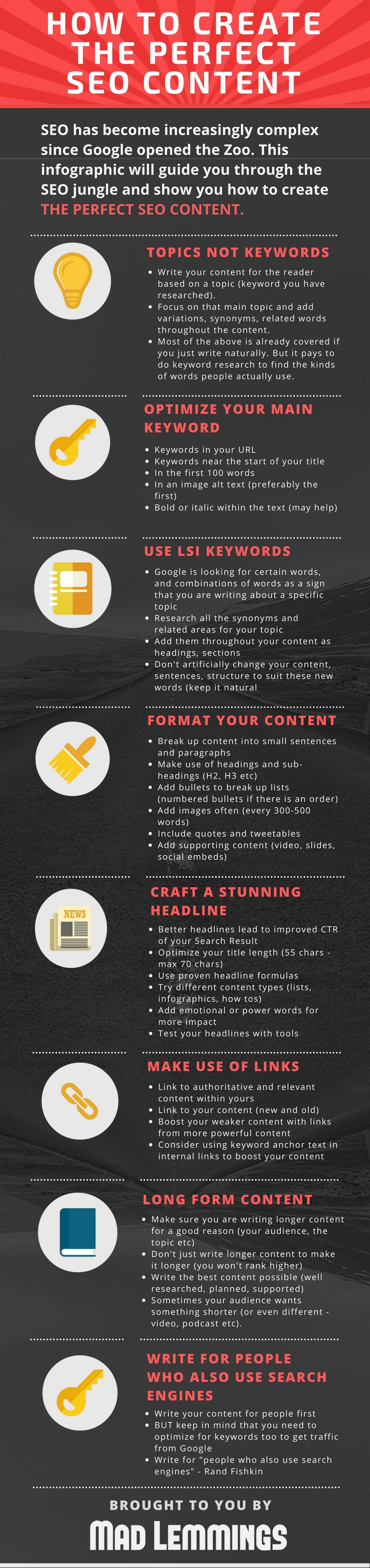
Mad Lemmings share their SEO content tips in this infographic.
Here’s what makes the list:
- Topics not keywords
- Optimise your main keyword
- Use LSI keywords
- Format your content
- Craft a stunning headline
- Make use of links
- Long form content
- Write for people who also use search engines
Check out the infographic for more detail.
In today’s digital age, search engines are the gateways to online success, and Google reigns supreme. With over 90% of the global market share, crafting content that aligns with Google’s ever-evolving search algorithms is crucial for any business, website, or blog. But how do you create content that ranks well while still being engaging for your audience? Here are 8 essential tips to craft perfect SEO content to keep both Google and your readers happy.
Topics, Not Keywords
For years, traditional SEO revolved around identifying specific keywords and placing them throughout your content in a bid to rank higher on search engines like Google. While keywords still play an essential role, the landscape has changed significantly. Modern SEO requires a more holistic approach, focusing on topics rather than just keywords. This shift reflects Google’s growing ability to understand content semantically and prioritize user intent over keyword density.
For small businesses, this presents an opportunity to create more meaningful and comprehensive content that not only helps rank higher on search engines but also builds trust with customers. Here’s how focusing on topics instead of just keywords can transform your SEO strategy, and how you can implement it effectively.
Why Google Prefers Topics Over Keywords
Google’s primary goal is to provide the best possible answer to a user’s query. As its algorithms have become more sophisticated, they’ve moved beyond simply matching exact keywords to understanding the context behind a search.
Here’s why Google is prioritizing topics:
- Natural Language Processing (NLP): Google’s advancements in NLP, particularly through algorithms like Hummingbird and BERT, allow it to understand the meaning behind words rather than just the words themselves. This means Google can discern the intent of a searcher and match it with the most relevant content, even if the exact keyword isn’t present.
- User Intent: Instead of focusing on one specific keyword, Google aims to answer the broader questions a user might have about a topic. For instance, someone searching for “healthy breakfast recipes” might also be interested in related topics like “low-calorie breakfast ideas” or “quick and easy breakfast meals.” By covering a topic comprehensively, you increase the chances of satisfying that user’s intent.
- Better Search Experiences: Focusing on topics means you’re addressing a broader array of questions that users may have. This leads to more satisfied searchers, longer dwell times, and lower bounce rates—all of which Google uses to determine a page’s relevance and authority.
For small businesses, this shift means you don’t need to chase after hundreds of different keyword variations. Instead, focus on creating in-depth, valuable content that covers topics in detail. Not only will this improve your SEO, but it will also establish your business as an expert in your field.
How Small Businesses Can Transition to Topic-Based Content
Shifting your content strategy from a keyword-based approach to a topic-based one requires planning and a deeper understanding of your audience’s needs. Here are some actionable steps for small businesses to make this transition successfully:
- Research Your Audience’s Intent
To effectively focus on topics, you need to understand what your target audience is searching for and why. Instead of simply identifying keywords with high search volumes, focus on identifying the intent behind those searches. There are four main types of search intent:
- Informational: The user is looking for information or answers to a question. Example: “How to fix a leaky faucet.”
- Navigational: The user is trying to reach a specific website or page. Example: “Facebook login.”
- Transactional: The user is ready to make a purchase or complete a specific action. Example: “Buy running shoes online.”
- Commercial investigation: The user is researching products or services before making a purchasing decision. Example: “Best running shoes for flat feet.”
By understanding what your audience is really looking for, you can create content that addresses those needs comprehensively. Tools like Google Search Console or Google Analytics can help you analyze which queries are driving traffic to your site and what kind of content your audience is interacting with the most.
- Create Topic Clusters
A topic cluster is a collection of related content that all links to a central pillar page. The pillar page provides a broad overview of a particular topic, while the related content (called cluster content) delves deeper into specific subtopics. This not only helps with SEO but also enhances the user experience by allowing them to explore related content easily.
Here’s how to create a topic cluster:
- Identify the core topic: Choose a broad subject relevant to your business. For example, if you run a small landscaping company, your pillar page might be “Residential Landscaping Tips.”
- Develop subtopics: Once you have your core topic, think of 5-10 related subtopics that you can cover in separate articles. Using the same example, subtopics could include “Best Plants for Low-Maintenance Landscaping,” “How to Design a Water-Efficient Yard,” and “Seasonal Landscaping Tips.”
- Interlink your content: Each subtopic article should link back to the pillar page and to each other, forming a tightly-knit web of content that signals to Google your website’s authority on that topic.
- Leverage Content That Answers Broad Questions
Small businesses can build SEO momentum by targeting broad questions related to their industry. These broad topics often provide opportunities to create evergreen content, which remains relevant and continues to generate traffic over time.
For example, a business that sells organic skincare products could write a blog post titled “What are the Benefits of Organic Skincare?” This broad question will attract a range of readers, including those just starting their research and those closer to making a purchase. From this topic, you can create multiple pieces of content such as:
- “How Organic Skincare Differs from Conventional Products”
- “Top 5 Ingredients in Organic Skincare”
- “Why Organic Skincare is Better for Sensitive Skin”
By answering broad questions thoroughly, you position your content to rank for a wide variety of queries. Additionally, it gives you opportunities to address more niche topics within the same subject, which can be interlinked to further enhance your site’s authority.
- Utilize Long-Tail Keywords
While topics are the primary focus, long-tail keywords should still play a role in your SEO strategy. Long-tail keywords are longer, more specific phrases that have lower search volumes but higher intent and less competition. Targeting long-tail keywords allows small businesses to rank for more niche search queries while aligning with broader topics.
For instance, instead of focusing on the keyword “organic skincare,” a small business might target “organic skincare for dry skin” or “organic anti-aging night cream.” These long-tail keywords align with the broader topic but target users with more specific needs, increasing the likelihood of conversions.
- Research Related Subtopics Using Tools
Several SEO tools can help small businesses identify related subtopics that are valuable for a topic-focused strategy. Some of the best tools include:
- AnswerThePublic: This tool helps you discover questions people are asking around a particular keyword or topic.
- Google’s “People Also Ask” and “Related Searches” sections: These sections offer insights into related queries that users are searching for.
- SEMrush or Ahrefs: These tools allow you to analyze your competitors’ content and see which topics or keywords they are ranking for.
By leveraging these tools, you can ensure that your content addresses a wide range of subtopics that users care about, ultimately improving your chances of ranking for a variety of search queries.
- Focus on Quality, Not Quantity
One of the key reasons to focus on topics rather than keywords is that it encourages you to create high-quality content rather than churning out multiple short, keyword-stuffed pieces. Search engines reward in-depth, valuable content, and long-form articles often perform better in rankings than shorter posts.
For small businesses, this means focusing on writing content that genuinely helps users, solves their problems, or provides valuable insights. Quality content will naturally include related keywords and phrases, as well as signal to Google that your site is a reliable source of information. Over time, this builds your site’s authority and improves your overall SEO performance.
- Update and Expand Existing Content
Another benefit of focusing on topics is the ability to refresh and expand existing content on your website. Google values fresh, up-to-date information, and expanding your content around a core topic can give it new life in search rankings.
For example, if you have an article titled “Top Tips for Organic Skincare,” you can revisit and update it by adding new information, subtopics, or even linking to newer blog posts related to skincare. Expanding existing content signals to Google that your page is still relevant and can boost your rankings for the broader topic.
- Monitor Topic Performance
Once you’ve implemented a topic-focused content strategy, it’s essential to monitor its performance. Track which topics are driving the most traffic, which pages have the highest engagement, and how users are interacting with your content. Tools like Google Analytics, Google Search Console, and SEMrush can provide valuable insights into the performance of your topic clusters.
By analyzing this data, you can make informed decisions about which topics to expand on, which areas need more coverage, and where to adjust your content strategy for better results.
Conclusion
For small businesses, focusing on topics rather than just keywords represents a fundamental shift in how to approach SEO. This strategy not only aligns with Google’s increasingly sophisticated algorithms but also allows you to create content that is more useful, relevant, and engaging for your audience.
By prioritizing topics, you can address a broader range of user needs, create comprehensive and valuable content, and build a stronger SEO foundation for long-term success. Start by understanding your audience’s intent, creating topic clusters, utilizing long-tail keywords, and continually monitoring your content’s performance. This approach will position your small business as an authority in your field and keep Google—and your audience—happy.
Optimise Your Main Keyword
Keyword optimization has been a central aspect of SEO since its inception, and despite Google’s shift toward topic-focused content, optimizing your main keyword remains essential. However, modern keyword optimization is about much more than simply stuffing a keyword into your content. Google now prioritizes context, relevance, and user experience, so it’s crucial to balance keyword placement with providing genuine value to readers.
For small businesses, mastering the art of keyword optimization is critical for driving organic traffic and staying competitive in search engine rankings. Below are some actionable tips and strategies to ensure you are optimizing your main keyword effectively while keeping both Google and your audience happy.
- Start with Thorough Keyword Research
Before you can optimize your content for a main keyword, you need to identify the right keyword to target. For small businesses, keyword research should be comprehensive and strategic, focusing on terms that align with your business goals while also being achievable in terms of competition.
Here are some effective steps for performing keyword research:
- Use Keyword Tools: Tools like Google Keyword Planner, SEMrush, Ahrefs, and Ubersuggest can help you identify relevant keywords, search volume, and competition levels. For small businesses, it’s often better to target long-tail keywords (phrases of three or more words) that are specific and less competitive.
- Analyze Search Intent: Understand what users are hoping to achieve when they search for your main keyword. Are they looking for information, ready to make a purchase, or comparing products? Choose a main keyword that aligns with the intent of your audience.
- Check Competitor Rankings: Look at the content ranking for your target keyword and analyze what makes these pages perform well. This will help you craft your content to be more competitive by addressing gaps or providing more value.
- Target Low Competition, High Intent Keywords: As a small business, competing for highly competitive keywords can be difficult. Instead, aim for keywords that have high purchase intent but lower competition. For example, instead of trying to rank for “skincare,” a small organic skincare business could target “best organic skincare for sensitive skin.”
- Strategic Keyword Placement
Once you’ve identified your main keyword, it’s important to use it strategically throughout your content. Google uses specific signals to understand the relevance of your content to a particular keyword, so keyword placement should be thoughtful and purposeful.
Here are key areas where you should optimize for your main keyword:
- Title Tag: The title tag is one of the most important on-page SEO elements. It appears as the clickable headline in search results and signals to Google what your page is about. Make sure your main keyword appears naturally in the title tag, ideally toward the beginning. For instance, if your main keyword is “affordable web design for small businesses,” a good title could be “Affordable Web Design for Small Businesses: Top Tips and Tools.”
- Meta Description: While the meta description doesn’t directly impact rankings, it can influence click-through rates (CTR). Including your main keyword in the meta description ensures that it’s bolded when users search for it, making your link more attractive to click. A well-optimized meta description might be: “Looking for affordable web design for small businesses? Discover the best tools, tips, and services to build a professional website on a budget.”
- URL Slug: Your keyword should also appear in the URL slug for your page. Keeping the URL short and including the main keyword makes it easier for Google to understand what your content is about. For example, a good URL could be: www.yourwebsite.com/affordable-web-design-small-business.
- First 100 Words: Google crawls the first 100-150 words of your content to understand its relevance to a keyword. Therefore, your main keyword should appear naturally early in the introduction. For example: “If you’re a small business owner looking for affordable web design, you’ve come to the right place. In today’s digital age, having a professional website is more important than ever…”
- Headings (H1, H2, H3): Headings help structure your content and make it easier for both users and search engines to scan. Use your main keyword in the H1 (main title) and in at least one of your H2 headings to ensure Google recognizes it as a focal point of the content. However, avoid overusing the keyword in every heading, as this can appear unnatural and hurt user experience.
- Alt Text for Images: Image alt text provides descriptions of your images for both visually impaired users and search engines. Including your main keyword in image alt text is a subtle but effective way to optimize your content. For example: <img src=”webdesign.jpg” alt=”affordable web design for small businesses”>.
- Avoid Keyword Stuffing
Keyword stuffing—overloading your content with a target keyword—was once a common SEO practice, but today it is penalized by Google. Not only can keyword stuffing hurt your rankings, but it can also diminish the quality of your content and drive users away. For small businesses, this can lead to lost credibility and trust.
Here’s how to avoid keyword stuffing while still optimizing for your main keyword:
- Use Variations: Instead of repeating your main keyword excessively, use synonyms or related phrases. Google’s ability to understand semantic meaning means that you don’t need to use the exact same phrase repeatedly. For example, if your main keyword is “affordable web design,” you can use variations like “cost-effective website design” or “budget-friendly web development.”
- Natural Language: Write your content for people, not just for search engines. Make sure your keyword is integrated naturally and fits within the context of the sentence. If it feels forced, chances are it will be off-putting to readers, and search engines will notice the over-optimization.
- Check Keyword Density: Keyword density refers to how often your main keyword appears relative to the total word count. While there’s no perfect percentage, a common rule of thumb is to aim for a keyword density of around 1-2%. This allows your keyword to be prominent without overdoing it. Tools like Yoast SEO or SEO Review Tools can help you monitor keyword density.
- Use LSI (Latent Semantic Indexing) Keywords
LSI keywords are conceptually related to your main keyword. These are the terms and phrases that provide additional context to help search engines better understand your content. For example, if your main keyword is “affordable web design,” LSI keywords could include “website builder tools,” “responsive design,” or “small business website.”
Here’s how to find and use LSI keywords:
- Use Google’s Search Suggestions: When you start typing your main keyword into Google, look at the autocomplete suggestions and the “People also ask” section for inspiration. These are often good sources of LSI keywords.
- LSIGraph or Ubersuggest: These tools are designed to help you identify LSI keywords and related search terms that can enrich your content.
- Integrate LSI Keywords Naturally: Once you’ve identified relevant LSI keywords, integrate them into your content where they make sense. This not only prevents over-optimization of your main keyword but also helps you rank for a broader range of related search terms.
- Optimize for Voice Search
As more users turn to voice-activated assistants like Siri, Alexa, and Google Assistant, optimizing for voice search is becoming increasingly important. Voice search queries tend to be longer and more conversational, which means you’ll need to adjust how you optimize your main keyword.
Here’s how to optimize your content for voice search:
- Use Natural Language: Voice search queries are typically more conversational than text queries. Think about how your target audience might phrase a question if they were speaking, not typing.
- Focus on Questions and Answers: Many voice search queries start with question words like “how,” “what,” “why,” or “where.” Try to incorporate these types of questions into your content and provide clear, concise answers. For example, “What is the most affordable web design option for small businesses?”
- Long-Tail Keywords: Voice search often involves longer, more specific phrases, so targeting long-tail keywords is key. For example, instead of focusing on “affordable web design,” you might optimize for “how to find affordable web design services for small businesses.”
- Monitor Performance and Adjust as Needed
Optimizing for your main keyword is an ongoing process, not a one-time task. Small businesses should regularly monitor their content’s performance to ensure it’s driving traffic and converting leads. Tools like Google Search Console, SEMrush, or Ahrefs can help you track your keyword rankings, identify any dips in performance, and spot new opportunities for optimization.
Here’s how to track and adjust your keyword strategy:
- Check Rankings: Regularly monitor where your pages rank for your main keyword. If your ranking drops, it might be time to update your content or target a different variation of the keyword.
- Analyze User Engagement: Track key engagement metrics like bounce rate, time on page, and scroll depth. If users are leaving your page quickly, it may indicate that your content isn’t fully addressing their needs.
- Update Content Regularly: Keywords and search trends evolve over time. To keep your content relevant, periodically revisit your main keyword and refresh your content with updated information, new LSI keywords, and fresh insights.
Conclusion
For small businesses, mastering keyword optimization can significantly impact your online visibility and drive valuable traffic to your website. By conducting thorough keyword research, placing your main keyword strategically, avoiding keyword stuffing, incorporating LSI keywords, and optimizing for voice search, you can ensure your content is well-positioned to rank and resonate with your target audience.
Remember, SEO is a long-term investment, so keep refining your keyword strategy to adapt to search engine algorithms and user behavior trends.
Use LSI Keywords
Latent Semantic Indexing (LSI) keywords play a crucial role in modern SEO strategies. As Google’s algorithms become more sophisticated, search engines now focus on understanding the context and meaning behind search queries, rather than just relying on exact match keywords. LSI keywords are semantically related terms that help search engines interpret the topic of your content and provide users with more accurate results.
For small businesses, utilizing LSI keywords can be a powerful way to boost SEO without falling into the trap of keyword stuffing or over-optimization. Below, we’ll dive deep into what LSI keywords are, why they matter, and how to use them effectively to enhance your SEO strategy.
- What Are LSI Keywords?
LSI keywords are not just synonyms; they are words and phrases that are closely related in meaning to your main keyword. They help search engines understand the overall theme of your content, ensuring that it is relevant and comprehensive.
For example, if your main keyword is “digital marketing,” some potential LSI keywords could include:
- Search engine optimization (SEO)
- Social media marketing
- Online advertising
- Content marketing
- PPC (pay-per-click)
- Google Analytics
These related terms help Google understand that your content isn’t just focused on the specific term “digital marketing,” but covers related subtopics that add depth and relevance.
- Why Are LSI Keywords Important?
Google no longer relies solely on the density of the exact-match keyword within a piece of content to determine its relevance. Instead, it uses LSI keywords to identify the broader context of a page and whether it is a high-quality resource on the topic.
Here’s why LSI keywords are essential for small businesses:
- Improved Search Engine Rankings: Using LSI keywords signals to search engines that your content is comprehensive and relevant, increasing your chances of ranking for a variety of related queries.
- Preventing Keyword Stuffing: Over-using your main keyword can lead to keyword stuffing, which search engines penalize. LSI keywords allow you to diversify your language while still maintaining a focus on the core topic.
- Increased Content Relevance: LSI keywords help ensure your content covers multiple facets of a subject, making it more relevant to user queries and increasing dwell time on your page.
- Wider Search Visibility: By incorporating LSI keywords, you can rank for multiple keywords in a single piece of content, expanding your visibility in search results and attracting more traffic.
- How to Find LSI Keywords
There are several tools and strategies you can use to identify relevant LSI keywords for your content. Below are some actionable ways to find LSI keywords for your small business content:
- Google Autocomplete: One of the simplest ways to find LSI keywords is to use Google’s search bar. When you start typing your main keyword, Google will provide suggestions in the dropdown menu. These suggestions are often related search terms that people commonly use and are good candidates for LSI keywords.
- Google’s ‘Related Searches’ Section: After conducting a Google search for your main keyword, scroll to the bottom of the search results page. There, you’ll find a section called “Searches related to [keyword].” These related searches are a rich source of LSI keywords that you can incorporate into your content.
- LSIGraph: LSIGraph is a dedicated tool that generates LSI keywords based on your main keyword. It provides a list of semantically related terms that are contextually relevant and can help improve your content’s SEO.
- SEMrush or Ahrefs: These comprehensive SEO tools offer keyword suggestions, including LSI keywords, based on your target keyword. They also provide insights into the search volume, competition, and potential traffic for each term, allowing you to choose the most effective ones for your content.
- Ubersuggest: Like SEMrush and Ahrefs, Ubersuggest provides LSI keyword ideas and related search terms. It’s a free and user-friendly tool that is especially useful for small businesses with limited budgets.
- How to Use LSI Keywords Effectively in Your Content
Once you’ve identified a list of LSI keywords, it’s time to incorporate them into your content. However, it’s important to use LSI keywords strategically and naturally to avoid over-optimization. Below are tips to guide small businesses in using LSI keywords effectively:
- Integrate LSI Keywords Naturally: The key to using LSI keywords is to make them flow naturally within your content. Don’t force them in where they don’t fit. Instead, focus on creating high-quality, informative content where LSI keywords occur organically.
- Incorporate LSI Keywords in Key Places: Just like your main keyword, LSI keywords should be used in strategic areas to boost your SEO:
- Headings (H2, H3): Using LSI keywords in subheadings helps structure your content and signals to search engines that your content covers multiple facets of the main topic.
- Introduction and Conclusion: Include LSI keywords in the opening and closing paragraphs to reinforce the theme of your content and signal its relevance early on.
- Body Text: Pepper LSI keywords throughout the body of your content where they fit naturally. This helps Google understand the depth and breadth of your article.
- Avoid Overstuffing LSI Keywords: Just like with your main keyword, it’s important not to overuse LSI keywords. Cramming too many related terms into your content can make it feel clunky and unreadable. Use LSI keywords sparingly, and only when they add real value to the sentence or paragraph.
- Use LSI Keywords to Answer User Intent: The primary goal of using LSI keywords is to better satisfy user intent. If someone searches for “digital marketing,” they may also want information on SEO, social media, or paid advertising. By covering these topics with LSI keywords, you create a more valuable resource that answers multiple questions a user may have.
- Using LSI Keywords to Rank for Multiple Search Queries
One of the key benefits of LSI keywords is their ability to help your content rank for multiple search queries, not just your main keyword. This is especially beneficial for small businesses that may not have the resources to create a large amount of content targeting different keywords. With LSI keywords, you can maximize the reach of a single piece of content.
For example, if your main keyword is “small business accounting software,” your content could also rank for related terms like:
- Best accounting software for startups
- Easy accounting tools for small businesses
- Bookkeeping software for entrepreneurs
By naturally incorporating these LSI keywords into your content, you can tap into multiple keyword variations and increase your chances of appearing in search results for a wider range of queries.
- Create Comprehensive Content Using LSI Keywords
Google values comprehensive content that thoroughly addresses a topic. Using LSI keywords helps you create more in-depth articles or blog posts by covering related topics and subtopics. This not only improves your chances of ranking for multiple keywords, but it also enhances the user experience by providing all the information a reader might be looking for in one place.
For example, if you’re writing about “organic skincare,” you can use LSI keywords to cover related topics such as:
- Natural skincare ingredients
- Benefits of organic skincare
- DIY organic skincare recipes
- Organic skincare for sensitive skin
This approach helps ensure that your content is seen as a complete resource on the subject, which increases the likelihood of earning backlinks, social shares, and higher rankings.
- Using LSI Keywords to Optimize for Voice Search
Voice search is becoming increasingly popular, especially with the rise of smart assistants like Alexa, Siri, and Google Assistant. Voice search queries tend to be longer and more conversational, which means that LSI keywords can help you optimize for these types of searches.
To optimize for voice search using LSI keywords:
- Use Natural, Conversational Language: Voice search queries are typically phrased as questions or longer sentences. Incorporating LSI keywords that mimic natural speech patterns can help you capture more voice search traffic.
- Target Long-Tail Keywords: Long-tail keywords are often more aligned with how people speak. For example, instead of optimizing for “accounting software,” you could use an LSI keyword like “What’s the best accounting software for freelancers?” to capture voice search traffic.
- Create FAQ Sections: Frequently Asked Questions (FAQ) sections are a great way to use LSI keywords while also optimizing for voice search. Each question in your FAQ can serve as an opportunity to address a specific user query, using both your main and LSI keywords.
- Monitor and Adjust LSI Keyword Usage
SEO is not static, and neither is your content. It’s important to regularly review and adjust your use of LSI keywords as search trends and algorithms evolve. Monitoring your content’s performance and the effectiveness of your keyword strategy is essential to maintaining strong rankings.
Use tools like Google Search Console, Ahrefs, and SEMrush to track the performance of your pages and identify which keywords (including LSI keywords) are driving traffic. If your rankings start to drop or if you notice new opportunities for related search terms, update your content with additional LSI keywords or refine your current keyword strategy.
Conclusion
For small businesses, leveraging LSI keywords can be a game-changer in the world of SEO. By using LSI keywords strategically, you can improve your content’s relevance, avoid keyword stuffing, and rank for a broader range of search queries. This holistic approach to SEO not only enhances your search visibility but also ensures that your content provides value and depth to your target audience.
Incorporate LSI keywords as part of a well-rounded SEO strategy to build high-quality content that both search engines and users will love. The result? Improved rankings, more traffic, and better engagement—keeping both Google and your customers happy.
Format Your Content
The way you format your content plays a crucial role in SEO success and user engagement. A well-formatted piece of content not only improves readability and user experience but also helps search engines understand the structure and relevance of your page. For small businesses, optimizing content formatting can enhance visibility, increase dwell time, and reduce bounce rates, all of which are key ranking factors.
In this section, we’ll explore how to format your content effectively, with specific tips for small businesses to improve both user experience and SEO performance.
- Use Headings and Subheadings for Clarity and SEO
Headings and subheadings are critical for organizing your content into easily digestible sections. They help readers skim through the content and find the information they’re looking for quickly. More importantly, they also provide search engines with a clear structure, making it easier for Google to crawl and understand your content.
- H1 Tag: This is the most important heading and should be used for your primary title. It should clearly indicate the main topic of your content and include your main keyword for SEO purposes. Typically, you should have only one H1 tag per page or post.
- H2 and H3 Tags: These are subheadings that break your content into sections and subsections. Use H2 tags for major sections and H3 tags for subtopics or supporting details. Including LSI keywords or related terms in your subheadings can improve SEO while ensuring your content covers multiple facets of the topic.
For example, a blog post about “Social Media Marketing for Small Businesses” might include H2 headings like:
- “How to Choose the Right Social Media Platforms”
- “Creating a Social Media Content Strategy”
- “Measuring the Success of Your Social Media Campaign”
Each of these subheadings signals to both users and search engines the specific topics being covered within the content.
Tips for Small Businesses:
- Ensure that your subheadings are descriptive and accurately reflect the content of the section. This enhances user experience by helping readers quickly navigate to the sections they care about.
- Use keywords and LSI keywords in your headings and subheadings naturally, without stuffing.
- Make sure your headings are concise yet informative to improve skimmability and readability.
- Leverage Bullet Points and Numbered Lists
Bullet points and numbered lists break up long blocks of text and make it easier for readers to scan your content. These formatting elements are especially useful for presenting key information, steps, or tips in a clear, concise manner.
- Bullet Points: Use bullet points to list out benefits, features, or short tips. They improve the readability of your content and help users quickly absorb important information.
- Numbered Lists: Numbered lists are ideal for step-by-step instructions, rankings, or ordered information. They provide a structured flow to your content and are easy for users to follow.
For example, if you’re writing about “How to Improve Your Website’s SEO,” you might format the steps as:
- Conduct keyword research
- Optimize on-page elements
- Improve site speed
- Build high-quality backlinks
- Monitor your SEO performance
Tips for Small Businesses:
- Use bullet points and numbered lists to highlight key takeaways or actionable steps.
- Limit each bullet or numbered point to a short, clear sentence or phrase. This keeps the content easily digestible and encourages users to stay engaged.
- Use lists when providing complex information to simplify the content and enhance readability.
- Keep Paragraphs Short and Concise
Long, dense paragraphs can overwhelm readers and cause them to lose interest, leading to higher bounce rates. Shorter paragraphs improve readability, especially on mobile devices, and help retain the attention of your audience. Search engines also favor content that is well-structured and easy to read.
- Aim for paragraphs that are 2-3 sentences long. If you find that a paragraph is becoming too long, break it up into smaller chunks.
- Avoid walls of text by using ample white space between paragraphs. This makes your content visually appealing and easier for users to engage with.
Tips for Small Businesses:
- Break up your content into digestible chunks. For example, instead of writing a long explanation of why social media marketing is important, break it into smaller, more focused sections.
- Keep your paragraphs focused on one idea. This makes it easier for readers to follow your content and keeps the flow of information clear.
- Use Visuals to Break Up Text
Including images, charts, infographics, and videos in your content is a great way to enhance engagement and improve user experience. Visual elements can help illustrate points, explain complex concepts, and make your content more memorable.
- Images: High-quality images or graphics can visually support the points you make in your content. They also give readers a break from reading text and keep the page interesting. Make sure to use alt text for images, which helps with SEO and makes your content more accessible.
- Infographics: Infographics are a powerful way to present data, statistics, or complex information in a visually engaging format. They can also be shared easily on social media, increasing the reach of your content.
- Videos: Adding video content is another effective way to keep users engaged. Videos can provide more detailed explanations and tutorials, which is particularly useful for small businesses looking to offer how-to guides or product demonstrations.
Tips for Small Businesses:
- Use original visuals where possible, such as product photos or custom infographics, to enhance authenticity and uniqueness.
- Optimize images and videos for faster loading times. Large, unoptimized media files can slow down your site, negatively affecting both SEO and user experience.
- Use visuals to reinforce the message of your content, not just for decoration. Ensure that every image, infographic, or video adds value and context.
- Optimize for Mobile Devices
A significant portion of users access content from their mobile devices. For small businesses, ensuring your content is formatted for mobile optimization is crucial to capturing mobile traffic and improving your site’s overall SEO performance.
- Responsive Design: Your website should use responsive design to ensure that content automatically adjusts to fit the screen size of different devices. Whether users are on a desktop, tablet, or smartphone, the content should be easily readable and navigable.
- Mobile-Friendly Formatting: Since mobile users tend to scan content quickly, format your text with short paragraphs, bullet points, and clear headings. Additionally, use larger fonts and ample spacing to improve readability on smaller screens.
Tips for Small Businesses:
- Test your content on multiple devices to ensure that it is fully optimized for mobile users. Pay attention to how text, images, and videos display on smaller screens.
- Use compressed images and limit the use of heavy media files to maintain fast loading speeds on mobile devices.
- Incorporate clickable buttons for calls to action (CTAs) instead of relying on hyperlinks, as buttons are easier for mobile users to interact with.
- Include White Space for a Clean Design
White space, or negative space, refers to the empty areas between blocks of text, images, and other elements on your webpage. While it may seem like an aesthetic choice, the strategic use of white space can have a significant impact on user experience and SEO.
- White space helps your content appear less cluttered and makes it easier for users to focus on the important elements. It also gives readers visual breaks as they move through your content, preventing them from feeling overwhelmed.
- From an SEO perspective, well-structured content with white space can improve dwell time and reduce bounce rates, as users are more likely to stay on a page that is easy to read and navigate.
Tips for Small Businesses:
- Avoid packing too much information onto a single page. Use white space to create a sense of balance and organization.
- Increase white space around key elements like CTAs, headings, and images to make them stand out more effectively.
- Add Call-to-Actions (CTAs) Strategically
CTAs guide readers toward taking specific actions, such as signing up for a newsletter, purchasing a product, or contacting your business. Placing clear and compelling CTAs at strategic points in your content can help drive conversions and keep users engaged with your business.
- CTAs should be visually distinct from the rest of the content, using contrasting colors or buttons to make them stand out.
- Use action-oriented language that clearly tells users what to do next, such as “Download our free guide,” “Contact us today,” or “Subscribe for updates.”
Tips for Small Businesses:
- Position CTAs above the fold and at the end of your content to capture user attention when they’re most engaged.
- Ensure that your CTAs are mobile-friendly with large, clickable buttons for easier interaction on smaller screens.
Conclusion
Formatting your content effectively is just as important as writing high-quality content. For small businesses, a well-structured and visually appealing format improves user experience, enhances readability, and makes it easier for search engines to understand and rank your content.
By using headings and subheadings, bullet points, visuals, white space, and CTAs strategically, you can create content that is both engaging and optimized for SEO. Focus on delivering value through easy-to-read, scannable, and mobile-friendly content that keeps both search engines and users happy.
Craft a Stunning Headline
Your headline is often the first—and sometimes the only—chance you have to capture a reader’s attention. Whether it’s a blog post, an email subject line, or a social media update, crafting a stunning headline is critical to driving clicks, engagement, and conversions. For small businesses, an eye-catching headline can be the difference between a successful content marketing campaign and one that falls flat.
In this section, we’ll explore how to create headlines that resonate with your audience, improve your SEO efforts, and encourage users to engage with your content.
- Make It Clear and Specific
A headline should give readers a clear idea of what they’ll find in the article. Vague or overly clever headlines might intrigue, but they often fail to convert because users want immediate clarity about what they’re clicking on.
- Be Specific: Instead of writing a headline like “Tips for Small Businesses,” opt for something more detailed such as “10 Essential Tips for Small Businesses to Boost Online Sales.” This specificity attracts readers who are looking for exactly what you’re offering.
- Answer a Question or Promise Value: Headlines that address a specific problem or offer a solution tend to perform well. For instance, “How to Double Your Instagram Followers in 30 Days” directly promises a solution to a common challenge many small businesses face.
Tips for Small Businesses:
- Focus on solving a problem your audience has. Headlines like “How to Improve Your Website’s SEO in 5 Simple Steps” attract users looking for practical, actionable content.
- Use numbers and data to add specificity and make your headline more attractive. For example, “7 Proven Strategies to Grow Your Local Business” is more compelling than a vague headline like “Grow Your Local Business.”
- Incorporate Keywords for SEO
While your headline needs to appeal to human readers, it’s equally important to make it SEO-friendly. Including your main keyword in the headline helps search engines understand what your content is about and increases the likelihood of ranking higher for that term.
- Place Keywords at the Start: Search engines often place more weight on words at the beginning of the headline, so try to position your primary keyword as close to the start as possible. For instance, “SEO Tips for Small Businesses: A Complete Guide” is more effective than “A Complete Guide for Small Business SEO Tips.”
- Avoid Keyword Stuffing: Overloading your headline with keywords can make it seem unnatural and deter readers. Instead, focus on one primary keyword and, if necessary, a secondary term that supports the headline without cluttering it.
Tips for Small Businesses:
- Use keyword tools like Google Keyword Planner or Ubersuggest to find high-traffic, relevant terms for your business niche and integrate them naturally into your headline.
- If possible, try to align your headline’s keyword strategy with user intent, ensuring the content matches what your audience is actively searching for.
- Use Numbers and Lists to Boost Engagement
Headlines that include numbers or listicle formats (e.g., “5 Tips for…” or “10 Reasons Why…”) tend to attract more clicks. This is because numbers provide a sense of structure and specificity, reassuring readers that they’ll receive clearly defined information.
- Odd Numbers Work Best: Research has shown that headlines with odd numbers tend to perform better than those with even numbers. This might be because odd numbers stand out more in a list, creating a psychological advantage.
- Use Large Numbers for Impact: If you’re sharing a list, using higher numbers like “25 Best Marketing Tools for Small Businesses” can create an impression of thoroughness and value. On the other hand, smaller numbers like “3 Quick Tips” are great for bite-sized, actionable advice.
Tips for Small Businesses:
- Create headlines like “7 Ways to Optimize Your Website for Google” or “10 Simple Strategies for Increasing Your Local Visibility.”
- Test different headline formats (such as Top 10 lists vs. How-to guides) to see which resonates most with your target audience and drives the most engagement.
- Use Emotional and Power Words
Adding emotional or power words to your headline can trigger an immediate response in readers, encouraging them to click and engage. These words evoke feelings of excitement, urgency, curiosity, or even fear, which can increase the headline’s effectiveness.
- Emotional Words: These words tap into the reader’s emotions, such as “amazing,” “incredible,” “life-changing,” or “unbelievable.” For example, “10 Incredible Ways to Market Your Small Business on a Budget” makes the reader curious about what the article will offer.
- Power Words: Power words like “proven,” “ultimate,” “best,” “guaranteed,” or “essential” make the content feel authoritative and valuable. A headline like “The Ultimate Guide to Building a Strong Referral Network” promises readers a comprehensive, must-read article.
Tips for Small Businesses:
- Experiment with emotional triggers such as “secret,” “ultimate,” or “life-changing” in your headlines to add intrigue and urgency.
- Mix power words with clear language to create a compelling headline. For instance, “Proven Techniques to Improve Your SEO Ranking” combines clarity with authority.
- Incorporate Curiosity or FOMO (Fear of Missing Out)
Creating a sense of curiosity or FOMO in your headline can make readers feel compelled to click, as they don’t want to miss out on valuable information. This is especially useful in social media and email subject lines, where your goal is to stand out in a crowded space.
- Open-Ended Headlines: Headlines that tease the content without giving away too much can spark curiosity. For instance, “The One Marketing Strategy Every Small Business Needs” makes the reader wonder what that strategy is, prompting them to click.
- FOMO-Based Headlines: Phrases like “Don’t Miss These 7 SEO Trends” or “5 Secrets You Should Know About Local Marketing” create a sense of urgency and exclusivity. They imply that the reader will be left behind if they don’t engage with the content.
Tips for Small Businesses:
- Try headlines that create curiosity gaps, such as “The Surprising Truth About Social Media Advertising” or “What You’re Doing Wrong with Your Email Marketing (and How to Fix It).”
- Use time-sensitive language like “Now,” “Today,” or “Before It’s Too Late” to add urgency and encourage immediate action.
- Keep It Short and Sweet
While it can be tempting to pack your headline with details, shorter headlines often perform better, particularly on mobile devices where space is limited. Google typically displays the first 60-70 characters of a title in its search results, so keeping your headline within this limit ensures it will be fully visible to users.
- Aim for 6-8 Words: Research shows that headlines with 6-8 words tend to receive the most clicks. This provides enough space to include your main idea without overwhelming the reader.
- Cut Out Unnecessary Words: Avoid filler words like “the,” “that,” or “in order to.” Focus on your core message and remove anything that doesn’t add value. For instance, instead of writing “The Complete Guide That Will Help You Grow Your Business,” you could simplify it to “Complete Guide to Growing Your Business.”
Tips for Small Businesses:
- Use headline analyzers, like CoSchedule’s Headline Analyzer, to measure the effectiveness and readability of your headlines.
- Test shorter variations of longer headlines to see which version resonates best with your audience.
- Use Actionable Language
A great headline encourages readers to take action. By using verbs and action-oriented language, you can make your headline more compelling and persuasive. Actionable headlines give the impression that your content is not just informative but also useful and practical.
- Start with a Verb: Begin your headline with an action word to make it more dynamic. For instance, “Boost Your SEO Rankings in 5 Easy Steps” or “Transform Your Social Media Strategy Today” clearly shows that the reader will be able to take action based on your content.
- Offer a Solution: Headlines like “Fix Common SEO Mistakes in Minutes” or “Grow Your Instagram Followers Fast” highlight the tangible benefits your readers will gain by clicking on your article.
Tips for Small Businesses:
- Use action words like learn, discover, grow, boost, improve, build, and get to create a sense of immediacy and action.
- Ensure that the action promised in the headline is actually delivered in the content to maintain trust and credibility with your audience.
- Test and Optimize Your Headlines
No matter how well-crafted your headline may seem, it’s essential to test different variations to see which performs best. A/B testing headlines can provide valuable insights into what resonates with your audience, helping you fine-tune your approach for future content.
- A/B Testing: Use tools like Google Optimize or Optimizely to run A/B tests on different headline versions. Track metrics such as click-through rate (CTR), time on page, and engagement to determine which headline is the most effective.
- Analyze Performance: Look at the performance of past headlines to understand what works for your audience. If your audience tends to click more on how-to guides than listicles, prioritize those in your future content strategy.
Tips for Small Businesses:
- Test variations of your headline across different platforms, including blog posts, emails, and social media.
- Monitor CTR and engagement metrics regularly to ensure your headlines are driving the desired outcomes.
By following these in-depth tips, small businesses can craft stunning headlines that attract attention, drive clicks, and ultimately lead to higher engagement and conversions. A well-crafted headline is a powerful tool in any content marketing strategy, and by continuously testing and optimizing, businesses can stay ahead of the competition.
Make Use of Links
When it comes to SEO, linking is one of the most powerful tools you can use to increase your content’s visibility and authority. Links serve as a bridge, connecting your content to other relevant pages, both within your website and on external sites. For small businesses, making strategic use of links is crucial to building credibility, driving traffic, and improving your rankings in search engine results pages (SERPs).
In this section, we’ll dive into how small businesses can effectively incorporate internal and external links into their SEO content strategy to keep Google and users happy.
- Internal Links: Strengthen the Structure of Your Website
Internal links are hyperlinks that point to other pages on your website. When used effectively, internal links help Google crawl your site more easily, allowing search engines to understand the relationship between different pages. For small businesses, internal linking helps guide visitors to additional resources, encouraging them to stay longer on your site and explore more of your content.
- Improve User Experience: Internal links guide users through your content, providing them with additional information that enhances their experience. For example, if you’re writing a blog post on “10 Ways to Improve Your Local SEO,” you could link to other relevant articles on your site, such as “A Guide to Google My Business” or “How to Optimize Your Website for Mobile.” This not only increases user engagement but also keeps them on your site longer, reducing your bounce rate.
- Distribute Page Authority: Not all pages on your site will carry the same weight in terms of SEO authority. By linking to less-visited pages from high-performing ones, you help spread link equity, also known as “link juice,” across your website. This means pages that are not ranking as well can benefit from the SEO power of pages that are performing better.
- Create a Logical Structure: Small businesses can use internal links to create a hierarchy of content. For instance, if you have a pillar page on “Digital Marketing for Small Businesses,” you could link to more specific blog posts about social media marketing, content marketing, or SEO strategies. This helps search engines understand the depth of your content and positions your website as an authoritative source.
Tips for Small Businesses:
- Link strategically: Don’t overload a page with internal links, but ensure that each link adds value. Aim for 2-4 internal links per 1,000 words, focusing on relevant content that will enhance the user’s journey.
- Anchor text: Use descriptive and keyword-rich anchor text (the clickable text in a hyperlink) to tell search engines what the linked page is about. Avoid generic phrases like “click here” or “read more,” as these don’t provide context.
- Use a natural flow: Make sure your internal links feel natural within the content. They should flow logically and lead users to pages that provide additional value.
- External Links: Build Credibility with High-Quality Sources
External links point to content on other websites. They are essential for building trust and showing Google that your content is well-researched and backed by credible sources. For small businesses, external links can increase the authority of your content and help you build relationships with other sites.
- Link to Authoritative Sites: When linking externally, prioritize high-authority domains that are relevant to your industry. For example, if you’re writing a post about SEO best practices, linking to resources like Moz, Search Engine Journal, or Google’s own guidelines adds credibility. This signals to Google that your content is well-informed and relies on trustworthy sources.
- Avoid Low-Quality Links: Be selective about the external links you use. Linking to low-quality or spammy sites can hurt your SEO and reduce the credibility of your content. Stick to reputable sites with strong domain authority (DA) and a track record of providing valuable, reliable information.
- Cite Your Sources: External links also function as citations that back up the claims you’re making in your content. For example, if you’re citing a statistic about how many people use mobile devices for shopping, link to the original study or source. This shows readers (and search engines) that your content is based on real data, enhancing your trustworthiness.
Tips for Small Businesses:
- Focus on relevance: Ensure the external links you include are closely related to your content. Irrelevant links can confuse readers and negatively impact your SEO.
- Open external links in a new tab: It’s a good practice to have external links open in a new browser tab so that users remain on your website. This minimizes the chance of losing visitors.
- No-follow links: Use “no-follow” tags for external links when linking to pages that you don’t want to pass SEO authority to, such as paid content, affiliate links, or low-quality pages.
- Anchor Text: Optimize for Relevance and SEO
The anchor text you use for your links is crucial for both user experience and SEO. Google uses anchor text to determine the relevance of the linked page, so using clear, descriptive text helps both search engines and readers understand the content’s context.
- Descriptive Text: Instead of vague phrases like “click here” or “learn more,” use anchor text that describes what the user can expect to find on the linked page. For instance, if you’re linking to an article on email marketing, use “email marketing best practices” as the anchor text instead of “click here.”
- Include Keywords: Where possible, incorporate your target keyword in the anchor text to give the link more SEO value. However, avoid over-optimizing by using the same keyword-rich anchor text repeatedly, as this can be seen as spammy by search engines.
- Vary Your Anchor Text: Use a mix of keyword-rich anchor text, branded terms, and generic phrases to create a natural link profile. Search engines prefer diverse anchor text over repetitive, identical links.
Tips for Small Businesses:
- Choose relevant keywords that describe the linked content accurately.
- Avoid keyword stuffing: Overloading your anchor text with keywords can harm your SEO and make your content less readable.
- Prioritize user experience: Ensure that your anchor text makes sense in the context of the sentence and enhances the readability of your content.
- Balance Internal and External Links
For small businesses, striking a balance between internal and external links is key to crafting SEO content that works. While both types of links have their own benefits, overloading your content with too many can be overwhelming for users and reduce the effectiveness of your SEO strategy.
- Don’t Overdo It: Aim for a healthy balance between internal and external links. A general rule of thumb is to include 2-3 internal links and 1-2 external links per 1,000 words of content. This helps spread out your link-building efforts without overwhelming readers or diluting the value of your content.
- Link Naturally: Both internal and external links should flow naturally within the content. Avoid forcing links into paragraphs just for the sake of SEO. The goal is to provide value and enhance the reader’s understanding of the topic.
- Prioritize User Intent: When deciding between internal or external links, think about the user’s intent. Are they looking for more in-depth information on your site, or would an external resource help clarify a point? If your content can provide further explanation, an internal link is likely the best choice.
Tips for Small Businesses:
- Plan your link strategy: Before you start writing, outline which internal pages you want to link to and what external sources you might use. This ensures a more structured approach and prevents you from adding too many links during the editing process.
- Check link health: Regularly audit your internal and external links to ensure they are still functional and leading to relevant content. Broken links can negatively impact your SEO.
- Monitor and Measure Your Linking Strategy
Once you’ve implemented a linking strategy, it’s essential to monitor and measure its performance. Use tools like Google Analytics or Ahrefs to track how well your internal and external links are contributing to your overall SEO efforts.
- Track Clicks: Keep an eye on how many users are clicking on your internal and external links. If certain links are underperforming, you may need to re-evaluate the placement or anchor text to make them more appealing.
- Monitor Backlinks: Backlinks, or external sites linking to your content, are a powerful signal of authority for search engines. Track who is linking to your content and consider reaching out to build relationships with these sites, possibly earning more backlinks over time.
- Check for Broken Links: Broken links not only frustrate users but also send negative signals to search engines. Regularly check for and fix broken internal and external links to maintain a healthy site structure.
Tips for Small Businesses:
- Use tools like Screaming Frog or SEMrush to audit your website for broken links and fix them promptly.
- Analyze which external sources are driving the most traffic to your site, and explore opportunities for further collaboration or guest blogging.
By making strategic use of internal and external links, small businesses can create content that is not only optimized for search engines but also delivers value to users. The right mix of links helps Google understand your site’s structure and boosts your authority, leading to better rankings and increased organic traffic.
Long-Form Content
In the realm of content marketing, long-form content refers to articles, blog posts, or guides that typically exceed 1,000 words and can go up to several thousand words. This format allows for a more in-depth exploration of a subject, providing readers with valuable information and insights. For small businesses, creating long-form content can significantly enhance SEO efforts, engage audiences, and position your brand as an authority in your niche. Here’s a detailed look at why long-form content is beneficial and how small businesses can effectively create it.
- The Benefits of Long Form Content
- Improved SEO Rankings: Long-form content tends to rank better on search engines. This is partly because it provides more comprehensive information that can satisfy search intent. According to studies, articles that are 1,500 words or more often perform better than shorter pieces because they tend to receive more backlinks and social shares.
- Increased Engagement: Readers are more likely to spend time on your website when they find well-researched, informative content. Long-form articles can lead to lower bounce rates and higher time-on-page metrics, both of which are positive signals to search engines.
- Enhanced Authority and Trust: When you offer in-depth insights and valuable information, you establish your business as an authority in your industry. This can foster trust with your audience, making them more likely to engage with your brand and consider your products or services.
- Greater Shareability: Well-crafted long-form content is often more shareable on social media and can attract organic traffic through social sharing. Readers are likely to share comprehensive guides or resourceful articles with their networks.
- Creating Effective Long Form Content
To maximize the benefits of long-form content, small businesses should follow these strategies:
- Identify Relevant Topics
Start by researching topics that resonate with your target audience. Use tools like Google Trends, BuzzSumo, or AnswerThePublic to find what questions people are asking in your industry. Focus on topics that not only interest your audience but also allow for deep exploration.
- User Intent: Understand the intent behind the search queries. Are users looking for information, solutions to problems, or recommendations? Tailor your content to meet these needs comprehensively.
- Competitor Analysis: Look at what your competitors are doing. Analyze their long-form content to identify gaps in information or unique angles you can take to differentiate your own content.
- Develop a Clear Outline
Before you start writing, create a detailed outline to structure your long-form content. This helps in organizing your thoughts and ensures that you cover all necessary points.
- Main Sections: Break your content into clear sections with headings and subheadings. This not only improves readability but also allows for easier navigation.
- Logical Flow: Ensure that there’s a logical progression in your content. Start with an introduction, followed by the body sections, and conclude with a summary or a call to action.
- Write Engaging and Valuable Content
The quality of your content is crucial. Here are ways to ensure it engages readers:
- Hook Your Readers: Start with a compelling introduction that captures interest. Use a relevant story, statistic, or question to draw readers in.
- In-Depth Research: Support your claims with data, statistics, and examples. Include insights from reputable sources to strengthen your arguments.
- Use Visuals: Incorporate images, infographics, videos, and charts to break up the text and illustrate key points. Visuals make the content more engaging and can aid in understanding complex information.
- Be Conversational: Write in a friendly, conversational tone to make your content more approachable. Avoid jargon unless it’s necessary and clearly explain any technical terms.
- Optimize for SEO
Long-form content should be optimized for search engines to maximize its reach. Here’s how to do it effectively:
- Keyword Research: Identify primary and secondary keywords related to your topic. Use tools like Google Keyword Planner or Ahrefs to find keywords with good search volume and lower competition.
- Natural Incorporation: Integrate your main keywords and LSI (Latent Semantic Indexing) keywords naturally throughout the content, particularly in headings, subheadings, and the introduction.
- Meta Tags: Write a compelling meta title and description that includes your target keywords. This helps improve click-through rates from search engine results.
- Internal and External Links: As discussed in the previous section, strategically include internal links to relevant pages on your site and external links to authoritative sources.
- Include a Call to Action
Conclude your long-form content with a clear call to action (CTA). Whether it’s subscribing to a newsletter, downloading a resource, or exploring your products, make it clear what you want the reader to do next.
- Engagement Opportunities: Encourage readers to leave comments, share their thoughts, or ask questions to foster interaction and community engagement.
- Promote Your Long Form Content
Once you’ve created your long-form content, it’s essential to promote it to reach a broader audience.
- Social Media Sharing: Share your article on all your social media platforms. Create engaging posts that highlight key takeaways or quotes to entice clicks.
- Email Marketing: If you have a mailing list, send out a newsletter featuring your new content. Provide a brief summary or excerpt to encourage opens and clicks.
- Influencer Outreach: Consider reaching out to industry influencers or bloggers who might be interested in your content. They may share it with their audience, giving you additional exposure.
- Analyzing the Performance of Long Form Content
After publishing your long-form content, it’s essential to track its performance and gather insights for future improvements.
- Use Analytics Tools: Utilize Google Analytics to monitor key metrics such as page views, average time on page, bounce rate, and conversion rates. This data will help you understand how well your content is performing.
- Engagement Metrics: Pay attention to social shares, comments, and backlinks. High engagement metrics indicate that your content is resonating with readers.
- Iterate and Improve: Use the insights gathered to refine your content strategy. If certain topics or formats perform better than others, focus on creating more of that type of content.
By embracing long-form content, small businesses can create valuable resources that enhance their SEO efforts and establish authority in their niche. With careful planning, in-depth research, and strategic promotion, long-form articles can significantly boost online visibility, engage audiences, and contribute to overall business growth.
Write for People Who Also Use Search Engines
In the world of content marketing, understanding your audience’s dual nature as both readers and search engine users is crucial. Writing for people who also use search engines means creating content that is not only engaging and informative but also optimized for search engines to ensure visibility. This approach involves striking a balance between meeting human needs and satisfying search engine algorithms. Here’s how small businesses can effectively write for both audiences.
- Understand User Intent
The foundation of writing effective content lies in understanding user intent—the reason behind a search query. Users generally have three primary intents when searching online:
- Informational Intent: Users are looking for information or answers to specific questions. For example, someone searching for “how to create an SEO strategy” is seeking guidance.
- Navigational Intent: Users intend to find a specific website or webpage, such as “Facebook login.” In this case, your content may not be aimed at capturing these searches unless you’re providing related content.
- Transactional Intent: Users are looking to make a purchase or complete a specific action, such as “buy running shoes online.” Content should clearly direct these users to product pages or offer comparisons.
Tips for Small Businesses:
- Research Queries: Use tools like Google Search Console or Keyword Planner to identify common queries related to your industry. Focus on crafting content that directly answers these questions.
- Segment Your Content: Create different content types based on user intent. For example, blog posts can target informational intent, while product pages can cater to transactional intent.
- Create Valuable, Comprehensive Content
Writing for people requires offering real value. Long-form content that thoroughly covers a topic can satisfy both human readers and search engines, as search engines often favor content that provides comprehensive answers.
Tips for Small Businesses:
- Research Thoroughly: Before writing, gather information from reputable sources. Ensure your content is accurate, insightful, and well-rounded.
- Answer Common Questions: Identify frequently asked questions in your industry and address them directly in your content. This not only helps your readers but can also position your content as a featured snippet on Google.
- Utilize Lists and Guides: Consider creating listicles or comprehensive guides that are easy to skim and navigate. These formats are often more appealing to readers and can rank well on search engines.
- Optimize for Readability and Engagement
When writing, focus on making your content easily digestible and engaging for readers. This includes proper formatting, clear language, and a compelling narrative.
Tips for Small Businesses:
- Use Subheadings: Break up content into sections with descriptive subheadings. This helps readers scan the content quickly and find the information they need.
- Short Paragraphs: Keep paragraphs concise. Aim for 2-4 sentences to maintain reader interest and improve readability.
- Engaging Tone: Write in a friendly, conversational tone. Avoid jargon unless necessary, and explain complex terms to ensure your content is accessible.
- Use Visuals: Incorporate images, infographics, and videos to enhance understanding and retention. Visuals can also break up large blocks of text, making your content more visually appealing.
- Incorporate Keywords Naturally
While it’s essential to optimize content for search engines, keyword stuffing can lead to poor user experience and lower rankings. Instead, focus on incorporating keywords naturally within your content.
Tips for Small Businesses:
- Primary and Secondary Keywords: Identify a primary keyword for your content and use it strategically in the title, headings, and throughout the text. Include secondary keywords and LSI (Latent Semantic Indexing) keywords to provide additional context.
- Keyword Placement: Place your main keyword in the first 100 words of your content, within subheadings, and in the conclusion. Use variations and synonyms to enhance readability.
- Avoid Over-Optimization: Write naturally, and ensure that your content flows well. If a keyword disrupts the flow, consider rephrasing or using synonyms.
- Engage with Your Audience
Writing for people means creating a two-way dialogue. Encouraging engagement can foster a sense of community around your brand and improve user experience.
Tips for Small Businesses:
- Call to Action: Include clear calls to action (CTAs) that encourage readers to comment, share, or ask questions. Prompting discussion can lead to more in-depth engagement.
- Respond to Comments: If your content allows for comments, actively engage with readers by responding to their questions and feedback. This interaction helps build trust and loyalty.
- Social Media Promotion: Share your content on social media platforms and invite your audience to engage. Encourage them to share their thoughts or experiences related to the topic.
- Utilize Analytics for Continuous Improvement
Writing for people who use search engines is an ongoing process. Utilize analytics tools to assess how well your content performs and make adjustments as needed.
Tips for Small Businesses:
- Track Performance Metrics: Use tools like Google Analytics to monitor page views, average time on page, bounce rates, and user interactions. This data can help you understand which content resonates with your audience.
- Analyze Keywords: Review which keywords drive traffic to your content. Adjust your strategy based on this data, focusing on keywords that generate the most engagement and conversions.
- Iterate and Optimize: Regularly update your content to keep it relevant and fresh. Consider adding new information, updating links, or refining your messaging based on audience feedback and search trends.
By adopting a reader-centric approach while also considering search engine optimization, small businesses can create content that engages and informs their audience. This dual strategy not only improves visibility on search engines but also builds a loyal customer base that appreciates valuable, actionable content.
Conclusion
In conclusion, crafting SEO content that satisfies Google while also engaging readers requires a well-rounded approach. By focusing on topics rather than just keywords, optimizing your main keyword strategically, using LSI keywords, formatting content for readability, crafting compelling headlines, leveraging links, embracing long-form content, and always prioritizing the user, you can create high-quality SEO content that performs well in search engine rankings and delights your audience.
Keep these 8 tips in mind, and you’ll be well on your way to crafting the perfect SEO content to keep Google happy!

Author:
Mark Ford