Do you sometimes struggle to understand the terminology your designer uses? Want to know what the common terms they use actually mean?
Design is a fascinating and multifaceted field that combines artistry, problem-solving, and communication. However, for those who aren’t well-versed in design, the industry can seem like a minefield of confusing jargon and terminology.
This blog post aims to demystify design for beginners and provide a clear understanding of 15 common design terms. By the end, you’ll be better equipped to navigate design conversations and appreciate the intricacies of this creative discipline.
Creative Market share the terms you need to know in this infographic.

- Typography
Typography is the art and technique of arranging type to make written language legible, readable, and appealing. It involves choosing fonts, adjusting their size, spacing, and alignment to enhance the visual and aesthetic aspects of written content.
- Whitespace
Whitespace, also known as negative space, refers to the empty areas in a design. It’s essential for creating balance, readability, and visual hierarchy in a layout. Whitespace doesn’t have to be white; it’s simply the absence of content.
- Color Palette
A color palette is a carefully selected range of colors used in a design. It helps create harmony, evoke emotions, and reinforce branding. Designers often use tools like the color wheel to choose complementary colors.
- Grid System
A grid system is a framework of horizontal and vertical lines that designers use to align and organize content. It provides structure and consistency to a design, making it easier to read and visually pleasing.
- Hierarchy
Hierarchy in design refers to the arrangement of elements to convey their importance and guide the viewer’s eye. It can be achieved through variations in size, color, font weight, and positioning.
- Mockup
A mockup is a visual representation or prototype of a design. It allows designers to present their concepts in a realistic context, such as a website or product packaging, before finalizing the project.
- Resolution
Resolution relates to the clarity and sharpness of images in digital design. It’s measured in pixels per inch (PPI) or dots per inch (DPI). Higher resolution images are crisper, while lower resolution images may appear pixelated.
- Vector and Raster Graphics
Vector graphics use mathematical equations to define shapes, making them infinitely scalable without losing quality. Raster graphics, on the other hand, use a grid of pixels and can lose quality when enlarged. Understanding these formats helps in choosing the right file types for various design needs.
- Kerning and Tracking
Kerning is the adjustment of space between individual characters in a font, ensuring that they appear visually balanced. Tracking, on the other hand, adjusts the overall spacing between characters in a text block.
- Contrast
Contrast is the difference between elements in a design, such as color, size, or typography. It creates visual interest and helps important elements stand out.
- Alignment
Alignment refers to the arrangement of elements along a common axis, such as left, right, center, or justified. Proper alignment enhances readability and creates a polished look.
- CMYK and RGB
CMYK (Cyan, Magenta, Yellow, Key/Black) and RGB (Red, Green, Blue) are color models used in design. CMYK is typically used for print materials, while RGB is used for digital screens. Understanding which color model to use is crucial for accurate color reproduction.
- Pixel Density
Pixel density is the number of pixels per unit of length, usually measured in pixels per inch (PPI). It’s essential for determining image quality in digital media and for selecting the appropriate image resolution.
- Responsive Design
Responsive design is an approach that ensures a website or application adapts to different screen sizes and devices. It involves flexible layouts, images, and content to provide an optimal user experience across various platforms.
- Wireframe
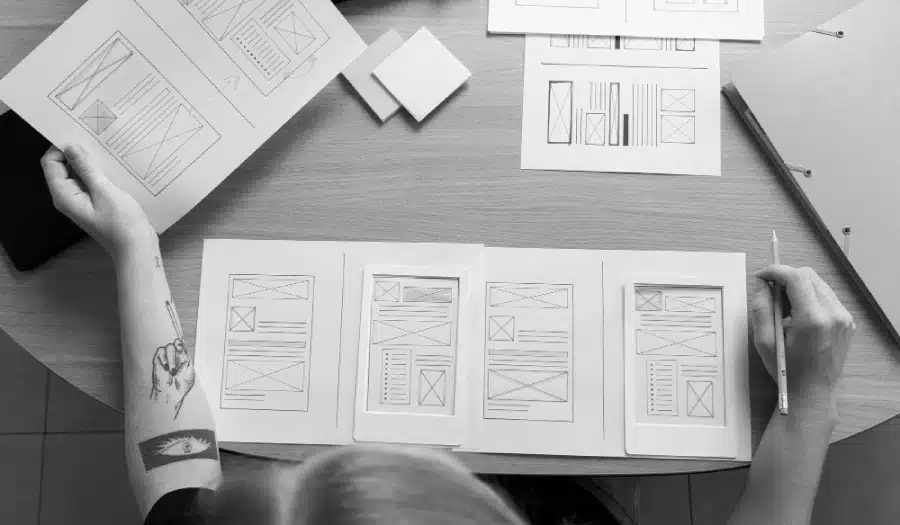
A wireframe is a simplified, schematic representation of a web page or app’s layout. It outlines the structure and placement of elements without including visual design details. Wireframes are essential for planning and prototyping.
Conclusion
Design may have its own set of jargon, but understanding these common terms can be a valuable asset, whether you’re working with designers, delving into design yourself, or simply appreciating the thought and effort that goes into creating visually appealing content. By grasping these fundamentals, you’ll be better equipped to communicate and collaborate effectively in the world of design. So, the next time you encounter design-related discussions, you’ll be able to participate with confidence and clarity.

Author:
Mark Ford