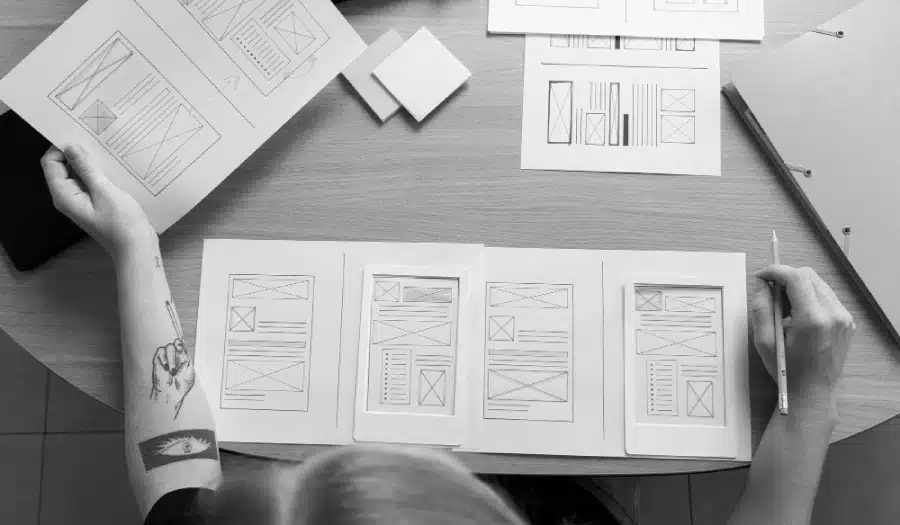
Are you struggling to understand what your website design company is saying to you?? Would you like a breakdown of what all their design jargon actually means?
Unless you’re a designer yourself it can be tricky understanding some of the terminology design companies use, and if you’re trying to use some of those words in conversation yourself it’s easy to get it wrong.
To help clear the confusion Pagemodo have come up with this handy infographic.
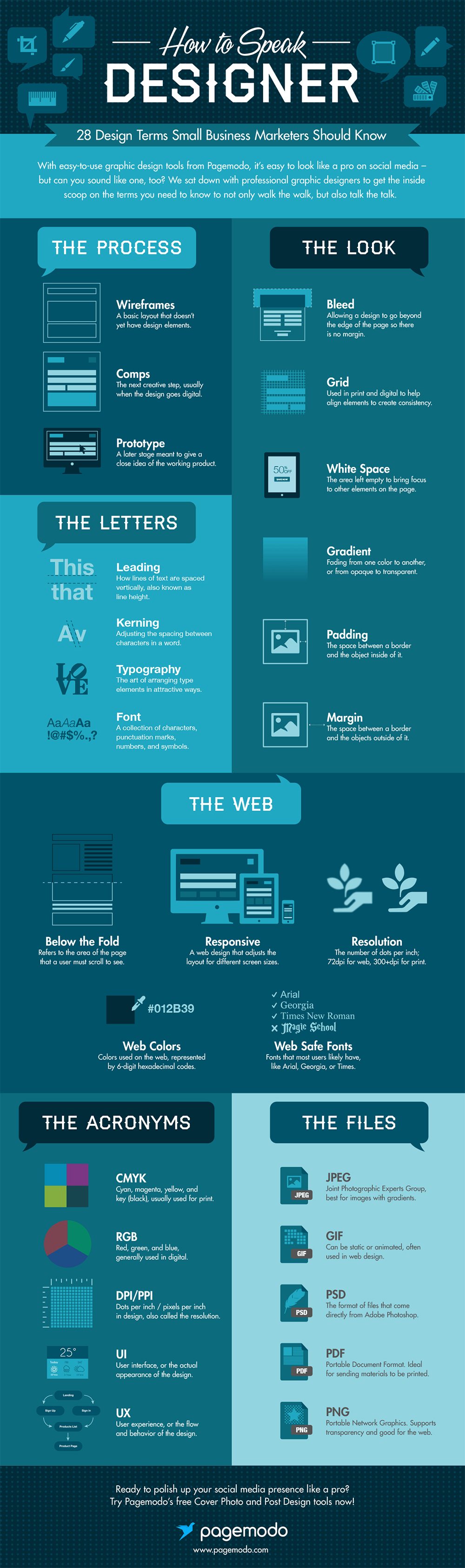
Design is a universal language that transcends cultures and communicates ideas, emotions, and functionality. Whether you’re a seasoned designer or just someone with an appreciation for aesthetics, understanding design terminology can greatly enhance your ability to appreciate and discuss the world of design. But with a seemingly endless array of design jargon out there, it’s easy to feel overwhelmed. That’s why we’ve compiled a list of 28 essential design terms that will help demystify the world of design and empower you to engage in meaningful discussions about everything from graphic design to interior design and beyond.
- Typography
- Typography refers to the art and technique of arranging type to make written language readable and visually appealing. It involves selecting fonts, font sizes, line spacing, and more to create an aesthetically pleasing and legible text.
- Whitespace
- Whitespace, also known as negative space, is the empty or blank areas in a design. It’s essential for visual clarity and balance, helping to define the relationships between different elements.
- Hierarchy
- Hierarchy in design refers to the arrangement of elements in order of importance. It guides the viewer’s eye and helps them understand the message or content’s structure.
- Grid
- A grid is a framework of horizontal and vertical lines used to organize content and maintain consistency in design. It’s particularly common in print and web design.
- Color Palette
- A color palette is a set of colors chosen for a design project. It includes primary, secondary, and accent colors that work harmoniously together to convey a specific mood or message.
- Contrast
- Contrast is the difference in visual properties, such as color, texture, or size, that makes an element stand out. It’s often used to draw attention to key elements in a design.
- Balance
- Balance in design refers to the distribution of visual weight within a composition. There are three main types: symmetrical (equal weight on both sides), asymmetrical (unequal weight that still feels balanced), and radial (balance around a central point).
- Composition
- Composition is the arrangement of visual elements within a design. It involves considerations of balance, symmetry, and harmony to create a cohesive and visually pleasing result.
- Kerning
- Kerning is the adjustment of space between individual characters in a font to achieve a visually pleasing and consistent spacing.
- Leading
- Leading, pronounced “ledding,” is the vertical space between lines of text. Proper leading ensures legibility and readability in typography.
- Resolution
- Resolution refers to the level of detail in an image and is typically measured in dots per inch (DPI) for print and pixels per inch (PPI) for digital media. Higher resolution results in crisper and clearer images.
- Mockup
- A mockup is a visual representation of how a design will look in its final form. It’s often used to showcase design concepts to clients or stakeholders.
- Wireframe
- A wireframe is a skeletal outline of a web page or interface, showing the basic structure and layout without detailing design elements. It’s used for planning and conceptualizing digital projects.
- User Interface (UI)
- UI encompasses all the elements and components that make up a user’s interaction with a digital product, such as buttons, menus, and navigation.
- User Experience (UX)
- UX focuses on the overall experience a user has when interacting with a product or service. It encompasses usability, accessibility, and user satisfaction.
- Prototype
- A prototype is a working model or representation of a design concept. It allows designers to test and refine their ideas before finalizing the design.
- Responsive Design
- Responsive design is an approach to web design that ensures websites adapt and function well on various devices and screen sizes, including smartphones and tablets.
- Gradient
- A gradient is a gradual transition between two or more colors. Gradients are commonly used in backgrounds, text, and other design elements to add depth and visual interest.
- Vector
- Vector graphics are created using mathematical equations to define shapes and lines. They are infinitely scalable without losing quality and are often used for logos and illustrations.
- Raster
- Raster graphics are made up of a grid of pixels. They have a fixed resolution and can lose quality when resized. Common raster formats include JPEG and PNG.
- DPI (Dots Per Inch)
- DPI is a measure of the print resolution of an image. A higher DPI results in a more detailed and sharper print, but it also requires more ink.
- Sans Serif
- Sans serif fonts do not have decorative serifs, or small lines, at the ends of letters. They are often used for modern and clean designs.
- Serif
- Serif fonts have small decorative lines or tails at the ends of letters. They are often associated with a more traditional and formal look.
- CMYK
- CMYK stands for Cyan, Magenta, Yellow, and Key (black). It is the color model used for printing, and designs intended for print are typically created in CMYK mode to ensure accurate color reproduction.
- RGB
- RGB stands for Red, Green, and Blue. It is the color model used for digital displays and screens. Designers use RGB when creating graphics for websites and digital media.
- Mockumentary
- A mockumentary is a fictional film or television show presented in the style of a documentary. It often satirizes real-life events or situations.
- Minimalism
- Minimalism is a design style characterized by simplicity, minimal elements, and a focus on essential features. It often emphasizes clean lines, ample whitespace, and a reduction of unnecessary details.
- Branding
- Branding is the process of creating a unique and memorable identity for a product, service, or company. It involves defining the brand’s values, personality, and visual elements such as logos and color schemes.
Conclusion
Design is a multifaceted field that encompasses a wide range of disciplines, from graphic design and web design to interior design and beyond. Understanding the key design terms discussed in this article will not only enable you to communicate effectively with designers but also deepen your appreciation for the art and science of design. So, the next time you encounter design jargon, you’ll be well-equipped to decipher its meaning and engage in meaningful discussions about the world of design. Whether you’re critiquing a website’s user interface or admiring the typography on a book cover, these 28 design terms are your gateway to a richer understanding of the visual world around you.

Author:
Mark Ford