
Are you looking for ways to improve your Ecommerce website in 2025? Want to learn more about the trends taking online retail by storm this year?
You’ll find 18 ecommerce trends for 2025 in this infographic.
Here are a few that make the list:
- TikTok Shop
- Short-Form Video Content
- Predictive Intelligence
- Sustainable Online Shopping
- Augmented and Virtual Reality
- Subscription-Based Models
Check out the infographic for more.
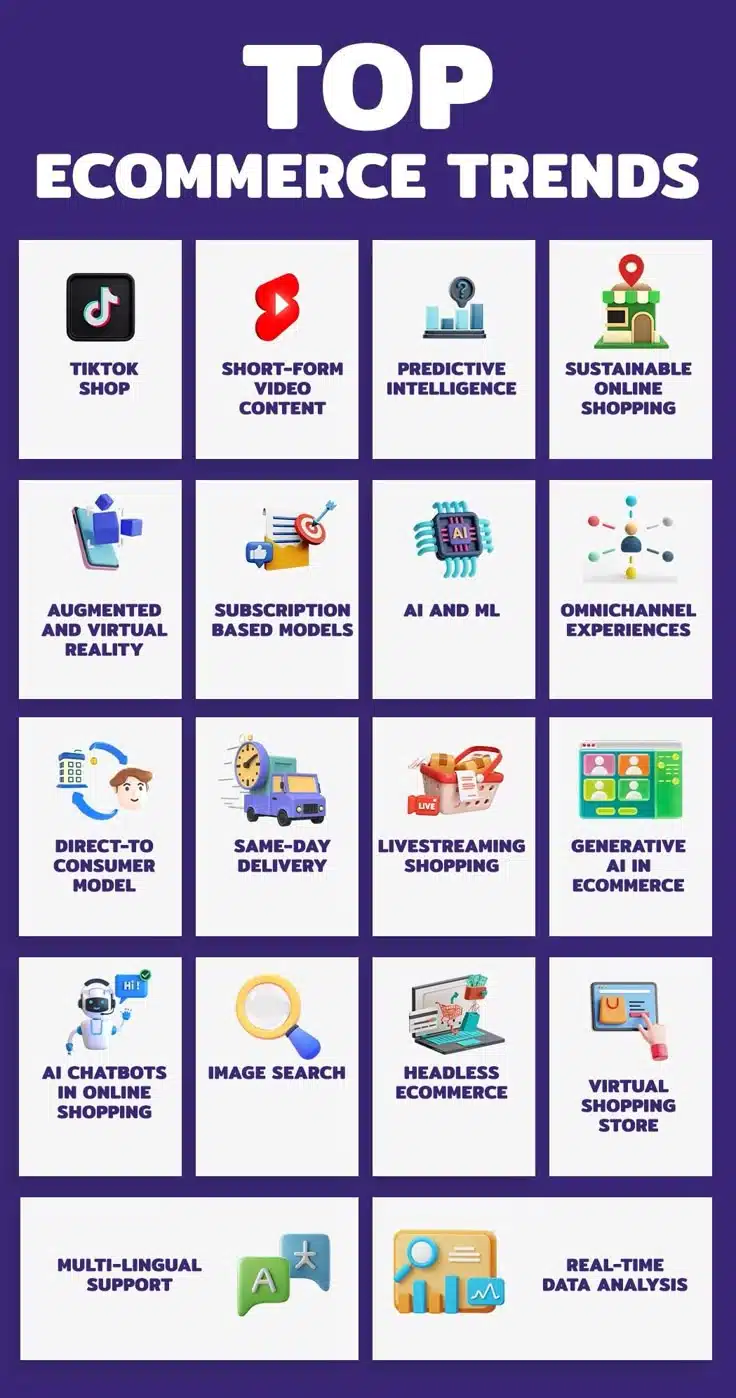
The ecommerce landscape is evolving rapidly, with new technologies and consumer behaviors shaping the way businesses sell online.
As we step into 2025, the competition in the digital marketplace is fiercer than ever, making it crucial for retailers to stay ahead of the curve.
This year, 18 key trends are driving innovation and transforming online shopping experiences.
TikTok Shop: Turning Engagement into Sales
TikTok has evolved beyond an entertainment platform into a major ecommerce powerhouse. With TikTok Shop, brands can sell directly within the app, making it easier for users to discover and purchase products without leaving their feed.
This trend is particularly effective for reaching Gen Z and Millennial shoppers who prefer engaging, visual-first shopping experiences.
How Ecommerce Website Owners Can Take Advantage
Set Up a TikTok Shop Account
If you haven’t already, register your business on TikTok Shop. This allows you to list products, create shoppable videos, and leverage the platform’s powerful algorithm to get your products in front of the right audience.
Create Engaging Product Videos
Unlike traditional ecommerce marketing, TikTok thrives on short, entertaining videos rather than polished, corporate-style ads. Show your products in action through:
- Behind-the-scenes content, such as packaging orders or showcasing product creation
- Influencer partnerships with TikTok creators who can introduce your products to their audience
- Trend-based videos that align with popular TikTok sounds and challenges
Leverage TikTok Live Shopping
Live shopping events allow you to demonstrate products in real time, answer customer questions, and drive instant conversions. This format works exceptionally well for beauty products, fashion items, and trending gadgets.
Use TikTok Ads for Retargeting
TikTok’s ad platform enables businesses to retarget viewers who have engaged with their videos or visited their website. Using dynamic product ads, you can show personalized recommendations to potential customers, increasing the likelihood of conversion.
Optimize for TikTok’s Algorithm
TikTok prioritizes content that is engaging and retains viewers. To improve visibility:
- Post frequently, at least three to five times per week
- Hook viewers in the first three seconds with compelling visuals or text overlays
- Include captions and clear calls to action, such as “Shop Now” or “Visit the Link in Bio”
Sync Your Ecommerce Store with TikTok
If you’re using Shopify, WooCommerce, or BigCommerce, integrate your store with TikTok for Business. This allows you to run shoppable ads, track conversions, and manage orders seamlessly.
Key Takeaway
TikTok Shop is a game-changer for ecommerce in 2025, providing a direct link between viral content and sales. Ecommerce website owners who embrace short-form video marketing, influencer collaborations, and live shopping will see higher engagement, stronger brand visibility, and increased revenue.
Action Step: If you haven’t explored TikTok Shop yet, start by creating a business profile and experimenting with short-form video content. The sooner you adapt, the more you can capitalize on this growing trend.
Short-Form Video Content: Capturing Attention and Driving Sales
Short-form video content has become the dominant format for engaging online audiences. Platforms like TikTok, Instagram Reels, and YouTube Shorts are designed for quick, visually compelling content that captures attention within seconds.
Consumers increasingly prefer video over static images or long-form text, making short-form video an essential tool for ecommerce businesses.
These videos are not just for brand awareness—they directly influence purchasing decisions. According to recent studies, consumers are more likely to buy a product after watching a short-form video showcasing its features or benefits.
The rise of social commerce means businesses can now integrate direct shopping links, making it easier than ever for customers to buy instantly.
How Ecommerce Website Owners Can Take Advantage
Create Product Demonstrations
Short videos are a powerful way to showcase your products in action. Instead of relying solely on product descriptions and images, create engaging videos that highlight the key benefits, usage, and unique selling points of your products. This could include:
- Quick unboxings to give viewers a first-hand look at the product
- Tutorials demonstrating how to use the product effectively
- Before-and-after comparisons to showcase results
Leverage User-Generated Content (UGC)
Consumers trust real customer experiences more than polished advertisements. Encourage satisfied customers to create short videos reviewing or demonstrating your products and share them across your marketing channels. You can also collaborate with influencers to generate authentic content that resonates with your target audience.
Keep It Fast-Paced and Engaging
Attention spans on social media are short. Your videos should:
- Hook viewers within the first three seconds
- Be visually engaging with dynamic camera angles and quick edits
- Use captions and on-screen text to emphasize key points
- Maintain a duration of 15–60 seconds for maximum impact
Use Calls to Action (CTAs) to Drive Sales
Short-form videos should always include a clear CTA. This could be:
- A direct shopping link in the description
- A pop-up message within the video encouraging viewers to visit your site
- A voice-over or text overlay saying, “Shop now” or “Link in bio”
Post Consistently Across Multiple Platforms
Short-form video content works best when shared frequently. Post videos on TikTok, Instagram Reels, YouTube Shorts, and even Facebook Stories to maximize reach. Repurpose content across different platforms to engage different segments of your audience.
Use Short-Form Video Ads
Platforms like Instagram and TikTok allow ecommerce businesses to run short-form video ads targeting specific audiences. These ads blend seamlessly into users’ feeds, making them more effective than traditional banner ads. Running shoppable video ads with embedded product links can drive immediate conversions.
Key Takeaway
Short-form video content is no longer optional for ecommerce brands—it’s essential. Consumers are drawn to quick, engaging content that showcases products in action, and social media platforms prioritize this format in their algorithms. Brands that consistently create high-quality, engaging videos will see increased engagement, higher conversion rates, and stronger brand loyalty.
Action Step: Start producing short-form videos for your products. Experiment with different styles, monitor performance, and refine your content strategy based on what resonates with your audience. The brands that master short-form video marketing in 2025 will have a significant competitive edge.
Predictive Intelligence: Personalising the Shopping Experience
Predictive intelligence uses AI and data analytics to anticipate customer behaviour, helping ecommerce businesses deliver a more personalised and seamless shopping experience.
By analysing past purchases, browsing habits, and user interactions, predictive intelligence can suggest products, optimise pricing, and improve marketing strategies.
Consumers today expect brands to understand their needs without having to search extensively. Predictive intelligence helps businesses offer relevant recommendations, reducing decision fatigue and increasing the likelihood of a purchase.
This trend is becoming a game-changer in ecommerce, driving higher conversion rates and customer satisfaction.
How Ecommerce Website Owners Can Take Advantage
Implement AI-Powered Product Recommendations
One of the most effective ways to use predictive intelligence is through smart product recommendations. By integrating AI-driven recommendation engines, you can:
- Display “Frequently Bought Together” or “You May Also Like” sections based on previous customer purchases
- Personalise homepages with product suggestions tailored to individual browsing history
- Send targeted email campaigns featuring items that align with the customer’s past interactions
Platforms like Shopify, WooCommerce, and Magento offer AI-powered recommendation tools that can be easily integrated into your store.
Optimise Pricing with Predictive Analytics
Dynamic pricing strategies use predictive intelligence to adjust prices based on demand, competitor pricing, and customer behaviour. This ensures your products remain competitively priced while maximising profitability. AI-driven pricing tools can:
- Offer personalised discounts to customers who frequently abandon their carts
- Adjust pricing based on seasonal trends and shopping habits
- Identify the best price points to drive conversions without sacrificing profit margins
Use Predictive Analytics for Inventory Management
Stock management is a common challenge for ecommerce businesses. Predictive intelligence can help by forecasting demand, ensuring you stock the right products in the right quantities. This reduces overstocking and prevents lost sales due to out-of-stock items. Features to look for include:
- Demand forecasting, which predicts which products will be popular in upcoming months
- Automated restocking alerts, ensuring you reorder inventory before it runs out
- AI-driven supply chain management, optimising logistics to reduce delivery times
Enhance Customer Retention with Predictive Behaviour Analysis
Predictive intelligence doesn’t just help with sales—it also improves customer retention. By analysing engagement patterns, businesses can identify customers who are likely to churn and proactively offer incentives to retain them. Strategies include:
- Sending loyalty rewards or exclusive discounts to customers who haven’t purchased in a while
- Using AI-driven chatbots to provide personalised assistance and resolve customer queries before they escalate
- Automating follow-up emails with personalised product suggestions based on previous interactions
Leverage Predictive Intelligence in Marketing Campaigns
AI-powered tools can help optimise your advertising spend by predicting which marketing campaigns will yield the best results. Predictive analytics can:
- Identify which customers are most likely to respond to promotions
- Automate retargeting campaigns to bring back visitors who abandoned their carts
- Optimise ad placements to ensure the highest ROI on social media and search engine advertising
Key Takeaway
Predictive intelligence is transforming ecommerce by making shopping experiences more personalised, efficient, and profitable. Businesses that leverage AI-powered recommendations, dynamic pricing, and behaviour-driven marketing will see increased conversions and stronger customer loyalty.
Action Step: Start by integrating an AI-powered recommendation engine into your ecommerce site. Then, explore predictive analytics tools for pricing, inventory management, and marketing automation to enhance efficiency and maximise sales.
Sustainable Online Shopping: Meeting Consumer Demand for Ethical Ecommerce
Sustainability is no longer a niche concern—it’s a major factor influencing consumer purchasing decisions.
Shoppers are actively looking for brands that align with their values, prioritising eco-friendly packaging, ethical sourcing, and carbon-neutral delivery options. Businesses that fail to adopt sustainable practices risk losing customers to competitors who embrace environmental responsibility.
Beyond consumer demand, governments and regulatory bodies are increasingly pushing for stricter sustainability standards in ecommerce.
Brands that invest in sustainable practices now will not only appeal to a growing eco-conscious audience but also future-proof their businesses against upcoming regulations.
How Ecommerce Website Owners Can Take Advantage
Offer Eco-Friendly Products and Packaging
Consumers are willing to pay more for sustainably sourced products, but they also expect brands to minimise their environmental impact. Here’s how you can align with this trend:
- Source responsibly: Work with suppliers who provide eco-friendly, organic, or recycled materials. Highlight these aspects in product descriptions to attract eco-conscious shoppers.
- Reduce plastic use: Offer biodegradable, compostable, or recyclable packaging. Many consumers now prefer minimal or plastic-free packaging.
- Introduce a carbon-offset programme: Give customers the option to offset the carbon footprint of their purchase at checkout. This small initiative can make a big difference in brand perception.
Optimise Logistics for Sustainability
Shipping is a significant contributor to ecommerce’s carbon footprint. To improve sustainability:
- Offer slower, eco-friendly delivery options: Express shipping increases emissions due to less efficient logistics. Encourage customers to choose carbon-neutral or consolidated shipping methods.
- Partner with green couriers: Work with delivery companies that use electric vehicles or sustainable packaging. Highlight this in your checkout process to reassure eco-conscious shoppers.
- Use local fulfilment centres: Reducing the distance between warehouses and customers lowers emissions and speeds up delivery times.
Make Sustainable Shopping Easy for Customers
Consumers want to shop sustainably, but they also value convenience. Help them make eco-friendly choices by:
- Creating a “Sustainable Products” category: Highlight environmentally friendly items in a dedicated section of your website.
- Adding sustainability filters: Allow customers to filter products based on sustainability credentials, such as “organic,” “vegan,” “fair trade,” or “recyclable.”
- Providing transparency: Clearly communicate sustainability efforts on product pages, packaging, and marketing materials. Certifications like FSC (Forest Stewardship Council) or Fair Trade labels add credibility.
Implement a Circular Economy Approach
Instead of focusing solely on selling new products, consider ways to extend product life cycles:
- Introduce a trade-in or recycling programme: Encourage customers to return old products for recycling or store credit.
- Sell refurbished or pre-loved items: Many consumers are open to buying refurbished goods, especially in electronics, fashion, and homeware.
- Encourage repairs over replacements: Provide repair guides, replacement parts, or repair services to help customers extend the life of their products.
Promote Your Sustainability Efforts Authentically
Consumers are increasingly wary of “greenwashing”—false or exaggerated sustainability claims. To build trust:
- Be transparent: Share specific actions your business is taking, backed by facts and certifications.
- Showcase real impact: Provide data on carbon savings, waste reduction, or social initiatives.
- Engage customers in your mission: Run campaigns that involve customers, such as tree-planting initiatives or charity donations for sustainable causes.
Key Takeaway
Sustainable online shopping is more than just a trend—it’s a shift in consumer expectations and industry standards. Ecommerce businesses that embrace sustainability will build stronger customer loyalty, attract eco-conscious shoppers, and ensure long-term business viability.
Action Step: Start by evaluating your supply chain, packaging, and shipping practices. Look for ways to reduce waste, minimise carbon emissions, and provide more sustainable product options. Then, communicate your sustainability initiatives clearly to customers to build trust and encourage greener shopping habits.
Augmented and Virtual Reality: Enhancing the Online Shopping Experience
One of the biggest challenges in ecommerce is the inability for customers to physically interact with products before making a purchase.
Augmented reality (AR) and virtual reality (VR) solve this problem by creating immersive shopping experiences that allow customers to visualise products in their real-world environment or engage with them in a virtual space.
Retail giants like IKEA, Sephora, and Nike have successfully integrated AR and VR into their online stores, enabling customers to try on makeup, preview furniture in their homes, or customise products in a 3D environment.
As technology becomes more accessible, even small and mid-sized ecommerce businesses can leverage AR and VR to boost customer confidence and reduce return rates.
How Ecommerce Website Owners Can Take Advantage
Implement AR Product Previews
Augmented reality lets customers see how products will look or function before purchasing, reducing uncertainty and increasing conversion rates. Consider integrating AR for:
- Furniture and home decor: Customers can use their phone cameras to place virtual furniture in their space to check dimensions, colours, and aesthetics.
- Clothing and accessories: Virtual try-on tools allow shoppers to see how clothing, glasses, or jewellery will look on them.
- Beauty and skincare: AR-powered beauty tools let customers test different makeup shades or skincare products to find the best match for their complexion.
Create Virtual Store Experiences
Virtual reality takes online shopping further by replicating the experience of browsing a physical store. You can:
- Develop a virtual showroom: Allow customers to explore a 3D store, interacting with products as they would in person.
- Offer guided VR tours: For luxury or high-ticket items, guided virtual shopping tours can provide a personalised experience.
- Use VR for event-based marketing: Launch new products with exclusive VR events where customers can explore the latest offerings in an interactive setting.
Make AR and VR Accessible on Mobile
Most shoppers browse ecommerce sites on their phones, so any AR/VR features should be optimised for mobile devices. Consider:
- Integrating AR directly into product pages: Use WebAR technology so customers can access AR features without needing an app.
- Creating an AR-enabled shopping app: If you have a mobile app, consider adding AR shopping tools to encourage app engagement.
- Ensuring cross-platform compatibility: Your AR/VR features should work seamlessly on both iOS and Android devices.
Reduce Returns with AR-Fitted Products
One of the major benefits of AR is reducing returns by helping customers make more informed purchasing decisions. To do this:
- Use size-matching tools: For fashion retailers, AR-powered size guides can help customers find the right fit without trying items on in person.
- Showcase customisation options: If your store offers customisable products, let customers see how their choices will look before finalising their order.
- Provide interactive product demos: Use AR to demonstrate product functionality, making it easier for customers to understand how items work.
Promote AR and VR Features Effectively
Customers won’t use AR or VR tools if they don’t know they exist. Ensure you:
- Highlight AR/VR capabilities on product pages: Use clear calls to action like “See this in your space” or “Try it on virtually.”
- Create tutorials or demos: Show customers how to use AR features through videos, social media content, or blog posts.
- Leverage social media integration: Platforms like Instagram and Snapchat allow businesses to create AR shopping experiences directly within their apps.
Key Takeaway
Augmented and virtual reality are transforming online shopping by bridging the gap between digital and physical retail experiences. By integrating AR and VR, ecommerce businesses can increase customer engagement, reduce return rates, and improve overall shopping satisfaction.
Action Step: Start small by implementing AR previews for key products, such as furniture, fashion, or beauty items. Then, explore more advanced VR shopping experiences to create an immersive online store that sets your brand apart.
Subscription-Based Models: Building Customer Loyalty and Predictable Revenue
Subscription-based ecommerce has grown significantly in recent years, with businesses like Amazon Prime, HelloFresh, and Birchbox demonstrating the model’s success. Consumers appreciate the convenience of receiving products regularly without having to reorder, while businesses benefit from predictable recurring revenue and increased customer loyalty.
Subscription services work well across various industries, including beauty, fashion, food, fitness, and pet supplies.
Whether offering curated boxes, product replenishment, or exclusive memberships, ecommerce businesses can capitalise on this trend to build long-term customer relationships.
How Ecommerce Website Owners Can Take Advantage
Determine the Right Subscription Model for Your Business
There are several types of subscription-based models, and the best one for you depends on your products and target audience:
- Replenishment subscriptions: Ideal for consumable products such as skincare, vitamins, coffee, or pet food. Customers receive recurring shipments of essential items at a set interval.
- Curated subscriptions: Common in beauty, fashion, and food industries, this model delivers a personalised selection of products to customers each month. Birchbox and Stitch Fix use this approach.
- Membership-based subscriptions: Instead of physical products, customers pay for exclusive benefits, such as discounts, premium content, or early access to new items. Amazon Prime is a well-known example.
Offer Flexible Subscription Options
Consumers may hesitate to commit to long-term subscriptions, so providing flexibility can increase sign-ups and reduce cancellations:
- Allow customers to choose their delivery frequency (e.g., weekly, monthly, or quarterly).
- Offer a “skip a month” feature to prevent cancellations from customers who don’t need products every cycle.
- Provide different subscription tiers to cater to various budgets and preferences.
Focus on Customer Experience and Personalisation
A great subscription service keeps customers engaged and excited about receiving their next delivery. To improve the experience:
- Personalise product selections based on customer preferences or past purchases. AI-driven recommendations can help with this.
- Ensure packaging is appealing and eco-friendly to create an unboxing experience that encourages social sharing.
- Include surprises or limited-edition items to keep customers engaged and prevent churn.
Implement a Simple and Transparent Cancellation Policy
A common reason people hesitate to subscribe is the fear of difficult cancellation processes. To address this:
- Make it easy to modify or cancel subscriptions through a user-friendly account dashboard.
- Offer incentives to retain customers, such as discounts on future renewals or alternative subscription plans.
- Use exit surveys to understand why customers cancel and make improvements accordingly.
Promote Your Subscription Service Effectively
To attract subscribers, ensure your marketing efforts highlight the convenience, value, and exclusivity of your service:
- Create a dedicated subscription landing page that explains the benefits, pricing, and customer testimonials.
- Offer a free trial or discount for first-time subscribers to encourage sign-ups.
- Use email marketing and retargeting ads to engage potential subscribers and remind existing customers to renew.
Key Takeaway
Subscription-based ecommerce is an excellent way to generate recurring revenue and build brand loyalty. Businesses that offer convenience, personalisation, and flexibility will have a competitive advantage in 2025.
Action Step: If your business sells consumables or highly curated products, consider introducing a subscription model. Start with a pilot program and refine your offering based on customer feedback.
AI and Machine Learning: Enhancing Personalisation and Automation
Artificial Intelligence (AI) and Machine Learning (ML) are transforming ecommerce by improving customer experiences, streamlining operations, and increasing conversion rates.
These technologies allow businesses to analyse vast amounts of data, predict customer behaviour, and provide highly personalised shopping experiences.
From AI-driven product recommendations to automated customer service, leveraging AI and ML can give online retailers a significant competitive edge.
How Ecommerce Website Owners Can Take Advantage
Implement AI-Powered Product Recommendations
One of the most effective uses of AI in ecommerce is personalised product recommendations. Platforms like Amazon and Netflix have set the standard by using AI to suggest relevant products based on user behaviour. To implement this:
- Use AI-driven recommendation engines to display “Customers Also Bought” or “Recommended for You” sections on product pages.
- Analyse browsing and purchase history to provide dynamic product suggestions in emails and retargeting ads.
- Ensure recommendations are context-aware, considering factors like seasonality, location, and current shopping trends.
Automate Customer Support with AI Chatbots
AI chatbots can enhance customer service by providing instant responses to common queries, handling order tracking, and even assisting with product selection. To maximise their effectiveness:
- Deploy AI chatbots on your website, social media, and messaging apps to provide seamless support.
- Use Natural Language Processing (NLP) to ensure bots understand customer intent and provide relevant answers.
- Offer a hybrid support model, where chatbots handle routine queries and human agents step in for complex issues.
Optimise Pricing with AI-Driven Dynamic Pricing
AI can analyse market trends, competitor pricing, and customer demand to help you adjust your prices in real time. This ensures your pricing remains competitive while maximising profits. To implement this:
- Use AI-powered pricing tools to monitor competitor prices and adjust yours accordingly.
- Offer real-time discounts or personalised promotions based on customer behaviour and purchase intent.
- Implement dynamic bundling, where AI suggests product bundles at an optimal price to increase average order value.
Improve Fraud Detection and Security
AI and ML can detect fraudulent transactions by analysing user behaviour and identifying suspicious patterns. To enhance security:
- Use AI-based fraud detection systems to flag unusual transactions and prevent chargebacks.
- Implement biometric authentication (such as facial recognition or fingerprint scanning) for secure logins.
- Use AI-powered cybersecurity tools to detect and block malicious activities on your website.
Enhance Inventory Management and Demand Forecasting
AI can help ecommerce businesses predict demand, manage stock levels, and prevent overstocking or understocking. To leverage AI in inventory management:
- Use predictive analytics to forecast demand based on historical sales data, seasonal trends, and external factors like weather.
- Automate inventory restocking by integrating AI with your supply chain and warehouse management systems.
- Implement AI-powered chatbots for inventory inquiries, so customers always know when products are back in stock.
Key Takeaway
AI and Machine Learning are no longer just for large corporations—small and medium-sized ecommerce businesses can also benefit from their capabilities. By automating processes, personalising shopping experiences, and optimising pricing and inventory, online retailers can improve efficiency and customer satisfaction in 2025.
Action Step: Start by integrating AI-driven product recommendations and chatbots into your ecommerce store. As you collect more data, expand into dynamic pricing and predictive analytics to stay ahead of the competition.
Omnichannel Experiences: Creating a Seamless Shopping Journey
Today’s consumers expect a consistent and connected shopping experience across multiple channels—whether they’re browsing a website, using a mobile app, engaging on social media, or visiting a physical store.
Omnichannel retailing ensures that customers can switch between these touchpoints effortlessly, maintaining a unified brand experience at every stage of their journey.
Businesses that adopt an omnichannel strategy can increase customer engagement, improve loyalty, and drive higher sales by making the shopping process more convenient and personalised.
According to studies, brands with strong omnichannel strategies retain 89% of their customers, compared to just 33% for businesses with weaker multichannel experiences.
How Ecommerce Website Owners Can Take Advantage
Integrate Online and Offline Shopping
For businesses with both an ecommerce store and physical locations, seamless integration is essential. Offer:
- Click-and-collect (BOPIS – Buy Online, Pick Up In-Store) to give customers flexibility.
- Real-time inventory syncing so shoppers can check stock availability before visiting a store.
- In-store returns for online purchases, making it easier for customers to exchange or refund items.
Retailers like Zara, Nike, and Apple have mastered this, allowing customers to start their journey online and complete it in-store without friction.
Unify Customer Data Across Channels
A disjointed customer experience can lead to frustration and lost sales. Use a customer relationship management (CRM) system to:
- Track purchase history across all platforms.
- Ensure customers receive personalised recommendations based on previous interactions.
- Sync loyalty programs so customers earn and redeem points whether they shop online, in-store, or through social media.
Platforms like Salesforce, HubSpot, and Shopify Plus offer omnichannel CRM tools to centralise customer interactions.
Optimise for Mobile Shopping
With mobile commerce (m-commerce) expected to dominate sales in 2025, ensure your omnichannel experience is mobile-friendly:
- Use progressive web apps (PWAs) to make your website function like a mobile app without requiring a download.
- Offer one-click checkout with payment options like Apple Pay and Google Pay.
- Ensure customer service is accessible via chatbots, SMS, and WhatsApp for on-the-go support.
Brands like Amazon and ASOS have set the standard with seamless mobile shopping experiences that integrate personalised recommendations, voice search, and fast checkout options.
Leverage Social Commerce
Shoppers no longer just browse social media—they buy directly through platforms like Instagram, TikTok, and Pinterest. Make sure your social commerce strategy is aligned with your ecommerce store by:
- Syncing product listings between your website and social media shops.
- Offering consistent pricing and promotions across platforms.
- Using social media messaging (Facebook Messenger, Instagram DMs, WhatsApp Business) for customer support.
Retailers like H&M and Sephora allow customers to browse and buy directly on Instagram, then track their order through the brand’s website or app.
Provide a Consistent Brand Experience Across All Touchpoints
Consumers expect a cohesive brand identity whether they interact with your business through email, your website, social media, or in-store. To maintain this consistency:
- Ensure branding, tone of voice, and messaging remain uniform across all platforms.
- Use personalisation tools to deliver targeted content, promotions, and product recommendations.
- Implement cross-channel remarketing, so if a customer views a product on your website, they see relevant ads on Google, Instagram, or Facebook later.
Retailers like Nike and Starbucks excel in omnichannel consistency, ensuring that no matter where customers engage, they experience the same branding, promotions, and customer service.
Key Takeaway
Omnichannel retailing is about more than just selling through multiple channels—it’s about ensuring a seamless, connected, and personalised experience across them all. By integrating online and offline shopping, unifying customer data, optimising mobile experiences, leveraging social commerce, and maintaining brand consistency, ecommerce businesses can increase customer loyalty, engagement, and conversions.
Action Step: Audit your current shopping experience across all touchpoints and identify gaps. Then, focus on connecting sales channels, syncing customer data, and enhancing mobile shopping to create a truly seamless omnichannel experience.
Direct-to-Consumer (DTC) Model: Cutting Out the Middleman for Greater Control
The direct-to-consumer (DTC) model is transforming ecommerce by allowing brands to sell directly to customers without relying on third-party retailers, wholesalers, or marketplaces like Amazon. This approach gives businesses greater control over branding, customer relationships, pricing, and profit margins.
DTC brands have seen massive growth in recent years, with companies like Warby Parker, Gymshark, and Glossier disrupting traditional retail by using social media, influencer marketing, and data-driven personalisation to connect directly with consumers.
As more shoppers seek authentic brand experiences and better pricing, ecommerce businesses that embrace the DTC model can increase profitability, enhance customer loyalty, and build a strong brand identity.
How Ecommerce Website Owners Can Take Advantage
Own the Customer Relationship and Data
One of the biggest advantages of DTC is direct access to customer data, unlike selling through retailers or marketplaces that control transactions. With first-party data, businesses can:
- Personalise marketing campaigns based on customer preferences.
- Offer loyalty programs to encourage repeat purchases.
- Use email and SMS marketing to nurture long-term customer relationships.
A strong customer data strategy allows brands to refine their products, tailor promotions, and improve customer service.
Increase Profit Margins by Cutting Out Retail Markups
Traditional retail involves multiple middlemen, each taking a share of the profits. By selling directly through an ecommerce website, businesses:
- Avoid retailer markups, allowing for better pricing or higher profit margins.
- Gain full control over pricing strategies, without restrictions from third-party platforms.
- Retain more revenue to reinvest in marketing, product innovation, and customer experience.
DTC brands like Allbirds and Casper successfully scaled by using this cost-saving model while still offering high-quality products at competitive prices.
Build a Strong Brand Identity
Selling through third-party retailers or marketplaces limits how brands can present themselves. A DTC model allows businesses to:
- Create a unique brand voice and customer experience.
- Control how products are marketed and packaged.
- Ensure that customers interact with your brand—not a retailer’s storefront.
A well-designed DTC ecommerce website with strong storytelling, customer reviews, and a seamless user experience can make a brand stand out in a crowded market.
Use Social Media and Influencer Marketing for Growth
Without relying on retailers for visibility, DTC brands must focus on direct engagement through digital marketing. This includes:
- Leveraging influencers and brand ambassadors to promote products authentically.
- Running targeted social media ads on platforms like Instagram, TikTok, and Facebook.
- Creating engaging content, such as behind-the-scenes videos, customer testimonials, and product demonstrations.
DTC success stories like Gymshark and Dollar Shave Club built their brands almost entirely through social media, proving that authentic engagement can drive massive growth.
Offer Subscription and Membership Models
To build customer retention and predictable revenue, many DTC brands implement:
- Subscription services for replenishable products (e.g., beauty, pet food, coffee).
- Exclusive membership programs that offer perks like discounts, early access, or free shipping.
- Bundles and personalised product recommendations to increase order value.
Brands like HelloFresh and BarkBox have successfully scaled with subscription-based DTC models, ensuring long-term customer engagement.
Differentiate from Marketplaces Like Amazon
One challenge of DTC is competing with the convenience of platforms like Amazon. To stand out, ecommerce businesses should:
- Offer a superior shopping experience (fast shipping, seamless checkout, excellent customer support).
- Focus on niche markets where personalised service and product quality matter.
- Build a strong community around the brand through exclusive perks, user-generated content, and personalised recommendations.
For example, brands like Patagonia and Glossier attract loyal customers by offering unique, high-quality products and strong brand messaging, rather than trying to compete on price alone.
Key Takeaway
The DTC model is reshaping ecommerce by giving brands more control over their business, higher profit margins, and direct access to customer relationships. While it requires strong branding, marketing, and logistics, businesses that implement a customer-centric, data-driven strategy can create a sustainable and highly profitable ecommerce brand.
Action Step: If you’re currently relying on retailers or marketplaces, start by building a standalone ecommerce website and focusing on social media marketing, email campaigns, and personalised customer experiences to drive direct sales.
Same-Day Delivery: Meeting Consumer Expectations for Speed
With ecommerce giants like Amazon and Argos setting the standard for fast delivery, consumers now expect same-day or next-day shipping as a norm rather than a premium service.
A recent study found that 56% of online shoppers expect same-day delivery, and nearly 61% are willing to pay extra for it.
For ecommerce businesses, offering same-day delivery can be a major competitive advantage, helping to:
- Reduce cart abandonment (slow shipping is one of the top reasons shoppers leave without buying).
- Increase customer satisfaction by providing near-instant gratification.
- Boost conversion rates by reassuring customers they’ll receive their orders quickly.
As logistics technology improves, even smaller ecommerce brands can implement same-day delivery, making it a key trend shaping online retail in 2025.
How Ecommerce Website Owners Can Take Advantage
Partner with Third-Party Delivery Services
Many ecommerce businesses don’t have the infrastructure to handle same-day delivery in-house, but partnering with courier and last-mile delivery providers can make it possible. Options include:
- Local courier services (e.g., Stuart, Gophr, or CitySprint in the UK).
- On-demand delivery platforms like Uber Eats, Deliveroo, or Postmates (some now offer retail deliveries).
- Logistics aggregators such as ShipBob and Huboo that connect businesses with same-day shipping options.
By integrating with these services, ecommerce stores can offer faster delivery without managing their own fleet.
Use Local Warehousing and Micro-Fulfilment Centres
A distributed warehouse model allows businesses to store inventory closer to customers, reducing delivery times. Consider:
- Using third-party fulfilment centres with multiple locations.
- Implementing micro-fulfilment centres (MFCs)—small warehouses in urban areas for rapid dispatch.
- Partnering with local retailers to act as pick-up points or dispatch centres.
Retailers like Tesco and Boots have successfully adopted this strategy, enabling same-day delivery across major cities.
Offer Click-and-Collect or Same-Day Pickup
For businesses with physical stores or local distribution hubs, offering click-and-collect is an effective alternative to same-day shipping.
- Customers order online and collect in-store within hours.
- Pickup lockers or designated locations speed up collection.
- Reduces last-mile delivery costs while maintaining convenience.
Even pure-play ecommerce brands can implement partnered pickup solutions, like Amazon Hub or InPost Lockers, to offer faster collection options.
Optimise Order Processing and Fulfilment
Fast delivery isn’t just about shipping—it starts with efficient order processing. To speed up fulfilment:
- Automate order routing to send requests to the nearest warehouse.
- Use AI-driven inventory management to ensure high-demand products are stocked in key locations.
- Implement batch processing and real-time tracking to reduce delays.
Investing in order management software (OMS) like Shopify Fulfilment, ShipStation, or Brightpearl can help streamline these processes.
Implement Real-Time Delivery Tracking
Transparency is key to a successful same-day delivery strategy. Customers expect to:
- Receive real-time order tracking via SMS or email.
- Have estimated delivery times updated dynamically.
- Communicate with the courier if needed.
Brands like ASOS and Argos provide live tracking and precise delivery slots, increasing customer confidence and reducing delivery-related complaints.
Manage Costs Effectively
Same-day delivery can be expensive, so businesses should:
- Offer it as a premium service (charge for express shipping).
- Set a minimum order value to qualify for free same-day delivery.
- Partner with eco-friendly couriers for cost-effective, sustainable last-mile delivery.
Balancing speed, cost, and efficiency ensures that same-day delivery remains profitable.
Key Takeaway
Same-day delivery is no longer a luxury—it’s an expectation. By leveraging courier partnerships, local fulfilment centres, click-and-collect options, and order automation, ecommerce businesses can offer fast, reliable shipping without compromising profitability.
Action Step: Evaluate your current fulfilment process and explore partnerships with local couriers or micro-fulfilment centres to implement same-day delivery in key locations.
Livestream Shopping: The Future of Interactive Ecommerce
Livestream shopping is transforming the way consumers engage with brands online. By combining live video, real-time interaction, and instant purchasing, this trend bridges the gap between traditional retail experiences and ecommerce.
Originally popular in China, where platforms like Taobao Live and Douyin (TikTok China) dominate, livestream shopping is now gaining momentum worldwide, with brands leveraging it on Instagram, TikTok, YouTube, and Amazon Live.
Livestream shopping works because it provides authentic product demonstrations, instant customer engagement, and a sense of urgency, all of which lead to higher conversion rates and increased sales.
How Ecommerce Website Owners Can Take Advantage
Host Live Product Demonstrations
One of the biggest advantages of livestream shopping is the ability to showcase products in real time. To maximise impact:
- Demonstrate product features and benefits – Show how a product works, its size, texture, and key features.
- Answer customer questions live – Engage with viewers in real time, addressing concerns and objections instantly.
- Highlight special deals and limited-time offers – Encourage viewers to make purchases before the livestream ends.
Choose the Right Platform
Different platforms cater to different audiences. Selecting the right one depends on your target customers:
- TikTok Shop LIVE – Best for younger audiences and viral product promotions.
- Instagram and Facebook Live Shopping – Ideal for fashion, beauty, and lifestyle brands.
- YouTube Live – Great for in-depth product reviews and tech demonstrations.
- Amazon Live – Best suited for brands already selling on Amazon.
Partner with Influencers and Brand Ambassadors
Collaborating with influencers who have an engaged audience can drive traffic and boost sales. When selecting influencers:
- Choose trusted voices in your niche who align with your brand.
- Prioritise engagement rate over follower count—micro-influencers often have higher trust levels.
- Offer exclusive discounts to viewers to create a sense of urgency.
Use Interactive Features to Boost Engagement
Livestream shopping isn’t just about showing products—it’s about creating an engaging experience. Ways to enhance interactivity include:
- Live polls and Q&As – Let viewers ask questions and vote on product preferences.
- Limited-time flash sales – Offer discounts exclusively for livestream viewers.
- Gamification elements – Introduce giveaways or competitions to encourage participation.
Repurpose Livestream Content for Future Marketing
Even after the livestream ends, the content can continue driving sales. Strategies include:
- Uploading the stream to YouTube or your website for on-demand viewing.
- Clipping highlights and repurposing them for social media ads.
- Embedding product links in video descriptions to generate ongoing traffic.
Key Takeaway
Livestream shopping is revolutionising ecommerce by bringing real-time engagement, product demonstrations, and instant purchasing together. Brands that embrace this trend can boost sales, enhance customer trust, and create immersive shopping experiences that go beyond static product pages.
Action Step: Start by testing livestream shopping on Instagram, TikTok, or YouTube, and experiment with live Q&As, product demos, and influencer collaborations to maximise engagement and sales.
Generative AI in Ecommerce: Personalisation, Automation, and Enhanced Customer Experiences
Generative AI is transforming ecommerce by enabling hyper-personalised shopping experiences, automated content creation, and AI-powered customer interactions.
With tools like ChatGPT, Midjourney, and DALL·E, businesses can generate product descriptions, marketing copy, customer support responses, and even product images in seconds.
AI-driven ecommerce solutions can:
- Boost sales by providing tailored recommendations based on customer behaviour.
- Improve efficiency by automating repetitive tasks like writing product descriptions.
- Enhance customer experience with AI chatbots, virtual shopping assistants, and automated support.
Major retailers like Amazon, Shopify, and eBay are already integrating AI into their platforms, and in 2025, smaller ecommerce businesses will need to embrace AI-driven tools to stay competitive.
How Ecommerce Website Owners Can Take Advantage
Use AI for Personalised Product Recommendations
Generative AI can analyse customer data to offer real-time, personalised product suggestions.
- AI tools like Shopify Magic, Dynamic Yield, and Nosto can predict what customers are most likely to buy.
- AI-driven recommendations increase average order value (AOV) and improve conversion rates.
- Ecommerce businesses can display tailored suggestions on product pages, cart pages, and email campaigns.
For example, Amazon’s AI-powered recommendation engine accounts for 35% of its sales, proving how effective personalisation can be.
Automate Product Descriptions and Marketing Copy
Writing product descriptions for hundreds or thousands of SKUs can be time-consuming. AI tools like Jasper, Copy.ai, and ChatGPT can generate:
- Unique, SEO-optimised product descriptions in seconds.
- Automated ad copy for Google and Facebook ads.
- Email subject lines and social media posts tailored to different audiences.
Brands like H&M and Nike are already using AI-generated copy to scale their marketing efforts.
Enhance Customer Support with AI Chatbots
AI-powered chatbots can handle common customer queries instantly, reducing the need for human intervention. Tools like Drift, Tidio, and Intercom AI can:
- Answer FAQs and provide order updates in real time.
- Offer personalised product recommendations based on customer preferences.
- Improve customer satisfaction by reducing wait times.
AI chatbots ensure that customers receive 24/7 support, improving overall shopping experiences.
Use AI-Generated Images and Videos for Product Visuals
AI-powered image generation tools like DALL·E and Midjourney allow ecommerce brands to:
- Create high-quality product images without costly photoshoots.
- Generate unique lifestyle imagery to showcase products in different settings.
- Develop AI-enhanced video ads to boost engagement.
For fashion and home decor brands, AI-generated try-on and room visualisation tools help customers see how products look before purchasing.
Implement AI for Dynamic Pricing and Demand Forecasting
AI can analyse market trends, competitor pricing, and customer demand to:
- Adjust pricing dynamically in real time (like how airlines change ticket prices).
- Identify which products are likely to sell out and optimise inventory levels.
- Offer personalised discounts based on individual shopping behaviour.
Retailers like Zara and Walmart use AI for pricing strategies, ensuring maximum profitability while staying competitive.
Create AI-Powered Virtual Shopping Assistants
AI-powered assistants can guide customers through the buying journey by:
- Answering product-related questions in real time.
- Helping customers choose the right size, colour, or variant.
- Assisting in checkout by providing payment or delivery options.
Luxury brands like Gucci and Burberry have introduced AI-powered virtual stylists, making online shopping more interactive.
Key Takeaway
Generative AI is revolutionising ecommerce by automating content creation, enhancing personalisation, and streamlining operations. Businesses that integrate AI into their strategy can improve customer experience, increase conversions, and scale faster.
Action Step: Start by integrating AI-powered chatbots, personalised recommendation engines, and AI-generated product descriptions into your ecommerce store to enhance efficiency and engagement.
AI Chatbots in Online Shopping: 24/7 Customer Support and Personalised Assistance
AI chatbots are reshaping ecommerce by providing instant, automated customer support, personalised shopping recommendations, and seamless order management. As consumers expect real-time responses and tailored assistance, businesses that implement AI chatbots can:
- Reduce response times and improve customer satisfaction.
- Increase conversions by guiding shoppers to the right products.
- Lower operational costs by automating repetitive customer service tasks.
With AI-powered chatbots like Drift, Tidio, Intercom, and ChatGPT-powered assistants, ecommerce brands can now offer human-like conversations at scale, making customer interactions more efficient than ever.
How Ecommerce Website Owners Can Take Advantage
Provide 24/7 Instant Customer Support
AI chatbots can handle customer queries around the clock, ensuring no sales are lost due to delayed responses.
- Customers can track orders, request refunds, or check return policies instantly.
- AI assistants can handle high volumes of inquiries without increasing staff costs.
- Businesses can reduce reliance on human agents, freeing them for complex issues.
Retail giants like H&M and ASOS use AI chatbots to manage thousands of queries daily, ensuring smooth customer interactions without long wait times.
Personalise the Shopping Experience
Modern AI chatbots use machine learning and customer data to provide tailored shopping recommendations. They can:
- Ask customers about their preferences and suggest relevant products.
- Recommend complementary items, increasing average order value (AOV).
- Remember past interactions, offering a more personalised experience over time.
For example, Sephora’s AI chatbot asks customers about their makeup preferences and recommends the best products based on skin type and previous purchases.
Automate Order Management and FAQs
AI chatbots can reduce customer service workload by automating order-related inquiries. Customers can:
- Check order status and estimated delivery times without human intervention.
- Modify or cancel orders directly through chat.
- Access self-service FAQs for common questions like shipping rates and return policies.
Ecommerce brands using chatbots for order tracking have seen a 30-40% reduction in customer service tickets, allowing teams to focus on more complex issues.
Offer Multi-Platform Customer Engagement
AI chatbots aren’t limited to ecommerce websites—they can also operate on:
- Social media messaging apps like Facebook Messenger, Instagram DM, and WhatsApp.
- Live chat widgets on ecommerce stores.
- Voice assistants like Alexa and Google Assistant.
This omnichannel approach ensures customers receive assistance wherever they shop, improving engagement and retention.
Boost Conversions with AI-Powered Sales Assistants
AI chatbots can act as virtual sales assistants, helping customers find products, answer questions, and overcome objections.
- Triggered chatbot prompts can engage visitors who hesitate at checkout.
- Exit-intent chatbots can offer discounts or answer last-minute concerns.
- AI chatbots can recover abandoned carts by reminding users of items left behind.
Brands like Nike and Levi’s have successfully implemented AI shopping assistants to guide customers through the buying process, increasing sales and retention rates.
Improve AI Responses with Machine Learning
AI chatbots become smarter over time by learning from interactions. They can:
- Understand common customer pain points and suggest improvements.
- Identify trending product requests to help with inventory planning.
- Adjust responses based on customer sentiment and tone, making conversations more natural.
By integrating AI with customer data platforms (CDPs), businesses can ensure more accurate and effective chatbot interactions.
Key Takeaway
AI chatbots are now a necessity, not a luxury, in ecommerce. They enhance customer experience, increase sales, and reduce costs by providing instant, personalised, and automated support.
Action Step: Start by integrating an AI chatbot on your ecommerce site, ensuring it can handle common queries, product recommendations, and order tracking to improve customer satisfaction and conversions.
Image Search in Ecommerce: Transforming Product Discovery
Image search technology is revolutionising how consumers discover products online. Instead of relying on keywords or browsing endless product categories, shoppers can now upload or take a photo to find visually similar products instantly.
With major platforms like Google Lens, Pinterest Lens, and Amazon StyleSnap driving this trend, ecommerce businesses that adopt AI-powered image search can:
- Enhance product discovery by allowing customers to search visually.
- Increase conversions by helping shoppers find exactly what they’re looking for.
- Reduce search friction, making the buying process faster and more intuitive.
As smartphone cameras and AI technology continue to improve, image search will become a must-have feature for ecommerce brands looking to stay competitive.
How Ecommerce Website Owners Can Take Advantage
Implement Visual Search on Your Website
To enable image search, ecommerce sites need AI-powered visual search engines that can analyse and match uploaded images to their product catalogue.
- Platforms like ViSenze, Syte, and Clarifai offer plug-and-play visual search solutions.
- Ecommerce platforms like Shopify, Magento, and WooCommerce now support image search integrations.
- AI-driven image search helps customers find products that match their preferences, even if they don’t know the product name or brand.
Retailers like Zara and ASOS already use image search to help customers find clothing items similar to what they’ve seen on social media or in real life.
Optimise Product Images for AI Recognition
For image search to work effectively, ecommerce businesses must ensure their product images are:
- High-quality and well-lit, so AI can accurately identify details.
- Consistent in format and angles, making it easier to match images.
- Tagged with metadata and alt text, helping AI understand product features.
For example, if an online fashion store sells black leather jackets, clear, high-resolution images from different angles will increase the chances of appearing in visual search results.
Encourage Shoppers to Use Image Search for Product Recommendations
Customers often see products they love but don’t know where to buy them. By enabling image search, businesses can:
- Allow shoppers to upload photos of desired items and find similar products instantly.
- Reduce dependency on text-based searches, which often lead to irrelevant results.
- Provide “shop the look” features, helping customers buy an entire outfit based on an inspiration image.
Pinterest Lens and Google Lens are already helping shoppers search for outfits, furniture, and accessories just by snapping a picture. Ecommerce brands can integrate similar technology to make product discovery seamless.
Leverage Image Search for User-Generated Content (UGC)
Many customers post photos of products on social media or share “in-the-wild” images of items they love. With image search, businesses can:
- Let users upload their own photos to find similar items in the store.
- Use AI to match UGC photos to products, increasing engagement and sales.
- Encourage influencers and customers to share images, making shopping more interactive.
Brands like Nike and IKEA are already using visual search to help customers find products through UGC and social media inspiration.
Improve Cross-Selling and Upselling with Visual AI
Visual search can also be used to recommend complementary products based on a shopper’s uploaded image.
- If a user searches for a handbag, AI can suggest matching shoes or accessories.
- If they upload an image of a sofa, AI can recommend similar furniture styles.
- Businesses can create AI-powered “shop the look” features, increasing average order value (AOV).
This approach makes the shopping experience more intuitive and personalised, leading to higher engagement and repeat purchases.
Key Takeaway
Image search is redefining product discovery in ecommerce, making it easier for shoppers to find what they want without relying on keywords.
Action Step: Ecommerce businesses should integrate AI-powered visual search tools, optimise their product images, and encourage customers to search using images to increase conversions and improve the shopping experience.
Headless Ecommerce: The Future of Flexible Online Shopping
Headless ecommerce is transforming online retail by separating the front-end (customer-facing experience) from the back-end (commerce engine and database).
This allows ecommerce businesses to build custom, highly adaptable shopping experiences across multiple channels—websites, mobile apps, smart devices, and even in-store displays—without being restricted by a traditional ecommerce platform’s limitations.
Major brands like Nike, Amazon, and Tesla are already using headless ecommerce to deliver faster, more personalised, and seamless shopping experiences. As consumer expectations grow, businesses that adopt a headless architecture will have a significant competitive advantage.
How Ecommerce Website Owners Can Take Advantage
Improve Website Speed and Performance
One of the biggest benefits of headless ecommerce is its ability to drastically improve site speed.
- Traditional ecommerce platforms often have pre-built themes and heavy code that slow down page loading times.
- Headless ecommerce allows businesses to build a lightweight, optimised front-end that loads quickly on any device.
- Faster websites lead to higher conversion rates and better SEO rankings, as Google prioritises speed in search results.
Brands like Nike have reported significant increases in sales and engagement after switching to a headless architecture that delivers lightning-fast page loads.
Create Customised Shopping Experiences
With headless ecommerce, businesses are not tied to a fixed template or theme. Instead, they can:
- Design unique front-end experiences that match their brand identity.
- Personalise product recommendations based on user behaviour.
- Implement interactive and immersive experiences, such as AR/VR shopping.
For example, Tesla’s ecommerce platform uses headless architecture to allow customers to fully customise their vehicles online before purchase, providing a highly engaging, tailored shopping journey.
Sell Seamlessly Across Multiple Channels
Headless ecommerce enables businesses to sell products anywhere—on websites, mobile apps, social media platforms, smartwatches, voice assistants, and even IoT devices.
- Customers can browse products on Instagram or TikTok and complete the purchase without leaving the app.
- Businesses can integrate ecommerce functionality into smart home devices like Alexa or Google Nest.
- Retailers can create interactive kiosks or in-store screens that sync with their online inventory.
A great example is Amazon’s Alexa voice shopping, which allows users to order products using only voice commands—powered by a headless backend.
Enable Faster Experimentation and Innovation
Traditional ecommerce platforms make it difficult to test new features because front-end and back-end changes are tightly connected. With headless ecommerce, businesses can:
- Launch and test new designs, payment options, or product pages without disrupting the back-end system.
- Run A/B tests easily, improving user experience based on data.
- Adapt quickly to new trends, such as AI-driven personalisation or emerging payment methods.
For instance, fashion brands using headless ecommerce can quickly experiment with different product layouts and checkout flows to optimise sales.
Future-Proof Your Ecommerce Store
A headless setup allows businesses to stay agile and ready for new technologies.
- As new devices, marketplaces, and social platforms emerge, headless ecommerce makes it easy to integrate them into the shopping experience.
- Businesses are not locked into a single platform like Shopify, Magento, or WooCommerce, giving them more freedom to choose the best tools for their needs.
- Developers can build progressive web apps (PWAs) that work like native apps, improving mobile commerce experiences.
By decoupling the front-end from the back-end, businesses can continuously evolve without costly platform migrations.
Key Takeaway
Headless ecommerce is the future of online retail, providing faster websites, customisable experiences, multi-channel selling, and greater flexibility.
Action Step: Ecommerce businesses should consider moving to a headless setup by working with developers or platforms like BigCommerce, Commerce Layer, or Shopify Plus to build a future-proof, high-performance online store.
Virtual Shopping Stores: The Future of Immersive Online Retail
Virtual shopping stores are redefining ecommerce by offering interactive, immersive experiences that go beyond traditional online shopping. Instead of browsing static product pages, customers can explore 3D-rendered stores, interact with products, and even receive real-time assistance from virtual or live sales associates.
Major brands like Gucci, IKEA, and Samsung are already leveraging virtual storefronts, augmented reality (AR), and virtual reality (VR) to engage shoppers and bridge the gap between online and in-store experiences.
With the rise of metaverse platforms, AI-driven personalization, and AR/VR technologies, virtual shopping is quickly becoming a game-changer in ecommerce.
How Ecommerce Website Owners Can Take Advantage
Create an Interactive 3D Shopping Experience
A virtual shopping store replicates the feeling of walking into a physical store—online. Businesses can:
- Design a fully immersive 3D store where customers can browse products as if they were inside a physical shop.
- Use 360-degree product views so shoppers can rotate and inspect items up close.
- Incorporate animated displays and virtual shelves to enhance engagement.
Luxury fashion brands like Gucci have launched virtual boutiques where customers can explore digital showrooms and limited-edition collections in an interactive way.
Integrate Augmented Reality (AR) Try-On Features
AR technology allows customers to try products before buying, increasing confidence and reducing returns. Ecommerce stores can:
- Let shoppers “place” furniture in their homes before making a purchase, like IKEA’s AR app.
- Offer virtual try-ons for fashion, makeup, and accessories, just like Sephora’s virtual beauty mirror.
- Use AR filters on social media platforms like Instagram and Snapchat, allowing users to test products directly from their phones.
Brands like Warby Parker use AR-powered try-ons for eyewear, letting customers see how glasses look on their faces without visiting a store.
Offer Virtual Shopping Assistance
Just like in a physical store, virtual shopping can include real-time customer support and AI-driven recommendations. Businesses can:
- Implement live video shopping, where real sales assistants guide customers through products in a live stream.
- Use AI-powered virtual assistants that help shoppers navigate the store and suggest products.
- Enable voice search and chatbots to enhance customer interactions.
For example, Samsung’s virtual store provides live video consultations, allowing customers to ask questions and get advice before purchasing high-value electronics.
Sell Products in the Metaverse
With the rise of metaverse platforms like Decentraland and Roblox, ecommerce brands can establish virtual storefronts in digital worlds. Businesses can:
- Sell virtual goods and NFTs, such as digital clothing for avatars.
- Host exclusive events or product launches inside metaverse spaces.
- Allow users to make real-world purchases within the metaverse, seamlessly connecting virtual and physical retail.
Nike’s Nikeland in Roblox lets users explore a digital showroom, try on virtual sneakers, and purchase real-life products directly from the platform.
Personalise the Virtual Shopping Experience
By combining AI and customer data, virtual shopping stores can offer tailored experiences similar to a personal shopping assistant. Businesses can:
- Use AI-driven recommendations to show relevant products based on past browsing behaviour.
- Create personalised virtual store layouts, adapting the environment to individual preferences.
- Offer exclusive VIP access to new collections or promotions for loyal customers.
Luxury brands like Burberry and Louis Vuitton use personalised virtual shopping experiences to engage high-value customers with curated selections.
Key Takeaway
Virtual shopping stores are transforming ecommerce by blending digital and physical shopping experiences. As consumers demand more interactive, engaging, and personalised ways to shop, ecommerce businesses that adopt AR, VR, and metaverse-driven retail will have a significant advantage.
Action Step: Businesses should explore 3D store development, AR try-ons, live video shopping, and metaverse integrations to create an immersive shopping experience that keeps customers engaged and drives higher conversions.
Multi-Lingual Support: Expanding Ecommerce Reach Globally
As ecommerce continues to grow, businesses are no longer limited to local markets. With more consumers shopping online from different countries, offering multi-lingual support is essential for reaching a broader audience, improving customer experience, and increasing sales.
Studies show that 76% of online shoppers prefer to buy from websites in their native language, and 40% won’t purchase if the site isn’t available in their preferred language.
Brands that fail to provide multi-lingual support risk losing potential customers, while those that invest in it can gain a significant competitive advantage.
How Ecommerce Website Owners Can Take Advantage
Implement AI-Powered Website Translation
Manually translating an ecommerce website can be time-consuming and expensive. Instead, businesses can:
- Use AI-driven translation tools like Weglot, Google Translate, or DeepL to automate content translation.
- Ensure translations are contextually accurate and not just direct word-for-word conversions.
- Regularly review translations to avoid errors or cultural misunderstandings that could harm brand reputation.
For example, Shopify stores can integrate Weglot to create a multi-lingual storefront with automatic language detection, ensuring customers see the right version based on their location.
Offer Multi-Lingual Customer Support
Providing assistance in multiple languages improves customer satisfaction and builds trust. Ecommerce stores should:
- Implement multi-lingual chatbots and live support using AI-based tools like Zendesk or ChatGPT-powered bots.
- Hire multi-lingual customer service agents or outsource to international support teams.
- Use pre-written templates for emails and FAQs in different languages to provide quick responses.
Amazon excels at multi-lingual support, offering customer service in multiple languages to ensure global shoppers receive help in their preferred language.
Localise Product Descriptions and Marketing Content
A successful multi-lingual strategy isn’t just about translation—it’s about localisation. Businesses should:
- Adapt product descriptions, slogans, and marketing messages to fit local cultures and preferences.
- Consider currency, date formats, and measurement units when displaying product details.
- Adjust SEO strategies to include local keywords that match how international shoppers search online.
For example, Nike’s website dynamically adjusts product names and descriptions based on the user’s location to ensure relevance.
Offer Currency and Payment Method Support
A truly localised shopping experience includes not just language but also currency and payment options. Ecommerce stores should:
- Display prices in local currencies using tools like Shopify Markets or WooCommerce Multi-Currency.
- Offer region-specific payment methods such as:
- Alipay & WeChat Pay (China)
- iDEAL (Netherlands)
- UPI & Paytm (India)
- Klarna & Sofort (Germany)
- Ensure international transactions are processed smoothly with secure, trusted payment gateways.
For example, ASOS automatically converts prices and suggests payment options based on the customer’s location, reducing cart abandonment rates.
Enable Automatic Language Detection
To create a seamless experience, ecommerce websites should:
- Use geo-location technology to detect a visitor’s country and automatically show content in their preferred language.
- Allow users to manually switch languages with a visible language selection option.
- Ensure language switching does not reset the shopping cart or checkout process.
Zara’s ecommerce site uses automatic language detection but also lets users switch manually, ensuring flexibility.
Key Takeaway
Multi-lingual support is no longer optional—it’s a necessity for ecommerce businesses looking to expand globally. A well-executed multi-lingual strategy can increase conversions, build customer trust, and unlock new markets.
Action Step: Ecommerce businesses should invest in AI-powered translation, localised content, multi-lingual customer support, and region-specific payment options to create a seamless shopping experience for international customers.
Real-Time Data Analysis: Enhancing Ecommerce Decision-Making
In today’s fast-paced ecommerce landscape, businesses can no longer afford to rely on outdated data for decision-making.
Real-time data analysis allows ecommerce store owners to track customer behaviour, sales trends, and inventory levels as they happen, leading to faster, data-driven decisions that improve sales, customer experience, and operational efficiency.
With advancements in AI, machine learning, and cloud computing, real-time data tracking is more accessible than ever. Businesses that adopt real-time analytics can optimise pricing strategies, prevent stock shortages, personalise customer experiences, and detect fraud before it happens.
How Ecommerce Website Owners Can Take Advantage
Track Customer Behaviour in Real Time
Understanding how customers interact with your website helps identify what’s working and what’s not. Ecommerce businesses can:
- Use tools like Google Analytics 4, Hotjar, or Crazy Egg to track real-time user behaviour.
- Monitor cart abandonment rates, bounce rates, and checkout drop-offs to optimise the shopping journey.
- Implement A/B testing to quickly adjust page layouts, CTAs, and product placements based on live results.
For example, Amazon uses real-time analytics to track customer browsing habits and adjust homepage recommendations accordingly.
Automate Dynamic Pricing Strategies
Pricing plays a crucial role in ecommerce success. With real-time data, businesses can:
- Adjust prices based on demand, competitor pricing, and customer purchasing behaviour.
- Use AI-driven pricing tools like Prisync or Dynamic Yield to automate price changes.
- Offer real-time discounts to customers who are hesitating at checkout to increase conversions.
For example, airlines and hotel booking platforms use real-time pricing to adjust rates based on demand, a model that ecommerce stores can also leverage.
Manage Inventory and Supply Chain Efficiently
Real-time inventory tracking prevents overstocking, stockouts, and lost sales opportunities. Ecommerce stores should:
- Use inventory management tools like TradeGecko, Zoho Inventory, or NetSuite to monitor stock levels in real time.
- Set up automated restock alerts to reorder products before they run out.
- Analyse purchase trends to forecast demand and adjust supply chain strategies.
For example, Walmart uses real-time data to manage inventory across multiple locations, ensuring customers never see out-of-stock products online.
Personalise Customer Experiences with Live Data
Real-time data enables ecommerce stores to create hyper-personalised shopping experiences that boost engagement and sales. Businesses can:
- Offer dynamic product recommendations based on live customer activity.
- Display recently viewed, trending, or best-selling products in real time.
- Use AI-driven chatbots that analyse customer behaviour and provide instant product suggestions.
For example, Netflix’s recommendation engine adapts in real time to user preferences, a strategy that ecommerce brands like Amazon and ASOS also use.
Detect and Prevent Fraud Instantly
Real-time fraud detection helps ecommerce businesses protect transactions and customer data. To reduce risks, businesses can:
- Use fraud detection tools like Signifyd, Riskified, or Stripe Radar to identify suspicious transactions.
- Monitor real-time payment activity to flag unusual patterns, such as multiple high-value purchases from the same IP address.
- Implement two-factor authentication (2FA) and AI-driven fraud detection for secure transactions.
For example, PayPal uses AI-powered fraud detection to block fraudulent transactions in real time, reducing chargebacks and fraud losses.
Key Takeaway
Real-time data analysis is transforming ecommerce by enabling businesses to respond instantly to customer behaviour, optimise pricing, prevent fraud, and manage inventory efficiently.
Action Step: Ecommerce store owners should invest in real-time analytics tools, AI-driven pricing strategies, dynamic inventory tracking, and fraud prevention systems to stay ahead of the competition and maximise profitability.
Conclusion
Ecommerce in 2025 is all about speed, personalization, and innovation. From AI-driven experiences to immersive technologies and sustainable solutions, these 18 trends are shaping the future of online retail.
To stay competitive, businesses must embrace these advancements and continuously adapt to evolving consumer expectations.
Which of these trends do you think will have the biggest impact this year?

Author:
Mark Ford