Are your email campaigns failing to get the opens, clicks, and conversions you expected? Want to uncover the hidden mistakes that could be sabotaging your email marketing success?
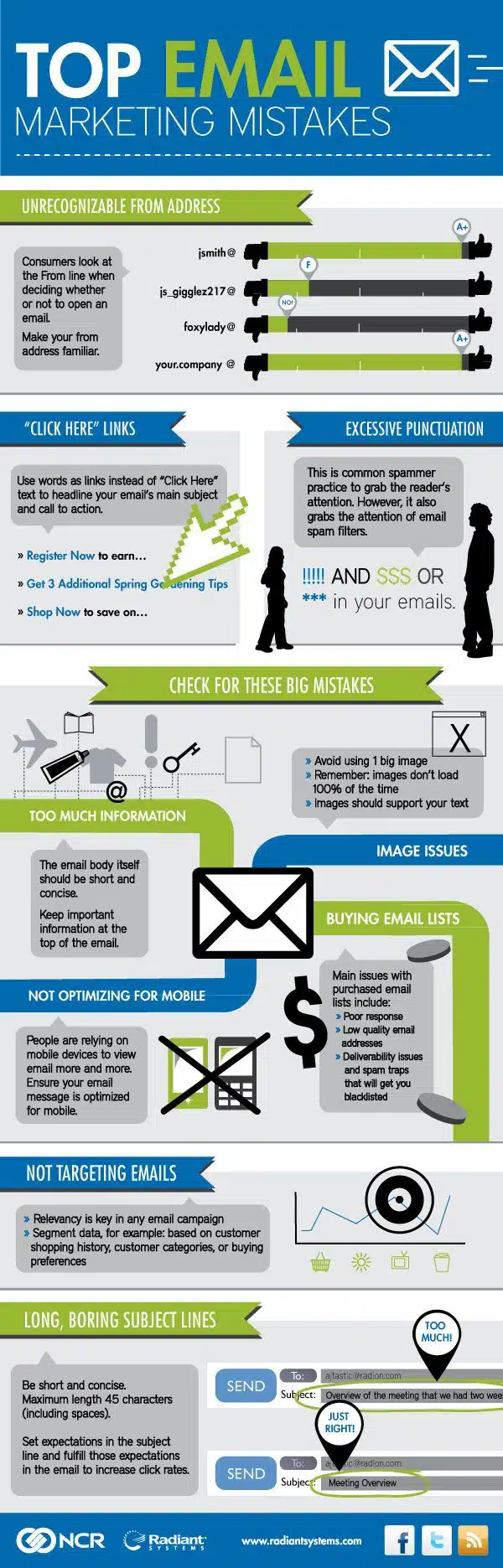
You’ll find some email marketing basics in this infographic.
Here’s a summary of what’s covered:
- Unrecognisable “From” Address
- “Click Here” Links
- Excessive Punctuation
- Too Much Information
- Image Issues
- Buying Email Lists
- Not Optimising for Mobile
- Not Targeting Emails
- Long, Boring Subject Lines
- Ignoring the Customer Experience
Check out the post below for more.
Email marketing remains one of the most powerful tools for connecting with customers, building loyalty, and driving sales. But even the best campaigns can fall flat if common mistakes go unnoticed. From confusing sender names to poor mobile design, small missteps can have a big impact on open rates, engagement, and conversions. Understanding where things go wrong is the first step toward creating emails that truly perform.
In this post, we’ll uncover the hidden reasons your campaigns aren’t working and show you how to fix them. Each section explores a key email marketing mistake, with actionable tips to help you build trust, capture attention, and encourage clicks.
Unrecognisable “From” Address
Your “From” address is one of the first things recipients see — and often the deciding factor in whether they open your email. If it looks unfamiliar, spammy, or impersonal, your message may never get read. A recognisable and trustworthy sender name helps to build instant credibility and ensures your emails feel legitimate and personal.
- Use your business or brand name as the sender to reinforce familiarity.
- Avoid using personal or unprofessional handles such as “jsmith123” or “foxygirl.”
- Keep your sender name consistent across all campaigns for brand recognition.
- Test variations like “Mark from Red Website Design” to see which performs best.
“Click Here” Links
“Click here” may seem like an obvious call to action, but it’s outdated and uninformative. Readers today expect clarity and value — they want to know what they’re clicking for. Using descriptive link text not only improves engagement but also boosts accessibility and SEO performance, helping your email stand out for the right reasons.
- Replace vague text like “Click Here” with benefit-driven language such as “Download Your Guide.”
- Incorporate action verbs that describe what the reader will gain or do.
- Keep your calls to action short, direct, and easy to identify.
- Use consistent formatting for links to make them stand out visually.
Excessive Punctuation
Overusing punctuation in your emails — such as multiple exclamation marks, symbols, or capital letters — can make your message look unprofessional or even spam-like. These small details might seem harmless, but they can trigger spam filters and reduce deliverability. A cleaner, calmer tone communicates confidence and credibility.
- Avoid using repetitive punctuation like “!!!” or “$$$” in your subject lines or content.
- Use exclamation marks sparingly and only to highlight genuine excitement.
- Keep formatting simple, focusing on clarity and tone rather than decoration.
- Run your email through a spam checker before sending to identify red flags.
Too Much Information
An email isn’t a blog post or brochure — it’s a quick communication designed to inspire action. Overloading readers with too much content makes them lose interest before reaching your key message. The most effective emails are short, scannable, and focused on one central goal, guiding the reader effortlessly toward the next step.
- Focus on one main message or offer per email to maintain clarity.
- Keep paragraphs brief and use white space to improve readability.
- Use bullet points or subheadings to break down complex information.
- Place the most important details and calls to action near the top.
Image Issues
Images can enhance your email design, but relying too heavily on them can backfire. Large or poorly optimised images may not load properly across all devices, causing your message to lose impact. A well-balanced approach ensures your email looks good, loads fast, and remains readable even when images are blocked.
- Avoid making a single large image the entire body of your email.
- Optimise all images for web use to improve loading times.
- Include descriptive alt text so your message is clear even if images don’t display.
- Use a blend of visuals and text to ensure accessibility and engagement.
Buying Email Lists
Purchasing email lists may seem like a quick way to expand your reach, but it’s one of the fastest routes to poor engagement and potential blacklisting. Recipients who didn’t consent to receive your messages are unlikely to respond positively — and you could violate data protection laws in the process. Building your list organically is slower but far more effective long term.
- Only email contacts who have explicitly opted in to receive communication.
- Use lead magnets or sign-up forms to attract genuinely interested subscribers.
- Regularly clean and verify your list to remove inactive or invalid addresses.
- Respect GDPR and other data privacy regulations to maintain trust.
Not Optimising for Mobile
With most users checking emails on their phones, mobile optimisation is no longer optional — it’s essential. A design that looks great on a desktop might appear broken or unreadable on a smaller screen. Responsive design ensures your emails are easy to read and interact with, no matter where your audience opens them.
- Use mobile-friendly templates that automatically adapt to different screen sizes.
- Keep subject lines short so they display fully on mobile devices.
- Use larger buttons and links that are easy to tap with a thumb.
- Test your emails on multiple devices and operating systems before sending.
Not Targeting Emails
Sending the same message to your entire subscriber list is a missed opportunity. Personalisation and segmentation allow you to speak directly to individual customer needs, increasing relevance and engagement. When recipients feel understood, they’re far more likely to open, read, and act on your messages.
- Segment your list by purchase history, interests, or customer type.
- Personalise content using dynamic fields like names or location.
- Adjust offers and messaging to match each segment’s preferences.
- Track results by segment to continuously improve targeting accuracy.
Long, Boring Subject Lines
Subject lines are your first and often only chance to capture attention. A long or dull subject line can easily get lost in crowded inboxes. Keep them short, intriguing, and relevant — offering a clear reason to open the email while setting expectations for what’s inside.
- Limit subject lines to around 45 characters, including spaces.
- Focus on clarity rather than cleverness to avoid confusion.
- Use emotional triggers or urgency carefully to spark interest.
- Test variations regularly to see which phrasing performs best.
Ignoring the Customer Experience
Your email content might be strong, but if the overall experience feels disjointed or frustrating, results will suffer. From inconsistent branding to broken links, every detail matters. A cohesive, trustworthy experience builds loyalty and strengthens your reputation with every send.
- Ensure your email design matches your website and brand identity.
- Test all links, buttons, and forms to confirm they work correctly.
- Maintain a consistent tone of voice and style across all communications.
- Provide a clear, visible unsubscribe option to respect customer control.
Neglecting Analytics and Testing
Without tracking your performance, you’re flying blind. Analytics reveal what’s working — and what isn’t — so you can refine your approach with each campaign. Testing different elements like subject lines, visuals, and send times helps uncover what resonates most with your audience.
- Use analytics tools to track opens, clicks, and conversions.
- A/B test subject lines, CTAs, and layouts to identify strong performers.
- Monitor engagement over time to spot trends or drops in interest.
- Use data insights to guide future content and design decisions.
Overlooking Compliance and Deliverability
Even beautifully designed emails can fail if they don’t reach the inbox. Spam filters, domain reputation, and compliance rules all influence deliverability. Following best practices ensures your messages land safely in front of your audience and keep your sender reputation intact.
- Authenticate your emails using SPF, DKIM, and DMARC records.
- Avoid spammy language and maintain a healthy text-to-image ratio.
- Keep your email lists clean and updated to reduce bounce rates.
- Comply with GDPR, CAN-SPAM, and other global regulations.
Inconsistent Sending Schedule
Sending emails too often can annoy subscribers, but going quiet for long periods can make them forget who you are. Consistency is key — it keeps your brand top-of-mind while establishing expectations for when and why you’ll appear in their inbox.
- Develop a regular email calendar that aligns with your marketing goals.
- Balance promotional messages with helpful, value-driven content.
- Track engagement rates to identify optimal send frequency.
- Communicate clearly about how often subscribers can expect to hear from you.
Weak Calls to Action
Even the most well-written email won’t convert without a strong, clear call to action. A CTA should tell the reader exactly what to do next and why it benefits them. Without one, your email risks becoming just another message without purpose.
- Use short, action-driven phrases like “Book Your Consultation” or “Shop the Sale.”
- Make your CTA button stand out visually with contrasting colours.
- Position your CTA strategically — ideally above the fold.
- Test different wording and placements to see what drives the most clicks.
Poor List Management
A healthy email list is the backbone of successful campaigns. If you never remove inactive contacts or update preferences, engagement rates can plummet. Regular list maintenance ensures your messages reach people who actually want them.
- Remove subscribers who haven’t engaged in several months.
- Offer re-engagement campaigns before removing dormant contacts.
- Keep sign-up forms clear about what subscribers can expect.
- Update segmentation regularly as customer behaviours change.
Forgetting to Add Value
Email marketing isn’t just about selling — it’s about building relationships. When every message feels like a hard sell, subscribers quickly tune out. Providing genuine value through education, inspiration, or exclusive insights keeps audiences engaged and loyal.
- Share useful tips, guides, or updates relevant to your audience.
- Offer occasional incentives or loyalty rewards to show appreciation.
- Maintain a friendly, conversational tone that adds warmth to each message.
- Focus on solving customer problems, not just promoting products.
Conclusion
Email marketing success isn’t about sending more messages — it’s about sending better ones. Many campaigns fail not because the product is wrong, but because the execution is filled with small, fixable errors. From improving your sender name to refining your subject lines and CTAs, every improvement builds stronger trust and engagement.
By identifying and correcting these hidden mistakes, you can transform your email marketing from a forgotten inbox item into a reliable driver of business growth. Keep refining, testing, and learning — and your emails will not only reach their audience but inspire them to take action.

Author:
Mark Ford