Are you trying to decide whether Facebook Ads or Google Ads is better for your business? Want a simple breakdown of how each platform works and when to use them?
You’ll find some website basics in this infographic.
It breaks things down as follows:
- Why Facebook and Google Ads are essential for your marketing strategy
- Key stats on audience size and user behaviour
- The unique benefits of each platform
- When to use push vs pull advertising
- Tips for targeting, retargeting, and keyword strategy
- A clear comparison to help you choose the right platform for your goals
Check out the post below for more.
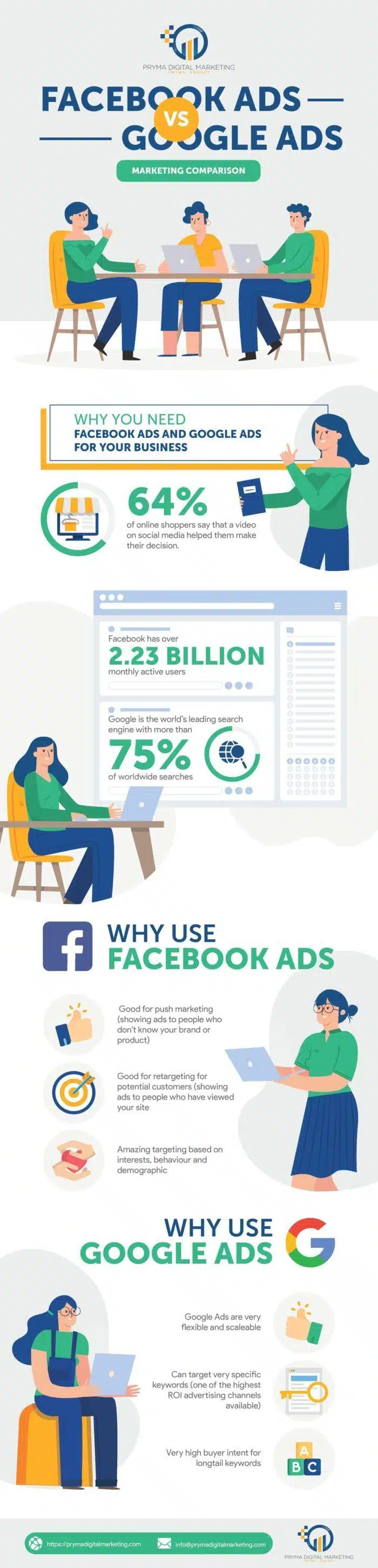
When it comes to online advertising, two platforms dominate the conversation: Facebook Ads and Google Ads. Both offer unique strengths, tools, and targeting capabilities—but which one is right for your business? In this simple guide, we break down the core benefits of each platform so you can make an informed decision based on your goals, budget, and audience.
Let’s explore the key factors that can help you choose the right platform to maximise your advertising ROI.
Why You Need Facebook Ads and Google Ads for Your Business
Before deciding between Facebook and Google Ads, it’s important to understand why businesses use them in the first place. Each platform reaches users in different ways, and together they can cover both ends of the customer journey—from awareness to action. Combining their strengths can significantly boost visibility, engagement, and conversions.
- Use Facebook Ads for visual, social content that builds awareness and brand trust.
- Use Google Ads to capture demand from people actively searching for your products or services.
- Combine both platforms to target customers at different stages of the buying journey.
- 64% of online shoppers say a video on social media helped influence a buying decision—don’t ignore social proof.
Facebook Has Over 2.23 Billion Monthly Active Users
With billions of monthly users, Facebook offers unparalleled reach and audience diversity. Its algorithm allows advertisers to target highly specific user segments based on interests, behaviour, and demographics. Whether you’re selling to a niche audience or a broad market, Facebook makes it easy to connect with the right people.
- Build awareness quickly by tapping into Facebook’s massive global user base.
- Target based on interests, age, gender, location, education level, relationship status, and more.
- Use Facebook’s custom audiences to retarget users who have visited your site or engaged with your content.
- Take advantage of Lookalike Audiences to find people similar to your best customers.
Google Is the World’s Leading Search Engine With Over 75% of Worldwide Searches
When people need something, they Google it. With more than 75% of global searches happening on Google, this platform gives businesses a direct line to high-intent users. If you’re selling something people are actively looking for, Google Ads can put you at the top of their search results at the exact right moment.
- Target people who are already searching for your product, service, or solution.
- Use Google Ads to show up on search results, shopping tabs, maps, and YouTube.
- Bid on high-converting keywords to drive qualified traffic to your landing pages.
- Track performance and fine-tune campaigns using detailed conversion and cost-per-click data.
Why Use Facebook Ads
Facebook is ideal for businesses looking to raise brand awareness, retarget lost leads, or build a strong community presence. With visually-driven formats like carousel ads, videos, and stories, you can tell your brand’s story in a way that’s engaging and shareable. Facebook excels at generating interest—even before a user has a need.
- Use Facebook Ads for push marketing to reach people who haven’t heard of you yet.
- Re-engage warm leads with retargeting ads based on past website visits or actions.
- Create emotion-driven campaigns with visuals, storytelling, and social interaction.
- Test different creative formats like videos, image carousels, and instant experiences.
Good for Push Marketing (Showing Ads to People Who Don’t Know Your Brand or Product)
Push marketing is about introducing your brand to new people. Facebook is perfect for this because it lets you place ads in users’ feeds based on interests and behaviours—not search intent. This makes it ideal for products or services that need some education or awareness before people are ready to buy.
- Promote content that sparks curiosity, like a behind-the-scenes video or a helpful how-to.
- Use eye-catching visuals to stop the scroll and grab attention in the feed.
- Offer lead magnets like free downloads or discounts to encourage engagement.
- Optimise campaigns for reach or impressions to get your name out there.
Good for Retargeting for Potential Customers (Showing Ads to People Who’ve Visited Your Site)
Most people don’t convert on their first visit to your website. Facebook’s retargeting tools help you reconnect with these visitors and guide them back to your funnel. You can show them personalised messages, limited-time offers, or reminders of products they viewed.
- Install the Meta Pixel on your site to track visits and build retargeting audiences.
- Create custom campaigns for cart abandoners, product viewers, or blog readers.
- Use dynamic ads to automatically show products people viewed or added to their basket.
- Set up frequency caps to avoid annoying your audience with too many ads.
Amazing Targeting Based on Interests, Behaviour and Demographics
One of Facebook’s greatest strengths is its advanced targeting options. You can go beyond basic demographics and reach people based on their lifestyle, hobbies, job roles, relationship status, or purchase behaviour. This level of precision helps you make every ad pound count.
- Use interest targeting to reach people passionate about fitness, travel, tech, and more.
- Layer demographic filters to narrow your audience by age, location, or language.
- Target by life events like new parents, recently engaged, or job changers.
- Test split audiences to see which segments drive the best ROI.
Why Use Google Ads
Google Ads shines when you’re trying to reach people with strong buying intent. Whether they’re searching for a local service, comparing product features, or looking for a solution to a problem, Google connects your offer with their need. With flexible budgets and powerful targeting, it’s a results-driven platform for direct conversions.
- Run ads that match real-time searches and drive traffic to your website.
- Reach people at the exact moment they’re ready to take action.
- Optimise for phone calls, form fills, or eCommerce checkouts.
- Gain measurable insights through Google Analytics and conversion tracking.
Google Ads Are Very Flexible and Scalable
Whether you’re a small business or an international brand, Google Ads offers the flexibility to match your budget, goals, and campaign type. You can start with a small daily spend and scale up based on performance. The platform supports a wide range of ad formats and bidding strategies.
- Start with a modest budget and adjust based on results and seasonal demand.
- Use automated bidding to let Google optimise for clicks, conversions, or ROAS.
- Run local ads, shopping ads, video ads, and more depending on your objectives.
- Monitor performance with real-time dashboards and make changes instantly.
Can Target Very Specific Keywords (One of the Highest ROI Advertising Channels Available)
Keyword targeting is the backbone of Google Ads. You can bid on exact-match, phrase-match, or broad-match keywords to control when your ads appear. With the right keyword strategy, you can show up for high-converting searches and achieve strong returns.
- Use tools like Google Keyword Planner to find keywords with buyer intent.
- Focus on niche or longtail keywords for lower CPCs and higher conversion rates.
- Set negative keywords to avoid wasting budget on irrelevant traffic.
- Group related keywords into tightly themed ad groups for better relevance.
Very High Buyer Intent for Longtail Keywords
Longtail keywords—phrases that are longer and more specific—tend to signal a user who is closer to making a purchase. These keywords often have lower competition and can be more cost-effective. Targeting them means you’re connecting with users who know exactly what they want.
- Bid on detailed search phrases like “best vegan protein powder UK” or “emergency plumber in Bristol.”
- Create landing pages that match the keyword intent with relevant offers or content.
- Use ad copy that speaks directly to the user’s search terms to boost click-through rates.
- Monitor keyword performance and continuously refine your list for better ROI.
Conclusion: Facebook Ads or Google Ads—Which Should You Choose?
There’s no one-size-fits-all answer—both Facebook and Google Ads have their strengths depending on your goals. Facebook is ideal for awareness, brand storytelling, and community engagement. Google Ads is unbeatable when it comes to capturing demand and driving high-intent conversions.
To get the best results, many businesses find that using both platforms in tandem offers the most comprehensive approach. Facebook builds interest, and Google capitalises on it when the customer is ready to buy. Choose based on your budget, your product type, and where your audience spends their time.
Still unsure? Start small on both platforms, test and measure performance, and scale what works. The data will show you where your next ad pound should go.

Author:
Mark Ford