
Are you ready to position yourself as a genuine thought leader in your industry? Want to learn how to create content that not only showcases your expertise but truly resonates with your audience?
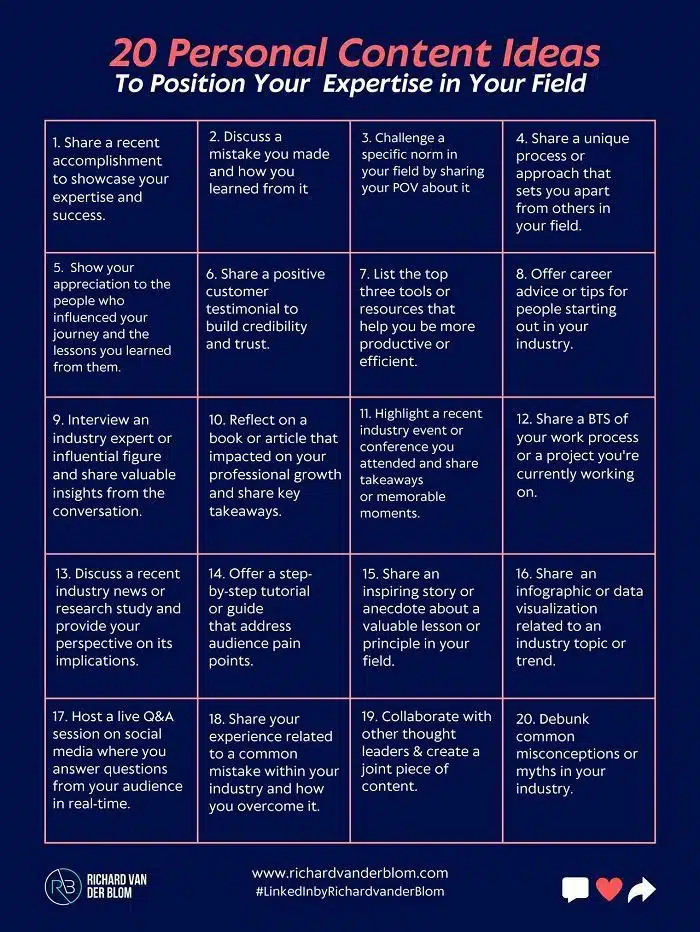
You’ll find some branding basics in this infographic.
Here’s a summary of what’s covered:
- Share a Recent Success or Achievement
- Discuss a Mistake You Made and What It Taught You
- Challenge an Industry Norm with Your Perspective
- Explain a Unique Process or Approach That Sets You Apart
- Thank Mentors or Influencers Who Shaped Your Growth
- Post a Positive Client Testimonial to Build Trust
- List Your Top Tools or Resources for Productivity
- Offer Career Advice for Newcomers in Your Field
- Interview an Industry Expert and Share Their Insights
- Reflect on a Book or Article That Influenced You
Check out the post below for more.
Creating thought leadership content isn’t just about sharing what you know – it’s about making people think differently, inspiring trust, and building long-term credibility. The most powerful voices in any industry are those that combine expertise with authenticity, using personal experiences and insights to help others grow.
In this guide, we’ll explore twenty ways to create content that positions you as a true leader in your field. Each idea will help you move from simple insight to real-world impact.
Share a Recent Success or Achievement
Audiences connect with genuine success stories that showcase both skill and perseverance. Sharing your accomplishments demonstrates credibility while giving others something to aspire to. When presented thoughtfully, this type of content reinforces your expertise without sounding boastful. Focus on lessons learned, results achieved, and the journey behind the win.
- Describe the challenge you faced before achieving the result.
- Highlight the specific actions or strategies that led to success.
- Include measurable outcomes or tangible results.
- End with a takeaway that your audience can apply to their own work.
Discuss a Mistake You Made and What It Taught You
People appreciate honesty, especially from those they look up to. Sharing a mistake is a powerful way to humanise your brand and demonstrate continuous learning. By revealing how you turned failure into growth, you help others avoid similar pitfalls while proving your resilience and humility.
- Choose a mistake that offers real value or insight for your audience.
- Explain the context so readers understand the situation clearly.
- Focus on what you learned and how it improved your approach.
- Conclude with advice or actions others can take from your experience.
Challenge an Industry Norm with Your Perspective
True thought leadership means questioning the status quo and offering a fresh perspective. Challenging accepted norms sparks discussion and sets you apart as an independent thinker. Done respectfully, it can inspire others to rethink outdated practices and look at your industry through a new lens.
- Identify a common belief or practice that you disagree with.
- Support your viewpoint with data, experience, or real-world examples.
- Encourage conversation rather than confrontation.
- Offer alternative solutions or approaches that make sense.
Explain a Unique Process or Approach That Sets You Apart
Every expert has a signature way of working – a process or method that defines their results. Sharing your own unique approach can give your audience a peek behind the curtain while reinforcing your authority. It’s a chance to show your expertise in action and demonstrate the value of your professional mindset.
- Outline the main steps in your process clearly and concisely.
- Explain why this approach delivers consistent results.
- Share examples or stories that illustrate how it works.
- Emphasise what makes your method different from standard practice.
Thank Mentors or Influencers Who Shaped Your Growth
Behind every strong professional story are people who helped shape it. Showing appreciation for mentors or industry influences highlights your humility and gratitude. It also gives your audience insight into the people and experiences that shaped your thinking.
- Name the individuals who played a key role in your journey.
- Describe specific lessons or habits they taught you.
- Explain how their influence still affects your work today.
- Tag or credit them publicly to strengthen professional relationships.
Post a Positive Client Testimonial to Build Trust
Testimonials remain one of the strongest forms of social proof. They demonstrate that others trust your expertise and have benefited from your work. Sharing a client’s story can subtly promote your brand while offering readers proof of your results.
- Choose testimonials that highlight measurable impact or transformation.
- Add brief commentary to provide context or background.
- Use visuals like screenshots or quotes to make it more engaging.
- Rotate testimonials regularly to reflect your ongoing success.
List Your Top Tools or Resources for Productivity
Audiences love practical recommendations that make their work easier. Sharing your favourite tools or resources adds value to your content and positions you as someone who’s not only knowledgeable but also helpful. This type of post can encourage discussion and inspire others to share their own recommendations.
- List tools that genuinely improve efficiency or workflow.
- Explain briefly why each one stands out to you.
- Include links or demos where appropriate.
- Keep your list updated to reflect current trends and technology.
Offer Career Advice for Newcomers in Your Field
Those just entering your industry are hungry for guidance from people who’ve already found success. Sharing lessons learned and practical advice can build your reputation as a trusted mentor figure. It’s also a great way to give back to your professional community.
- Reflect on what you wish you’d known when starting out.
- Share tips that are actionable and realistic.
- Encourage readers to embrace patience and continuous learning.
- Use a friendly, supportive tone rather than one of superiority.
Interview an Industry Expert and Share Their Insights
Collaborating with other experts is a strong way to expand your reach and credibility. By interviewing someone respected in your field, you bring fresh insights to your audience while strengthening professional relationships. It also shows that you value continuous learning and diverse perspectives.
- Choose interviewees who complement your expertise.
- Prepare thoughtful, open-ended questions.
- Summarise key insights or lessons from the conversation.
- Share quotes or short clips to make the content more engaging.
Reflect on a Book or Article That Influenced You
Books, podcasts, and articles often shape how we think and work. Reflecting on a piece of content that changed your perspective is a subtle yet effective way to show growth and intellectual curiosity. It also provides your audience with recommendations that could benefit them too.
- Choose a work that directly relates to your field or mindset.
- Summarise the key ideas or arguments.
- Explain how it influenced your professional approach.
- Share how readers can apply those ideas to their own work.
Recap Takeaways from an Event or Conference
Attending professional events keeps you informed and connected within your industry. Sharing what you’ve learned shows commitment to ongoing development. It also gives your audience valuable insights without them having to attend in person.
- Highlight the most interesting sessions or speakers.
- Share three to five key lessons or trends discussed.
- Include photos or quotes for added authenticity.
- Mention how you plan to apply what you learned moving forward.
Share Behind-the-Scenes Moments from Your Work
Audiences enjoy seeing the human side of business. Behind-the-scenes content reveals the effort and creativity that go into your work, helping people relate to you on a personal level. It makes your expertise feel more approachable and real.
- Show parts of your process that others don’t usually see.
- Use informal photos or short videos for authenticity.
- Explain how you overcome challenges during projects.
- Emphasise teamwork, preparation, or craftsmanship.
Comment on Industry News or Research
Offering your perspective on recent developments keeps your audience informed and positions you as someone who’s actively engaged with your industry. Well-considered commentary can spark discussion and highlight your ability to think critically about trends.
- Choose timely topics that are relevant to your audience.
- Summarise the key facts before offering your opinion.
- Discuss how it could impact professionals or customers.
- Invite others to share their own interpretations or experiences.
Create a Step-by-Step Tutorial or Guide
Tutorials and guides provide direct value to your audience by helping them solve a problem or learn a new skill. This content builds authority and trust because it demonstrates not only knowledge but also your ability to teach effectively.
- Choose a topic that aligns with your area of expertise.
- Break the process into clear, manageable steps.
- Use screenshots or visuals to clarify complex parts.
- End with a summary or checklist to reinforce learning.
Tell an Inspiring Story or Lesson
Personal stories often resonate more deeply than data or facts. Sharing a meaningful anecdote about perseverance, creativity, or growth helps people connect emotionally with your message. It transforms your content from informative to inspirational.
- Choose a story with a clear lesson or turning point.
- Keep it authentic and avoid over-embellishment.
- Highlight the takeaway that others can learn from.
- Encourage reflection or discussion among your readers.
Post an Infographic or Data Visualisation
Complex information becomes more digestible when presented visually. Infographics help you share valuable data in a way that’s easy to understand and shareable. They can quickly establish your authority while keeping your audience engaged.
- Focus on one key message or data set per visual.
- Use clear headings and concise text for readability.
- Incorporate your brand colours and design style.
- Share a short caption summarising the key insight.
Host a Live Q&A Session
Live sessions are an excellent way to engage directly with your audience and build community. They allow you to demonstrate expertise in real-time and show confidence in your subject matter. It’s also a great opportunity to identify recurring questions or pain points among your followers.
- Announce the session in advance to encourage participation.
- Collect questions beforehand to prepare strong answers.
- Keep your responses conversational and authentic.
- Record and repurpose highlights for future content.
Share How You Overcame a Common Industry Challenge
Everyone faces recurring challenges in their profession. Sharing how you navigated a difficult situation or solved a common problem demonstrates problem-solving skills and empathy. This content resonates deeply because it’s both relatable and instructive.
- Identify an issue your audience frequently encounters.
- Describe the impact it had on your work or mindset.
- Explain the steps you took to resolve it.
- Offer key takeaways others can implement immediately.
Collaborate with Other Experts on Content
Collaboration expands your reach and adds variety to your content. Partnering with other thought leaders allows you to share audiences, build authority, and create richer, more well-rounded discussions. It’s a hallmark of true leadership and openness in your field.
- Choose collaborators whose expertise complements your own.
- Define the goal and format of your joint content clearly.
- Promote each other’s contributions across channels.
- Use the collaboration to build long-term relationships.
Debunk a Common Myth or Misconception
Misinformation can spread quickly in any industry. By tackling myths head-on, you not only educate your audience but also demonstrate authority and critical thinking. These posts often attract engagement because they challenge assumptions.
- Identify misconceptions that frequently cause confusion.
- Present facts and evidence to clarify the truth.
- Explain why the myth persists and its potential consequences.
- End with practical advice or a call to action for readers.
Conclusion
Thought leadership content isn’t about broadcasting your achievements – it’s about sharing ideas that make a difference. When you blend expertise with honesty, curiosity, and generosity, you create a voice people trust.
Use these twenty content approaches to connect, educate, and inspire your audience, transforming your insights into meaningful impact.

Author:
Mark Ford