
Are you trying to understand how branding and marketing work together to grow your business? Want to learn how branding builds trust while marketing turns that trust into action?
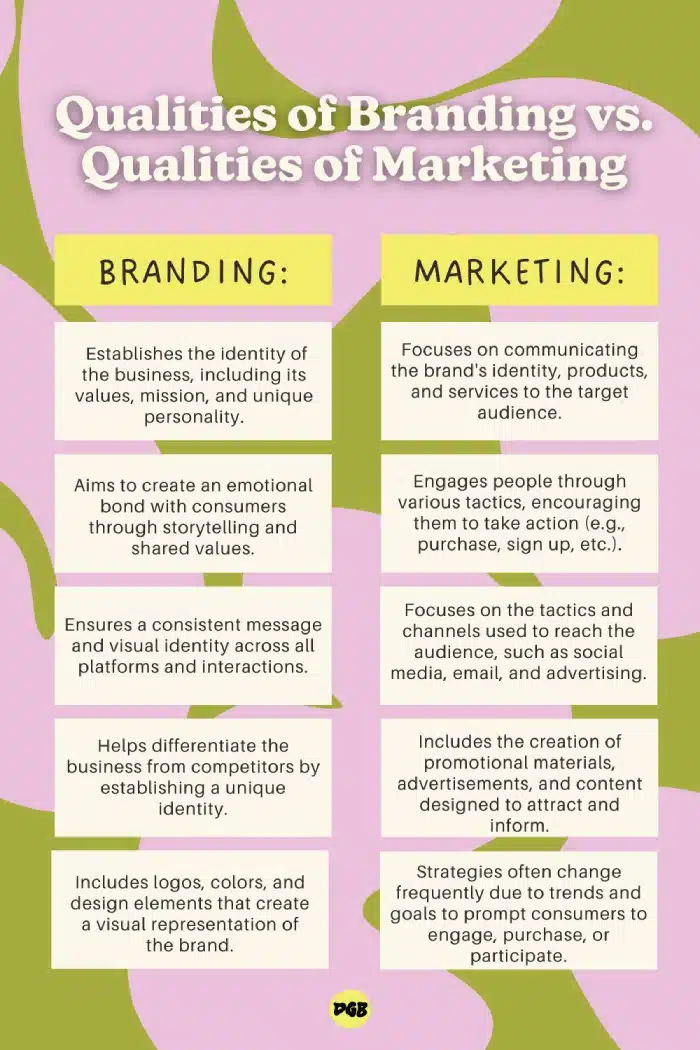
You’ll find some branding basics in this infographic.
Here’s a summary of what’s covered:
- Defines a Business’s Identity, Values, Mission, and Personality
- Builds Emotional Connections Through Storytelling and Shared Values
- Ensures Consistent Messaging and Visuals Across All Channels
- Differentiates the Business with a Distinct Identity
- Uses Logos, Colours, and Design to Represent the Brand Visually
- Communicates the Brand’s Identity, Products, and Services to Its Audience
- Uses Tactics to Engage and Drive Actions Like Purchases or Sign-Ups
- Relies on Channels Like Social Media, Email, and Advertising
- Produces Promotional Content to Attract and Inform
- Adapts Strategies Based on Trends and Goals to Boost Engagement
Check out the post below for more.
Branding and marketing are often used interchangeably, but they serve very different—yet deeply connected—purposes. Branding gives your business its soul, while marketing gives it a voice. One shapes how people feel about your company; the other shapes what they do next. Understanding how these two forces work together is key to building long-term loyalty and driving consistent results.
When you connect branding and marketing strategically, your business becomes more than a product or service—it becomes an experience. Below, we explore how branding builds trust and identity, while marketing turns that trust into measurable action.
Defines a Business’s Identity, Values, Mission, and Personality
Your brand is the foundation of everything you communicate. It defines who you are, what you stand for, and why you exist. Branding creates a framework that guides every marketing decision—from tone of voice to the visuals you use. Without this clarity, marketing efforts can feel disjointed and lack authenticity.
- Establish clear brand values that reflect what your business truly believes in.
- Create a mission statement that serves as a north star for every campaign.
- Develop a unique personality that distinguishes your business from competitors.
- Ensure all messaging aligns with your core purpose and long-term goals.
Builds Emotional Connections Through Storytelling and Shared Values
Branding goes beyond logos and colours—it’s about how your audience feels when they interact with you. People don’t just buy products; they buy the stories and values behind them. Emotional storytelling transforms your brand from something transactional into something meaningful.
- Share authentic stories about how your business started or what drives you.
- Highlight customer experiences that reflect your values and impact.
- Use visuals and tone to evoke emotion and empathy in your audience.
- Make your audience feel like part of your brand’s journey, not just its customer base.
Ensures Consistent Messaging and Visuals Across All Channels
Consistency is what turns recognition into trust. When your brand voice and visuals are uniform across every platform, you create a cohesive experience that reassures your audience. Marketing amplifies this consistency by repeating the same core messages across multiple touchpoints.
- Develop brand guidelines covering logos, colours, fonts, and tone of voice.
- Train your team to apply these guidelines across all content and communication.
- Audit your digital and print materials regularly to maintain consistency.
- Reinforce the same brand promises in every piece of marketing collateral.
Differentiates the Business with a Distinct Identity
In competitive markets, differentiation is the key to visibility and growth. Branding helps your business stand out by shaping how people perceive you. It positions your company as something unique, memorable, and worth choosing. Marketing then communicates this uniqueness to the right audience.
- Identify what makes your business different and define your unique selling proposition.
- Build a visual and verbal identity that reflects that uniqueness clearly.
- Highlight your strengths through storytelling, imagery, and tone.
- Focus your marketing on the audiences that resonate most with your differentiators.
Uses Logos, Colours, and Design to Represent the Brand Visually
Visual identity is often the first impression people get of your business. It conveys your personality, values, and professionalism instantly. A strong design language makes your brand recognisable and reinforces trust every time someone interacts with your marketing.
- Choose a colour palette that reflects the emotions you want your brand to evoke.
- Use typography and imagery consistently across all platforms.
- Keep your logo simple, memorable, and scalable for all media.
- Refresh your visuals periodically to stay modern while maintaining recognition.
Communicates the Brand’s Identity, Products, and Services to Its Audience
Marketing transforms your brand identity into a story the world can hear. It’s the vehicle that carries your brand’s values, offers, and messages to the people who need them. Effective marketing not only informs but also inspires audiences to take notice and act.
- Build campaigns that clearly reflect your brand’s values and mission.
- Use clear, benefit-focused messaging that shows what makes you different.
- Tailor your communication style to resonate with your target audience.
- Measure how well your marketing aligns with your brand perception through feedback and analytics.
Uses Tactics to Engage and Drive Actions Like Purchases or Sign-Ups
While branding builds awareness and trust, marketing drives conversions. It’s about taking that emotional connection and turning it into measurable results. Strong marketing campaigns motivate people to take the next step—whether that’s making a purchase, subscribing, or visiting your website.
- Create strong calls to action that clearly tell users what to do next.
- Leverage persuasive copy that connects benefits to audience needs.
- Use time-sensitive offers or incentives to encourage immediate engagement.
- Continuously test and optimise campaigns to improve conversion rates.
Relies on Channels Like Social Media, Email, and Advertising
Different marketing channels provide unique ways to connect with audiences, but they all rely on your brand’s foundation. Whether it’s a tweet, an ad, or an email newsletter, your marketing should sound and look like your brand. Consistency across these platforms strengthens recognition and trust.
- Choose platforms where your target audience is most active.
- Adapt your content to suit the tone and format of each channel.
- Maintain your brand’s personality across organic and paid media.
- Track performance across channels to identify what drives engagement best.
Produces Promotional Content to Attract and Inform
Marketing thrives on content that attracts, educates, and converts. This could include blog posts, videos, newsletters, or advertisements—all designed to bring your brand to life. The key is ensuring that every piece of content ties back to your brand identity.
- Develop a content strategy that aligns with your brand story.
- Mix educational, entertaining, and promotional content for variety.
- Use visuals and tone that reflect your brand’s established aesthetic.
- Repurpose successful content across different channels for maximum reach.
Adapts Strategies Based on Trends and Goals to Boost Engagement
Marketing is constantly evolving. While your brand identity remains consistent, your marketing tactics must adapt to stay relevant. By responding to audience behaviour and market trends, you can keep your campaigns fresh without losing your brand’s authenticity.
- Monitor trends and adjust campaigns to reflect current audience interests.
- Test new platforms, formats, or technologies to reach broader audiences.
- Stay flexible with campaign goals to respond to real-time results.
- Keep brand consistency intact even when refreshing your marketing approach.
How Branding and Marketing Work Together
Branding and marketing are two sides of the same coin. Branding builds the emotional groundwork—trust, recognition, and loyalty—while marketing turns those qualities into measurable actions. When these two are aligned, your audience experiences a seamless journey from awareness to conversion.
- Use branding to inform marketing strategy, not the other way around.
- Ensure marketing campaigns reflect your brand’s tone, visuals, and values.
- Track how branding efforts (like storytelling) influence engagement metrics.
- Reinforce your brand message through every marketing interaction.
Conclusion
Branding builds trust by defining who you are; marketing drives action by showing what you can do. When combined effectively, they create a cycle of growth—branding attracts and reassures, while marketing converts and sustains. Businesses that master this connection move beyond selling products; they build relationships that last.
By investing in a strong brand identity and aligning it with smart, adaptable marketing strategies, you give your audience both a reason to believe and a reason to act. That’s the true power of connecting branding and marketing—turning trust into tangible success.

Author:
Mark Ford