
Struggling to get consistent traffic to your website no matter what you try? Want to uncover what’s really holding your site back and how to fix it for good?
You’ll find some website basics in this infographic.
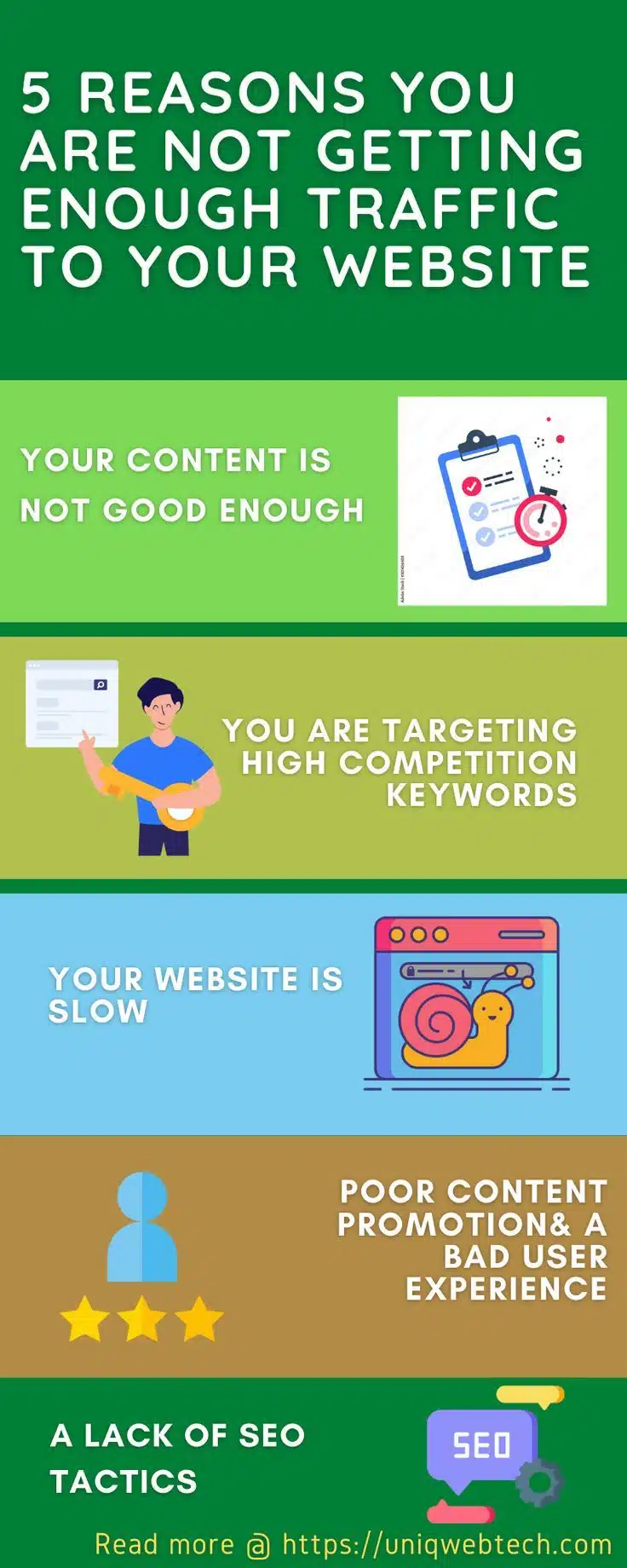
Here’s a summary of what’s covered:
- Your Content Is Not Good Enough
- You Are Targeting High Competition Keywords
- Your Website Is Slow
- Poor Content Promotion & a Bad User Experience
- A Lack of SEO Tactics
Check out the post below for more.
If your website feels like a digital ghost town, you’re not alone. Many business owners struggle with low traffic, despite having a live website and active presence. But traffic doesn’t come from just being online—it comes from doing the right things consistently.
In this post, we’ll break down the key reasons your site might be invisible and show you how to fix them, one problem at a time.
Your Content Is Not Good Enough
Search engines and users both crave high-quality content that solves real problems. If your content is thin, poorly written, or lacks value, it won’t rank or convert. Instead of publishing for the sake of volume, focus on creating content that’s informative, engaging, and user-focused. Make sure every post earns its place on your site.
- Write with your audience in mind—solve specific problems they’re searching for.
- Include expert insights, examples, and original research to increase credibility.
- Use headings, short paragraphs, and visual aids to improve readability.
- Keep content updated and relevant to maintain its SEO performance.
You Are Targeting High Competition Keywords
Ranking for broad, high-volume keywords sounds great in theory—but in reality, it’s a losing battle unless you’re already an authority. Competing against industry giants can bury your content deep in search results. Instead, aim for low-competition, high-intent keywords that your audience is more likely to search. Smart targeting leads to faster wins and more qualified traffic.
- Use keyword research tools to identify low-competition, long-tail phrases.
- Focus on local or niche variations to reduce SEO resistance.
- Align keywords with clear search intent (informational, transactional, etc.).
- Regularly review and refine your keyword strategy based on performance.
Your Website Is Slow
Site speed has a direct impact on both user experience and search rankings. A slow website frustrates visitors, increases bounce rates, and tells Google your site isn’t user-friendly. With mobile browsing now dominant, speed is more important than ever. A few seconds of lag can cost you hundreds of potential clicks.
- Use tools like Google PageSpeed Insights to identify performance issues.
- Compress images and use next-gen formats like WebP.
- Minimise the use of bloated plugins and heavy scripts.
- Choose fast, reliable hosting and consider a content delivery network (CDN).
Poor Content Promotion & a Bad User Experience
Even the best content will fail if no one sees it. If you’re not actively promoting your content and your website is hard to use, traffic will suffer. Distribution and experience are just as important as creation. Make sure your site is easy to navigate and your content gets shared in the right places.
- Promote new content across social media, email newsletters, and relevant communities.
- Encourage backlinks by reaching out to industry blogs and collaborators.
- Ensure your website is mobile-friendly, fast, and intuitive.
- Use clear calls-to-action (CTAs) to guide users through your content journey.
A Lack of SEO Tactics
Without solid SEO, your content may as well be invisible. Search engine optimisation isn’t optional—it’s the foundation of online visibility. If you’re not using proven SEO techniques, you’re missing out on consistent, long-term traffic. Start with the basics and build up a sustainable SEO strategy that works.
- Optimise title tags, meta descriptions, and URLs for target keywords.
- Use internal linking to help search engines crawl and understand your site.
- Implement schema markup to improve how your content appears in search.
- Track performance with tools like Google Search Console and refine based on data.
Conclusion
Improving website traffic isn’t about luck—it’s about identifying what’s holding you back and making smart, targeted changes. Whether it’s weak content, poor SEO, or simply not promoting your work, every problem has a fix.
By addressing each of these traffic killers head-on, you can turn an underperforming site into a powerful online asset. Make the switch from invisible to unmissable—your audience is waiting.

Author:
Mark Ford