
Are you trying to figure out how to get your website onto the first page of Google? Want a clear, beginner-friendly roadmap that actually works without the jargon?
You’ll find the essential steps to SEO success in this beginner’s guide.
Here’s a summary of what’s covered:
- Master Search Intent
- Target Long-Tail Keywords
- Build High-Quality Backlinks
- Optimise for Page Speed
- Track Everything with Data
Check out the post below for more.
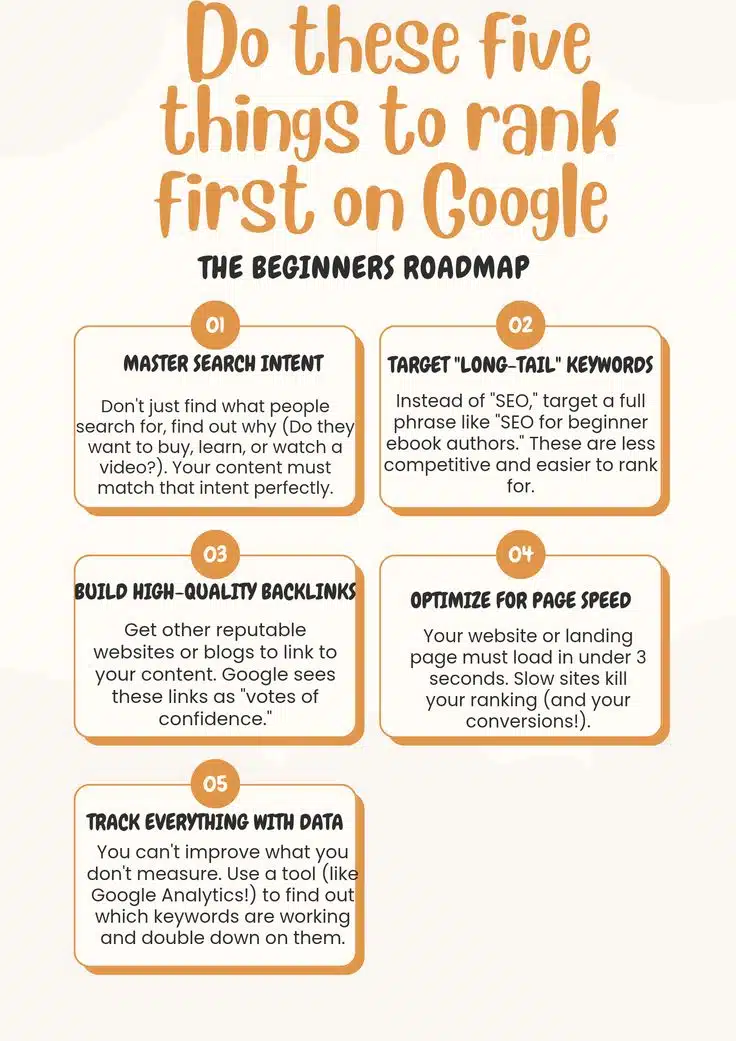
If you’ve ever wondered how some websites consistently appear at the top of Google while others stay buried, the answer lies in a few key SEO principles. Search Engine Optimisation (SEO) isn’t as mysterious as it seems. With the right foundation, even beginners can start climbing the rankings and attracting steady, organic traffic.
This guide walks you through five essential steps that can help your website move from zero visibility to that coveted first page of Google.
Master Search Intent
Ranking on Google starts with understanding why people are searching, not just what they’re searching for. Every query comes with an underlying intent—whether the user wants to buy something, learn something, or find a specific page. Matching your content to that intent is the cornerstone of good SEO. When your page answers exactly what a searcher is looking for, Google recognises its relevance and rewards it with higher placement.
- Identify the three main types of intent: informational (to learn), navigational (to find), and transactional (to buy).
- Analyse the top-ranking pages for your target keyword to see what kind of intent they serve.
- Structure your content to meet that intent fully—don’t just use the keyword, satisfy the purpose behind it.
- Regularly review your analytics to see if visitors are engaging as expected; if not, refine your message to better match their needs.
Target Long-Tail Keywords
Beginners often make the mistake of targeting broad, competitive keywords like “SEO” or “marketing.” The truth is, it’s far easier—and more effective—to target long-tail keywords. These are specific phrases with a clearer search intent, such as “SEO tips for small business owners.” They may bring less traffic individually, but they convert better and are much easier to rank for.
- Use tools like Google Keyword Planner or Ubersuggest to find long-tail keywords with low competition and decent search volume.
- Think about the natural language your audience uses—how they’d phrase questions or problems.
- Incorporate long-tail keywords into headings, meta descriptions, and body text naturally without stuffing.
- Build clusters of related long-tail phrases to capture multiple variations of a user’s search intent.
Build High-Quality Backlinks
Backlinks remain one of the strongest ranking factors in Google’s algorithm. When reputable websites link to your content, it signals to Google that your site is trustworthy and authoritative. Quality backlinks act like endorsements from credible sources, helping you climb higher in search results. However, not all links are created equal—focus on earning genuine links from relevant, respected domains.
- Create valuable, shareable content such as guides, infographics, or research-based posts that others naturally want to reference.
- Reach out to industry blogs or publications and offer guest posts that include a link back to your site.
- Build relationships with other website owners, influencers, or local partners who can mention your content.
- Avoid spammy link schemes or buying backlinks—these can damage your rankings rather than improve them.
Optimise for Page Speed
Your website’s loading time plays a major role in SEO and user experience. Google’s algorithm prioritises fast-loading sites because they offer a smoother experience for users. A delay of even a few seconds can lead to higher bounce rates and lower conversions. Optimising your page speed isn’t just good for rankings—it’s vital for keeping visitors engaged and encouraging them to explore more of your content.
- Compress images without sacrificing quality using tools like TinyPNG or ImageOptim.
- Minimise unnecessary plugins or scripts that slow down your site’s performance.
- Use caching tools and content delivery networks (CDNs) to speed up load times across regions.
- Regularly test your website speed with tools like Google PageSpeed Insights and address the recommendations provided.
Track Everything with Data
You can’t improve what you don’t measure. Tracking your website’s performance is the only way to understand what’s working and what needs adjustment. Analytics tools like Google Analytics or Google Search Console provide crucial insights into your audience’s behaviour, keyword performance, and conversion rates. Data-driven SEO ensures you’re focusing effort where it matters most rather than guessing.
- Monitor which keywords drive the most organic traffic and refine your content around them.
- Track user behaviour metrics like bounce rate, time on page, and click-through rate to identify engagement issues.
- Use conversion tracking to see which pages or blog posts lead to sign-ups, sales, or enquiries.
- Regularly review your SEO data and adjust your strategy to build on successes and fix weaknesses.
Conclusion
SEO success doesn’t happen overnight, but the path is clear for those who commit to the fundamentals. By understanding search intent, focusing on long-tail keywords, earning credible backlinks, improving site speed, and tracking progress with data, you lay the groundwork for sustainable growth.
Think of SEO as a long-term investment rather than a quick fix—one that rewards consistency, patience, and quality. With the right strategy and steady effort, your website can move from obscurity to visibility, one click at a time.

Author:
Mark Ford