
Are you struggling to create a marketing plan that’s clear and easy to follow? Want a simple, step-by-step approach to attract, convert, and keep more customers?
You’ll find some marketing basics in this infographic.
Here’s a summary of what’s covered:
- Identify Your Target Market
- Craft a Compelling Message
- Nail Down Your Media Strategy
- Capture Your Leads (CRM)
- Begin Nurturing Your Leads
- Convert Those Leads to Sales
- Deliver a World-Class Experience
- Turn Customers Into Raving Fans
- Actively Request Referrals
Check out the post below for more.
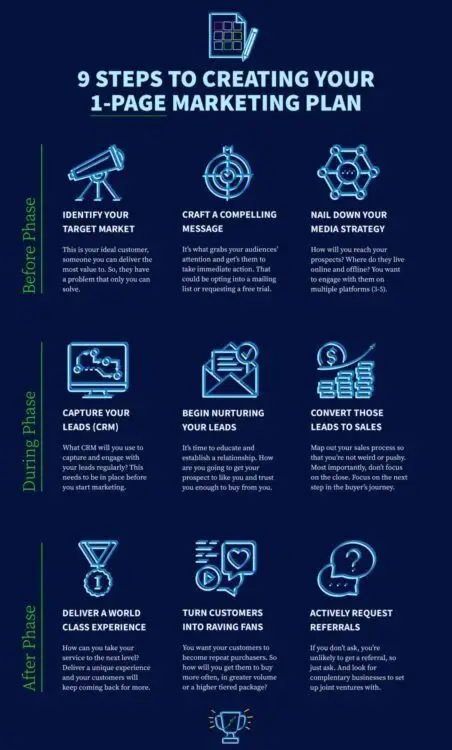
Creating a marketing plan doesn’t have to be overwhelming. A one-page marketing plan gives you clarity, focus, and a clear roadmap for growing your business. Instead of juggling dozens of disconnected tactics, you can work through each step with intention, knowing how it all fits together.
This guide will walk you through the nine key stages of building a simple but powerful plan that delivers results.
Identify Your Target Market
Every effective marketing plan starts with a deep understanding of who you want to reach. Defining your ideal customer allows you to focus your efforts on the right people, rather than wasting time and budget on broad audiences. You need to get clear on the problems they face and the solutions they are searching for. This step is about narrowing your focus to those who are most likely to buy.
- Define your ideal customer profile including demographics, interests, and pain points.
- Identify the specific problem you can solve better than competitors.
- Research where your ideal customers spend time online and offline.
- Focus on the segment most likely to take action and deliver the highest ROI.
Craft a Compelling Message
Once you know who you’re speaking to, you need a message that resonates with them. A compelling message grabs attention, connects emotionally, and motivates your audience to take the next step. This isn’t just about clever words; it’s about showing customers you understand their needs. Your message should make it clear why they should choose you over anyone else.
- Create a headline that immediately communicates your core benefit.
- Address your audience’s pain points and present your solution as the answer.
- Keep your message clear, simple, and free from jargon.
- Include a strong call-to-action that tells readers exactly what to do next.
Nail Down Your Media Strategy
Even the best message won’t work if it never reaches the right people. Your media strategy determines how you deliver your message and where you show up for your audience. Choosing the right mix of online and offline channels ensures you maximise your exposure without spreading yourself too thin. The key is to meet your audience where they already are.
- Select the channels where your ideal customers spend the most time.
- Balance paid, owned, and earned media for a well-rounded approach.
- Decide on frequency and timing to keep your brand top of mind.
- Test and measure each channel to refine your strategy for the best results.
Capture Your Leads (CRM)
Before you start marketing, you need a reliable way to capture and organise your leads. A Customer Relationship Management (CRM) system is the foundation for tracking potential customers and following up consistently. Without a process, it’s easy for leads to fall through the cracks and opportunities to be lost. Setting this up early ensures every lead is handled properly.
- Choose a CRM that fits your business size and workflow.
- Collect contact details through forms, landing pages, and sign-up incentives.
- Segment your leads to deliver relevant follow-ups for each group.
- Keep your database clean and up to date to avoid missed opportunities.
Begin Nurturing Your Leads
Not everyone is ready to buy immediately, which is why nurturing is so important. This stage is about building trust and guiding potential customers through their decision-making process. By staying in touch and offering value, you remain top-of-mind until they are ready to buy. Done well, nurturing turns cold leads into warm prospects.
- Send helpful, educational content that positions you as an expert.
- Use email automation to stay consistent without overwhelming leads.
- Personalise your communication based on interests and behaviour.
- Track engagement to know which leads are most sales-ready.
Convert Those Leads to Sales
This is where all your effort pays off. Converting leads into paying customers requires a smooth and persuasive process that removes friction from the buying journey. The goal is to make it easy for prospects to say yes. You should guide them clearly through the final decision without creating unnecessary barriers.
- Map out your sales process from first contact to final purchase.
- Address objections proactively with clear explanations and guarantees.
- Offer incentives such as discounts, bonuses, or limited-time offers.
- Make purchasing simple with clear next steps and multiple payment options.
Deliver a World-Class Experience
The marketing doesn’t end once the sale is made. Providing an exceptional customer experience keeps people coming back and turns them into long-term clients. This stage is about delighting your customers, exceeding expectations, and creating a seamless experience. When customers are happy, they become natural advocates for your brand.
- Communicate clearly about delivery times, processes, and expectations.
- Provide excellent support and resolve issues quickly.
- Look for ways to add value beyond the initial sale.
- Collect feedback regularly to continuously improve the experience.
Turn Customers Into Raving Fans
Satisfied customers are good, but raving fans are even better. These are the people who tell others about you and share your brand organically. Turning customers into promoters requires you to go above and beyond. When people feel connected to your brand, they will champion it for free.
- Surprise customers with thoughtful touches or exclusive perks.
- Recognise and reward loyal customers publicly.
- Encourage user-generated content and social sharing.
- Build a community where customers can engage with you and each other.
Actively Request Referrals
Word-of-mouth remains one of the most powerful marketing tools. Happy customers are usually willing to refer others but often need a little encouragement. Actively asking for referrals turns satisfied clients into a reliable growth engine. This final step closes the loop and fuels the start of your marketing plan again.
- Create a clear, simple process for requesting referrals.
- Offer an incentive or reward for successful referrals.
- Follow up with a thank you to show appreciation.
- Partner with complementary businesses to cross-refer clients.
Conclusion
A one-page marketing plan doesn’t just save time – it gives you clarity and focus. By working through each step, from identifying your target market to actively requesting referrals, you build a complete system that attracts, nurtures, and converts customers.
This approach keeps your efforts aligned and measurable, helping you grow your business with confidence. The beauty of this plan is its simplicity – you can adapt it, improve it, and use it again and again to achieve consistent results.

Author:
Mark Ford

85 Game-Changing Tools for Creators, Marketers, and Entrepreneurs
Are you searching for powerful yet free tools to help you grow your brand, streamline your workflow, and boost your online presence? Want to discover game-changing platforms that every creator, marketer, and entrepreneur should be using right now? […]