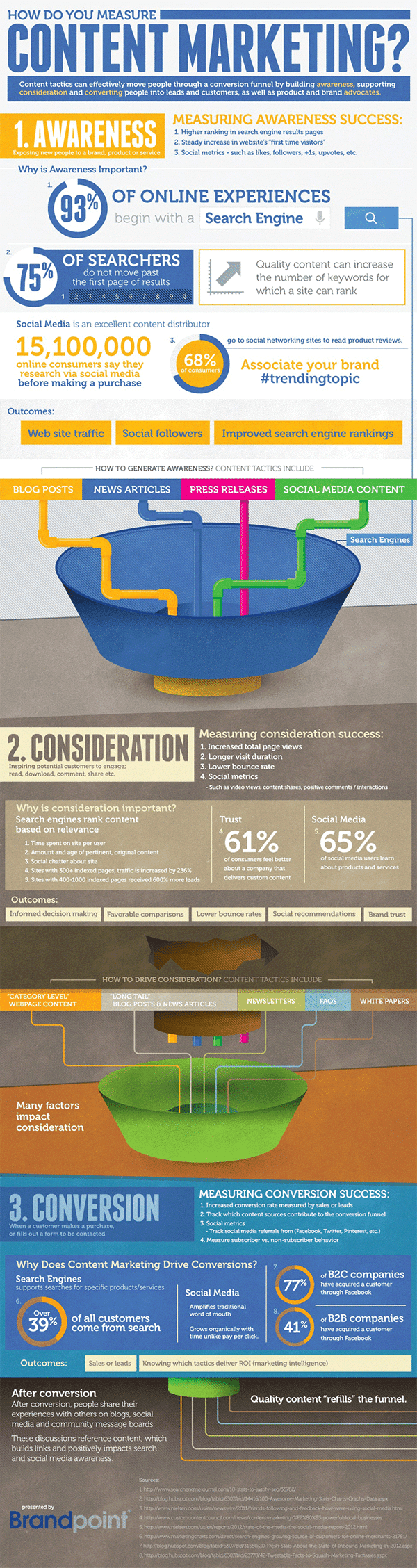
Content marketing enables you to effectively move potential clients through a conversion funnel by building awareness, supporting consideration and converting them into leads. But how can you tell if your strategy is working?
Content marketing has become an integral part of the modern digital landscape. Businesses of all sizes and industries are creating and sharing content to engage their audiences, build brand awareness, and drive revenue.
However, many marketers struggle to determine how effective their content marketing efforts truly are. To make informed decisions and optimize your content strategy, you need to measure your content marketing success. In this comprehensive guide, we will explore various methods and metrics to help you gauge the effectiveness of your content marketing campaigns.
The team at Brandpoint have created the awesome infographic below giving you 3 ways to track your content marketing success.
Why Measuring Content Marketing Success is Crucial
Before diving into the details of measurement, let’s understand why it’s essential to measure your content marketing success.
- Accountability: Measuring your content marketing efforts holds your team accountable for results. It allows you to track progress toward your goals and identify areas that need improvement.
- Resource Allocation: You may be investing significant time and resources into content creation. Measuring success helps you allocate these resources wisely by focusing on what works and eliminating what doesn’t.
- Strategy Refinement: Effective measurement enables you to refine your content strategy continuously. As you learn what resonates with your audience, you can adjust your approach accordingly.
- Demonstrating ROI: Businesses often require a clear return on investment (ROI) for marketing efforts. Measurement helps you demonstrate the value of your content marketing initiatives to stakeholders.
- Competitive Advantage: By understanding what works best in your niche, you can gain a competitive advantage. You can identify gaps in the content landscape and fill them with valuable, high-quality content.
Now that we understand the importance of measuring content marketing success, let’s dive into the specific metrics and methods you can use.
Key Metrics for Measuring Content Marketing Success
- Website Traffic: One of the most fundamental metrics to track is the increase in website traffic resulting from your content marketing efforts. Tools like Google Analytics can help you monitor the number of visitors to your site, pageviews, and the sources of your traffic.
- Engagement Metrics: Engagement metrics measure how well your content resonates with your audience. Key indicators include likes, shares, comments, and social media engagement. High engagement indicates that your content is striking a chord with your target audience.
- Conversion Rate: Ultimately, your content should drive conversions. Whether it’s signing up for a newsletter, filling out a contact form, or making a purchase, tracking conversion rates helps you determine how effectively your content is moving prospects through the sales funnel.
- Bounce Rate: A high bounce rate indicates that visitors are leaving your site quickly after arriving. It could be a sign that your content isn’t meeting their expectations or answering their questions. Analyze bounce rates to identify content that may need improvement.
- Time on Page: The amount of time visitors spend on a page is a good indicator of content quality. If people are quickly clicking away, your content may not be engaging enough. Conversely, longer time on page suggests that your content is holding their attention.
- Click-Through Rate (CTR): CTR is crucial for assessing the effectiveness of email marketing campaigns or paid advertising promoting your content. It measures the percentage of people who clicked on a link in your email or ad compared to the total number who saw it.
- Lead Generation: If your content includes lead generation forms or calls to action (CTAs), tracking the number of leads generated is essential. High-quality leads are a strong indicator of successful content marketing.
- Customer Acquisition Cost (CAC): Calculate the cost of acquiring a customer through your content marketing efforts. This metric helps you understand the efficiency of your campaigns and whether they are cost-effective compared to other acquisition methods.
- Customer Lifetime Value (CLV): Assess the long-term value of customers acquired through content marketing. A high CLV indicates that your content is not only attracting customers but also retaining and nurturing them.
- Return on Investment (ROI): Calculate the ROI by comparing the revenue generated from your content marketing efforts to the cost of creating and promoting the content. A positive ROI demonstrates that your content is a profitable investment.
- Content Consumption Patterns: Analyze which types of content (blog posts, videos, infographics, etc.) perform best and resonate most with your audience. Use this insight to tailor your content strategy.
- Search Engine Rankings: Track your content’s performance in search engine rankings. Improved rankings for targeted keywords indicate that your content is both high-quality and optimized for SEO.
Tools for Measuring Content Marketing Success
To effectively measure your content marketing success, you’ll need the right tools. Here are some of the most valuable tools for tracking and analyzing your content metrics:
- Google Analytics: A free and powerful tool that provides a comprehensive view of your website’s performance, including traffic sources, engagement metrics, and conversion data.
- Google Search Console: This tool helps you monitor your website’s presence in Google’s search results, showing you how often your site appears in searches and which keywords are driving traffic.
- Social Media Analytics: Each social media platform offers its analytics tools (e.g., Facebook Insights, Twitter Analytics, LinkedIn Analytics) to track engagement, reach, and audience demographics.
- Email Marketing Platforms: If you use email marketing, platforms like Mailchimp or HubSpot provide detailed email campaign analytics, including CTR and conversion rates.
- Marketing Automation Tools: Tools like Marketo or HubSpot offer advanced analytics for tracking the entire customer journey, from initial interaction to conversion.
- Heatmap Tools: Services like Hotjar or Crazy Egg create visual heatmaps of user interactions on your site, helping you understand where users are clicking and scrolling.
- Customer Relationship Management (CRM) Software: CRM systems like Salesforce or Zoho CRM can help you track leads and customer data, providing insights into customer acquisition and retention.
- Content Management Systems (CMS): CMS platforms like WordPress often have built-in analytics plugins or integrations that can provide valuable content-specific insights.
- SEO Tools: Tools like Moz, SEMrush, or Ahrefs can help you monitor search engine rankings, keyword performance, and backlink data.
- Marketing Dashboards: Tools like Google Data Studio or Tableau can help you create custom dashboards that consolidate data from multiple sources for a holistic view of your content marketing performance.
Setting Clear Goals
Before you can measure your content marketing success, you need to establish clear goals. Your goals should be specific, measurable, achievable, relevant, and time-bound (SMART). Here are some common content marketing goals:
- Increase Website Traffic: You might aim to boost website traffic by a certain percentage over a defined period.
- Grow Social Media Followers: If social media is a significant part of your strategy, set goals for increasing your follower count.
- Generate Leads: Define how many leads you want to generate through your content marketing efforts each month.
- Improve SEO Rankings: Set specific targets for improving your search engine rankings for targeted keywords.
- Boost Engagement: If engagement is a priority, set goals for increasing likes, shares, and comments on your content.
- Increase Conversion Rates: Determine how much you want to increase conversion rates for your lead generation forms or product pages.
- Enhance Brand Awareness: Set goals for increasing brand mentions and recognition in your industry.
- Drive Sales: If your primary goal is revenue generation, define specific sales targets to track your progress.
The Content Marketing Measurement Process
Now that you have your goals in place, let’s walk through the process of measuring your content marketing success:
Step 1: Data Collection
Collect data from various sources, including your website analytics, social media platforms, email marketing software, and any other relevant tools. Make sure you have access to all the necessary data points for your chosen metrics.
Step 2: Data Analysis
Analyze the collected data to assess the performance of your content marketing efforts. Look for trends, patterns, and areas of improvement. Pay attention to which content pieces perform best and which channels are driving the most engagement.
Step 3: Key Performance Indicator (KPI) Tracking
Track your chosen KPIs regularly, whether it’s weekly, monthly, or quarterly. Create reports and dashboards to visualize your data and make it easier to spot trends and anomalies.
Step 4: A/B Testing
Conduct A/B tests to experiment with different content formats, headlines, CTAs, and distribution channels. This helps you identify what resonates most with your audience and fine-tune your content strategy.
Step 5: Optimization
Use the insights gained from your analysis and A/B testing to optimize your content strategy. This might involve creating more of what works, refining your targeting, or adjusting your content calendar.
Step 6: Iteration
Content marketing is an ongoing process. Continuously iterate and refine your strategy based on the data and insights you gather. Be open to adapting to changing consumer preferences and industry trends.
Common Challenges in Measuring Content Marketing Success
While measuring content marketing success is crucial, it’s not without its challenges. Here are some common obstacles marketers face:
- Attribution: It can be challenging to attribute conversions or sales directly to specific content pieces, especially in complex customer journeys.
- Data Integration: Combining data from various sources can be time-consuming and require technical expertise.
- Lack of Clear Goals: Without clear, measurable goals, it’s challenging to determine whether your content marketing efforts are successful.
- Short-Term vs. Long-Term Metrics: Balancing short-term metrics (e.g., traffic spikes) with long-term goals (e.g., brand building) can be tricky.
- Content Quality vs. Quantity: Finding the right balance between creating high-quality content and producing enough content to meet audience demand can be a challenge.
- Changing Algorithms: Algorithms on platforms like social media and search engines can change, affecting your content’s reach and performance.
To address these challenges, it’s essential to stay adaptable, keep learning, and remain committed to data-driven decision-making.
Conclusion
Measuring your content marketing success is essential for optimizing your strategy and demonstrating the value of your efforts. By setting clear goals, tracking key metrics, and using the right tools, you can gain valuable insights into your content’s performance. Remember that content marketing is an ongoing process of experimentation and refinement. Stay agile, adapt to changes, and use data-driven insights to continually improve your content marketing efforts. With the right approach, you can drive growth, engage your audience, and achieve your business objectives through content marketing.

Author:
Mark Ford