
Are you trying to create website content that brings in more traffic and leads? Want to learn how to write content that ranks on Google and turns visitors into customers?
You’ll find some website basics in this infographic.
Here’s a summary of what’s covered:
- Define Your Purpose
- Understand Your Target Audience
- Research Your Competitors’ Content
- Hook Readers from the First Line
- Make Your Copy Scannable
- Help Readers Navigate
- Talk to Readers as You Would to a Friend
- Use Clear Language That’s Easy to Understand
- Proofread to Catch Errors
- Encourage Readers to Act
Check out the post below for more.
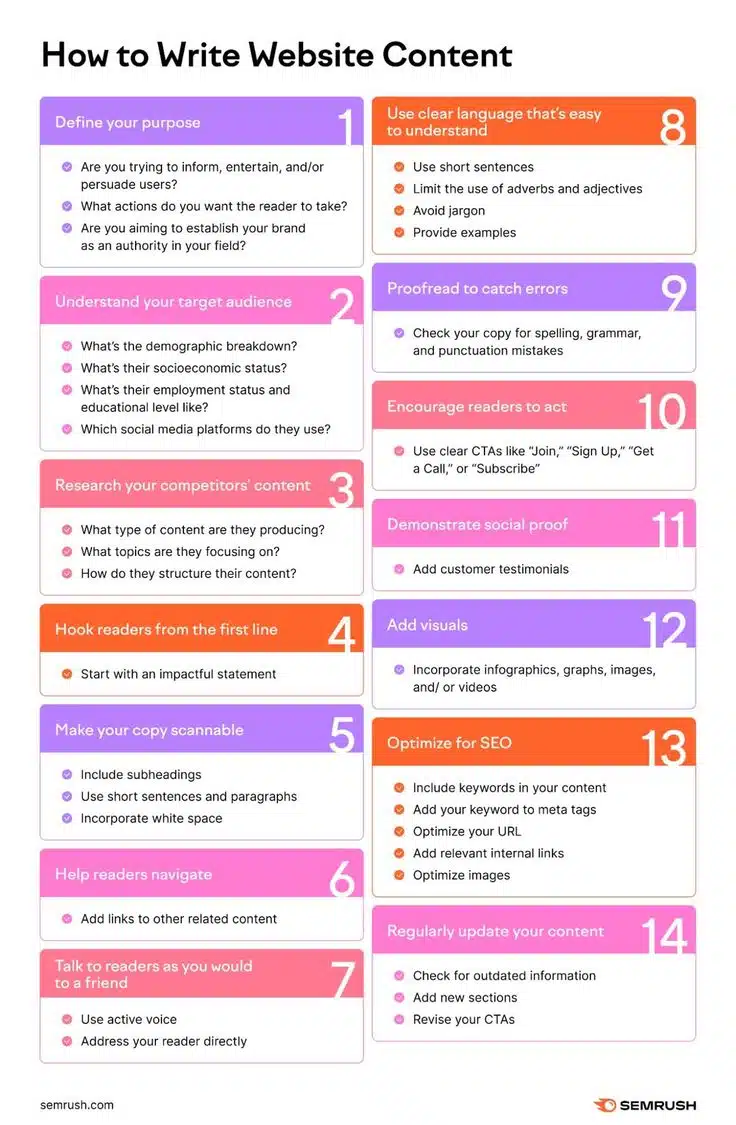
Creating website content that both ranks well in search engines and converts visitors into customers isn’t just about clever words or stuffing in keywords. It’s a balance of strategy, clarity, and purpose—designed to meet the needs of both your users and the algorithms that serve them.
Whether you’re building a new site or updating an old one, strong content is essential to achieving real business results. In this post, we’ll guide you through each step of writing high-impact content that delivers traffic and drives action.
Define Your Purpose
Every piece of content needs a clear objective before you begin writing. Without a defined purpose, your messaging can feel scattered or unfocused, making it harder to engage users or rank effectively. Are you educating, entertaining, persuading, or prompting a specific action? Clarifying your intent is the foundation of content that converts.
- Determine whether your goal is to inform, entertain, or sell
- Decide what action you want the reader to take next
- Align your tone and structure with your business objectives
- Position your brand as a trusted expert in your field
Understand Your Target Audience
Knowing your audience is critical if you want your content to resonate. What matters to a 25-year-old freelancer might not matter to a 55-year-old executive—and your language, tone, and examples should reflect that. Before you write, gather as much insight as possible about who you’re writing for and what they care about.
- Identify demographic details like age, gender, and location
- Understand their professional status, education, and goals
- Explore which platforms and devices they prefer to use
- Research their pain points, motivations, and decision-making style
Research Your Competitors’ Content
Looking at what your competitors are doing gives you a benchmark—and a springboard to outperform them. By analysing their structure, topics, and tone, you can spot what’s working in your niche and what gaps you could fill. This helps you avoid duplication and carve out a unique position online.
- Identify your top-ranking competitors in search results
- Evaluate the type and depth of content they publish
- Take note of their tone, CTAs, and visual elements
- Look for missed opportunities or topics they’ve overlooked
Hook Readers from the First Line
Online attention spans are short—if you don’t grab interest instantly, readers will bounce. The first line of your content is prime real estate for making an impact, asking a compelling question, or leading with a bold claim. Great hooks spark curiosity and make users want to keep scrolling.
- Open with a striking statistic or surprising fact
- Ask a relatable or provocative question
- Use vivid language to set the scene
- Keep it concise and relevant to the page topic
Make Your Copy Scannable
People don’t read website content like a book—they scan it for key points. Structuring your content with short paragraphs, subheadings, and white space improves readability and keeps users engaged. Scannable content also increases the chances that important messages are seen and remembered.
- Break up text with subheadings every 2–4 paragraphs
- Use bullet points and numbered lists to summarise key ideas
- Keep sentences short and paragraphs under five lines
- Add spacing between sections to guide the eye
Help Readers Navigate
Good content doesn’t exist in isolation—it connects to the rest of your website. Linking to other relevant pages gives users more context, boosts SEO, and reduces bounce rates. Internal links help structure your site more logically and keep visitors engaged for longer.
- Link naturally to supporting blog posts or service pages
- Use descriptive anchor text that reflects the linked page’s content
- Avoid overloading a paragraph with multiple links
- Make sure all links open quickly and correctly
Talk to Readers as You Would to a Friend
Formal, robotic language turns users off. Instead, speak to your readers with warmth, clarity, and directness—as though you’re having a one-to-one conversation. This tone builds trust and makes your content feel more approachable, persuasive, and human.
- Use an active voice to sound clear and confident
- Address your reader directly with “you” and “your”
- Avoid overuse of passive constructions and corporate jargon
- Let your personality shine through while staying professional
Use Clear Language That’s Easy to Understand
Clarity is everything when it comes to website copy. If users don’t understand what you’re offering—or how to take the next step—they’ll leave. Strive to make your writing simple, punchy, and accessible to a wide range of readers.
- Keep sentences short and to the point
- Avoid using jargon or overly technical terms
- Limit the use of unnecessary adverbs or adjectives
- Explain complex ideas using everyday examples
Proofread to Catch Errors
Spelling and grammar mistakes damage credibility and disrupt the user experience. Even the best ideas can be overshadowed by sloppy execution, so proofreading is a vital step before hitting publish. It ensures your content is polished, professional, and easy to trust.
- Read your content out loud to catch awkward phrasing
- Use tools like Grammarly or Hemingway for a second pass
- Check for consistency in tone, punctuation, and spelling
- Ask a colleague to review with fresh eyes
Encourage Readers to Act
Your content must guide readers toward a clear next step. Whether it’s making a purchase, signing up for a newsletter, or contacting your team, a strong call to action (CTA) is essential. Make it obvious, specific, and hard to ignore.
- Use CTAs like “Get a Quote,” “Download the Guide,” or “Subscribe Now”
- Place CTAs strategically throughout the page—not just at the end
- Keep CTA buttons clear, visible, and action-oriented
- Test different CTA phrases to see what gets results
Demonstrate Social Proof
Visitors are more likely to trust your business if they see others have had a good experience. Social proof builds credibility and helps reduce hesitation, particularly when someone is close to making a decision. Even one strong testimonial can tip the balance in your favour.
- Add brief testimonials from happy customers
- Highlight well-known clients or partners if applicable
- Include metrics like “5,000+ customers served”
- Show star ratings or review scores from trusted platforms
Add Visuals
Good content isn’t just about words—images, videos, and graphics can clarify concepts and make your page more engaging. Visuals also help break up large sections of text, keeping users scrolling instead of skimming. They support your message and improve retention.
- Use high-quality images that reinforce your points
- Incorporate charts or infographics to visualise data
- Add explainer videos for complex processes or products
- Use consistent branding in all visual content
Optimise for SEO
To rank well on search engines, your content needs to follow proven SEO principles. This means using the right keywords, structuring pages correctly, and ensuring all elements—like images and meta tags—are properly optimised. Good SEO not only brings in traffic, it brings in the right traffic.
- Include your target keyword in the title, URL, and headings
- Use internal links to related pages on your site
- Add alt text to images with relevant keywords
- Write compelling meta descriptions that drive clicks
Regularly Update Your Content
Publishing content isn’t the final step—keeping it updated is just as important. Search engines prefer fresh, accurate content, and users will bounce quickly from outdated information. Regularly reviewing your website helps you stay relevant and competitive.
- Set a schedule to review and refresh content quarterly
- Update statistics, facts, and service descriptions as needed
- Add new CTAs based on your current marketing goals
- Expand content that’s ranking well to improve conversions
Conclusion
Writing website content that both ranks and converts requires more than clever wordplay—it’s about purpose, clarity, structure, and continual improvement.
From researching your audience to crafting strong CTAs and optimising for SEO, each step plays a part in helping your site perform better. When done right, your content becomes more than words on a page—it becomes a powerful tool that brings people in, earns their trust, and moves them to act.
Let your content work harder for you—one well-written page at a time.

Author:
Mark Ford