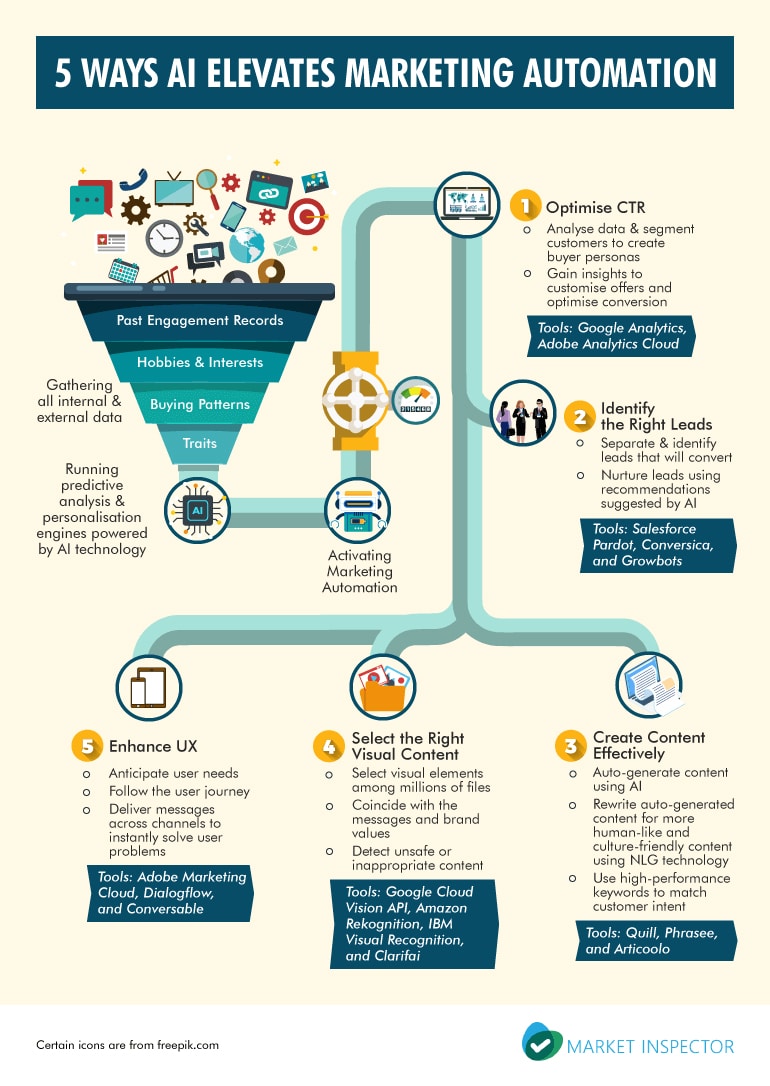
Are you looking for ways to improve your marketing automation strategy? Want to know how artificial intelligence can improve your marketing automation efforts?
Market Inspector share their tools you should try in this infographic.
They show you how to achieve the following goals:
- Optimise CTR
- Identify the right leads
- Create content effectively
- Select the right visual content
- Enhance UX
Check out the infographic for more detail.
Marketing automation has become a critical part of efficient, scalable business strategies. Yet, as competition intensifies, it’s crucial to do more than just automate repetitive tasks; leveraging artificial intelligence (AI) can elevate your automation strategy, making it smarter, more personalized, and more impactful. With AI, brands can better understand customer behaviors, predict preferences, and drive more meaningful engagements. Below, we’ll explore how AI can enhance marketing automation in five core areas: optimizing click-through rates (CTR), identifying the right leads, creating content effectively, selecting the best visual content, and enhancing user experience (UX).
Optimise CTR
For small businesses, optimizing click-through rates (CTR) is essential in maximizing the effectiveness of marketing efforts, as higher CTRs indicate that content is resonating with the audience and encouraging engagement. With AI-driven tools, small businesses can achieve precision in targeting, personalization, and timing—all key factors in boosting CTR. Here’s a closer look at actionable steps and strategies that small businesses can implement.
- Deep Audience Segmentation for Targeted Messaging
- Leverage Behavioral Data: AI tools can gather and analyze data such as user browsing habits, previous purchases, and interactions with past campaigns. By segmenting audiences based on these behaviors, small businesses can create tailored messages that resonate with each unique group.
- Create Niche Segments: Instead of broad demographics (e.g., age or location), segment users into more specific groups based on interests, shopping behavior, or engagement history. For instance, segmenting users who frequently open email promotions but haven’t made a purchase can help you craft messages that specifically address what might be holding them back.
- Use Dynamic Content: AI can help small businesses dynamically change content in real time to match user preferences. For example, if a customer has a history of browsing a particular product category, they can automatically receive messages highlighting similar products or special offers related to that category.
- Personalization Through AI-Driven Insights
- Personalized Email Content: AI-powered tools can personalize email subject lines, greetings, and body text, making each email feel more personal and relevant. This could be as simple as addressing the recipient by name, or as advanced as recommending specific products based on their browsing history.
- Customized Product Recommendations: For e-commerce businesses, personalized product recommendations can significantly boost CTR. AI algorithms analyze user behavior to identify products that align with each user’s preferences. For example, if a customer recently bought a camera, the AI might suggest accessories or complementary items in follow-up emails.
- Hyper-Localized Offers: Personalization doesn’t have to be limited to product recommendations. Small businesses with a local presence can offer location-based deals using AI-powered geo-targeting. This could involve sending an email promoting in-store discounts when customers are in close proximity to the business location.
- Continuous A/B Testing and Optimization
- Automate A/B Testing: AI can continuously test multiple variations of subject lines, calls-to-action, images, and other elements. It quickly identifies which elements lead to higher CTRs and automatically adjusts campaigns accordingly.
- Granular Insights: Traditional A/B testing often provides limited insight, such as which email version performed better. However, AI-powered A/B testing tools dig deeper, offering insights into why one version performed better, allowing small businesses to continuously improve.
- Test Headlines, Timing, and Visuals: Test different types of email headlines, sending times, and images to determine which combination gets the most clicks. For example, an email headline that’s friendly and conversational might outperform a formal, sales-focused headline, depending on the audience.
- Optimal Timing and Predictive Send Times
- Use Predictive Send Times: AI algorithms can analyze a customer’s previous engagement times to identify patterns, suggesting the best times to reach out. For example, if a customer consistently opens emails in the early evening, AI can automatically time the next email to arrive at that hour.
- Seasonal and Event-Based Timing: AI can identify seasonal trends and help small businesses schedule messages around key events, holidays, or even personal milestones like birthdays. These timely interactions feel relevant and can boost CTRs, as customers are more likely to respond when the message aligns with their current needs or interests.
- Real-Time Adjustments: AI can also adjust timing based on real-time factors like recent web interactions. If a customer browsed the website without making a purchase, AI can trigger an immediate follow-up email or SMS reminder to encourage them to take action.
- Crafting Compelling Calls-to-Action (CTAs) with AI Insight
- A/B Test CTA Wording: AI can help test and refine CTAs to find language that resonates with customers. For instance, a “Learn More” CTA might be more effective for informational content, while “Shop Now” could drive clicks for product-focused campaigns.
- Dynamic and Contextual CTAs: AI allows businesses to tailor CTAs dynamically based on context. If a user is browsing winter products, the CTA could say “Stay Warm with Our Winter Collection” instead of a generic “Shop Now.”
- Experiment with CTA Placement and Style: AI can help identify optimal CTA placement within emails or web pages by analyzing user click patterns. For instance, a “floating” CTA button that moves as users scroll might lead to higher engagement on mobile devices.
- Boosting CTR on Social Media Channels
- Analyze Post Timing and Frequency: AI can help identify peak engagement times for each platform, allowing businesses to schedule posts when users are most active. This can also inform decisions on how frequently to post without overwhelming followers, helping optimize the balance between visibility and engagement.
- Optimize Content Format: Use AI insights to determine the best content format for each platform, such as text-only posts, images, carousels, or videos. For instance, if the data shows that videos have higher engagement rates, focus more on video content for social media campaigns.
- Targeted Ads for Increased Engagement: AI can optimize ad targeting by predicting which users are most likely to engage with specific content. Instead of a general ad, an AI-driven ad platform can target users with high engagement scores, increasing CTR for social ads.
- Utilizing Predictive Analytics for Content Optimization
- Behavioral Predictions: Predictive analytics tools can analyze a user’s behavior patterns to anticipate future needs and preferences, helping businesses design content that’s more likely to resonate with specific audience segments.
- Adaptive Content Strategies: AI can dynamically adapt content based on user engagement and feedback. For example, if a user consistently clicks on educational resources, the system can adjust future messages to include more informative content, building a more engaged audience.
- Real-Time Adjustment of Content Based on Engagement Metrics: If a campaign isn’t achieving expected CTRs, AI can analyze where users drop off and adjust the content. This allows small businesses to course-correct mid-campaign, optimizing messages to encourage more clicks.
Key Takeaways for Small Businesses
Using AI to optimize CTR enables small businesses to engage their audiences in a highly personalized and effective manner. By leveraging deep audience insights, predictive timing, dynamic content, and continuous optimization, small businesses can ensure that their marketing efforts reach the right people with the right message at the right time.
Implementing AI for CTR optimization doesn’t have to be overwhelming. Start by choosing an AI-powered marketing platform that integrates well with your existing tools, and gradually explore its capabilities. Testing personalized email subject lines, trying out predictive send times, and analyzing which visuals perform best can all have a significant impact on your CTR.
With time and data, AI can help you fine-tune your approach, creating a feedback loop that continually boosts CTR while delivering better engagement and results for your business.
Identify the Right Leads
For small businesses, identifying the right leads is crucial to ensure that marketing efforts are directed at prospects who are most likely to convert. By focusing on high-quality leads, businesses can optimize resources, reduce acquisition costs, and improve overall conversion rates. AI-powered tools offer small businesses advanced capabilities to qualify and prioritize leads efficiently. Here are key steps and strategies to enhance lead identification with AI.
- Automate Lead Scoring for Better Qualification
- Use AI-Driven Lead Scoring Models: Traditional lead scoring assigns values to leads based on static criteria (e.g., location, industry). However, AI-powered lead scoring tools go further by analyzing real-time behavioral data, such as website visits, email opens, and social media interactions. This provides a more accurate, dynamic score that reflects a lead’s current interest and engagement level.
- Assign Scores Based on Engagement and Fit: AI tools can assign scores based on two main factors: engagement (how often a lead interacts with your content) and fit (how well a lead matches your ideal customer profile). By scoring leads on both factors, businesses can prioritize highly engaged leads who are also an ideal fit.
- Refine Scoring Criteria Over Time: AI algorithms continuously learn from past lead data, refining the scoring criteria over time to reflect patterns associated with successful conversions. This ensures that the scoring model evolves alongside changing customer behaviors, helping small businesses stay relevant in their lead prioritization.
- Utilize Predictive Analytics to Forecast Conversion Potential
- Analyze Historical Data: AI-powered predictive analytics can analyze historical customer data, identifying traits and behaviors associated with conversions. This information helps predict which new leads are likely to convert based on patterns observed in past buyers.
- Forecast Lifetime Value (LTV): For many small businesses, understanding a lead’s potential lifetime value is as important as short-term sales potential. AI tools can estimate the LTV of leads by analyzing similar customer profiles, helping businesses focus on leads that might contribute to long-term growth.
- Optimize Marketing Efforts for High-Potential Leads: Knowing which leads are more likely to convert allows small businesses to allocate marketing resources more effectively. For instance, businesses can invest in targeted campaigns for high-potential leads while using nurturing strategies to engage those who are less likely to convert immediately.
- Implement Behavioral Segmentation for Personalized Outreach
- Segment Leads by Behavior: Behavioral segmentation involves categorizing leads based on their actions, such as visiting a particular product page or opening multiple emails. AI tools can identify patterns in these behaviors to create segments, allowing for more tailored messaging.
- Trigger Specific Campaigns Based on Behavior: AI-driven automation can trigger campaigns when leads take certain actions, such as abandoning a shopping cart or visiting the pricing page. For example, leads who spend significant time on product comparison pages might be segmented into a group that receives content focused on features and benefits.
- Leverage AI-Driven Retargeting: Behavioral data can also guide retargeting efforts. For example, if a lead has visited a product page several times without making a purchase, AI can help craft personalized ads that showcase reviews, testimonials, or limited-time offers to encourage conversion.
- Identify High-Quality Leads Using Social Listening Tools
- Monitor Social Media Engagement: AI-powered social listening tools analyze user interactions on social media to uncover leads that may not be on your immediate radar. Look for individuals discussing topics relevant to your business or industry and engage them with informative or helpful responses.
- Identify Key Influencers and Advocates: Small businesses can use AI to identify potential influencers or advocates within their audience. These individuals may have a following or demonstrate influence in a particular niche, making them ideal candidates for collaboration or customer referrals.
- Gauge Sentiment for Targeted Messaging: AI can analyze sentiment in social media comments or reviews, giving businesses insight into the tone and intent behind customer conversations. Positive sentiment can indicate warm leads open to engagement, while neutral or slightly negative sentiment might require a different approach, such as providing educational content to build trust.
- Refine the Ideal Customer Profile (ICP) with AI Insights
- Analyze Customer Data for Better ICP: AI helps small businesses analyze large datasets, enabling them to refine the ideal customer profile based on real customer data rather than assumptions. Factors like demographics, purchase history, and average transaction value can help build a more accurate ICP.
- Identify Common Characteristics of High-Value Leads: By analyzing historical data, AI can identify shared traits among high-value customers, such as specific behaviors, interests, or geographic locations. This allows businesses to focus on leads with similar attributes, increasing the likelihood of successful conversions.
- Adjust ICP Based on Real-Time Data: With AI, small businesses can update their ICP in real-time to reflect current market trends, economic conditions, or changing customer preferences. This dynamic approach ensures that lead targeting remains relevant as the business environment evolves.
- Use AI-Driven Lead Generation on Website and Chatbots
- Implement AI Chatbots for 24/7 Engagement: Chatbots powered by AI can engage with website visitors around the clock, qualifying leads and answering questions. By analyzing visitor interactions, chatbots can identify leads with high intent, transferring them to a human team member if needed.
- Analyze Chatbot Conversations for Insights: AI tools can review chatbot conversations to identify frequently asked questions, common objections, and other insights into lead needs. This information helps businesses refine messaging and better understand what resonates with potential customers.
- Capture and Qualify Leads through Interactive Content: Interactive content, such as quizzes, calculators, or assessments, can be highly effective in generating leads. AI can analyze responses to qualify leads based on their answers, scoring them automatically based on engagement and intent.
- Automate Lead Nurturing for Long-Term Relationship Building
- Create Nurturing Campaigns for Different Stages of the Funnel: AI can automate nurturing sequences for different stages of the customer journey, delivering educational content to top-of-funnel leads and more conversion-focused content to those at the bottom. This keeps leads engaged and moving through the funnel.
- Set Up Triggers Based on Lead Actions: AI can automatically send follow-up messages based on lead behavior, such as visiting a key webpage or downloading a resource. For instance, if a lead downloads a whitepaper, an AI-driven tool can automatically send them a follow-up email with related resources.
- Score Leads Throughout the Nurturing Process: AI can continuously update lead scores based on their actions throughout the nurturing process. If a lead becomes more engaged over time, they may receive a higher score and move to a priority list for sales outreach.
Key Takeaways for Small Businesses
Using AI to identify the right leads is a powerful way for small businesses to refine their marketing efforts, target potential high-value customers, and optimize conversion rates. By leveraging AI for lead scoring, predictive analytics, behavioral segmentation, and real-time lead engagement, small businesses can improve the quality of leads, ensuring that their marketing resources are directed at the most promising prospects.
The journey of lead identification is iterative, requiring ongoing adjustments as more data becomes available and as AI models learn. Starting with automated lead scoring, predictive analytics, and segmentation will allow small businesses to experience the immediate benefits of AI, while refining their ideal customer profile and nurturing strategies over time will create a well-rounded, effective approach to lead generation.
With AI tools integrated into their lead identification strategies, small businesses can not only reach the right leads but also engage them at the perfect time with personalized messages that truly resonate, increasing the likelihood of conversion and building lasting customer relationships.
Create Content Effectively
Content creation is a cornerstone of any marketing strategy. For small businesses, crafting the right content can help build brand awareness, foster trust, and ultimately convert prospects into customers. However, the challenge often lies in doing this effectively and at scale. Artificial Intelligence (AI) has emerged as a game-changer, helping businesses create high-quality content faster, more efficiently, and with a level of personalization that resonates with their audience.
Here are some key strategies for small businesses to create content effectively using AI-powered tools.
- Leverage AI for Content Ideation
- AI-Powered Topic Generation: AI tools like BuzzSumo, Answer the Public, or even Google Trends use machine learning to analyze what people are searching for across the web. These tools provide insights into trending topics, frequently asked questions, and pain points in your industry. Small businesses can use these insights to craft relevant and engaging content that addresses what their audience is already interested in.
- Customer-Driven Ideas: AI can also scan customer queries, emails, and feedback on social media to identify recurring questions or concerns. By addressing these issues in blog posts, FAQs, or instructional videos, small businesses can provide real value to their audience and position themselves as a solution provider.
- AI Content Generators for Inspiration: AI tools such as ChatGPT, Jasper, or Copy.ai can generate initial content ideas or even assist with drafting outlines and articles. These tools use natural language processing (NLP) to understand your business and generate tailored suggestions for your content strategy.
- Automate Content Creation for Speed and Consistency
- AI for Blog Writing and Article Generation: AI-powered writing assistants can help small businesses create long-form content like blog posts or whitepapers in a fraction of the time. These tools analyze your input (topic, keywords, target audience) and generate structured, coherent, and SEO-optimized content. For example, ChatGPT can create an outline for a blog post, then expand it into full text with just a few prompts.
- Streamline Product Descriptions and Landing Pages: AI can quickly generate engaging and accurate product descriptions, allowing businesses to maintain consistency and scalability in their content efforts. Whether it’s for eCommerce sites or landing pages, AI can automate the writing process to ensure content is both informative and compelling.
- Repurposing Content: Small businesses can use AI to transform existing content into new formats, such as converting blog posts into social media snippets, podcasts, infographics, or videos. This not only saves time but also helps extend the reach of content across multiple platforms.
- Personalize Content for Better Engagement
- Segment Content for Different Audiences: AI can help businesses segment their audience based on behavior, demographics, and interests. With this data, businesses can create hyper-targeted content tailored to each segment’s specific needs. For example, an AI tool can track how a visitor interacts with your website and deliver content recommendations based on their past behavior.
- Dynamic Content Personalization: AI enables dynamic content delivery. For example, using personalization engines on your website, you can adjust headlines, images, and calls to action based on the visitor’s behavior or preferences. If a returning visitor has previously looked at specific products, AI can surface content that is most relevant to their past interests, improving the chances of conversion.
- AI-Driven Email Personalization: AI can analyze customer behavior to generate personalized email content. For instance, AI can suggest personalized subject lines, tailor email content to a user’s preferences, and even recommend products based on previous purchases or browsing behavior. Tools like Mailchimp and ActiveCampaign use AI to help craft personalized email marketing campaigns that are more likely to engage and convert.
- Optimize Content for SEO
- AI for Keyword Research: AI-powered SEO tools like SEMrush, Moz, or Ahrefs help small businesses find the most relevant keywords for their industry, target audience, and competition. AI can identify long-tail keywords, search intent, and trending topics that should be incorporated into your content strategy.
- Content Optimization: AI tools can also optimize existing content for SEO by suggesting the best keywords, backlinks, and content improvements. Tools like SurferSEO or MarketMuse use AI to scan your content and provide recommendations on how to improve keyword usage, heading structures, and content depth to rank higher in search results.
- AI Content Gap Analysis: One of the unique features of AI is its ability to conduct a content gap analysis. AI can help identify gaps in your content strategy by comparing your website’s content with competitor websites. These tools will suggest topics that you haven’t yet covered, giving you a roadmap for content creation.
- Refine Content with AI-Driven Editing Tools
- Grammar and Style Checkers: AI tools like Grammarly, Hemingway, or ProWritingAid can help small businesses refine their written content. These tools analyze content for grammar, spelling, readability, tone, and structure, ensuring that the content is not only error-free but also engaging and easy to read.
- Maintain Brand Voice: AI tools can be trained to understand your brand’s unique voice and writing style. By inputting a few examples of past content, businesses can create a consistent tone that matches their brand identity across all content pieces. This ensures that all content resonates with the intended audience and reinforces brand consistency.
- Automate Editing for Multiple Formats: Whether you’re writing for blogs, social media, or emails, AI can assist with the editing process by suggesting changes for specific formats. For example, AI can recommend shortening sentences for tweets or highlighting key points for an infographic. This ensures your content is optimized for the specific medium.
- Use AI to Improve Visual Content Creation
- AI Tools for Graphic Design: Tools like Canva, Crello, and Adobe Express use AI to help small businesses create stunning visuals, even without a graphic design background. These platforms offer AI-powered templates, layouts, and design suggestions that are customizable, helping you produce high-quality visuals with minimal effort.
- AI-Based Image and Video Enhancement: AI can enhance images or videos to make them more eye-catching or relevant to your audience. For example, AI can automatically adjust the color, contrast, or brightness of images to make them more visually appealing. Additionally, AI can help with video editing, including cutting unnecessary sections, adding transitions, or improving audio quality.
- Generate Visual Content from Text: With AI tools like DALL·E, businesses can create visuals directly from written prompts. If you need a specific image to match your blog or social media post, AI can generate high-quality visuals that align with the tone and message of your content.
- Measure Content Performance with AI Analytics
- Track Content Engagement: AI can provide detailed analytics on how your content is performing across different channels. AI tools can track key metrics like click-through rates (CTR), time on page, bounce rates, and social shares, helping businesses understand what resonates with their audience and what needs improvement.
- Optimize Content Based on Data: AI can analyze engagement data and suggest content adjustments. For example, if a certain type of content (e.g., blog posts or videos) is driving higher engagement, AI can suggest producing more of that content in the future. It can also help businesses identify underperforming content and recommend changes to increase its impact.
- Predict Content Trends: AI tools like Google Analytics or social listening tools use predictive analytics to forecast trends. By analyzing past data, AI can identify emerging content trends, helping small businesses stay ahead of the curve and tailor their content to future demand.
Key Takeaways for Small Businesses
Creating content effectively in today’s competitive digital landscape requires more than just creativity and effort; it requires smart tools that can optimize the entire process. AI empowers small businesses to streamline content creation, optimize for SEO, personalize for better engagement, and measure content performance to continually improve results.
By incorporating AI into the content creation process, small businesses can:
- Speed up content production without sacrificing quality.
- Ensure personalization that connects deeply with target audiences.
- Optimize for SEO to rank higher and increase visibility.
- Enhance visuals and design with AI-powered tools that improve the aesthetics and effectiveness of content.
- Track and analyze content performance, adapting quickly to achieve better results.
Integrating AI into content creation doesn’t mean completely replacing human creativity. Instead, it enhances and accelerates the process, allowing small businesses to focus more on strategic tasks while automating repetitive tasks. With AI as a reliable partner, small businesses can create content that resonates with their audience, boosts engagement, and drives conversions.
Select the Right Visual Content
Visual content plays a crucial role in capturing attention, increasing engagement, and driving conversions for small businesses. In today’s highly competitive digital environment, it’s essential to not only create visually appealing content but to also ensure that it aligns with your brand identity and resonates with your target audience. Artificial Intelligence (AI) can be an invaluable tool in streamlining the process of selecting the right visual content, optimizing its effectiveness, and enhancing its impact.
Here’s an in-depth guide on how small businesses can use AI to select and leverage the right visual content in their marketing strategies:
- Understand Your Audience’s Preferences
- Audience Behavior Insights: AI-powered tools can help small businesses gather valuable data on their audience’s preferences and behavior. Platforms like Google Analytics and social media insights provide information about what types of visual content (images, videos, infographics, etc.) resonate best with your target audience. For example, AI can track which visual content gets the most engagement (likes, shares, comments, etc.) on your website or social channels.
- Audience Segmentation: AI can segment your audience based on demographics, behavior, and interests. With this segmentation, small businesses can create highly targeted visual content for each group. For example, younger audiences may engage more with bright, playful graphics or memes, while a more professional audience might prefer sleek, minimalistic designs. By analyzing the data, AI helps you choose visuals that match your audience’s tastes.
- A/B Testing Visual Content: AI tools like Optimizely or VWO allow businesses to conduct A/B tests to see how different types of visual content perform with various audience segments. By testing different styles, formats, and colors, you can identify what type of visual content resonates most with your customers, allowing for more data-driven content selection.
- Leverage AI for Visual Content Creation
- Design Automation Tools: AI-powered design tools like Canva, Crello, and Adobe Express offer pre-made templates and design suggestions based on user preferences and industry trends. These tools use AI to suggest layouts, fonts, color schemes, and graphics that align with your brand’s style and messaging. Small businesses can use these platforms to quickly create high-quality visuals that are aesthetically pleasing and effective without needing a graphic design team.
- Personalization of Visuals: AI tools can personalize visuals based on user behavior or preferences. For example, if an AI tool detects that a visitor has previously interacted with a specific product category on your website, it can automatically suggest related images or videos to display. Personalizing visual content in this way increases its relevance, leading to higher engagement and conversions.
- Generate Visuals from Text: AI tools like DALL·E or RunwayML allow businesses to generate custom visuals from written descriptions. If you need specific imagery to match your blog post, social media campaign, or ad, you can input descriptive text and let the AI create high-quality visuals that match your needs. This can be especially useful when you need unique imagery without the time or cost associated with custom photography or graphic design.
- Ensure Consistency with Brand Identity
- AI Brand Guidelines: Maintaining brand consistency is essential for small businesses, and AI can help ensure that your visuals align with your established brand guidelines. Tools like Frontify use AI to help businesses create and enforce brand guidelines that outline the appropriate use of colors, fonts, logos, and imagery. By using AI-generated templates and suggestions, small businesses can create consistent visual content that strengthens their brand identity across all platforms.
- Automated Image Enhancement: AI tools can help refine images to ensure they meet your brand’s standards. For example, AI can automatically adjust the brightness, contrast, saturation, and sharpness of photos, making them look professional and polished without manual editing. These tools can also resize images to fit various platforms, ensuring that visuals look great on social media, websites, or email marketing campaigns.
- Visual Storytelling: AI can assist small businesses in using visuals to tell a cohesive story across multiple channels. Whether through a series of Instagram posts, a video, or a long-form blog, AI can suggest imagery that ties into the narrative and aligns with the overall message. By using visuals strategically, businesses can enhance their storytelling, improving audience connection and engagement.
- Optimize Visual Content for Different Platforms
- Platform-Specific Recommendations: Different social media platforms, websites, and email newsletters have unique requirements for visual content. For example, Instagram is more focused on square or vertical images, while Twitter favors horizontal images and GIFs. AI-powered tools like Lumen5 and Animoto can optimize your videos and images to fit platform-specific dimensions and specifications automatically, saving you time and ensuring your content looks great across all channels.
- AI-Powered Image Cropping and Resizing: AI tools such as Fotor and Snappa automatically crop and resize images based on the platform they’re intended for. These tools can detect the most important elements in an image and adjust the framing accordingly, ensuring that your visuals are perfectly optimized for each platform’s layout.
- Video Optimization: AI tools like Magisto and Promo use machine learning algorithms to optimize videos for specific platforms, ensuring the content is visually appealing and delivers the right message. For example, these tools can automatically adjust the pacing of a video for different social media platforms (e.g., a fast-paced edit for Instagram and a slower-paced version for YouTube).
- Use Visual Content to Improve Engagement
- Visual Content as a Hook: People are more likely to engage with content that includes a compelling visual. AI can analyze engagement metrics across platforms and suggest visuals that have the potential to capture attention. For example, AI tools can identify which color schemes, image compositions, or design styles generate the highest engagement rates and recommend visuals that align with these insights.
- Create Emotionally Resonant Visuals: Certain visuals are more likely to evoke emotions like happiness, trust, or excitement. AI-powered tools can analyze images and predict how they will make an audience feel based on factors like color psychology, facial expressions, and visual composition. For small businesses, selecting visuals that evoke the right emotions can help foster a stronger connection with your audience and improve engagement.
- Infographics and Data Visualizations: AI can help small businesses create stunning and informative infographics. Tools like Piktochart and Visme use AI to turn data into visually compelling graphics that are easy to digest and share. Infographics and data visualizations are highly engaging because they simplify complex information, making it more accessible and appealing to your audience.
- AI for Image Recognition and Optimization
- AI-Powered Image Search: AI-powered image recognition tools like Google Vision or Clarifai can analyze your images and suggest alternative images that are similar in theme, style, or subject. This helps businesses select the right visual content based on context and ensures that the images align with specific keywords or themes.
- SEO for Visual Content: Just as with written content, AI can help optimize visual content for search engines. AI-powered SEO tools can analyze images and suggest improvements like adding alt text, optimizing file names, and compressing images for faster loading times. This not only improves the user experience but also helps images rank in search results, driving more organic traffic to your website.
- Stay Ahead of Trends with AI-Driven Insights
- Predictive Visual Content Trends: AI tools like Trendalytics and WGSN use machine learning to track and predict visual content trends. Small businesses can use these tools to stay ahead of design trends and ensure their visuals are fresh, modern, and aligned with current preferences.
- Competitive Visual Content Analysis: AI can also be used to track your competitors’ visual content. Tools like SpyFu or SEMrush can analyze the types of visuals your competitors are using and how well they’re performing, providing insights into visual content strategies that are working in your industry.
Key Takeaways for Small Businesses
Selecting the right visual content is essential for creating an engaging and effective marketing strategy. AI can help small businesses:
- Understand their audience: AI analyzes audience behavior to help select visuals that resonate with different customer segments.
- Streamline design creation: AI-powered tools make it easier to create consistent, branded visuals quickly and at scale.
- Optimize content for platforms: AI can adjust visuals to fit the specifications of different platforms, ensuring that they look great everywhere.
- Improve engagement: AI identifies visuals that evoke emotion and boost engagement, creating a stronger connection with your audience.
- Stay ahead of trends: AI tools track industry trends and provide insights into visual content that is likely to perform well.
By incorporating AI into the visual content selection process, small businesses can create more engaging, relevant, and personalized visuals, boosting their overall marketing effectiveness and helping them stand out in a crowded digital space.
Enhance UX
User experience (UX) is critical in today’s digital landscape. For small businesses, providing a seamless, intuitive, and enjoyable user experience on their websites, apps, and digital interfaces can significantly impact engagement, conversion rates, and customer retention. AI can play a key role in improving UX by offering insights into user behavior, automating certain processes, and personalizing the experience. Below are several strategies and tips on how small businesses can use AI to enhance UX and create a more satisfying experience for their users.
- Personalize the User Experience
- AI-Driven Personalization: One of the most powerful ways AI enhances UX is through personalization. AI can analyze user data, such as browsing history, demographic information, and past interactions, to offer personalized content and product recommendations. For example, Amazon uses AI to suggest products based on a customer’s previous searches or purchases. Small businesses can use AI-driven tools like Dynamic Yield or Optimizely to personalize their website content, product suggestions, and offers for each user, improving engagement and conversion rates.
- Dynamic Content Customization: AI can dynamically change the content displayed to users based on their preferences, behavior, or location. For instance, if a user is visiting a website for the first time, AI can greet them with a tailored introduction, offer a special first-time visitor discount, or show them content based on their geographical location. This dynamic content presentation ensures that users feel that the website or app is specifically designed to meet their needs, enhancing their overall experience.
- Behavioral Triggering: AI can track user behavior in real-time, identifying when a user is about to abandon a page, leave the website, or make a purchase. Based on this data, AI can trigger personalized messages or offers to keep the user engaged. For example, if a user adds a product to their cart but doesn’t complete the checkout, AI can send a personalized reminder or offer a discount code to encourage them to complete the purchase.
- Improve Website Navigation and Search
- AI-Powered Search Engines: AI can enhance the on-site search function by providing more accurate and relevant search results. AI-powered search engines like Elasticsearch and Algolia can understand user intent better than traditional search systems, delivering more precise results even if users make spelling mistakes or use vague search terms. This leads to a smoother and more efficient search experience for users, making it easier for them to find what they’re looking for without frustration.
- Voice Search Integration: As voice search becomes increasingly popular, AI can help small businesses optimize their websites for voice queries. By using natural language processing (NLP) and machine learning, AI can enhance the voice search experience on your site, ensuring that it understands and processes user queries accurately. This is particularly important for users who prefer speaking to typing, allowing businesses to cater to this growing trend in consumer behavior.
- Intelligent Navigation Menus: AI tools can help improve website navigation by analyzing how users interact with a site. Based on these insights, AI can optimize the placement and structure of the navigation menu, making it more intuitive and accessible. For instance, if AI detects that users are often searching for a specific category, it might automatically adjust the navigation menu to highlight that category, making it easier for users to find relevant content or products.
- Simplify User Onboarding
- AI Chatbots and Virtual Assistants: One of the most effective ways to enhance UX is through the use of AI-powered chatbots and virtual assistants. These tools can engage users in real-time, answer questions, provide product recommendations, and even guide users through complex processes such as sign-up or checkout. Chatbots like Drift or Intercom are designed to create smooth onboarding experiences by interacting with users in a natural, conversational way. They help reduce friction and assist users in completing tasks more efficiently, ensuring a better experience from the first interaction.
- Progressive Onboarding: AI can improve onboarding by offering progressive tutorials that adapt to the user’s behavior. For example, instead of bombarding new users with an overwhelming amount of information upfront, AI can deliver bite-sized tutorials that only appear when the user reaches a relevant step in the process. This ensures that users are not overwhelmed and that they only receive the information they need at the right time.
- Personalized Onboarding Flows: AI can also be used to personalize the onboarding experience based on user behavior. If the AI detects that a user is a returning visitor, it can skip introductory steps and guide them directly to more advanced features. Alternatively, if a user is new to your site or app, the AI can offer an introductory guide that highlights key features and benefits, ensuring they get started without confusion.
- Improve Page Load Speed and Mobile Optimization
- AI-Based Performance Optimization: Website load time is a critical factor in user experience. Slow load times can frustrate users and drive them away. AI tools like Cloudflare and Google’s PageSpeed Insights analyze website performance and offer AI-driven recommendations to reduce load times. For example, AI can suggest image optimization, script deferment, or caching strategies to speed up the site, ultimately providing users with a faster and smoother experience.
- Mobile-Friendly Design: With an increasing number of users browsing websites on mobile devices, it’s essential for small businesses to have a mobile-optimized site. AI can help identify how users interact with the mobile version of your site and recommend adjustments to improve the mobile UX. For example, AI tools can assess whether buttons are too small, whether content is properly spaced for touch, or if the page layout is responsive. AI can then suggest design changes to make the mobile experience more intuitive and user-friendly.
- Predictive Load Speed: Some AI tools can predict the speed of a page load based on past user interactions, network conditions, and device types. By predicting slow-loading pages, AI can preemptively load critical resources to ensure the user’s experience is not hindered. This is especially helpful for e-commerce sites, where faster page loading can directly impact sales.
- Leverage AI for Continuous UX Improvement
- User Feedback Analysis: AI can help small businesses continuously improve their UX by analyzing user feedback at scale. Tools like MonkeyLearn or Qualtrics use sentiment analysis to scan reviews, surveys, and support tickets, extracting insights about what users like or dislike about their experience. By monitoring feedback in real-time, AI enables businesses to make data-driven decisions about which aspects of the UX need attention.
- Heatmaps and Session Recordings: AI tools like Hotjar or Crazy Egg use heatmaps and session recordings to understand user behavior on your site. AI analyzes where users are clicking, scrolling, or abandoning the site, providing actionable insights into how to improve the layout, content placement, and navigation. For example, if AI detects that users are repeatedly clicking on an image expecting it to be clickable, businesses can modify the design to meet user expectations, thus improving the UX.
- Continuous A/B Testing: AI can automate A/B testing of various UX elements, such as button placements, page layouts, and calls to action (CTAs). With AI-based tools like Google Optimize or VWO, small businesses can run experiments and test different versions of their site to determine which version provides the best user experience. These tools can analyze large amounts of user data in real-time, making it easier to optimize your site iteratively based on user preferences.
- Accessibility and Inclusivity
- AI-Powered Accessibility Enhancements: AI tools can help small businesses make their websites more accessible to users with disabilities. For example, AI-powered features such as voice recognition, screen readers, and real-time captions make websites more accessible to visually impaired or hearing-impaired users. Tools like AccessiBe use AI to analyze your website and make it more compliant with accessibility standards, ensuring that users with disabilities can navigate and interact with your site effectively.
- Language Translation: AI-driven language translation tools like Google Translate can help break down language barriers and make your website more inclusive for a global audience. By offering automatic translation of website content, small businesses can ensure that non-native speakers can easily understand and interact with your site, improving overall UX.
Key Takeaways for Small Businesses
Enhancing UX is essential for small businesses that want to increase user satisfaction, boost conversions, and build long-term customer loyalty. AI provides a wealth of opportunities to improve UX by:
- Personalizing the experience: AI can deliver tailored content and product recommendations based on user behavior and preferences.
- Streamlining navigation: AI improves site search functionality, voice search, and intelligent navigation, making it easier for users to find what they’re looking for.
- Simplifying onboarding: AI-powered chatbots, personalized onboarding flows, and progressive tutorials help users get started quickly and easily.
- Improving performance: AI tools optimize page load speed, ensure mobile responsiveness, and predict slow-loading pages, providing a faster experience.
- Continuous improvement: AI helps small businesses gather user feedback, analyze behavior, and conduct A/B testing to make iterative improvements.
By using AI to enhance UX, small businesses can create a more seamless, personalized, and enjoyable digital experience for their users, ultimately leading to increased satisfaction, higher engagement, and improved business outcomes.
Conclusion
Integrating AI into your marketing automation strategy offers transformative potential across many facets of marketing. From optimizing CTR and identifying promising leads to creating compelling content, selecting the best visuals, and enhancing UX, AI-driven insights enable marketers to move beyond basic automation, fostering deeper customer connections and maximizing campaign efficiency. As AI continues to evolve, it will play an increasingly pivotal role in making marketing automation more intelligent, responsive, and effective. By embracing AI, you can position your brand as a forward-thinking player in an ever-competitive landscape, delivering personalized and engaging experiences that drive growth and long-term success.

Author:
Mark Ford