Want to understand how customers move from discovering your brand to making a purchase? Looking for practical ways to optimise each stage of your marketing funnel for better results?
You’ll find some marketing basics in this infographic.
Here’s a summary of what’s covered:
- Awareness
- Interest
- Consideration
- Conversion
Check out the post below for more.
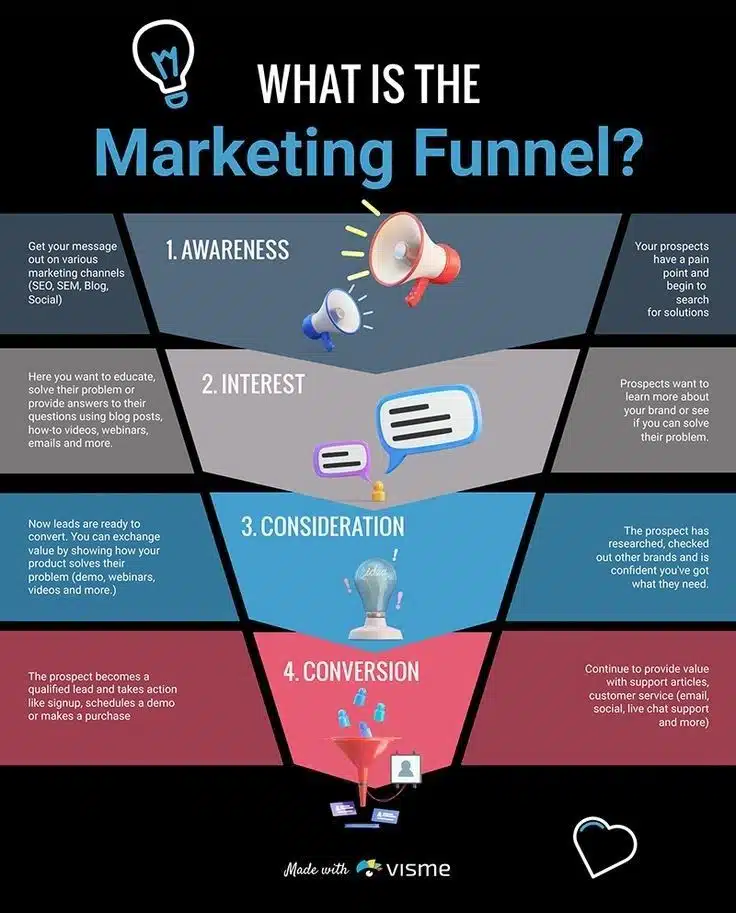
The marketing funnel is one of the most important frameworks in any successful marketing strategy. It maps out the journey your customers take from discovering your brand to finally making a purchase.
By understanding each stage of this funnel, you can deliver the right message at the right time and increase your chances of turning interest into action. In this post, we break down each stage of the marketing funnel and show you how to optimise it for better results.
Awareness
At the top of the funnel is awareness, where potential customers first come into contact with your brand. This is when they realise they have a problem or need and begin searching for solutions. Your goal at this stage is to get noticed—ideally before your competitors do. Visibility across multiple channels is key to building recognition and planting the seed for future engagement.
- Leverage SEO and PPC: Optimise your website and run search ads to appear when users are researching their problems.
- Invest in social media content: Post consistently on platforms your audience uses to stay top of mind and build brand familiarity.
- Use blog content to attract interest: Publish educational or thought-provoking articles that address common pain points.
- Collaborate with influencers or partners: Tap into existing audiences through influencer campaigns or content partnerships.
Interest
Once a prospect is aware of your brand, they move into the interest stage. Here, they start to evaluate whether your product or service could be a possible solution to their problem. Your role is to provide valuable content that deepens their interest and builds trust, without pushing too hard for a sale.
- Create detailed blog posts and guides: Offer real solutions to their problems in the form of how-to content or comprehensive tutorials.
- Host webinars and video explainers: Use multimedia content to engage visual learners and present your value proposition clearly.
- Send helpful email newsletters: Share curated content that keeps your brand top-of-mind and gently educates readers over time.
- Encourage interaction: Use polls, comment prompts, and surveys to invite feedback and build a connection with your audience.
Consideration
At the consideration stage, your prospect has done some research and is weighing up their options. They may be comparing you to your competitors, reading reviews, or watching demos. This is your chance to showcase what makes you different and why your offer is the best solution for their specific needs.
- Provide comparison guides: Help them decide with honest comparisons between your product and others in the market.
- Offer live or recorded product demos: Show exactly how your product works and highlight features that solve their core problems.
- Publish customer testimonials and case studies: Let real success stories do the talking to build social proof and credibility.
- Make it easy to reach out: Provide clear calls to action, quick contact forms, and responsive customer service for further questions.
Conversion
This is the bottom of the funnel—where interest becomes action. Your prospect is now ready to make a decision, and everything you’ve done so far has led them to this point. The goal here is to make conversion as simple, reassuring, and compelling as possible.
- Streamline your checkout or signup process: Minimise friction by reducing steps and eliminating unnecessary fields.
- Use urgency and social proof: Highlight limited-time offers or showcase how many others have purchased to encourage quick action.
- Provide guarantees or risk-reducers: Offer money-back guarantees, free trials, or clear return policies to overcome hesitation.
- Follow up immediately: Send confirmation emails and follow-up messages to reassure customers and open the door to further engagement.
Conclusion
The marketing funnel is more than just a visual model—it’s a powerful framework for attracting, nurturing, and converting leads. By understanding each stage and what your prospects need as they move through the funnel, you can build stronger relationships and drive better results.
Focus on delivering value, solving problems, and making decisions easier at every step. With a well-optimised funnel, your marketing efforts will be more efficient, more effective, and more profitable.
Let us know how you’re optimising your funnel—or get in touch if you’d like help refining your customer journey.

Author:
Mark Ford