Are you looking for simple ways to make your marketing content flow more smoothly? Want to learn how sequence words can keep your readers engaged from start to finish?
You’ll find some copywriting basics in this infographic.
Here’s a summary of what’s covered:
- Introduction
- Beginning
- Middle
- Interruption (Something Unexpected)
- Ending
Check out the post below for more.
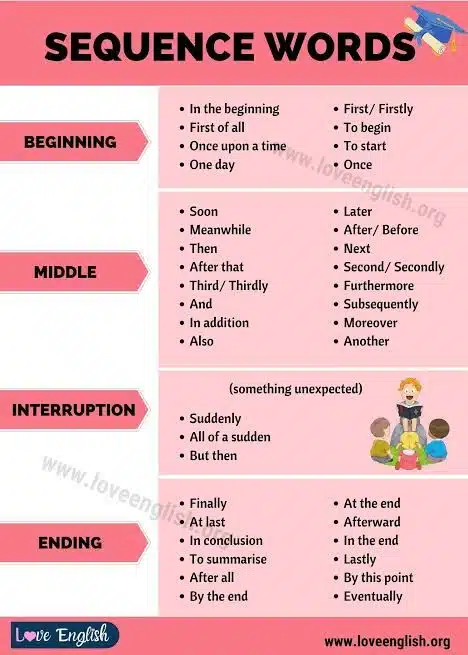
When it comes to marketing content, flow matters as much as the message. If your writing feels disjointed, your audience will quickly lose interest. That’s where sequence words come in.
These simple but powerful connectors make your copy smoother, more persuasive, and easier to read—whether you’re writing a blog, a landing page, or an email campaign.
Beginning
First impressions count in business writing. The right sequence words at the start help you guide readers into your message without confusion. They signal the opening of your content and establish a professional, structured flow. By using them correctly, you ensure your audience is engaged from the first line.
- Use “In the beginning” or “First of all” to open marketing copy with clarity.
- Try “To start” or “Firstly” when introducing a list of benefits.
- Add “Once” or “One day” in storytelling-based content to set the scene.
- Signal direction with “To begin” when explaining a process or strategy.
Middle
The middle of your copy is where your message builds momentum. This is often where businesses lose their readers if the flow is weak. Sequence words keep content structured and make it easy for your audience to follow each point. They help transition between features, benefits, and supporting details seamlessly.
- Use “Next” or “Then” to move readers through your service benefits.
- Add “In addition” or “Also” to highlight extra features without sounding repetitive.
- Employ “Meanwhile” or “Later” when showing progression in a client story or case study.
- Strengthen copy with “Furthermore” or “Moreover” when emphasising key advantages.
Interruption (Something Unexpected)
Marketing content often needs to grab attention with something surprising. Sequence words that mark interruption are perfect for doing this. They show a shift in tone, highlight an unexpected benefit, or introduce a contrast your reader didn’t see coming. This creates impact and makes your copy more memorable.
- Use “Suddenly” to spotlight a dramatic benefit or market change.
- Insert “But then” to show how your service solves an unexpected problem.
- Try “All of a sudden” in storytelling-style campaigns for added punch.
- Deploy these sparingly to avoid over-dramatising your message.
Ending
Your conclusion is what your readers remember, and sequence words make it smooth and persuasive. They help you wrap up your content with authority and guide the audience toward your call to action. Strong endings are especially vital in sales copy, blog posts, and email campaigns.
- Use “Finally” or “At last” when closing with a key benefit or solution.
- Add “In conclusion” or “To summarise” for blog post wrap-ups.
- Write “By the end” or “At the end” to set expectations in case studies.
- Finish with “Lastly” or “Eventually” to signal your final call to action.
Why Sequence Words Improve Marketing Content
In marketing, clarity equals conversion. Sequence words make your copy easy to read and help you maintain attention. They act as guideposts that show prospects exactly where you’re taking them. Without them, content risks becoming clunky, confusing, and less persuasive.
- They ensure landing pages and blogs flow logically.
- They improve email campaigns by guiding readers through benefits.
- They reduce friction in long-form sales copy, keeping attention high.
- They make content sound professional, polished, and credible.
How to Choose the Right Sequence Words
Different sequence words work better for different marketing contexts. Choosing the right one makes your copy sound natural and persuasive. If the tone is too formal or casual, it can create a disconnect with your audience. Being intentional about word choice keeps your message aligned with your brand voice.
- Match sequence words to tone: use formal words for B2B, conversational ones for B2C.
- Avoid repetition by mixing up your transitions across a page.
- Use storytelling-friendly words in brand stories and case studies.
- Test variations in your content to see which improves engagement.
Common Mistakes to Avoid with Sequence Words
Even helpful tools can be misused, and sequence words are no exception. If they’re overused or inserted awkwardly, they weaken your content. Many business owners and marketers make these mistakes without realising, which can result in copy that feels forced or unnatural.
- Don’t overload your copy with sequence words—only use them where needed.
- Avoid mixing storytelling-style openers with corporate sales copy.
- Ensure each word adds meaning instead of filling space.
- Always proofread to check flow and eliminate clunky transitions.
Using Sequence Words in Blogs and Articles
Blogs are an excellent place to practise sequence word mastery. Readers expect clarity, structure, and logical flow, and sequence words deliver exactly that. By using them effectively, you’ll keep visitors engaged and reduce bounce rates. Structured blogs also help with SEO by making content easier to scan.
- Start blog sections with “Firstly” or “To begin with” to introduce points.
- Move through supporting details with “Next” or “In addition.”
- Add depth with “Furthermore” or “Moreover” to expand on benefits.
- Wrap up with “To summarise” or “Finally” before your call to action.
Using Sequence Words in Sales Copy
Sales copy thrives on momentum. Each sentence should lead naturally into the next, pulling the reader toward a buying decision. Sequence words help create that momentum, turning features into benefits and objections into solutions. Without them, your sales copy risks losing its persuasive power.
- Use “First” or “To start” when introducing your product’s main benefit.
- Add “Then” or “Next” to guide prospects through features.
- Highlight extras with “Also” or “In addition” for bonus offers.
- Close with “Finally” or “At last” when moving into your call to action.
Using Sequence Words in Email Marketing
Emails need to be concise but also engaging, which makes sequence words invaluable. They help you structure short messages so they’re easy to follow. They can also add rhythm, encouraging readers to keep scrolling down to the CTA. Used well, they make campaigns sharper and more persuasive.
- Start with “First of all” or “To begin” to introduce the main point.
- Use “Next” or “After that” when guiding readers through a short sequence.
- Add “But then” or “Suddenly” to highlight a pain point your solution fixes.
- Finish with “Finally” or “To summarise” before your closing line.
Practical Tips for Mastering Sequence Words
Like any writing technique, using sequence words effectively takes practice. They should enhance your content, not distract from it. The best way to master them is by reading widely, editing carefully, and testing variations in your marketing campaigns. Over time, they’ll become a natural part of your writing flow.
- Read your copy aloud to check if transitions sound smooth.
- Vary your sequence words to avoid repetition and monotony.
- Analyse competitor content to see how they guide readers.
- Rewrite old content using stronger sequence words to improve flow.
Conclusion
For business owners and marketers, clarity in communication is everything. Sequence words might seem small, but they have a big impact on how well your content flows. They make blogs easier to read, sales copy more persuasive, and emails more engaging.
By mastering them, you’ll keep your audience hooked from the first line to the final call to action—making your marketing more effective at every stage.

Author:
Mark Ford