So, you’re working on your SEO, you’ve tried every “trick” in the book, but you just can’t get your site onto page one of Google?
In the digital age, where nearly every business has an online presence, search engine optimization (SEO) is crucial for success. Google, as the leading search engine, plays a significant role in driving organic traffic to websites.
If your website isn’t on page 1 of Google’s search results, you’re likely missing out on a substantial amount of potential traffic and revenue. In this blog post, we’ll discuss 15 common SEO mistakes that could be killing your rankings and preventing your website from reaching that coveted first page of Google.
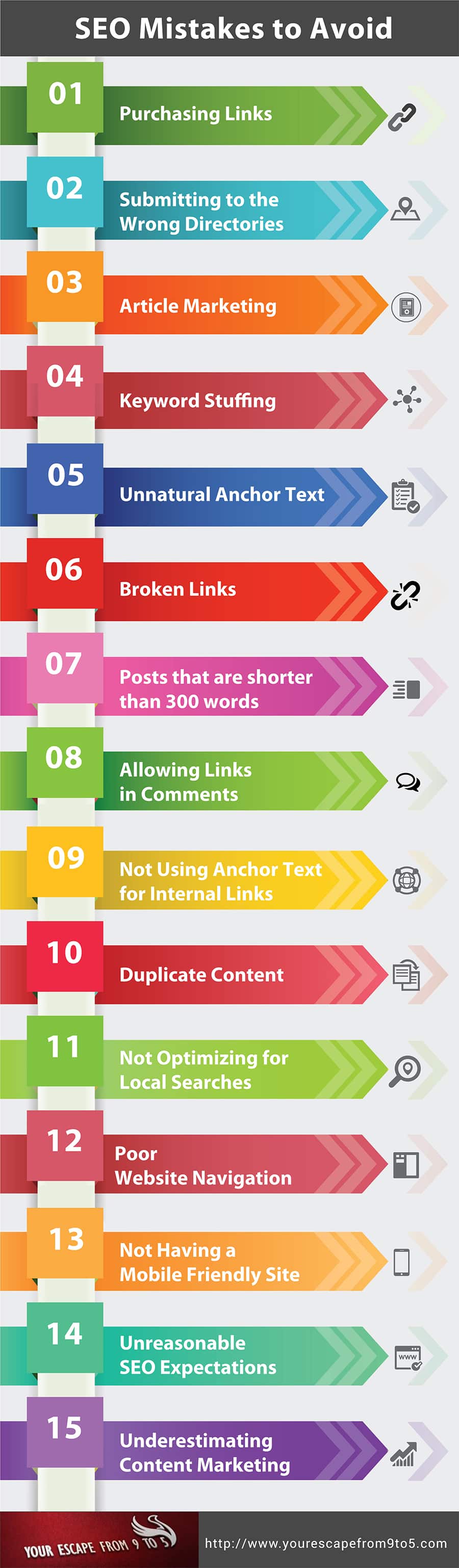
Your Escape From 9 to 5 share some of the tactics that do more harm than good in this infographic.
1. Neglecting Keyword Research
One of the fundamental aspects of SEO is understanding the keywords your target audience uses when searching for products or services like yours. Neglecting keyword research means you might be optimizing for the wrong terms or missing out on high-traffic keywords. To avoid this mistake, invest time in thorough keyword research using tools like Google Keyword Planner, SEMrush, or Ahrefs. Identify relevant keywords and incorporate them strategically into your content.
2. Overlooking On-Page SEO
On-page SEO encompasses a wide range of elements, including optimizing titles, meta descriptions, headers, and content. Neglecting these on-page factors can significantly impact your search rankings. Make sure each page on your website has a unique and descriptive title and meta description that includes relevant keywords. Use headers (H1, H2, H3, etc.) to structure your content logically and make it more readable for both users and search engines.
3. Ignoring Mobile Optimization
With the increasing use of mobile devices for browsing, Google now prioritizes mobile-friendly websites in its rankings. If your site isn’t mobile-responsive, it’s likely to be penalized in search results. Ensure that your website is fully optimized for mobile devices to provide a seamless user experience and improve your search engine rankings.
4. Slow Page Loading Speed
Page loading speed is a critical factor in SEO. If your website takes too long to load, users are likely to bounce, leading to a high bounce rate and lower search engine rankings. You can use tools like Google’s PageSpeed Insights to analyze and improve your website’s loading speed. Compress images, enable browser caching, and use a content delivery network (CDN) to speed up your website.
5. Ignoring Technical SEO Issues
Technical SEO issues can significantly impact your website’s search engine rankings. These issues may include broken links, duplicate content, improper use of canonical tags, and poor website structure. Regularly audit your site for technical issues and fix them promptly to ensure optimal SEO performance.
6. Neglecting Content Quality
Content is king in the world of SEO. If your content isn’t high-quality, informative, and engaging, it won’t perform well in search results. Avoid thin or duplicate content, and strive to create valuable content that addresses the needs and interests of your target audience. Invest in content that provides solutions, answers questions, and establishes your expertise in your niche.
7. Not Utilizing Backlinks Effectively
Backlinks, or inbound links from other websites to yours, play a crucial role in SEO. However, some website owners make the mistake of focusing solely on quantity rather than quality when it comes to backlinks. Low-quality, spammy backlinks can harm your website’s reputation and rankings. Instead, focus on earning high-quality, relevant backlinks from authoritative sources in your industry.
8. Ignoring Local SEO
If your business serves a specific geographic area, local SEO is essential. Neglecting local SEO practices, such as optimizing your Google My Business profile, managing online reviews, and creating location-specific content, can prevent your website from ranking well in local search results. Ensure that your website is fully optimized for local searches to attract local customers.
9. Not Monitoring Analytics
Failing to monitor your website’s performance through analytics is a common SEO mistake. Analytics tools like Google Analytics provide valuable insights into user behavior, traffic sources, and more. Regularly review your website’s analytics to identify areas for improvement and track the effectiveness of your SEO efforts.
10. Keyword Stuffing
Keyword stuffing is an outdated and black-hat SEO practice that involves overloading content with keywords in an attempt to manipulate search engine rankings. Google’s algorithms have become more sophisticated and can detect keyword stuffing easily. Instead of trying to stuff keywords, focus on natural and relevant keyword usage that enhances the user experience.
11. Neglecting User Experience
User experience (UX) is a crucial factor in SEO. If users have a poor experience on your website, they are likely to leave quickly, resulting in a higher bounce rate and lower rankings. Ensure that your website is easy to navigate, mobile-responsive, and visually appealing. Improve page load times, and provide valuable and relevant content to keep users engaged.
12. Skipping Image Optimization
Images are an important part of web content, but they can also slow down your website if not optimized correctly. Neglecting image optimization can impact your website’s loading speed and user experience. Compress images, use descriptive file names, and add alt text to help search engines understand the content of your images and improve your chances of ranking in image search results.
13. Not Optimizing for Voice Search
As voice-activated devices become more prevalent, optimizing for voice search is becoming increasingly important. People often use different language patterns when speaking than when typing queries into a search engine. Consider the conversational nature of voice search and optimize your content to address common voice search queries.
14. Failing to Update Content Regularly
Outdated content can hurt your website’s SEO rankings. Google rewards fresh and up-to-date content. Make it a regular practice to update and refresh your existing content to ensure its relevance and accuracy. Additionally, consistently publishing new content can signal to search engines that your website is active and authoritative in your niche.
15. Not Investing in SEO Long-Term
SEO is not a one-time effort but an ongoing process. Some website owners make the mistake of thinking that once they’ve optimized their site, they can forget about it. However, search engine algorithms and user behavior change over time, so it’s essential to stay up-to-date with SEO best practices and continue to invest in your SEO strategy for long-term success.
In conclusion, achieving and maintaining a high ranking on Google’s search results requires a strategic and consistent approach to SEO. Avoiding these common SEO mistakes can help improve your website’s visibility and organic traffic, ultimately leading to better online success. Remember that SEO is a dynamic field, and staying informed about the latest trends and best practices is crucial for long-term success in the digital landscape.

Author:
Mark Ford