Do you want to generate more traffic to your business website? Wondering whether you should invest in search engine optimisation (SEO) or pay per click marketing (PPC)?
In the digital age, driving targeted traffic to your website is paramount for online success. Whether you’re running an e-commerce store, a blog, or a business website, the competition for online visibility is fierce. To stand out and attract potential customers, you need a solid strategy.
Two of the most popular methods for generating targeted website traffic are Search Engine Optimization (SEO) and Pay-Per-Click (PPC) advertising.
Both SEO and PPC have their strengths and weaknesses, and understanding how they work can help you make an informed decision about which approach is right for your specific goals and circumstances. In this comprehensive guide, we’ll dive deep into the world of SEO and PPC, exploring their key differences, advantages, and disadvantages.
By the end of this article, you should have a clear understanding of which method is better suited for your website’s unique needs.
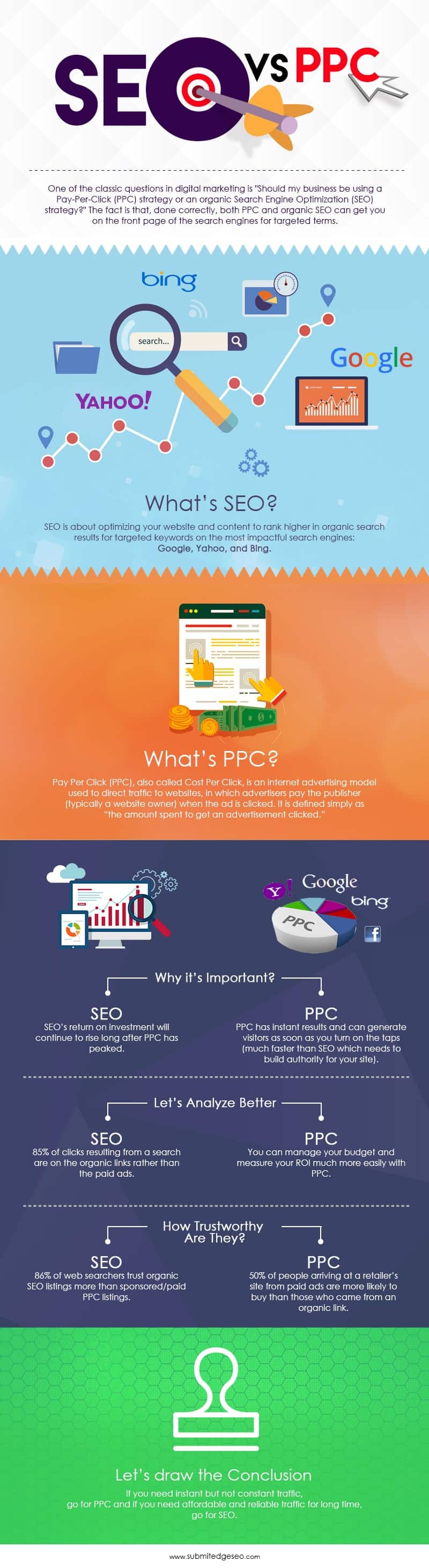
Submit Edge SEO look at the advantages of each in this infographic.
Chapter 1: Understanding SEO
Search Engine Optimization (SEO) is the process of optimizing your website and its content to rank higher in search engine results pages (SERPs) organically. The goal is to increase your website’s visibility and attract more organic (unpaid) traffic. Here’s a closer look at how SEO works:
1.1 Keyword Research
Keyword research is the foundation of any successful SEO strategy. It involves identifying the keywords and phrases that your target audience is searching for on search engines like Google. There are various tools available, such as Google Keyword Planner and SEMrush, that can help you discover relevant keywords with sufficient search volume.
1.2 On-Page SEO
On-page SEO focuses on optimizing individual web pages to rank higher in search results. This includes optimizing meta tags (title and description), using relevant keywords in your content, improving page load times, and ensuring mobile-friendliness. The aim is to provide a great user experience while signaling to search engines that your content is valuable and relevant.
1.3 Off-Page SEO
Off-page SEO encompasses activities outside your website that influence your rankings. Link building is a crucial aspect of off-page SEO, where you aim to acquire high-quality backlinks from reputable websites. Social media presence and online reputation management also fall under this category.
1.4 Technical SEO
Technical SEO involves optimizing the technical aspects of your website to make it more search engine-friendly. This includes optimizing site speed, improving mobile responsiveness, and ensuring proper website architecture. Addressing technical issues can significantly impact your website’s performance in search results.
1.5 Content Creation
High-quality, relevant content is a cornerstone of SEO. Regularly publishing informative, engaging, and keyword-optimized content not only helps your website rank better but also keeps your audience engaged and coming back for more.
1.6 SEO Benefits
- Cost-Effective: Unlike PPC, SEO doesn’t require you to pay for each click. Once your website ranks well, organic traffic is essentially free.
- Long-Term Strategy: SEO efforts can provide long-lasting results. Once you establish your website’s authority and rankings, it’s easier to maintain and build upon them.
- Trust and Credibility: High organic rankings are seen as an endorsement of your website’s quality and credibility.
Chapter 2: Understanding PPC
Pay-Per-Click (PPC) advertising is a digital marketing strategy where advertisers pay a fee each time their ad is clicked. This method allows you to buy visits to your website rather than earning them organically. Here’s a closer look at how PPC works:
2.1 Keyword Selection
Similar to SEO, keyword selection is vital in PPC. You bid on keywords relevant to your business, and your ads are displayed when users search for those specific terms. The bid amount, ad quality, and relevance determine the ad’s position in search results.
2.2 Ad Creation
Creating compelling and relevant ad copy is crucial in PPC. Your ad should resonate with users and entice them to click. Well-crafted ad headlines and descriptions, along with eye-catching visuals, can make a significant difference in the success of your PPC campaign.
2.3 Budget Management
With PPC, you set a daily or monthly budget, ensuring you don’t overspend on advertising. You only pay when someone clicks on your ad, and you can adjust your budget and bidding strategy as needed to control costs.
2.4 Ad Placement
PPC ads can appear at the top of search results (above organic listings), on other websites within the Google Display Network, or on social media platforms. Ad placement depends on your campaign goals and targeting options.
2.5 Tracking and Analytics
PPC offers robust tracking and analytics tools that allow you to monitor the performance of your ads in real-time. You can track metrics such as click-through rate (CTR), conversion rate, and return on investment (ROI) to optimize your campaigns for better results.
2.6 PPC Benefits
- Immediate Results: PPC can generate traffic and leads quickly. Once your campaign is set up, ads can start running within hours.
- Targeted Audience: You have precise control over who sees your ads based on demographics, location, interests, and more.
- Scalability: You can increase or decrease your PPC budget as needed, making it a flexible option for businesses of all sizes.
Chapter 3: SEO vs. PPC: A Detailed Comparison
Now that we have a solid understanding of how both SEO and PPC work, let’s compare these two strategies across various dimensions to help you make an informed decision:
3.1 Cost
One of the most significant differences between SEO and PPC is the cost structure. SEO is typically considered more cost-effective in the long run, as it doesn’t involve paying for each click. However, it’s essential to note that SEO requires a considerable upfront investment in terms of time, resources, and possibly hiring an SEO expert or agency.
PPC, on the other hand, offers more immediate results but comes with a direct cost for each click. The cost per click (CPC) can vary widely depending on competition for keywords and industry. Small businesses with limited budgets may find PPC expenses challenging to manage.
3.2 Time
SEO is a long-term strategy that often takes months to yield significant results. It requires ongoing efforts, such as creating and optimizing content, building backlinks, and monitoring your website’s performance. Patience is essential when it comes to SEO, as it may take time to see a return on your investment.
In contrast, PPC can generate traffic and leads almost instantly. Once you set up your PPC campaign, your ads can start appearing in search results, driving immediate traffic to your website. This makes PPC a viable option for businesses looking for quick results or those running time-sensitive promotions.
3.3 Traffic Quality
Both SEO and PPC can generate targeted traffic, but there are differences in the quality of that traffic:
- SEO traffic is considered high-quality because it’s organic and driven by users actively searching for information or products related to your website. However, the conversion rate may vary, as users’ intent can range from research to purchase.
- PPC traffic can also be highly targeted, especially when you select relevant keywords and demographics. Since users are clicking on your ads, they often have a higher intent to take a specific action, such as making a purchase or filling out a contact form.
3.4 Click-Through Rate (CTR)
CTR is an essential metric in both SEO and PPC, but it’s measured differently:
- In SEO, CTR refers to the percentage of users who click on your organic search result when they see it in the search results. A higher CTR indicates that your meta title and description are compelling and relevant to users’ queries.
- In PPC, CTR represents the percentage of users who click on your ads when they’re displayed. A higher PPC CTR indicates that your ad copy and targeting are effective in attracting clicks.
3.5 Sustainability
SEO’s sustainability lies in its ability to generate organic traffic over the long term. Once you’ve established authority and rankings, you can maintain them with ongoing optimization efforts. However, search engine algorithms and competition can change, requiring continuous adaptation.
PPC campaigns are sustainable as long as your budget allows. As long as you have the funds to run your campaigns, you can continue generating traffic. The sustainability of PPC is directly tied to your advertising budget and strategy.
3.6 Competition
Competition in both SEO and PPC can vary depending on your industry and niche:
- SEO competition is fierce in many industries, and ranking on the first page of Google can be challenging. It often requires significant time and effort to outperform competitors in organic search.
- PPC competition can also be intense, especially for highly competitive keywords. Advertisers bid against each other for ad placement, and the cost per click can increase significantly in competitive markets.
3.7 Return on Investment (ROI)
ROI is a critical metric for assessing the effectiveness of both SEO and PPC campaigns:
- In SEO, calculating ROI can be more challenging due to the long-term nature of the strategy. It may take time to see a positive ROI, but once achieved, it can be substantial as organic traffic continues to flow without ongoing ad spend.
- In PPC, ROI is more immediate and measurable. You can track the cost of clicks and the revenue generated from those clicks, allowing you to calculate ROI more directly. However, managing and optimizing PPC campaigns effectively is essential to ensure a positive ROI.
Chapter 4: When to Choose SEO
Now that we’ve explored the key differences between SEO and PPC, let’s discuss when it’s advisable to choose SEO as your primary traffic generation strategy:
4.1 Long-Term Goals
If you have long-term business goals and are willing to invest in building a sustainable online presence, SEO is an excellent choice. It may take several months or even years to achieve top rankings, but once you do, you can benefit from a consistent stream of organic traffic without ongoing advertising costs.
4.2 Limited Budget
For businesses with limited budgets, SEO can be a cost-effective solution. While it requires an initial investment, ongoing expenses are relatively low compared to PPC. If you can’t afford the recurring costs of PPC advertising, SEO allows you to attract organic traffic without daily ad spend.
4.3 Content Marketing Strategy
If your content marketing strategy is central to your online presence, SEO is a natural fit. High-quality, informative content that aligns with user search intent can help your website rank well in organic search results. SEO and content marketing go hand in hand, creating a synergistic approach to attracting and engaging your target audience.
4.4 Niche or Authority Building
If you’re in a niche industry or aiming to establish authority in your field, SEO is essential. Ranking well in organic search results can enhance your credibility and position you as an industry leader. Users often trust organic listings more than paid ads, making SEO a valuable strategy for building trust and authority.
4.5 Content Quality
If you’re committed to creating high-quality content that serves the needs of your audience, SEO can help you reach a wider audience. Optimizing your content for relevant keywords and user intent can drive organic traffic to your valuable resources, increasing their visibility and impact.
Chapter 5: When to Choose PPC
Now, let’s explore scenarios in which choosing PPC as your primary traffic generation strategy makes sense:
5.1 Immediate Results
If you need immediate results and want to drive traffic to your website quickly, PPC is the way to go. With PPC advertising, you can set up campaigns and start getting clicks within hours, making it ideal for time-sensitive promotions or product launches.
5.2 Limited Time and Resources
If you have limited time or resources to invest in SEO’s long-term efforts, PPC offers a more manageable and straightforward approach. You don’t need to worry about content creation, backlink building, or algorithm updates. PPC allows you to focus on ad creation, targeting, and budget management.
5.3 Highly Competitive Keywords
In industries with extremely competitive keywords, it can be challenging to rank well in organic search results through SEO alone. PPC offers a way to compete for top positions in search results by outbidding competitors. It allows you to gain visibility for high-value keywords that may be challenging to rank for organically.
5.4 Seasonal Promotions
If your business relies on seasonal promotions or specific events, PPC can be an effective strategy. You can create targeted ad campaigns tailored to the timing and theme of your promotions, ensuring that you capture relevant traffic during peak periods.
5.5 Precise Targeting
If you want precise control over who sees your ads, PPC offers advanced targeting options. You can narrow down your audience based on demographics, location, interests, and more. This level of targeting can help you reach your ideal customers with precision.
Chapter 6: Combining SEO and PPC for Maximum Impact
While SEO and PPC are often discussed as separate strategies, they can be powerful when used together. Here’s how you can combine these two approaches for maximum impact:
6.1 Keyword Synergy
Identify high-performing keywords from both your SEO and PPC efforts. Use the data from your PPC campaigns to inform your SEO keyword strategy and vice versa. This synergy can help you optimize your content for keywords that not only rank well but also convert effectively through PPC.
6.2 Testing and Refinement
Use PPC campaigns to test ad copy, landing page designs, and various marketing messages. Once you identify what resonates with your audience and leads to conversions, apply these insights to your SEO strategy. This iterative approach can improve both your organic and paid marketing efforts.
6.3 Enhanced Visibility
By running both SEO and PPC campaigns simultaneously, you can increase your overall visibility in search results. Your website can appear in both organic and paid listings, which can reinforce your online presence and credibility in the eyes of users.
6.4 Addressing Competitive Gaps
Monitor your competitors’ strategies in both SEO and PPC. Identify areas where they may be outperforming you, and adjust your approach accordingly. This proactive stance can help you stay competitive and capture market share.
6.5 Remarketing
Leverage PPC for remarketing campaigns. If a user visits your website through organic search but doesn’t convert, you can retarget them with relevant PPC ads. This approach can help you re-engage users and guide them towards a conversion.
Conclusion
In the ongoing debate of SEO vs. PPC, there’s no one-size-fits-all answer. Your choice between these two strategies should be based on your specific business goals, budget, timeline, and competition. Both SEO and PPC have their unique strengths and can be powerful tools for generating targeted website traffic.
In summary, here are key takeaways to help you decide:
Choose SEO if:
- You have long-term business goals and are willing to invest in sustainable organic traffic.
- You have limited advertising budget and prefer a cost-effective approach.
- Content marketing is a central part of your strategy.
- You’re in a niche or aiming to build authority in your industry.
- You’re committed to creating high-quality, informative content.
Choose PPC if:
- You need immediate results and want to drive traffic quickly.
- You have limited time and resources for ongoing SEO efforts.
- Your industry is highly competitive, and organic rankings are difficult to attain.
- Your business relies on seasonal promotions or specific events.
- You require precise audience targeting for your campaigns.
In many cases, a combination of both SEO and PPC can yield the best results. By strategically integrating these approaches, you can enhance your online presence, reach a broader audience, and achieve your business objectives more effectively. Ultimately, the decision should align with your unique circumstances and goals, ensuring a tailored approach to generating targeted website traffic.

Author:
Mark Ford