
Are you trying to decide whether to focus your marketing efforts on social media or search engines? Want to understand which channel delivers better long-term return on investment for your business?
You’ll find some marketing basics in this infographic.
Here’s a summary of what’s covered:
- Social Browsing vs. Search Intent
- Short-Form Social vs. Long-Form Search
- Instant Social Results vs. Delayed Search Payoff
- Engagement-Focused Social vs. Relevance-Focused Search
- Short-Lived Social vs. Long-Term Search Visibility
- Follower Interests vs. Search Intent Matching
- Lower Social Conversions vs. Higher Search Conversions
- Unlimited Social Reach vs. Capped Search Volume
- Which Channel Delivers Better Long-Term ROI?
Check out the post below for more.
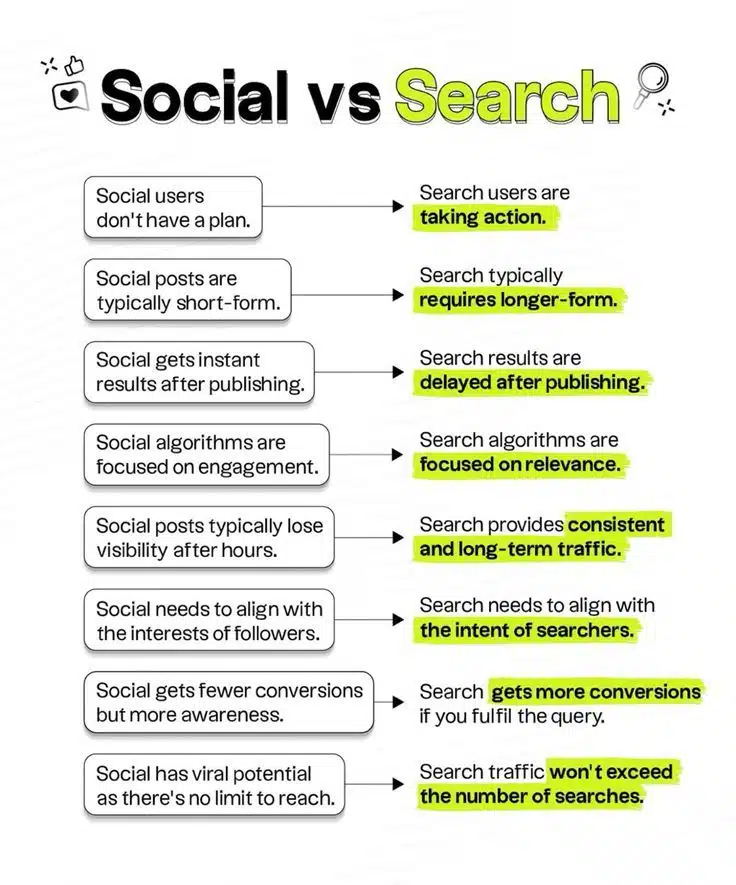
When planning a digital marketing strategy, one of the most common questions is whether to focus on social media or search. Both channels offer unique advantages, but their return on investment (ROI)—especially in the long term—can differ significantly.
While social brings fast visibility and engagement, search delivers sustainable traffic and high-intent conversions. In this post, we break down key differences to help you decide where your marketing efforts are best spent.
Social Users Don’t Have a Plan vs. Search Users Are Taking Action
Social media users typically scroll aimlessly, consuming content passively. They aren’t always looking to buy or solve a problem; they’re there to be entertained or informed. In contrast, search users are intentional. They’re actively seeking answers, solutions, or products—which naturally makes them more likely to convert.
- Focus search strategy on solving specific problems or answering direct questions.
- Use social to build brand presence and capture passive interest over time.
- Recognise that social engagement may not translate into purchase intent.
- Invest in search when targeting users ready to take a measurable action.
Social Posts Are Typically Short-Form vs. Search Typically Requires Longer-Form
Social platforms reward brevity. Posts must catch attention in seconds and deliver impact quickly. Search, however, values depth and detail. Google rewards content that thoroughly answers questions, demonstrates expertise, and holds user attention.
- Use concise visuals and hooks on social to grab attention fast.
- Develop blog posts, guides, and pillar pages to boost SEO.
- Repurpose long-form search content into short-form snippets for social.
- Recognise the time investment needed for long-form content to perform.
Social Gets Instant Results After Publishing vs. Search Results Are Delayed After Publishing
Social media can deliver rapid feedback—likes, comments, and shares often appear within minutes. But that momentum fades quickly. Search, on the other hand, takes time to build authority and rank. However, once established, the results are far more sustainable.
- Use social for immediate traction on time-sensitive or trending topics.
- Be patient with SEO—long-term content growth builds exponential value.
- Track search performance over months, not days, to gauge true ROI.
- Use early social engagement to inform what content may also perform in search.
Social Algorithms Are Focused on Engagement vs. Search Algorithms Are Focused on Relevance
Social media rewards reactions—likes, shares, comments, and watch time. The more engagement, the more visibility. Search engines operate differently: they prioritise content based on how well it satisfies the user’s query, not how many reactions it gets.
- Optimise social posts for interactivity (polls, questions, reactions).
- Align SEO content with user search intent, not just keyword density.
- Don’t confuse popularity with relevance—each algorithm values different behaviours.
- Review performance metrics specific to each platform to shape your strategy.
Social Posts Typically Lose Visibility After Hours vs. Search Provides Consistent and Long-Term Traffic
The shelf life of a social post is notoriously short. Once it drops out of the feed, visibility plummets. SEO content, however, can attract traffic for months or even years—especially when optimised and regularly updated.
- Use evergreen content on search platforms to drive steady traffic over time.
- Treat social as a tool for bursts of visibility—not sustained reach.
- Refresh older SEO content to keep it ranking high and relevant.
- Consider paid boosts on social only when short-term reach is essential.
Social Needs to Align with the Interests of Followers vs. Search Needs to Align with the Intent of Searchers
To succeed on social, you need to understand what your followers enjoy. That could be humour, behind-the-scenes content, or community engagement. For search, it’s about matching user intent—what people are actively looking to learn, do, or buy.
- Research social trends and audience preferences for each platform.
- Use keyword tools to uncover search demand and align with intent.
- Align tone and content format to the platform (social = informal, search = informative).
- Create content clusters for SEO that mirror the journey of your search audience.
Social Gets Fewer Conversions but More Awareness vs. Search Gets More Conversions If You Fulfil the Query
Social builds familiarity and brand recall, often at the top of the funnel. It’s less about conversions and more about visibility. Search, particularly for high-intent queries, can lead directly to conversions—if your content or offer hits the mark.
- Use social to warm up audiences who may convert later through search or email.
- Target bottom-of-funnel keywords on search for strong conversion opportunities.
- Test landing pages tailored to both channels to refine conversion strategies.
- Combine retargeting with search to close the loop on initial social awareness.
Social Has Viral Potential as There’s No Limit to Reach vs. Search Traffic Won’t Exceed the Number of Searches
Social campaigns can go viral, generating massive exposure beyond your audience. Search, while powerful, is limited by how often a term is searched. There’s a ceiling, but also a certainty in the demand behind each visit.
- Create emotionally resonant or shareable content to boost social reach.
- Avoid overestimating viral potential—use it as a bonus, not a strategy.
- Maximise SEO by targeting a mix of high-volume and niche keywords.
- Use search data to validate demand before launching large campaigns.
So, Which Channel Wins on Long-Term ROI?
Both social and search play essential roles in a complete marketing strategy—but when it comes to long-term return on investment, search usually has the edge. Its slow burn produces consistent traffic, better-qualified leads, and scalable results over time. That doesn’t mean social should be ignored; its real-time feedback and brand-building capabilities are invaluable. The best approach? Use both together—social to spark interest and search to convert it.
If you’re aiming for a campaign that continues to deliver months after it ends, SEO is your foundation. But if you’re launching a new brand, campaign, or product, social can accelerate visibility and engagement. Blend the two strategically, and you’ll get the best of both worlds.

Author:
Mark Ford