Are you starting to feel like your social media marketing isn’t delivering the results it used to? Want to understand why relying too heavily on platforms like Facebook or Instagram could be holding your business back?
You’ll find the biggest hidden downsides of social media dependence — and how to avoid them — in this post.
Here’s a summary of what’s covered:
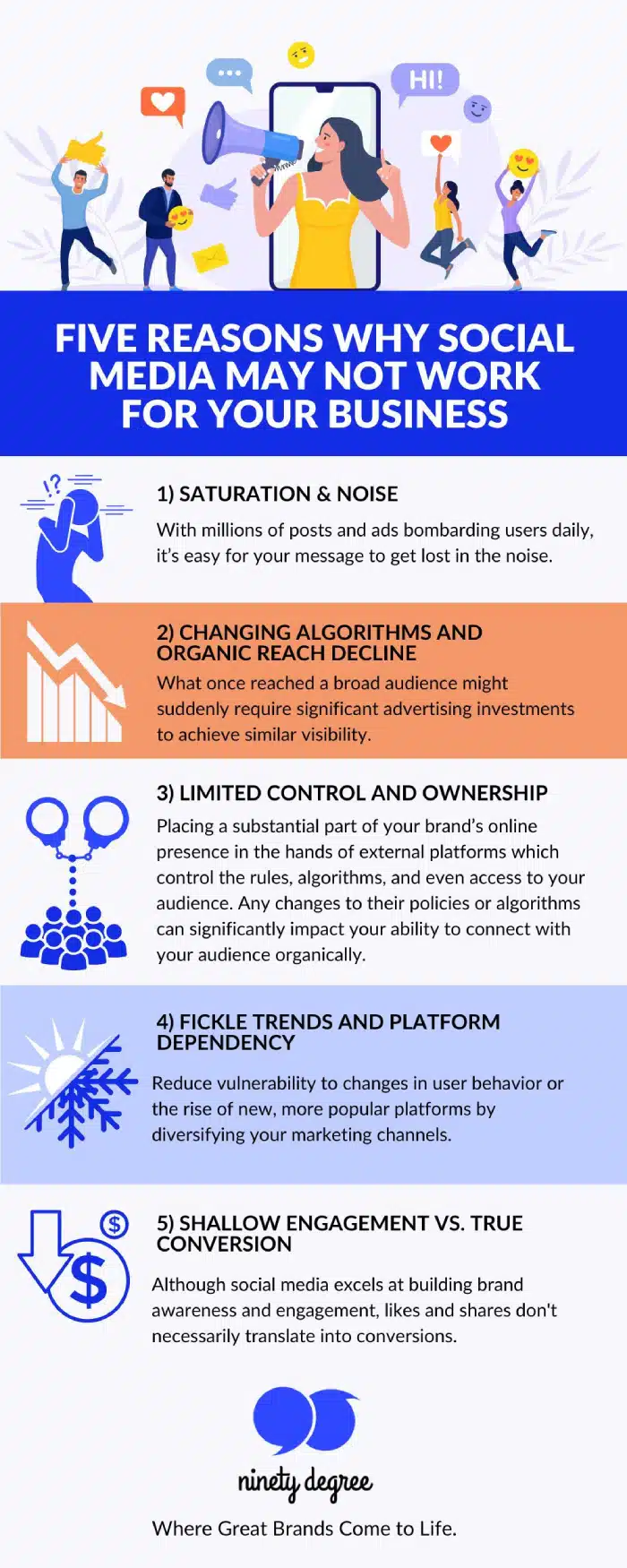
- Saturation and Noise
- Changing Algorithms and Organic Reach Decline
- Limited Control and Ownership
- Fickle Trends and Platform Dependency
- Shallow Engagement vs. True Conversion
- The Cost of Staying Visible
- Decline in Authentic Interaction
- Data and Privacy Concerns
- Short-Term Thinking and Burnout
- The Illusion of Success
Check out the post below for more.
Social media has become one of the most dominant forces in modern marketing. Platforms like Facebook, Instagram, LinkedIn, and TikTok allow brands to reach vast audiences instantly, connect with followers, and showcase products in creative ways. But beneath the surface of engagement metrics and viral potential lies a growing concern for businesses: overreliance. Depending too heavily on social platforms can expose brands to serious risks that undermine long-term stability and control.
In this post, we’ll explore the hidden downsides of relying too much on social media marketing — from algorithm changes to audience control — and share actionable strategies to help you build a more balanced, sustainable marketing approach.
Saturation and Noise
With millions of posts flooding social media feeds daily, the competition for attention is fierce. Your brand isn’t just competing with other businesses but also with influencers, news outlets, and users’ personal content. The result is an environment where visibility is hard to maintain and genuine engagement can quickly fade.
- Focus on quality over quantity by producing fewer but more meaningful posts that resonate with your audience.
- Use data-driven scheduling to post when your followers are most active, increasing visibility without spamming feeds.
- Invest in strong visuals and storytelling to stand out from the endless scroll of repetitive content.
- Build brand recognition through consistency in tone, colour palette, and messaging across every post.
Changing Algorithms and Organic Reach Decline
Social media algorithms are constantly evolving, reshaping what users see and how often they see it. What once delivered broad organic reach can suddenly shrink overnight due to a platform update. Businesses that depend too heavily on organic visibility often find themselves forced to pay for reach they previously enjoyed for free.
- Diversify your traffic sources by balancing social activity with SEO, email marketing, and direct website engagement.
- Monitor algorithm updates regularly to adapt your strategy and protect visibility as rules shift.
- Prioritise owned channels such as blogs or newsletters, where you control access to your audience.
- Experiment with paid social campaigns strategically, using small, targeted budgets to maintain reach without overdependence.
Limited Control and Ownership
When your brand’s online presence depends primarily on third-party platforms, you’re playing by their rules. Social networks can alter algorithms, restrict content, or even suspend accounts with little warning. This limited ownership means you’re effectively renting space on someone else’s digital property rather than building your own.
- Maintain a strong website foundation where all content, data, and customer interactions belong to you.
- Encourage email sign-ups through your social posts to retain direct access to your audience.
- Regularly back up content and data from your social platforms to avoid total loss during outages or bans.
- Build community spaces you own, such as private forums or subscriber-only groups hosted on your own site.
Fickle Trends and Platform Dependency
Social media thrives on novelty, and user behaviour shifts quickly. A platform that drives traffic today can lose relevance tomorrow. Brands that tie their success to one or two major platforms risk losing visibility if audiences migrate elsewhere, or if the platform itself declines.
- Spread your marketing presence across multiple channels, both digital and offline, to avoid dependency.
- Focus on timeless brand values and storytelling instead of chasing every viral trend.
- Analyse audience demographics and behaviour to identify where genuine engagement happens.
- Keep an eye on emerging platforms but approach them strategically rather than reactively.
Shallow Engagement vs. True Conversion
It’s easy to get swept up in likes, comments, and shares, but these numbers often mask a lack of real customer action. High engagement doesn’t always lead to sales or meaningful relationships. True marketing success lies in conversion — guiding people from interest to commitment.
- Create content pathways that lead users from social media to your website, where conversions happen.
- Use clear calls-to-action that invite specific next steps, such as signing up, booking, or purchasing.
- Track conversion metrics like click-through rates and sales, not just engagement counts.
- Develop nurture campaigns (e.g., email sequences) to build trust beyond the initial social interaction.
The Cost of Staying Visible
As organic reach declines, many businesses find themselves spending more just to maintain visibility. Paid advertising has become a necessity for consistent reach, but rising costs can quickly eat into your budget. Without careful strategy, social media can become one of your least cost-effective channels.
- Set a defined ad budget and measure return on investment carefully for each campaign.
- Target ads to specific audience segments to maximise efficiency and relevance.
- Use retargeting tools to re-engage users who already showed interest, reducing wasteful ad spend.
- Balance paid and organic content to keep brand presence strong without overspending.
Decline in Authentic Interaction
As platforms become more commercialised, users grow sceptical of overly polished or sales-heavy content. Authentic engagement is increasingly rare, and audiences crave genuine human connection. Brands that rely too much on curated posts can appear distant or disingenuous.
- Share behind-the-scenes stories or user-generated content to humanise your brand.
- Encourage dialogue through comments and messages, not just broadcast-style posts.
- Feature real employees, customers, or community stories to build trust.
- Respond promptly and personally to feedback, showing authenticity and attentiveness.
Data and Privacy Concerns
Social platforms collect and control vast amounts of user data, and changes in privacy laws or platform policies can disrupt your marketing. Overreliance on these systems exposes your business to risks if data access or tracking options are limited.
- Stay updated on data privacy regulations like GDPR and platform policy updates.
- Collect first-party data directly through your website, surveys, or email subscriptions.
- Be transparent with customers about how you use their data to maintain trust.
- Explore analytics tools outside social platforms for more reliable insights into audience behaviour.
Short-Term Thinking and Burnout
Social media rewards immediacy — trending topics, rapid posting, and instant engagement. But this pace can push marketing teams toward burnout and neglect of long-term strategy. Businesses that chase short-term attention risk losing focus on sustainable growth and customer loyalty.
- Build a content calendar aligned with broader business goals, not just platform trends.
- Schedule regular strategy reviews to ensure campaigns support long-term objectives.
- Encourage team balance by automating routine tasks and rotating responsibilities.
- Measure long-term metrics such as lifetime value and retention instead of daily engagement.
The Illusion of Success
High follower counts and viral posts can create a false sense of achievement. A strong social presence looks impressive, but without measurable business results, it’s an illusion of progress. Real success lies in meaningful outcomes like leads, revenue, and loyalty — not vanity metrics.
- Identify KPIs that reflect business goals, such as conversions, referrals, and retention rates.
- Conduct regular performance audits to assess whether social media activity supports profitability.
- Integrate social insights with other analytics (e.g., website traffic, sales data) for a complete picture.
- Keep lead generation and customer satisfaction at the centre of your marketing evaluation.
Conclusion
Social media remains an important part of modern marketing, but it should never be the sole pillar supporting your business growth. The platforms you use today could change or disappear tomorrow, and your brand must be strong enough to stand independently. By diversifying your strategy, owning your audience data, and focusing on authentic, measurable outcomes, you can transform social media from a risky dependency into a powerful supporting channel.
The most successful brands balance visibility with stability. They use social media to connect — not to depend. When your digital presence is built on owned assets, genuine relationships, and long-term thinking, no algorithm update or trend shift can shake your foundation.

Author:
Mark Ford