In today’s digital age, content is king.
Whether you’re a blogger, a business owner, a social media marketer, or an aspiring influencer, creating and sharing online content is an essential part of your strategy. But have you ever wondered how long your content should be to engage your audience effectively?
Does length really matter, or is it the quality of the content that counts?
In this blog post, we will explore the ideal length for various types of online content and provide insights into why it matters.
Infographic by Content Champion.
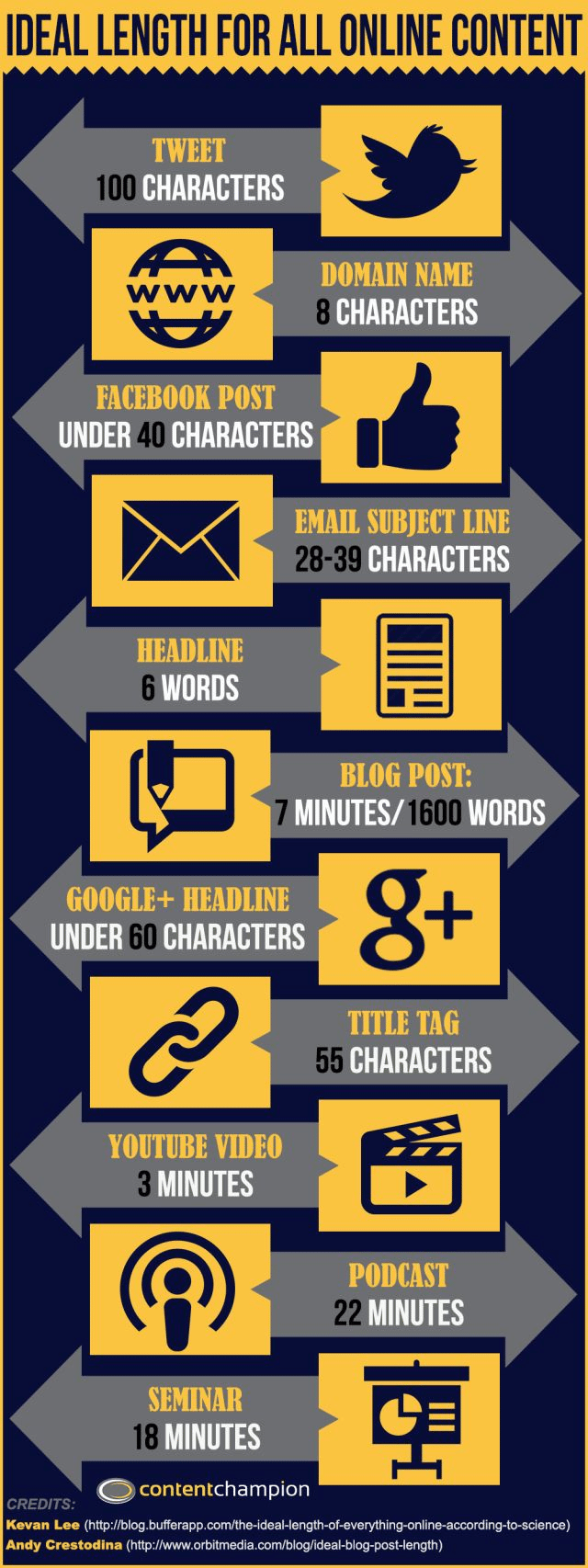
Introduction
The ideal length for online content is a subject of constant debate among content creators and marketers. While there’s no one-size-fits-all answer, understanding the optimal length for different types of content is crucial for capturing and retaining your audience’s attention. From blog posts and social media updates to videos and email marketing, let’s dive into the ideal content length for each format.
Blog Posts
Short-Form Blog Posts (300-600 words)
Short-form blog posts are concise, focused pieces of content that are typically around 300 to 600 words long. These bite-sized articles are great for quickly delivering information or addressing specific questions. Short-form blog posts are particularly effective for topics that don’t require in-depth exploration and are often used for news updates, product announcements, and quick tips.
Pros:
- Quick to read and easy to digest.
- Ideal for time-sensitive topics.
- Can be posted more frequently.
Cons:
- May lack depth and detail.
- Limited room for in-depth analysis.
Medium-Length Blog Posts (600-1,200 words)
Medium-length blog posts strike a balance between brevity and depth. Ranging from 600 to 1,200 words, these articles provide enough space to delve into a topic while still maintaining the reader’s attention. They are suitable for various subjects, from tutorials and reviews to opinion pieces and case studies.
Pros:
- Allows for in-depth exploration of a topic.
- Good for SEO and keyword optimization.
- Appeals to a wider audience.
Cons:
- Requires more time and effort to create.
- May still lack comprehensive coverage for complex subjects.
Long-Form Blog Posts (1,200+ words)
Long-form blog posts are the heavyweights of online content, typically exceeding 1,200 words. These articles are perfect for thoroughly exploring complex topics, providing comprehensive guides, and establishing thought leadership. While they demand more time and research, long-form blog posts can deliver substantial value to your audience.
Pros:
- Offers comprehensive information.
- Demonstrates expertise and authority.
- Enhances SEO and backlink potential.
Cons:
- Time and resource-intensive.
- May deter readers with short attention spans.
Social Media Posts
Twitter (280 characters)
Twitter is known for its brevity, limiting posts to 280 characters. This constraint forces users to be concise and creative with their messaging. It’s an ideal platform for quick updates, announcements, and engaging with your audience in real-time.
Pros:
- Forces clarity and conciseness.
- Fosters real-time engagement.
- Widely used for news and trends.
Cons:
- Limited space for detailed information.
- Requires frequent posting to maintain visibility.
Facebook (40-80 characters for organic posts)
While Facebook allows for longer posts, research shows that organic posts with 40-80 characters receive the highest engagement rates. Short and punchy messages tend to grab users’ attention as they scroll through their feeds.
Pros:
- Maximizes engagement.
- Ideal for sharing attention-grabbing headlines.
- Encourages users to click for more information.
Cons:
- May not be suitable for all types of content.
Instagram (125-150 characters for captions)
Instagram is primarily a visual platform, but captions matter. Aim for captions that are around 125 to 150 characters long. This length provides enough space for context without overwhelming the image or video.
Pros:
- Enhances the visual storytelling.
- Allows for brief descriptions or calls to action.
- Keeps the focus on the visual content.
Cons:
- Limited space for extensive storytelling.
Videos
YouTube (7-15 minutes)
YouTube has grown into a massive platform for content creators. While video length can vary depending on the content, aiming for a duration of 7 to 15 minutes is a good starting point. This allows you to deliver valuable information without losing the audience’s interest.
Pros:
- Provides room for in-depth explanations.
- Maximizes ad revenue potential.
- Encourages audience engagement through likes and comments.
Cons:
- Longer videos require more production time.
Instagram Reels and TikTok (15-60 seconds)
Short video formats like Instagram Reels and TikTok have gained immense popularity. These platforms prioritize quick, entertaining, and visually appealing content. Keeping your videos within the 15 to 60-second range is crucial to maintain viewers’ engagement.
Pros:
- Ideal for viral content.
- Encourages creativity within a short timeframe.
- High potential for discoverability.
Cons:
- Limited time for detailed content.
Email Marketing
Subject Line (40-50 characters)
The subject line is the first thing recipients see when they receive an email. Keeping it between 40 to 50 characters ensures that it’s concise and mobile-friendly. A well-crafted subject line can significantly impact email open rates.
Pros:
- Increases email open rates.
- Appeals to mobile users.
- Sparks curiosity or interest.
Cons:
- Limited space for a detailed message.
Email Content (200-300 words)
When it comes to the body of your marketing email, aim for a length of 200 to 300 words. This provides enough space to convey your message without overwhelming your recipients. Be clear, concise, and include a compelling call to action.
Pros:
- Allows for clear communication.
- Ideal for promotional emails and newsletters.
- Maintains reader interest.
Cons:
- Requires effective writing to convey the message concisely.
Podcasts
Episode Length (20-40 minutes)
Podcasting is another popular content medium. While the ideal length can vary depending on your niche and audience, most successful podcasts fall within the 20 to 40-minute range. This allows for meaningful discussions without overwhelming listeners.
Pros:
- Provides ample time for in-depth conversations.
- Appeals to both short commutes and longer journeys.
- Allows for diverse guest interviews.
Cons:
- Longer episodes may require more preparation.
Conclusion
Determining the ideal length for your online content depends on various factors, including your audience, the platform you’re using, and the nature of your content. Short-form content is excellent for quick updates, while long-form content can establish your authority and provide comprehensive information. Understanding the nuances of different platforms, from social media to email marketing, is key to capturing and retaining your audience’s attention.
Remember that while length matters, quality should never be sacrificed for quantity. Regardless of the length, your content should always provide value, engage your audience, and align with your overall content strategy. Experiment with different lengths, monitor the performance of your content, and adjust your approach based on the feedback and data you receive. Ultimately, finding the ideal length for your online content is an ongoing journey that requires adaptation and creativity.

Author:
Mark Ford

The Complete Content Mix: What Every Business Should Be Publishing
Are you struggling to decide what types of content your business should be publishing to attract more traffic and engagement? Want to learn how to build the perfect content mix that keeps your audience interested and your brand growing? […]