Are you struggling to grab attention in a world where audiences scroll past content in seconds? Want to learn how to craft social media hooks that stop the scroll and make people click?
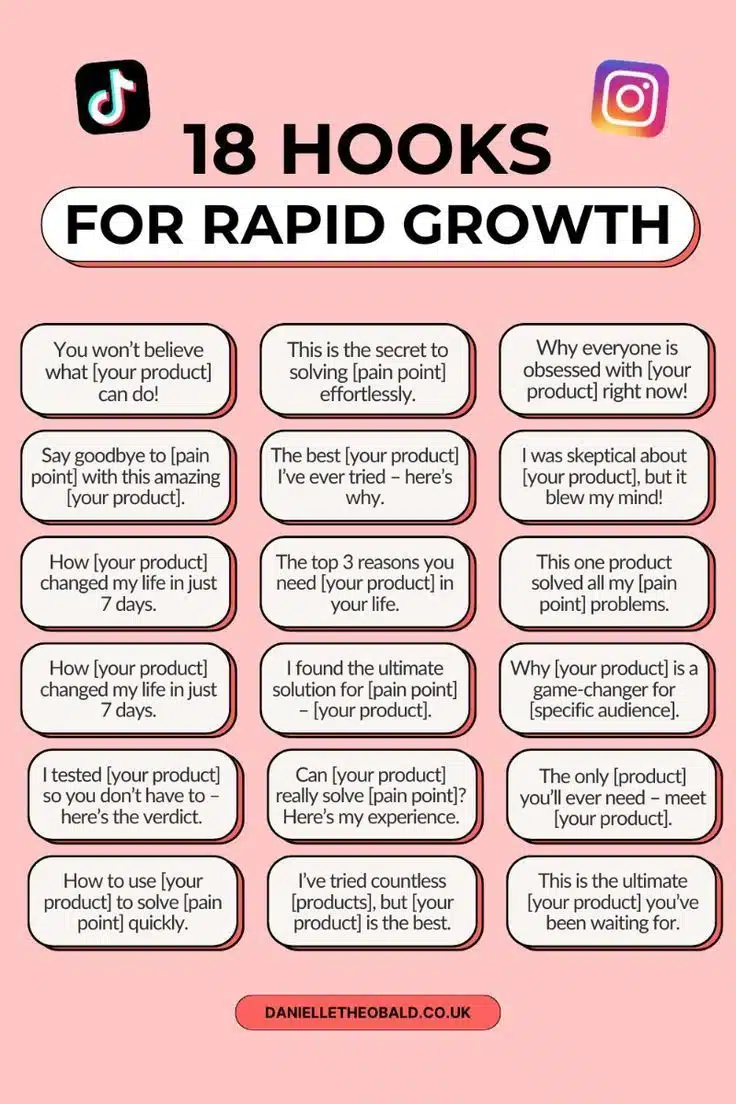
You’ll find some social media basics in this infographic.
Here’s a summary of what’s covered:
- You Won’t Believe What [Your Product] Can Do!
- This Is the Secret to Solving [Pain Point] Effortlessly
- Why Everyone Is Obsessed with [Your Product] Right Now!
- Say Goodbye to [Pain Point] with This Amazing [Your Product]
- The Best [Your Product] I’ve Ever Tried – Here’s Why
- I Was Sceptical About [Your Product], but It Blew My Mind!
- How [Your Product] Changed My Life in Just 7 Days
- The Top 3 Reasons You Need [Your Product] in Your Life
- This One Product Solved All My [Pain Point] Problems
- I Found the Ultimate Solution for [Pain Point] – [Your Product]
Check out the post below for more.
In a world where audiences scroll through endless content, attention has become the most valuable currency. Social media is crowded, fast-paced, and fiercely competitive, which means your first few words matter more than ever.
A powerful hook can stop the scroll, capture curiosity, and spark engagement that leads to real growth. In this guide, we’ll explore the science behind attention-grabbing hooks and show you how to adapt proven formulas to make people click, comment, and convert.
You Won’t Believe What [Your Product] Can Do!
Shock and curiosity are two of the most effective triggers in human psychology. A statement like “You won’t believe…” immediately challenges the reader’s expectations and invites them to learn more. This kind of hook works because it creates an emotional gap between what the audience thinks they know and what they want to discover next.
- Use bold, surprising claims that promise a clear benefit or unexpected result.
- Keep it credible by following with proof, results, or a real story.
- Pair the hook with a striking visual to heighten the curiosity effect.
- Avoid clickbait exaggeration—deliver genuine value behind the promise.
This Is the Secret to Solving [Pain Point] Effortlessly
Audiences are drawn to anything that simplifies their struggles. The word “secret” implies insider knowledge and an easy fix for something that feels complex or frustrating. By positioning your product or message as the effortless solution, you engage people who crave simplicity and relief.
- Identify the specific pain point your audience wants to eliminate.
- Use language that conveys ease and transformation rather than hard work.
- Combine authority and empathy to sound both knowledgeable and relatable.
- Reinforce the “effortless” idea with a short example or demonstration.
Why Everyone Is Obsessed with [Your Product] Right Now!
Social proof is one of the strongest motivators in marketing. When people see that others are excited about something, they instinctively want to be part of it. This hook leverages the psychology of belonging and FOMO (fear of missing out) to build instant intrigue.
- Use trending topics or statistics to show genuine popularity.
- Feature real user reactions, testimonials, or viral moments.
- Pair the hook with an image or clip showing engagement or enthusiasm.
- Keep the tone energetic and timely to make it feel relevant right now.
Say Goodbye to [Pain Point] with This Amazing [Your Product]
This hook appeals to the desire for resolution and positive change. It speaks directly to the audience’s frustrations while offering hope and relief. “Say goodbye” also suggests a final, satisfying solution rather than a temporary fix.
- Identify the problem your audience is ready to leave behind.
- Use emotional language that conveys freedom or transformation.
- Position your product as the bridge between struggle and success.
- Reinforce the promise with a brief proof point or testimonial.
The Best [Your Product] I’ve Ever Tried – Here’s Why
People love authentic experiences and recommendations that sound personal. This hook works because it feels like a genuine endorsement rather than a sales pitch. It taps into the power of storytelling and peer influence to make your audience trust your message.
- Use a real personal or customer story to build credibility.
- Be specific about what makes your product “the best.”
- Include sensory details or emotional reactions to make it relatable.
- End the story with a clear benefit or takeaway for the audience.
I Was Sceptical About [Your Product], but It Blew My Mind!
Honesty creates trust, especially when it comes to overcoming scepticism. This hook disarms resistance by acknowledging doubts that your audience may share. When the story ends in surprise or amazement, it reinforces authenticity and inspires curiosity.
- Begin with a relatable moment of hesitation or doubt.
- Use dramatic language to emphasise your transformation or discovery.
- Keep the tone conversational, as if sharing with a friend.
- Reveal the turning point where your perception changed completely.
How [Your Product] Changed My Life in Just 7 Days
Time-bound results create urgency and intrigue. This hook promises a measurable transformation within a short period, making it feel achievable and worth exploring. It’s especially effective for lifestyle, health, and productivity-related products.
- Focus on tangible, visible changes that occurred within the timeframe.
- Use day-by-day storytelling to show progress and build suspense.
- Reinforce that the results are realistic and repeatable for others.
- End with a strong call to action to inspire the same experience.
The Top 3 Reasons You Need [Your Product] in Your Life
Numbered lists are psychologically appealing because they set expectations and structure. This hook instantly signals value and clarity—readers know they’ll get concise, practical information. It’s a reliable format that works across nearly any platform.
- Choose reasons that highlight different but complementary benefits.
- Lead with the most surprising or powerful reason first.
- Keep each reason short and easy to digest in a few seconds.
- Use visual cues like emojis or numbers to enhance readability.
This One Product Solved All My [Pain Point] Problems
The phrase “one product” suggests simplicity, efficiency, and relief. It implies that the audience doesn’t need to keep searching for multiple fixes—they’ve found the ultimate answer. This hook satisfies the human desire for closure and certainty.
- Define the specific pain point your audience is tired of facing.
- Use confident, solution-oriented language throughout the post.
- Back up the claim with before-and-after comparisons or data.
- Position your product as both practical and emotionally rewarding.
I Found the Ultimate Solution for [Pain Point] – [Your Product]
The word “ultimate” evokes finality and perfection—it’s the best of the best. This hook works well when you want to highlight superior performance or innovation. It speaks to audiences who are frustrated by half-measures and want a definitive fix.
- Emphasise what makes your solution unique or comprehensive.
- Address the specific pain point with empathy and expertise.
- Include proof of effectiveness such as case studies or demos.
- Reinforce trust with guarantees or transparent comparisons.
Why [Your Product] Is a Game-Changer for [Specific Audience]
Tailoring your hook to a defined audience makes it feel personal and targeted. Calling something a “game-changer” positions it as revolutionary and worth attention. This hook appeals to both aspiration and relevance—two key emotional drivers in marketing.
- Identify the niche audience you want to reach.
- Use insider language or references they’ll instantly relate to.
- Clearly explain how your product transforms their experience.
- Back up the claim with results or examples from real users.
I Tested [Your Product] So You Don’t Have To – Here’s the Verdict
Audiences love authenticity and trust those who “try before they buy.” This hook positions you as an honest reviewer or guide, removing the risk for your audience. It works especially well for products, services, or trends that people are curious but uncertain about.
- Share a genuine personal test or trial experience.
- Be transparent about both pros and cons for credibility.
- Use visuals or data to support your conclusions.
- End with a clear, concise summary of whether it’s worth it.
Can [Your Product] Really Solve [Pain Point]? Here’s My Experience
Questions trigger the brain’s instinct to seek answers. This hook uses curiosity and scepticism to draw readers in while offering a promise of truth. It feels conversational, authentic, and relevant to those with the same doubts.
- Start by acknowledging the common pain point or frustration.
- Describe your personal experience in simple, relatable terms.
- Reveal the outcome with honesty rather than hype.
- End with advice or lessons learned to add value for the reader.
The Only [Product] You’ll Ever Need – Meet [Your Product]
Exclusivity and finality make this hook persuasive. It suggests that your product is the ultimate choice, eliminating confusion or comparison. This approach works best when your offer truly stands out in performance, quality, or simplicity.
- Highlight the unique selling point that makes your product irreplaceable.
- Use language that conveys confidence without arrogance.
- Reinforce longevity, reliability, or versatility as key traits.
- Support the claim with customer stories or measurable results.
How to Use [Your Product] to Solve [Pain Point] Quickly
Instructional hooks perform well because they promise immediate, actionable value. “How to” phrases signal that the reader will learn something practical and beneficial. Combining this with speed appeals to people seeking fast solutions.
- Focus on one clear problem and one concise method of solving it.
- Use step-by-step guidance that feels achievable for beginners.
- Pair the content with visuals or short clips for clarity.
- End with a tip that reinforces the ease and speed of results.
I’ve Tried Countless [Products], but [Your Product] Is the Best
Comparison hooks highlight authority and credibility. They show you’ve explored alternatives and found one that truly stands out. This type of hook appeals to decision-makers who want assurance that they’re making the right choice.
- Share the criteria you used when comparing products.
- Explain what makes your preferred option superior.
- Include quantifiable improvements or benefits for proof.
- Keep the tone authentic—acknowledge other options respectfully.
This Is the Ultimate [Your Product] You’ve Been Waiting For
The phrase “you’ve been waiting for” builds anticipation and emotional connection. It suggests that your audience’s search or struggle is finally over. This hook works best when launching something new or unveiling a significant upgrade.
- Create excitement with language that conveys fulfilment and relief.
- Use visuals or video to dramatise the reveal moment.
- Highlight what makes this version special or long-awaited.
- End with a compelling call to action to encourage immediate response.
Conclusion
Attention is not given freely—it’s earned through precision, emotion, and timing. Each of these hooks taps into a different aspect of human psychology, from curiosity and urgency to trust and belonging. When crafted well, your opening line becomes the spark that ignites engagement across every social platform.
By understanding the science behind why people click, you can transform your content from background noise into irresistible storytelling that commands attention and drives results.

Author:
Mark Ford