
Are you looking for ways to improve how your marketing messages influence customer behaviour? Want to learn the psychological principles that help drive ethical, high-converting decisions?
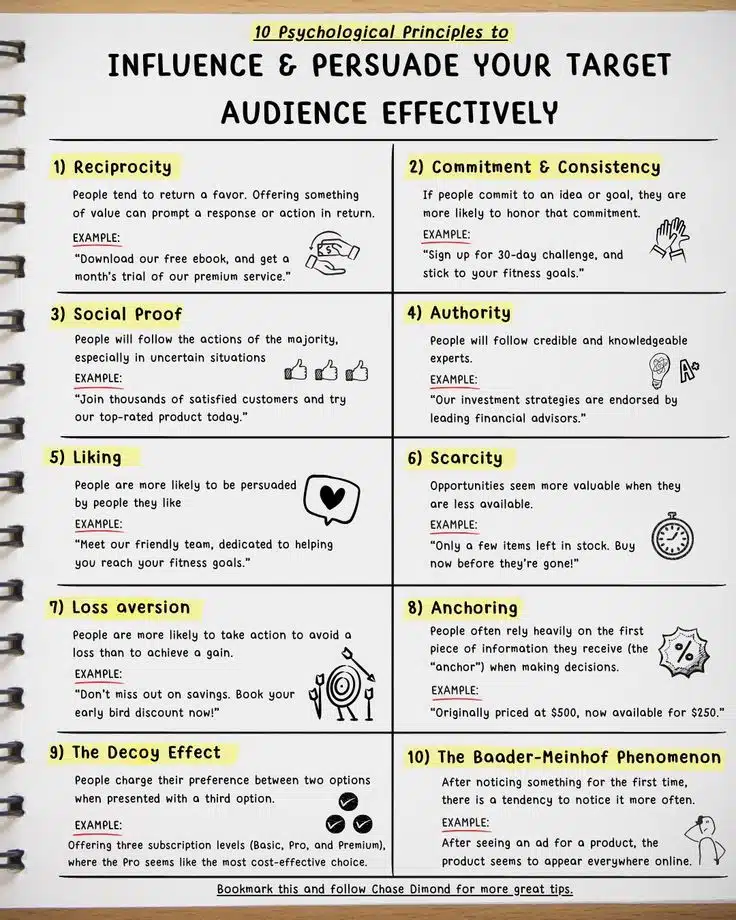
You’ll find some psychology basics in this infographic.
Here’s a summary of what’s covered:
- Reciprocity
- Commitment & Consistency
- Social Proof
- Authority
- Liking
- Scarcity
- Loss Aversion
- Anchoring
- The Decoy Effect
- The Baader-Meinhof Phenomenon
Check out the post below for more.
Why do people say yes? What makes a customer choose one brand over another—even when products are nearly identical? The answer often lies in psychology. Understanding the science of persuasion allows businesses to ethically guide customer decisions while building trust and long-term loyalty.
This blog explores ten powerful psychological principles that influence buying behaviour. Used responsibly, these tactics can significantly improve your marketing effectiveness without resorting to manipulation or gimmicks.
Reciprocity
Reciprocity is a powerful social norm: when someone gives us something, we naturally feel compelled to return the favour. In business, this means offering value upfront—such as free content, trials, or bonuses—can lead to increased conversions and stronger customer relationships.
- Offer free tools, samples, or guides to build goodwill and encourage engagement.
- Use gated content (e.g., free ebooks) as a low-friction way to collect leads.
- Send thank-you emails or small bonuses after a purchase to reinforce loyalty.
- Surprise customers with unexpected extras to foster positive brand associations.
Commitment & Consistency
People want to appear consistent in their actions and beliefs. Once someone makes a small commitment—like signing up for a newsletter—they’re more likely to follow through with larger actions later. Use this tendency to create marketing flows that build gradually on customer engagement.
- Start with micro-conversions, like downloading a resource or answering a poll.
- Use step-by-step challenges to encourage ongoing interaction and progress.
- Ask users to commit publicly to a goal (e.g., on social media or in a review).
- Highlight progress (“You’ve completed 3 of 5 steps!”) to reinforce consistency.
Social Proof
When unsure of what to do, people look to others—especially similar others—for guidance. This principle of social proof is a cornerstone of effective marketing and can be reinforced with testimonials, user stats, reviews, and community engagement.
- Showcase customer testimonials prominently on landing pages.
- Use real-time pop-ups (“Jane just bought this product!”) to indicate popularity.
- Display user statistics (e.g., “Trusted by 20,000+ professionals”) for credibility.
- Encourage happy customers to share their experience on review sites and socials.
Authority
People are more likely to follow guidance from figures they perceive as experts. Establishing authority in your niche builds trust and makes your messages more persuasive. The key is to back your claims with credibility, not just confidence.
- Highlight endorsements or affiliations with respected industry organisations.
- Showcase certifications, qualifications, or awards to build professional trust.
- Use expert quotes, research, and white papers in your marketing content.
- Create content authored or supported by recognised specialists in your field.
Liking
We are more easily persuaded by people (and brands) we like. Liking can come from perceived similarities, compliments, humour, and friendliness. Brands that present a warm, personable tone often build deeper emotional connections with their audience.
- Feature relatable team members or founders in your brand storytelling.
- Use friendly, conversational copy that makes customers feel understood.
- Engage with followers directly and positively on social media platforms.
- Highlight shared values or causes that resonate with your ideal audience.
Scarcity
When something is limited, it becomes more desirable. Scarcity taps into our fear of missing out (FOMO) and creates urgency. However, ethical use is essential—false scarcity damages trust, so ensure your claims are genuine and verifiable.
- Display stock levels or countdown timers to highlight limited availability.
- Use phrases like “Only X left in stock” or “Ends tonight” to drive urgency.
- Run flash sales or exclusive offers to motivate immediate action.
- Emphasise limited editions or one-time opportunities for added appeal.
Loss Aversion
People are more motivated to avoid losses than to achieve equivalent gains. This means highlighting what customers might miss out on can be more effective than focusing solely on the benefits. Loss aversion works especially well with time-sensitive deals.
- Frame offers around what the user stands to lose by not acting quickly.
- Use messaging like “Don’t miss out” or “Avoid paying more later.”
- Offer early bird discounts and show how savings decrease over time.
- Use abandoned cart emails to remind customers what they’re about to lose.
Anchoring
Anchoring refers to the psychological tendency to rely heavily on the first piece of information received when making decisions. For marketers, it’s a chance to set expectations and demonstrate value by presenting a high anchor before showing your offer.
- Show the original price next to the discounted price to emphasise savings.
- Introduce high-end products first, then follow with more affordable options.
- Use comparisons (“Worth £500, now only £250”) to create perceived value.
- Present premium features first, then show how they’re all included in your plan.
The Decoy Effect
The decoy effect shifts customer preferences by introducing a third, less appealing option that makes one of the other options look more attractive. This is especially useful in pricing strategies and product tiering.
- Create three-tier pricing plans (e.g., Basic, Pro, Premium) with a decoy plan.
- Make the decoy slightly less attractive than your ideal choice at a similar price.
- Highlight the value of your middle-tier option to steer decisions naturally.
- Use visual design to emphasise the most cost-effective or popular choice.
The Baader-Meinhof Phenomenon
Also known as the frequency illusion, this occurs when someone notices something once and then begins seeing it everywhere. It’s a powerful reminder of the value of repetition in marketing and remarketing strategies.
- Use retargeting ads to reinforce awareness after first contact.
- Mention your brand or product name consistently across touchpoints.
- Encourage users to sign up or follow you, increasing exposure opportunities.
- Create follow-up campaigns that appear soon after initial engagement.
Conclusion
Persuasion isn’t about tricking people—it’s about understanding human behaviour and communicating in ways that align with how we naturally think, feel, and decide. These ten psychological principles can elevate your marketing strategy, helping you ethically influence your audience while building genuine trust.
Used responsibly, persuasion becomes a tool for clarity and connection. Start applying these tactics today to create marketing experiences that are not only more effective but also more respectful of your customers’ needs and choices.

Author:
Mark Ford