Are you looking for ways to make more of your company website visitors convert into customers? Want to understand what makes people say yes to something in the first place?
Understanding the scientific decision making process we all go through when saying yes to something can play a major role in the success of your website layout and copy. It often isn’t enough to just expect people to see how good your products and services are.
According to Everreach there are 6 universal factors that guide our decision making, they’ve detailed them in the infographic below.
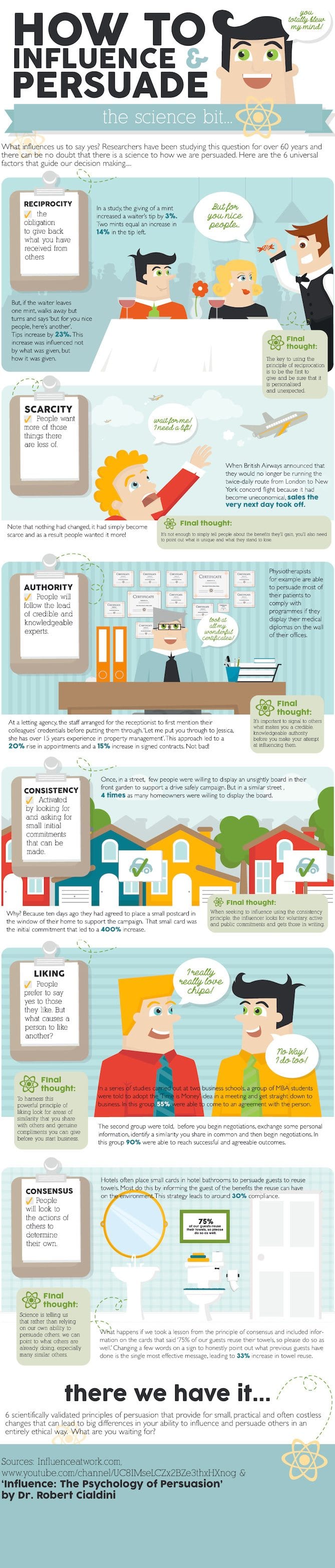
In the digital age, having an online presence is crucial for businesses and individuals alike. Your website serves as a powerful tool for communicating your message, promoting your brand, and driving conversions. To make the most of your online platform, you need to understand the science behind user behavior and persuasion. By applying scientific principles, you can influence and persuade your website visitors effectively. In this blog post, we will explore six scientific ways to achieve just that.
- Leverage the Power of Visual Hierarchy
First impressions matter, and your website’s visual design plays a crucial role in shaping these initial perceptions. Visual hierarchy is a design principle based on the idea that people naturally prioritize information based on its visual prominence. Understanding how to control visual hierarchy can significantly impact how users perceive your website.
- Focal Points: Utilize focal points to direct your visitors’ attention to specific elements. For instance, you can use contrasting colors, bold typography, or strategically placed images to make important information stand out.
- Eye Tracking: Studies have shown that people tend to follow an “F” pattern when reading web content. The most attention is paid to the top-left corner, so place your most critical content or call-to-action buttons there.
- Whitespace: Adequate whitespace can enhance readability and help users focus on essential elements. It prevents visual clutter and makes your website appear more organized and inviting.
- Harness the Psychology of Color
Color psychology is a well-researched area that demonstrates how colors can evoke specific emotions and influence behavior. By carefully selecting and implementing colors on your website, you can create a more compelling and persuasive user experience.
- Red for Urgency: Red is often associated with urgency and action. Use it sparingly for buttons or notifications to encourage immediate action.
- Blue for Trust: Blue conveys trust and reliability. It’s a common choice for business websites to build credibility and establish a sense of security.
- Green for Positivity: Green is associated with nature and positivity. It can be used to promote a sense of well-being or eco-friendliness.
- Yellow for Attention: Yellow grabs attention and can be used for highlighting important information or calls to action.
- Implement the Rule of Three
The Rule of Three is a cognitive principle that suggests people tend to remember and process information more effectively when presented in groups of three. Incorporating this rule into your website’s content and design can make it easier for visitors to absorb and retain information.
- Navigation Menus: Organize your navigation menus into three main categories or sections to simplify user navigation.
- Bullet Points: When listing features or benefits, use three concise bullet points. This makes the information more digestible.
- Testimonials: Showcase three strong testimonials or reviews to highlight the positive experiences of others.
- Utilize Social Proof
Social proof is a psychological phenomenon where people rely on the actions and opinions of others to make decisions. By incorporating social proof elements into your website, you can increase trust and credibility.
- Customer Reviews and Ratings: Display genuine customer reviews and ratings for your products or services. Include both positive and negative reviews to appear transparent.
- Trust Seals: Show trust seals, certifications, or endorsements from reputable organizations to assure visitors of your credibility and reliability.
- User Counters: If applicable, display the number of users, subscribers, or customers you have. This can create a sense of popularity and trust.
- Master the Art of Persuasive Copywriting
Words have the power to persuade, and persuasive copywriting is an essential component of any effective website. Understanding the psychology behind persuasive language can help you create compelling content that drives action.
- Use Power Words: Incorporate words that evoke emotion or action, such as “exclusive,” “limited time,” “guaranteed,” or “free.”
- Tell Stories: Storytelling is a potent way to engage visitors emotionally. Share success stories or case studies that demonstrate the value of your products or services.
- Highlight Benefits: Instead of focusing solely on features, emphasize the benefits users will gain. Explain how your offerings can solve their problems or improve their lives.
- Optimize for Mobile Responsiveness
With the increasing use of smartphones and tablets, ensuring your website is mobile-responsive is not just a suggestion; it’s a necessity. Mobile optimization is not only about design but also about providing a seamless user experience.
- Responsive Design: Implement a responsive design that adapts to various screen sizes and orientations. This ensures that your website looks and functions well on mobile devices.
- Fast Loading: Mobile users expect fast-loading pages. Optimize images and minimize unnecessary elements to reduce load times.
- Intuitive Navigation: Make sure your navigation menu and buttons are easily clickable on touchscreens. Test your website on different devices to ensure smooth navigation.
Conclusion
Incorporating these scientific principles into your website design and content can significantly enhance your ability to influence and persuade visitors. Remember that the ultimate goal is not just to attract users but to engage them and guide them towards your desired actions, whether it’s making a purchase, subscribing to your newsletter, or contacting you for more information.
By leveraging the power of visual hierarchy, color psychology, the Rule of Three, social proof, persuasive copywriting, and mobile responsiveness, you can create a website that not only looks appealing but also drives meaningful conversions. In the ever-evolving digital landscape, staying informed about these scientific approaches is key to maintaining a competitive edge and maximizing the impact of your online presence.

Author:
Mark Ford