
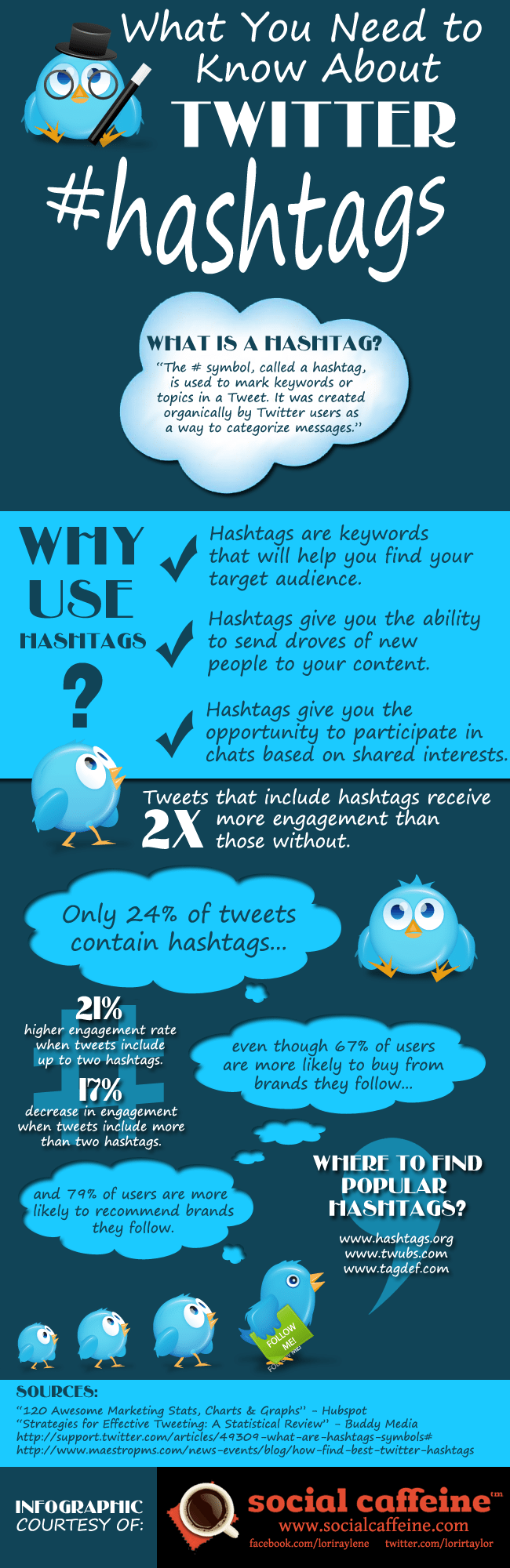
For the newbies amongst you a hashtag or # is used to label keywords or topics within a tweet. Users can click on a hashtag and it will display every tweet using that hashtag. So why is this crucial to your Twitter success?
Take a look at the infographic below from Social Caffeine. It gives you 3 reasons why you should be using hashtags and some statistics about how they can improve the effect of your tweets.
Need a list of hashtags to use in your tweets? Take a look at this article – A Complete List of UK Twitter Hashtags to Help Market your Business
In the fast-paced world of social media, where brevity and relevance reign supreme, Twitter stands out as a platform that has truly embraced the power of the hashtag. Since its inception in 2006, Twitter has become a global phenomenon, serving as a hub for news, trends, and conversations. And at the heart of this whirlwind of information and interaction are hashtags. In this blog post, we’ll explore three compelling reasons why hashtags are not just helpful but absolutely essential for achieving success on Twitter.
1. Enhancing Discoverability
Imagine Twitter as a vast digital universe filled with millions of tweets being sent every minute. In such a vast expanse, how do you ensure your message reaches the right audience? This is where hashtags come into play. Hashtags are like navigation tools in the Twitterverse, helping users discover relevant content amidst the chaos.
A. Connecting with Your Target Audience
Whether you’re a brand promoting a product, a content creator sharing your latest work, or an individual expressing your thoughts, hashtags can significantly enhance your discoverability. When you include relevant hashtags in your tweets, you increase the likelihood of your content appearing in the search results or timelines of users interested in that topic.
For example, if you’re a tech company launching a new smartphone, using hashtags like #TechNews, #Smartphones, or even #NewRelease can help your tweet reach a broader audience interested in technology and new gadgets. This broader reach can lead to more engagement, retweets, and followers.
B. Joining Trending Conversations
Twitter is known for its trending topics, which showcase the most-discussed subjects at any given moment. These trends often include hashtags, making them a powerful way to tap into ongoing conversations and connect with a wider audience.
By incorporating trending hashtags into your tweets, you can ride the wave of a popular discussion and increase your tweet’s visibility. Just be sure that your tweet is relevant to the trending topic, as jumping on irrelevant trends can backfire and harm your credibility.
2. Fostering Community and Engagement
One of Twitter’s unique strengths is its ability to bring people with shared interests together. Hashtags play a crucial role in this by creating virtual communities and fostering engagement within them.
A. Building Communities
Hashtags allow users to create and participate in niche communities centered around specific topics or interests. For instance, if you’re a fitness enthusiast, you can find or create hashtags like #FitFam (short for “fitness family”) or #RunnersCommunity to connect with like-minded individuals. By using these hashtags consistently in your tweets, you can become a part of these communities and engage in conversations with others who share your passion.
B. Driving Conversations
Hashtags also serve as conversation starters. When you include a relevant hashtag in your tweet, you’re essentially tagging it for a particular discussion. This makes it easier for others interested in that topic to find your tweet and join the conversation. It’s a simple yet effective way to spark discussions and engage with your followers.
For instance, if you’re a food blogger, using hashtags like #FoodieChat or #RecipeSwap can prompt your followers to share their favorite recipes or restaurant recommendations, leading to lively and interactive conversations.
C. Encouraging User-Generated Content
Brands have leveraged hashtags as a means of encouraging user-generated content (UGC). By creating branded hashtags and encouraging their customers or followers to use them, companies can gather a wealth of user-generated content, such as testimonials, photos, and reviews.
For example, a clothing brand might create a hashtag like #MyBrandStyle and ask customers to share pictures of themselves wearing the brand’s products. This not only boosts engagement but also provides authentic social proof of the brand’s popularity.
3. Amplifying Marketing Campaigns
Hashtags are not just for casual conversation; they are potent tools for marketing and promotion. When used strategically, hashtags can amplify the reach and impact of your marketing campaigns.
A. Branding and Promotion
Brands often create unique and memorable hashtags as part of their marketing strategies. These branded hashtags help in promoting specific campaigns, product launches, or events. When customers and followers use these hashtags, they become brand advocates and contribute to the campaign’s success.
For instance, Coca-Cola’s #ShareACoke campaign encouraged customers to share pictures of Coke bottles with their names on them using the hashtag. This not only generated user-generated content but also created a sense of community among Coke enthusiasts.
B. Tracking and Analytics
Hashtags also play a crucial role in tracking the success of your marketing efforts. Most social media management tools and platforms offer analytics on the performance of specific hashtags. By monitoring the reach, engagement, and impressions of your hashtagged tweets, you can gain valuable insights into what resonates with your audience.
This data can inform future marketing strategies and help you refine your approach to maximize your Twitter success. You can identify which hashtags perform best, when your audience is most active, and which content types generate the most engagement.
C. Event Promotion
Twitter is a go-to platform for real-time updates on events, whether they’re industry conferences, sports events, or entertainment shows. Event organizers often create event-specific hashtags to aggregate and curate related content.
By including event hashtags in your tweets, you can join the conversation and stay informed about the latest developments. If you’re attending an event, using its official hashtag can also help you connect with fellow attendees, share your experiences, and network.
Conclusion
In the dynamic world of Twitter, hashtags are not just optional accessories; they are indispensable tools for success. From enhancing discoverability and fostering communities to amplifying marketing campaigns, hashtags are the key to making your voice heard in the Twitterverse.
By using relevant hashtags strategically, you can connect with your target audience, join trending conversations, build communities, and drive engagement. Additionally, hashtags empower brands and individuals alike to promote their messages effectively, measure their impact, and connect with others during events.
So, whether you’re a seasoned Twitter user or just starting, don’t underestimate the power of the hashtag. Embrace it as your ally, and watch your Twitter success soar to new heights.

Author:
Mark Ford

How to Create Platform-Specific Social Media Content Without Doubling Your Workload
Are you struggling to keep your social media content consistent across platforms without it eating up your time? Want to learn how to adapt one idea for Facebook, Instagram, LinkedIn, TikTok, and X without creating everything from scratch? […]