
Are you wondering why your blog isn’t attracting the traffic it deserves? Want to discover the most common blogging mistakes and how to turn them around for better results?
You’ll find some blogging basics in this infographic.
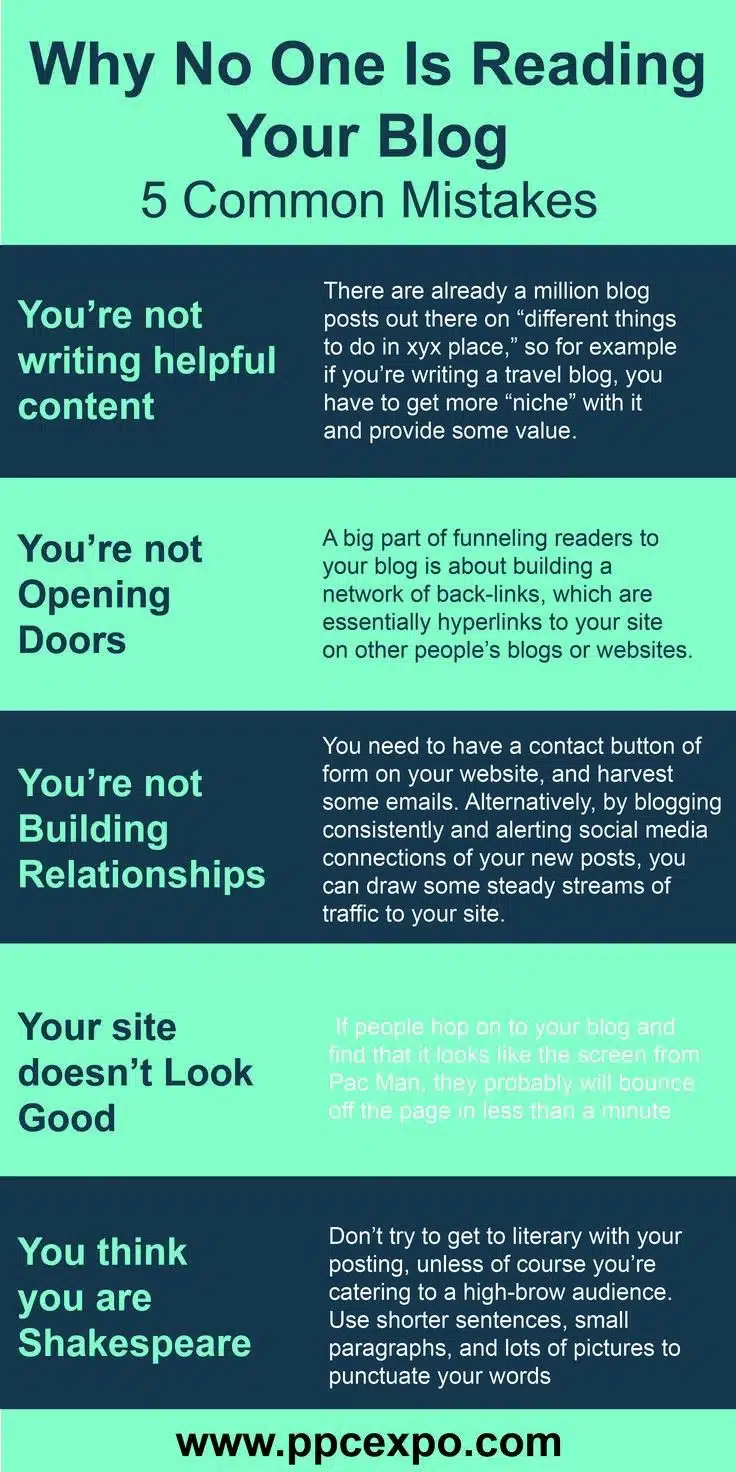
Here’s a summary of what’s covered:
- You’re Not Writing Helpful Content
- You’re Not Opening Doors
- You’re Not Building Relationships
- Your Site Doesn’t Look Good
- You Think You Are Shakespeare
Check out the post below for more.
If you’ve poured hours into writing blog posts but still hear nothing but digital crickets, you’re not alone. Many bloggers face the frustrating reality of low or no traffic, despite their best intentions. The problem usually isn’t the effort—it’s a series of common mistakes that silently sabotage your blog’s performance.
In this post, we’ll cover five of the most likely reasons your blog isn’t getting traffic—and more importantly, how to fix each one.
You’re Not Writing Helpful Content
Writing for the sake of publishing isn’t enough. Your blog needs to solve a problem, answer a question, or offer unique insight if it’s going to gain traction. Readers won’t stick around for generic information they’ve seen a hundred times before. To attract real interest, your content must be useful, relevant, and targeted.
- Find a niche angle: Instead of broad topics, go deep into specific subjects your audience cares about.
- Solve real problems: Answer questions your ideal readers are actively searching for on Google or forums.
- Add value, not fluff: Prioritise actionable advice, unique insight, and clarity over word count.
- Use tools like AnswerThePublic: Discover what your audience is genuinely asking and build content around it.
You’re Not Opening Doors
If your blog exists in isolation, don’t expect readers to magically find it. Backlinks—links from other websites to yours—are essential for traffic and SEO. Think of them as digital pathways that help new audiences discover your content. Without backlinks, your blog will struggle to appear in search results or gain referral traffic.
- Guest post on other blogs: Write content for relevant websites and include links back to your blog.
- Get listed in niche directories: Submit your blog to industry-specific directories to build backlinks and exposure.
- Build relationships with other bloggers: Engage in collaborations, link swaps, and networking to gain visibility.
- Create linkable content: Publish original research, statistics, or tools that other websites want to reference.
You’re Not Building Relationships
Blogging is not a one-way street. If you’re only publishing posts and hoping for organic traction, you’re missing a crucial part of the puzzle: relationship-building. Strong connections with your audience, fellow bloggers, and social media followers can significantly boost your visibility and credibility.
- Add a clear contact form: Make it easy for visitors to reach out or subscribe to your mailing list.
- Engage on social media: Share your posts, respond to comments, and be active in relevant communities.
- Use email marketing: Capture email addresses and send updates when new content goes live.
- Comment on other blogs: Contribute to the conversation on related blogs to build rapport and gain backlinks.
Your Site Doesn’t Look Good
First impressions matter. If your site looks dated, cluttered, or amateurish, visitors are unlikely to stay long—no matter how good your content is. Design plays a major role in trust, credibility, and readability. A clean, professional, and user-friendly site invites readers to explore further.
- Use a modern, responsive theme: Make sure your site looks great on all devices, especially mobile.
- Avoid clutter: Use whitespace, consistent fonts, and clear headings to improve readability.
- Speed matters: Optimise your site’s loading time using tools like Google PageSpeed Insights.
- Invest in good imagery: Use high-quality visuals and avoid generic stock photos where possible.
You Think You Are Shakespeare
Flowery language and long-winded paragraphs might impress your English teacher, but they won’t win over online readers. Internet users scan content quickly and expect clarity, brevity, and relevance. If your writing is too dense or difficult to follow, visitors won’t hesitate to leave.
- Write in short paragraphs: Limit paragraphs to 2–4 sentences to keep the content digestible.
- Use plain English: Avoid jargon or overly technical terms unless they’re absolutely necessary.
- Break it up visually: Use bullet points, subheadings, and images to improve structure and flow.
- Prioritise clarity: Edit ruthlessly for simplicity, removing anything that doesn’t serve the reader.
Conclusion
Getting blog traffic isn’t about luck—it’s about strategy, structure, and consistency. If you’re not seeing results, it’s time to look at your content, your design, your networking efforts, and how well you’re engaging with your audience.
By fixing these five common blogging mistakes, you’ll transform your blog from a digital ghost town into a destination worth visiting. Take action today, and start watching your traffic grow.

Author:
Mark Ford