
Are you trying to figure out why your blog isn’t delivering the results you hoped for? Want to learn the most common blogging mistakes marketers make and how to avoid them?
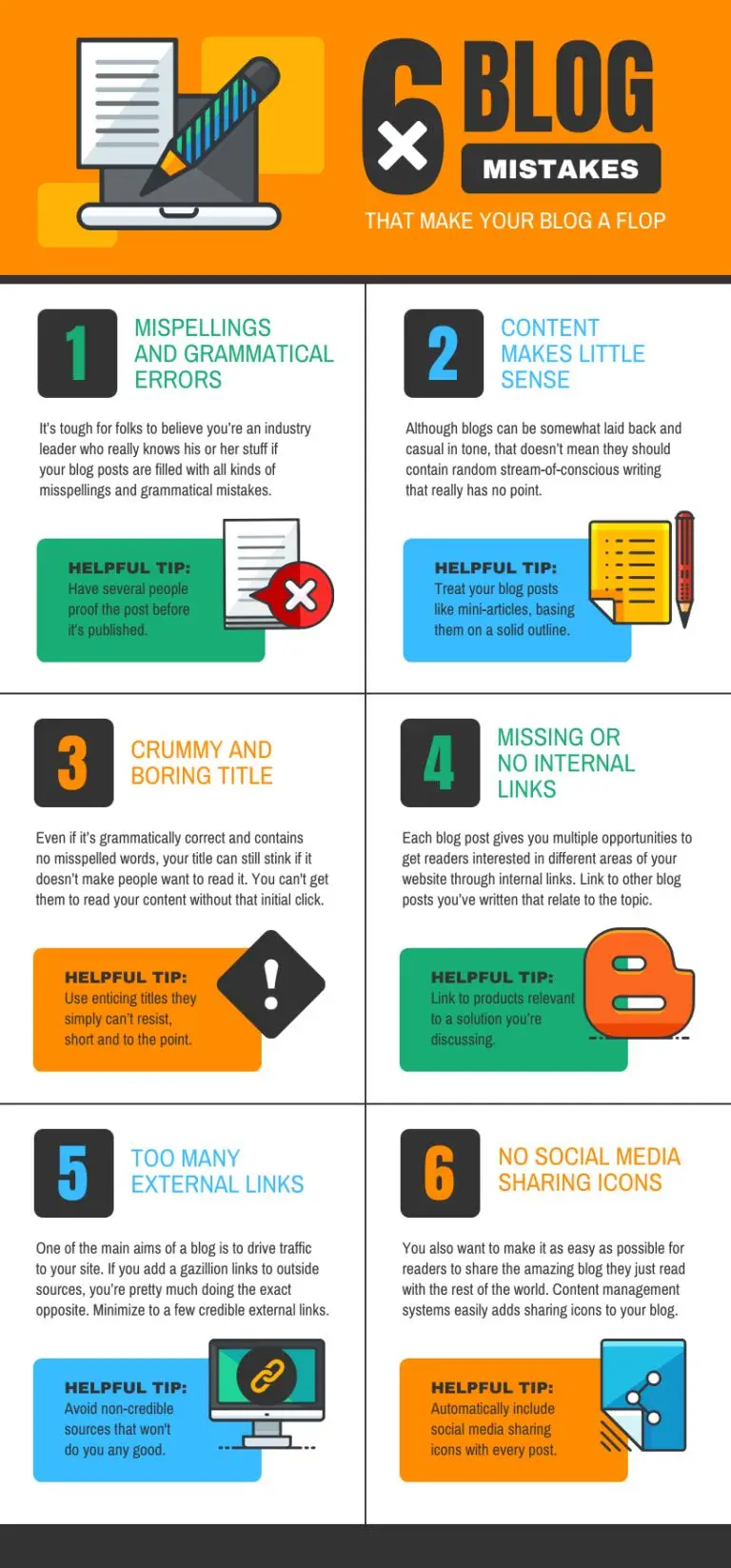
You’ll find some blogging basics in this infographic.
Here’s a summary of what’s covered:
- Misspellings and Grammatical Errors
- Content Makes Little Sense
- Crummy and Boring Title
- Missing or No Internal Links
- Too Many External Links
- No Social Media Sharing Icons
Check out the post below for more.
Blogging remains one of the most effective ways to connect with your audience, drive organic traffic, and build authority in your industry. But while blogs can be a powerful tool, too many marketers unknowingly fall into traps that reduce their effectiveness. These mistakes can undermine credibility, waste effort, and even drive readers away instead of drawing them in.
By recognising and avoiding the most common blogging missteps, you can ensure that every post delivers maximum value. In this post, we’ll explore six major mistakes that marketers often make and provide practical tips to help you steer clear of them. Each one may seem small, but together they can make the difference between a thriving blog and one that fails to resonate.
Misspellings and Grammatical Errors
Your blog represents your brand, and readers will quickly judge your professionalism based on the quality of your writing. Even if your insights are valuable, sloppy spelling and grammar can erode trust and make you look careless. Poorly written content distracts readers from your message and gives the impression that you don’t pay attention to detail.
To ensure your blog communicates authority, take steps to polish your writing before publishing. Readers expect content that is not only informative but also presented in a clear, accurate way. Good grammar and error-free posts help you appear credible and trustworthy.
- Have at least one or two people proofread each blog post before it goes live.
- Use writing tools like Grammarly or Hemingway to catch common errors.
- Take time to re-read your posts aloud to spot awkward phrasing or typos.
- Build a style guide to maintain consistency across your blog content.
Content Makes Little Sense
A blog may be informal in tone, but that doesn’t mean it should ramble without direction. Readers can quickly spot when content lacks structure or purpose, and nothing drives them away faster than confusion. Without a clear point or flow, your blog post risks wasting the reader’s time.
Creating a solid framework for your content ensures that your ideas are presented logically and persuasively. Outlining your blog before writing helps keep it focused, while editing ensures that every section ties back to your main goal. Clarity is key to building an audience that returns for more.
- Start each blog with a clear purpose or central theme.
- Draft an outline before writing to stay on track.
- Edit ruthlessly to remove tangents and unnecessary filler.
- Conclude by tying your points back to your original message.
Crummy and Boring Title
Your blog title is the first thing potential readers see, and it determines whether they will click or scroll past. Even if your content is strong, a dull or uninspiring headline can stop it from being read. A weak title fails to capture attention, meaning your hard work inside the post goes unnoticed.
Compelling titles are short, sharp, and designed to spark curiosity. They should give readers a reason to click while clearly indicating what the post is about. Investing time in crafting the right title is just as important as the content itself.
- Keep titles short and easy to understand, ideally under 70 characters.
- Use power words or emotional triggers that make people curious.
- Ensure your title promises a clear benefit to the reader.
- Test different title variations to see which drives the most clicks.
Missing or No Internal Links
Every blog post you write is an opportunity to guide readers deeper into your website. Without internal links, you miss valuable chances to showcase related content or direct readers to services and products. This not only reduces engagement but also limits the SEO benefits of your blog.
Internal linking helps search engines understand the structure of your site and boosts the visibility of important pages. More importantly, it enhances the user experience by making it easier for readers to explore relevant topics. Thoughtful linking creates a more connected and valuable journey for your audience.
- Add links to relevant blog posts that expand on the current topic.
- Direct readers towards service or product pages where appropriate.
- Use descriptive anchor text instead of generic phrases like “click here.”
- Regularly audit your blog to ensure older posts link to newer content.
Too Many External Links
External links can be useful for backing up your arguments or pointing to valuable resources, but using too many undermines your blog’s purpose. Sending readers away repeatedly prevents them from staying on your site, which reduces engagement and conversions. Worse still, linking to unreliable sources can damage your credibility.
The goal of your blog should be to establish your own expertise while providing value. This means balancing external references with your own insights. A few high-quality links can strengthen your authority, while too many weaken it.
- Limit external links to only the most credible, authoritative sources.
- Prioritise your own insights and original ideas over outside references.
- Open external links in a new tab so readers stay on your site.
- Regularly check links to ensure they are still live and trustworthy.
No Social Media Sharing Icons
Even the best content won’t spread if it’s difficult for readers to share. Without social sharing buttons, you make it harder for your audience to promote your blog on their networks. This oversight limits your reach and prevents your blog from growing through organic word-of-mouth.
Adding sharing icons is one of the simplest yet most effective ways to extend your blog’s visibility. By making it effortless for readers to share, you tap into their networks and multiply the potential audience for every post. Small adjustments like this can lead to significant increases in traffic.
- Include visible sharing icons for platforms like Facebook, LinkedIn, and X.
- Place icons at both the top and bottom of each post for convenience.
- Use tools or plugins that integrate sharing options into your CMS.
- Monitor which platforms drive the most shares to refine your strategy.
Conclusion
Blogging can be one of the most powerful tools in a marketer’s arsenal, but only if done well. Seemingly small mistakes—like poor grammar, unfocused content, or a lack of sharing options—can drastically reduce the impact of your work. Recognising these pitfalls is the first step to ensuring your blog supports your wider marketing goals.
By avoiding these six common blogging mistakes, you can create content that builds trust, engages readers, and drives long-term results. Focus on clarity, quality, and user experience, and your blog will become a valuable asset that strengthens your brand and attracts a loyal audience.

Author:
Mark Ford