Are you trying to keep up with Google’s constantly changing algorithms? Not sure who’s advice you should be following?
One guy who certainly knows his stuff is Neil Patel, we’ve been reading his very helpful posts quite a lot recently. His recent post which covers 17 SEO myths you shouldn’t follow really hit home with some of the SEO work we’ve been doing for clients lately and we felt the need to share.
We’ve pulled out the 6 most common myths we come up against and given them the infographic treatment below.
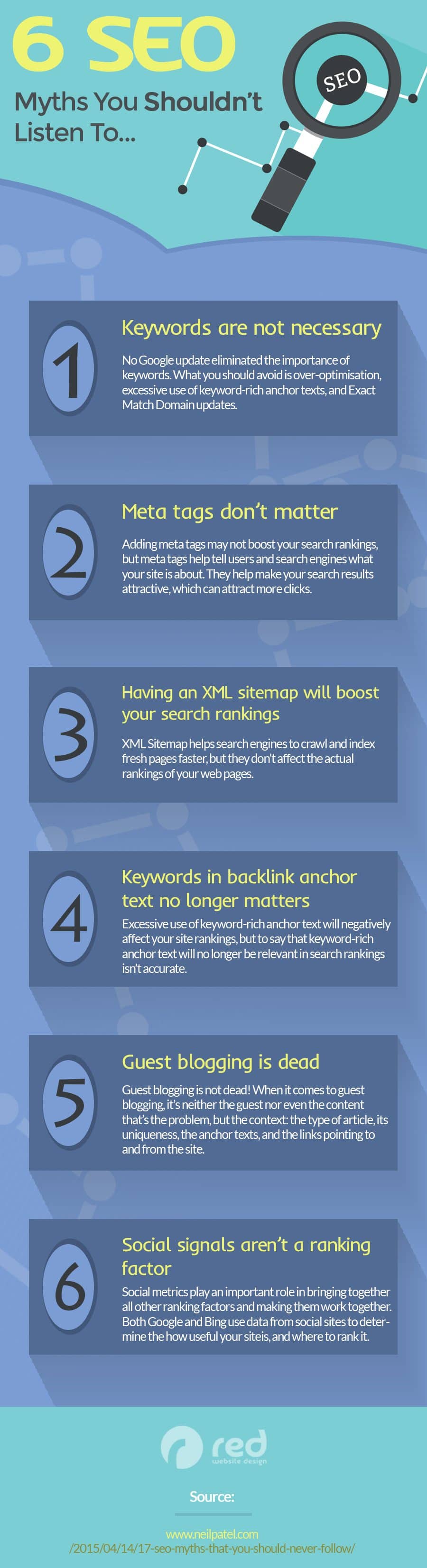
Search Engine Optimization (SEO) is a dynamic field that has evolved significantly over the years. As a website owner or digital marketer, it’s crucial to stay up-to-date with the latest SEO practices to improve your website’s visibility and rankings in search engine results. Unfortunately, there are many myths and misconceptions about SEO that can lead you down the wrong path. In this blog post, we’ll debunk six common SEO myths that you should stop listening to immediately.
Myth 1: Keyword Stuffing is the Key to Higher Rankings
Debunked: Keyword stuffing, the practice of excessively using keywords on a webpage in an attempt to manipulate search engine rankings, is an outdated and counterproductive SEO tactic. In the past, search engines like Google relied heavily on keyword density to determine a page’s relevance to a specific query. However, search algorithms have become much more sophisticated.
Today, search engines use a wide range of factors to assess a page’s quality and relevance, including user engagement, content quality, backlinks, and semantic analysis. Keyword stuffing not only makes your content unreadable for users but can also lead to penalties from search engines. Instead of stuffing keywords, focus on providing valuable and relevant content that naturally incorporates keywords in a meaningful way.
Myth 2: Backlinks Are All That Matters
Debunked: Backlinks, or links from other websites to yours, are undoubtedly important for SEO. They can help improve your website’s authority and rankings. However, the idea that the quantity of backlinks is the sole determinant of success is a myth.
Quality matters more than quantity when it comes to backlinks. A few high-quality, relevant, and authoritative backlinks can have a more significant impact on your SEO efforts than a multitude of low-quality links. Focus on building a natural and diverse backlink profile by earning links through valuable content and genuine outreach rather than resorting to black-hat link-building practices.
Myth 3: SEO is a One-Time Effort
Debunked: SEO is an ongoing process, not a one-time task. Many website owners mistakenly believe that they can optimize their site once and expect to maintain high rankings indefinitely. In reality, search engine algorithms are continually evolving, and your competitors are also working on their SEO strategies.
To stay competitive and maintain or improve your search rankings, you must regularly update your website’s content, monitor keyword performance, adapt to algorithm changes, and keep an eye on your competitors’ strategies. SEO is an ongoing commitment that requires time and effort.
Myth 4: Content Quantity Trumps Content Quality
Debunked: While consistently publishing new content is important for SEO, quality should always take precedence over quantity. Some website owners believe that churning out a high volume of low-quality articles or blog posts will help them rank better in search results. This couldn’t be further from the truth.
Search engines aim to provide users with the best possible answers to their queries. High-quality, informative, and well-researched content is more likely to satisfy user intent and earn higher rankings. Focus on creating valuable content that addresses your audience’s needs and interests, and you’ll see better long-term results.
Myth 5: SEO is All About On-Page Optimization
Debunked: On-page optimization, which includes optimizing elements like meta titles, meta descriptions, headings, and keyword placement, is undoubtedly a crucial part of SEO. However, it’s just one piece of the puzzle. SEO also involves off-page factors like backlinks, technical aspects like website speed and mobile-friendliness, and user experience.
Ignoring off-page and technical SEO can severely limit your website’s potential. To achieve the best results, take a holistic approach to SEO that includes all aspects of optimization, both on and off your website.
Myth 6: SEO Results Are Instantaneous
Debunked: Some people believe that implementing SEO changes will lead to instant results, with their website skyrocketing to the top of search engine rankings overnight. This is far from reality. SEO is a gradual process that takes time to show measurable results.
The time it takes to see SEO results depends on various factors, including your website’s current state, the competitiveness of your industry, and the keywords you’re targeting. It may take several weeks or even months before you notice a significant improvement in your rankings. Be patient, stay consistent with your SEO efforts, and focus on the long-term benefits.
Conclusion
SEO is a critical component of any successful online presence, but it’s essential to separate fact from fiction when it comes to optimizing your website. The SEO myths mentioned above are prevalent but can lead you down the wrong path if you follow them. Instead, focus on best practices that prioritize user experience, content quality, and ethical SEO techniques. By doing so, you’ll be on the right track to improving your website’s visibility and driving organic traffic. Remember that SEO is a continuous journey, and staying informed about industry developments is key to long-term success in the ever-evolving world of search engine optimization.

Author:
Mark Ford