Google has been clamping down hard on website owners lately with a wave of zoo like updates and penalties. Some websites have dropped from the first page down to the 10th or been removed from the index completely. If you’ve been using shady techniques and haven’t been hit yet no doubt your time will come.
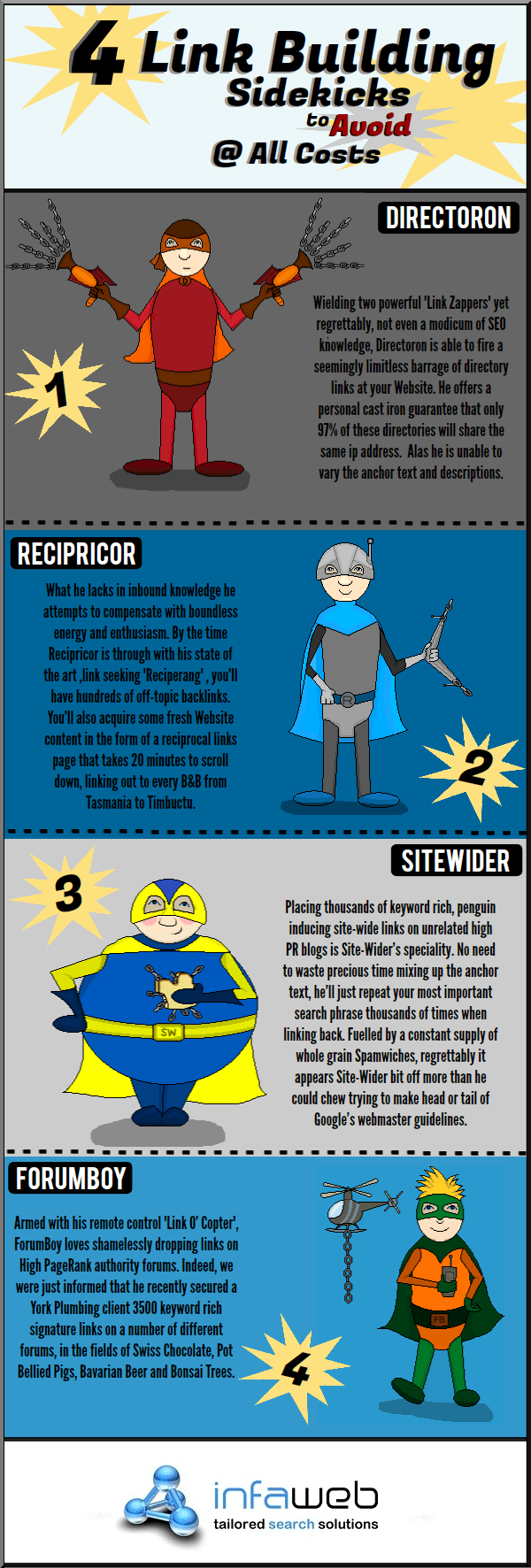
But what are these shady techniques? Well, this really cool infographic from Infaweb gives you 4 examples of SEO techniques you should stop using immediately.
1 – Directory Links: Google wants you to earn links from relevant websites. Low quality directories that list every Tom, Dick or Harry isn’t going to help achieve that.
2 – Reciprocal Linking: Do you have a page on your site that links to hundreds of websites who link back to you? What value is that giving to your site visitors?
3 – Site wide links: If you’ve got a link on a website and it appears on all 1,507 of their webpages with the same anchor text you can be sure red flags will be waving at Google HQ.
4 – Forum and Blog Comments: Stop spamming a load of low authority and off topic sites with comments in order to build links.
Search Engine Optimization (SEO) is a dynamic field that constantly evolves as search engines update their algorithms. What worked in the past may not be effective today, and using outdated SEO techniques can harm your website’s rankings and visibility. In this blog post, we will discuss four SEO techniques that you must stop using immediately if you want to improve your website’s search engine performance and avoid potential penalties.
Keyword Stuffing
Keyword stuffing is a practice where website owners try to manipulate search engine rankings by overloading their content with keywords. This technique involves using the target keyword excessively and unnaturally in the hopes of ranking higher for that keyword. However, keyword stuffing is a black hat SEO technique that can have severe consequences for your website’s SEO.
Why you should stop using it:
- a. Search engines are smarter than ever: Search engines like Google have become sophisticated at understanding the context and intent of web content. Overloading your content with keywords makes it look spammy and unnatural, which can result in penalties.
- b. Poor user experience: Keyword-stuffed content is challenging to read and provides a poor user experience. Visitors are more likely to bounce from your site, which can negatively impact your bounce rate and rankings.
- c. Modern SEO focuses on user intent: SEO has shifted towards satisfying user intent rather than keyword density. Creating high-quality, valuable content that answers users’ questions is more important than stuffing keywords.
Instead, focus on:
- Conducting thorough keyword research to identify relevant keywords for your content.
- Using keywords naturally and in context.
- Prioritizing user experience and providing valuable, informative content that meets user needs.
Duplicate Content
Duplicate content refers to identical or substantially similar content that appears on multiple pages of a website or across different websites. Some website owners may use duplicate content to try and manipulate search engine rankings or save time on content creation. However, search engines aim to deliver diverse and valuable results to users, and duplicate content can hinder this goal.
Why you should stop using it:
- a. Ranking dilution: When search engines encounter duplicate content, they may have difficulty determining which page to rank for a specific query. This can result in ranking dilution, where your pages compete against each other, leading to lower rankings for all of them.
- b. Penalization risk: Google’s algorithms can detect and penalize websites that use duplicate content as a strategy to manipulate rankings. This can lead to a significant drop in organic traffic and rankings.
- c. Poor user experience: Duplicate content doesn’t provide users with additional value or information. It can confuse visitors and make it harder for them to find what they are looking for.
Instead, focus on:
- Creating unique and valuable content for your website.
- Using canonical tags to indicate the preferred version of a page if you have similar content.
- Consolidating similar pages when necessary to avoid redundancy.
- Properly citing and linking to external sources when quoting or referencing their content.
Low-Quality Backlinks
Backlinks, also known as inbound links, are links from other websites to your site. While backlinks are an essential part of SEO, not all backlinks are created equal. In the past, acquiring a large number of backlinks, regardless of their quality, was a common SEO tactic. This practice often led to the creation of low-quality or spammy backlinks, which can now harm your website’s SEO efforts.
Why you should stop using them:
- a. Google’s algorithm updates: Google’s algorithms, such as Penguin, have become more adept at identifying and penalizing websites with low-quality backlinks. This can result in a significant drop in rankings.
- b. Loss of trust and credibility: Low-quality backlinks can make your website appear less credible and trustworthy to both search engines and users.
- c. Negative impact on user experience: Users may encounter spammy or irrelevant content through low-quality backlinks, leading to a poor user experience and reduced trust in your site.
Instead, focus on:
- Building high-quality, natural backlinks from authoritative and relevant websites.
- Earning backlinks through content that provides value to other websites and their audiences.
- Regularly monitoring your backlink profile and disavowing toxic or spammy backlinks.
- Avoiding link schemes and manipulative tactics.
Over-Optimized Anchor Text
Anchor text is the clickable text in a hyperlink. In the past, SEO practitioners would use exact match anchor text (anchors that precisely matched the target keyword) extensively in their backlinks to boost their rankings. However, over-optimized anchor text is no longer an effective or safe SEO technique.
Why you should stop using it:
- a. Algorithmic penalties: Search engines, particularly Google, have algorithms that detect over-optimized anchor text. Using it excessively can result in algorithmic penalties and a drop in rankings.
- b. Unnatural linking patterns: Overusing exact match anchor text can create unnatural linking patterns, which search engines can easily identify. This can raise suspicion and lead to penalties.
- c. Reduced user trust: When users encounter an excessive amount of exact match anchor text, it can appear spammy and untrustworthy, negatively impacting the user experience.
Instead, focus on:
- Using a variety of anchor text types, including branded, generic, and related keywords, in your backlinks.
- Prioritizing user experience by ensuring that anchor text provides context and value to readers.
- Creating high-quality content that naturally attracts diverse anchor text from reputable sources.
Conclusion
SEO is a constantly evolving field, and it’s essential to stay up-to-date with best practices and avoid outdated techniques that can harm your website’s performance. Keyword stuffing, duplicate content, low-quality backlinks, and over-optimized anchor text are all practices that you must stop using immediately to maintain and improve your website’s SEO rankings.
Instead, focus on creating high-quality, valuable content, earning high-quality backlinks, and providing an excellent user experience to achieve sustainable SEO success in the long run. By following ethical and modern SEO practices, you can ensure that your website continues to rank well and attract organic traffic.

Author:
Mark Ford