
Are you trying to understand how cognitive biases can make your copy more persuasive and effective? Want to learn the psychological principles that help marketers write copy that converts more consistently?
You’ll find the essential cognitive biases every marketer should master in this guide.
Here’s a summary of what’s covered:
- Ambiguity Bias
- Bandwagon Bias
- Anchoring Bias
- Confirmation Bias
- Story Bias
- Humour Effect
- Primary Effect
Check out the post below for more.
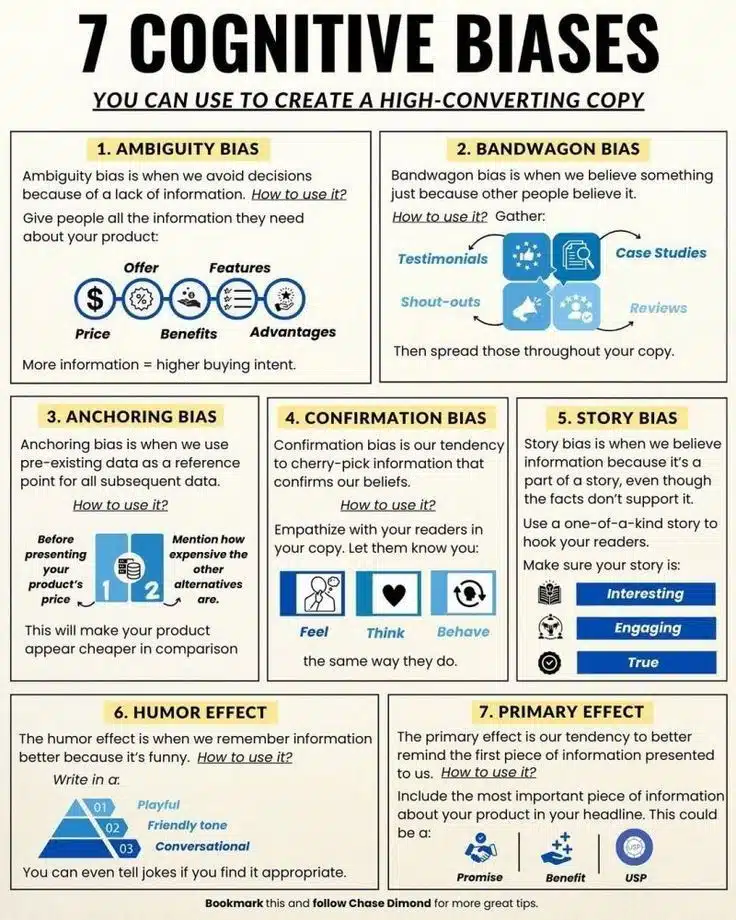
Effective copywriting is not just about choosing the right words. It is about understanding how the human mind interprets information, makes decisions and responds to subtle psychological cues. Cognitive biases are shortcuts our brains rely on to simplify thought processes, and when used ethically, they can dramatically increase how persuasive and memorable your copy becomes. Mastering these biases allows you to write content that aligns with how people naturally think, helping your messages resonate more clearly and powerfully.
Marketers who understand cognitive biases quickly discover that even small adjustments to structure, language and positioning can influence how readers engage with a product or idea. Instead of forcing the audience to work harder to evaluate information, good copy gently supports the way their minds already make decisions. This is what separates average content from high-performing copy. By weaving these psychological principles into your writing, you create messaging that feels relevant, trustworthy and effortlessly compelling.
Below you will find seven essential cognitive biases that belong in every marketer’s toolkit. Each one creates a different kind of influence, and together they form a powerful foundation for writing copy that converts. Whether you are crafting sales pages, emails, landing pages or ads, these principles will help you build messages that meet your readers where they already are mentally.
Ambiguity Bias
People often avoid making decisions when they feel they do not have enough information. When something is unclear, uncertain or incomplete, the brain instinctively holds back because it perceives a higher risk. In marketing, this means readers who are confused or unsure will almost always leave rather than act. Ambiguity bias highlights the importance of clarity, transparency and thoroughness in your copy.
The more clearly you explain your product, service or offer, the easier it becomes for your audience to feel confident about taking the next step. Good copy removes doubt rather than creating it. When you eliminate ambiguity, you reduce friction, increase trust and guide the reader toward a decision engineered for clarity. High-converting copy is clear, complete and easy to understand at a glance.
- Provide full details about the offer, including price, features and benefits.
- Explain advantages and value in simple, digestible language.
- Avoid vague claims and replace them with specific information.
- Ensure your copy answers the most common questions upfront.
Bandwagon Bias
Bandwagon bias reflects our tendency to believe or do something simply because other people are already doing it. Humans naturally look for social cues when making decisions, especially when they feel uncertain. In marketing, this bias is activated when people see that others have already chosen a product, endorsed a service or shared a positive experience.
Copy that leverages social proof is far more persuasive because it reduces perceived risk and increases credibility. When readers see that others like them have benefited from the offer, they are more likely to follow. Social proof communicates safety, trust and popularity, all of which move people closer to conversion.
- Highlight testimonials that reflect real customer experiences.
- Include reviews that address common doubts or concerns.
- Share case studies that demonstrate results in a clear narrative.
- Use shout-outs, endorsements or user milestones to show widespread acceptance.
Anchoring Bias
Anchoring bias occurs when people rely heavily on the first piece of information they see and use it as the reference for all future judgments. In copywriting, the most common application of this bias is price anchoring. By showing a higher comparison point upfront, the actual cost of your offer appears more reasonable.
Marketers use anchoring to shape how customers perceive value. When the audience first sees information that establishes a frame of reference, their minds evaluate everything else relative to it. This bias helps you position your offer more strategically and guide readers toward a more favourable decision.
- Present comparison pricing before revealing your actual price.
- Reference more expensive alternatives to emphasise affordability.
- Position your offer as high value relative to what the reader expects.
- Use tiered pricing options to make specific choices appear more attractive.
Confirmation Bias
Confirmation bias is our natural tendency to notice, value and prioritise information that confirms what we already believe. When your copy aligns with the reader’s worldview, they feel validated and understood. This makes them far more receptive to your message because you appear to be reinforcing their existing thoughts rather than challenging them.
Effective copywriting leverages confirmation bias by matching the reader’s language, emotions and motivations. When your audience feels that you think the same way they do, they are more likely to trust you. This creates a powerful connection that can shift buying behaviour and increase engagement.
- Use language that reflects your audience’s existing beliefs and frustrations.
- Acknowledge their emotions to show understanding and alignment.
- Mirror their preferred thinking patterns and values in your messaging.
- Reinforce the behaviours they already consider sensible or desirable.
Story Bias
Story bias describes our tendency to believe and remember information more easily when it is presented as a story rather than as isolated facts. Stories help the brain interpret meaning, creating emotional engagement and better recall. Even when data is strong, it becomes more persuasive when framed within a narrative.
For marketers, stories are a powerful tool because they help readers picture themselves experiencing results or overcoming a challenge. They also make complex concepts easier to understand. When your copy includes a well-constructed narrative, you create more impact and leave a lasting impression.
- Craft a unique story that highlights transformation or insight.
- Ensure the story is interesting enough to capture attention quickly.
- Keep the narrative engaging with clear conflict and resolution.
- Base the story on real, truthful elements to maintain credibility.
Humour Effect
The humour effect explains why people remember information better when it is presented in a playful, light-hearted or conversational way. Humour increases attention, reduces resistance and makes the message more enjoyable. When used appropriately, it helps your copy stand out in a sea of predictable marketing language.
Humour also humanises your brand, making readers feel more relaxed and open to persuasion. However, balance is important; humour should enhance clarity, not distract from it. When done well, it creates a positive emotional experience that supports recall and connection.
- Use a friendly, conversational tone that feels natural.
- Include playful phrasing where appropriate to keep readers engaged.
- Soften heavy or complex topics with relatable humour.
- Add occasional light jokes only when they fit the brand voice.
Primary Effect
The primary effect describes how people tend to remember the first piece of information they encounter more strongly than anything that follows. In copywriting, this principle shapes how you approach headlines, openings and key value statements. What you say first sets the tone for everything else.
Because readers form impressions quickly, your opening message must immediately communicate value. Whether you highlight a promise, a benefit or a unique selling point, this early emphasis can significantly influence how the rest of the copy is interpreted. A strong first impression is essential for capturing attention and encouraging deeper engagement.
- Lead with your most important message in the headline or first sentence.
- Emphasise a clear promise, benefit or USP right at the start.
- Structure your content so key points appear early and prominently.
- Avoid opening with vague or generic statements that dilute impact.
Conclusion
Cognitive biases shape nearly every decision people make, and mastering them allows marketers to create copy that feels natural, persuasive and aligned with real human behaviour. By understanding how people process information, you can design messages that simplify choices, reduce uncertainty and strengthen emotional connection. Each bias influences the reader in a different way, but together they form a powerful foundation for writing copy that converts with greater consistency.
When used ethically, cognitive biases help you communicate more clearly, build trust more effectively and guide your audience toward choices that truly benefit them. Whether you are writing landing pages, emails, website content or ads, these principles will help you craft messages that meet the reader’s needs more precisely. The best copy does not fight against how the mind works. It works with it, and these cognitive biases are the key to making that happen.

Author:
Mark Ford