
Are you wondering whether your social media presence is enough to represent your business online? Want to know if a website still plays a vital role in today’s social-first digital landscape?
You’ll find some marketing basics in this infographic.
Here’s a summary of what’s covered:
- Ownership and Control
- Flexibility and Customisation
- Purpose and Role
- Insights and Data
- Credibility and Professionalism
- SEO and Discoverability
- Lead Generation and Conversion
- Platform Risk and Limitations
- Long-Term Asset Building
- Integration and Scalability
Check out the post below for more.
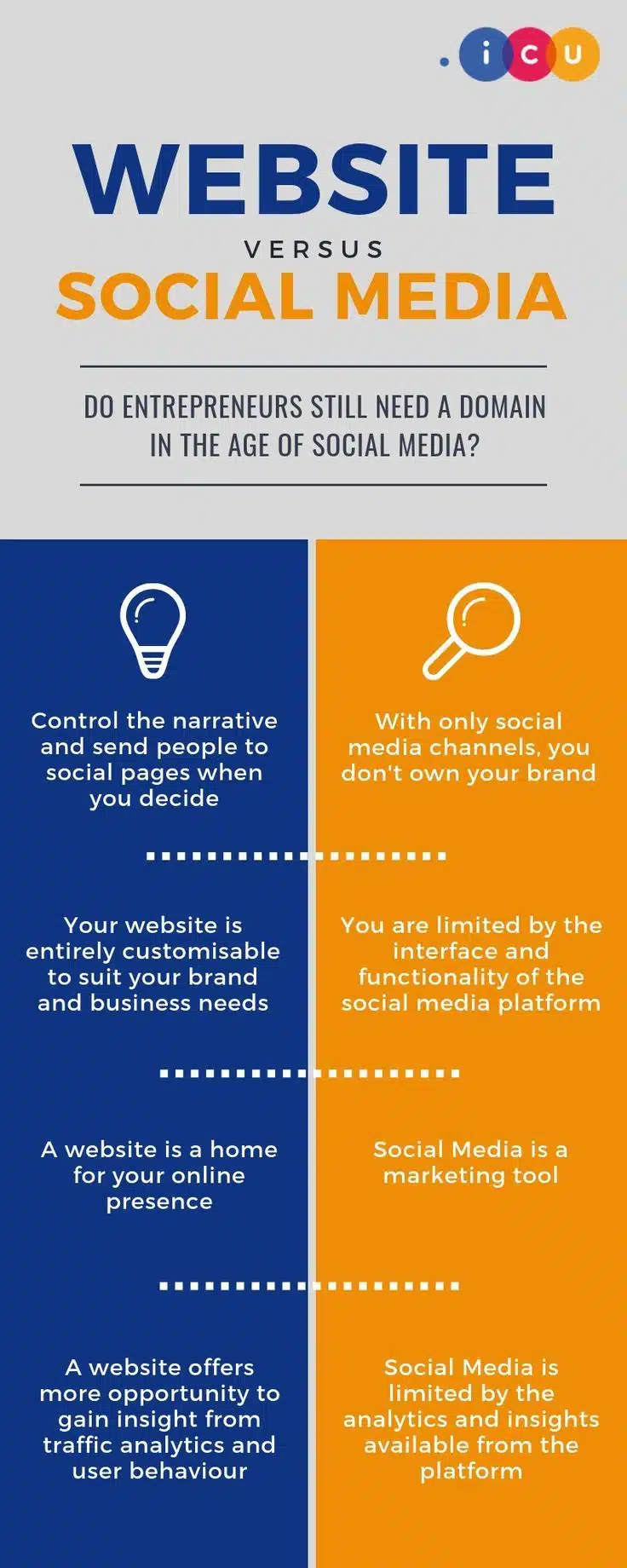
In today’s digital-first world, many entrepreneurs question whether a dedicated website is still necessary. With the rise of social media platforms offering storefronts, content tools, and audience engagement, it’s tempting to rely on them alone.
But while social media can boost visibility and engagement, it has limits that a website can overcome. In this post, we explore the key differences and explain why a professional web presence still matters—especially for long-term growth.
Ownership and Control
Social media may offer convenience, but you don’t actually own the space. Platforms can change the rules, limit your reach, or shut down accounts at any time. A website, by contrast, gives you full ownership of your content, brand, and user experience. If you’re serious about building something that lasts, control matters.
- Maintain full authority over your content, layout, and branding with your own site.
- Avoid algorithm dependency by choosing how and when visitors see your content.
- Protect your assets from sudden changes in platform policies or outages.
- Build on solid ground instead of relying on rented digital space.
Flexibility and Customisation
Social platforms are designed for mass usage, which limits what you can do with your brand. Your layout, messaging, and design options are constrained by the platform’s interface. A website, on the other hand, is a blank canvas—you can tailor it precisely to fit your business goals and customer journey. That flexibility is crucial for standing out.
- Design pages that reflect your brand identity down to the smallest detail.
- Add functionality like booking systems, e-commerce, or lead magnets that social platforms don’t support.
- Optimise user journeys without being forced into the platform’s default structure.
- Make changes quickly to reflect new services, pricing, or brand updates.
Purpose and Role
Social media is a tool—but your website is the foundation. Your site acts as a central hub where all your marketing channels converge. It houses your long-form content, key business information, and lead generation tools. Social media should support that hub, not replace it.
- Centralise your presence by linking all content, offers, and touchpoints in one place.
- Drive traffic intentionally to pages that are built for conversion, not just scrolling.
- Use your site as home base for campaigns, product launches, and content marketing.
- Position your brand as a serious, established presence—something a profile alone can’t do.
Insights and Data
Understanding your audience is critical—but social platforms only show you what they want you to see. With a website, you get deeper insights through tools like Google Analytics. You can measure how users interact with your content, identify drop-off points, and make informed improvements based on real data.
- Track user journeys across every page and action, not just likes and follows.
- Analyse conversions and bounce rates to see what’s working.
- Monitor performance trends and use them to optimise SEO and content.
- Own your data instead of relying on filtered or restricted platform metrics.
Credibility and Professionalism
A website signals that your brand is serious, credible, and ready for business. Anyone can create a social media page, but investing in a website shows commitment. For potential customers, collaborators, and press—your site is often the first real impression they’ll trust. It’s your digital storefront, and it should reflect your standards.
- Make a strong first impression with a branded, well-structured online presence.
- Showcase testimonials, media features, and in-depth case studies that build trust.
- Provide clear, accessible contact info and business details in one place.
- Demonstrate professionalism through intentional design and user experience.
SEO and Discoverability
A well-optimised site can bring organic traffic month after month, while social posts disappear in hours. By investing in SEO, you can reach people actively searching for what you offer—at the exact moment they need it.
- Target high-intent keywords that bring in ready-to-buy visitors.
- Create landing pages that rank for local, product, or service-based searches.
- Gain long-term visibility through evergreen blog content and backlinks.
- Control your search listings with structured metadata and rich results.
Lead Generation and Conversion
Social media is great for engagement, but it’s not built for conversion. A website lets you guide visitors from interest to action with purpose-built tools. Whether it’s a sales page, a contact form, or an email signup, your site is where curiosity becomes commitment.
- Use clear CTAs and conversion paths tailored to your business model.
- Build lead magnets like guides or checklists to grow your email list.
- Run A/B tests to improve messaging, layout, and user flow.
- Integrate tools like CRMs, schedulers, and e-commerce systems with ease.
Platform Risk and Limitations
Social media platforms can delete, shadowban, or suspend accounts without warning. Changes to algorithms or ad policies can ruin your reach overnight. Relying solely on these platforms puts your business in a vulnerable position. A website gives you independence.
- Protect against sudden loss of reach or access due to platform decisions.
- Avoid over-reliance on third-party systems you don’t control.
- Diversify your online presence so no single channel can break your strategy.
- Maintain business continuity with an owned and stable home base.
Long-Term Asset Building
A website grows in value over time. As you add content, optimise SEO, and refine design, it becomes a true business asset. Social posts, on the other hand, are fleeting and hard to repurpose. If you want to build something sustainable, your site is the foundation.
- Create a content library that attracts visitors year-round.
- Develop authority in your niche through long-form resources and insights.
- Increase brand equity through consistent updates and recognisable design.
- Own your archives instead of losing them when a feed changes or breaks.
Integration and Scalability
As your business grows, you need systems that can grow with it. A website can integrate with your marketing stack, sales tools, booking platforms, and more. Social media can’t offer that kind of scalability. If you plan to scale your business, a website is non-negotiable.
- Connect seamlessly with payment processors, email platforms, and CRMs.
- Add features over time without rebuilding from scratch.
- Create tailored customer experiences across multiple buyer journeys.
- Adapt quickly to changing needs, launches, or market shifts.
Conclusion
Being active on social media is no longer optional—but it’s not the whole story. Without a website, you’re building your business on rented land, subject to shifting rules and limited control. A website offers permanence, professionalism, and potential that social platforms simply can’t replicate. It’s not either/or—it’s both.
But your website should always be the foundation, not the fallback. For entrepreneurs with long-term ambitions, it remains an essential tool for ownership, growth, and impact.

Author:
Mark Ford