
Are you trying to figure out the best way to grow your business? Want to understand the key strategies—from selling more to buying out competitors—that can drive your expansion?
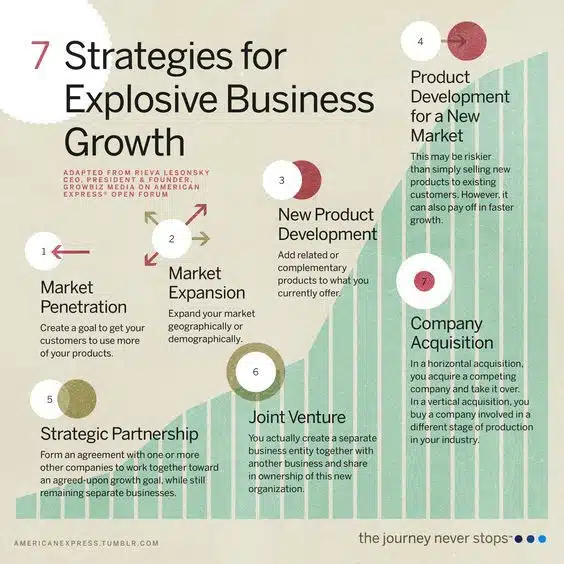
You’ll find some business basics in this infographic.
Here’s a summary of what’s covered:
- Market Penetration
- Market Expansion
- New Product Development
- Product Development for a New Market
- Strategic Partnership
- Joint Venture
- Company Acquisition
Check out the post below for more.
Every business reaches a point where growth becomes essential to survive and thrive. But with so many ways to expand, it can be difficult to choose the strategy that suits your goals, resources, and risk appetite.
From selling more to existing customers to acquiring an entirely new company, your path to growth will depend on your vision and the market you operate in. This post explores seven powerful strategies and helps you decide which one is right for your business.
Market Penetration
Market penetration focuses on increasing sales of your existing products to your current customer base. It’s typically the least risky growth strategy and often involves pricing tactics, promotions, or improved customer engagement to drive higher volume. The aim is to win more of the market share you’re already competing in. If your market has room to grow, this approach can be both fast and cost-effective.
- Run limited-time discounts or offers to encourage repeat purchases from existing customers.
- Invest in loyalty programmes to increase customer retention and long-term value.
- Use customer feedback to refine your product or service and boost satisfaction.
- Increase marketing spend on your best-performing channels to amplify existing results.
Market Expansion
Market expansion involves taking your existing products and services to new audiences. This could be geographical—entering a new region or country—or demographic, such as targeting a different age group or industry. It’s a great way to extend your reach without developing new offerings. However, it does require research and strategic execution to avoid wasting resources.
- Conduct market research to identify untapped regions or segments with high potential.
- Tailor your messaging and branding to resonate with new customer groups.
- Partner with local distributors or agencies to ease market entry.
- Assess local competition and pricing to position your offering competitively.
New Product Development
New product development means creating additional or complementary offerings to meet the needs of your current customer base. This strategy works well when your audience already trusts your brand but is looking for more value or variety. It allows you to increase average order value and customer lifetime value without changing your market focus.
- Use customer surveys and sales data to identify product gaps or opportunities.
- Test new ideas through limited launches or MVPs before full-scale production.
- Upsell and cross-sell your new product alongside existing bestsellers.
- Ensure quality and branding remain consistent with your core offering.
Product Development for a New Market
This approach involves designing a brand-new product for a completely different target market. While riskier than the other strategies, it opens up doors to entirely new streams of revenue. If successful, this strategy can accelerate growth and establish your brand as a more diversified player. Just be prepared for longer timelines and higher investment.
- Research emerging trends and unmet needs in new markets.
- Allocate dedicated resources and teams to avoid diluting your core focus.
- Leverage existing capabilities where possible to reduce costs.
- Develop tailored marketing strategies that address the specific pain points of the new audience.
Strategic Partnership
Forming strategic partnerships allows you to work with other companies towards shared goals without merging operations. These relationships can help you expand your reach, share resources, and tap into new expertise. It’s a flexible way to grow without giving up control or making major investments. The key is finding the right partner and aligning objectives clearly.
- Look for partners with complementary products, audiences, or capabilities.
- Define clear goals, responsibilities, and performance metrics from the outset.
- Create a joint marketing strategy to promote the partnership.
- Review progress regularly and remain open to adjusting the terms if needed.
Joint Venture
A joint venture goes a step further than a partnership by creating a separate business entity. Both parties contribute resources and share ownership, profits, and control. This structure allows for deeper collaboration while distributing risk. It’s often used for entering new markets or launching major projects that neither party could pursue alone.
- Choose a partner with a strong reputation and aligned long-term vision.
- Establish a formal legal agreement outlining roles, shares, and exit terms.
- Assign leadership from both sides to ensure balanced input and governance.
- Protect your core business by limiting the joint venture’s scope and liabilities.
Company Acquisition
Acquisition involves buying another business to quickly gain market share, enter new markets, or acquire valuable resources like talent, technology, or contracts. While it can deliver rapid growth, acquisitions are complex and come with financial, cultural, and operational risks. Thorough due diligence and post-acquisition planning are essential for success.
- Identify acquisition targets that align with your strategic goals.
- Analyse the financial health, brand reputation, and operational fit.
- Plan for integration early—people, systems, and culture all matter.
- Consider hiring specialist advisers to guide the negotiation and legal process.
Conclusion
Choosing the right growth strategy isn’t just about ambition—it’s about alignment. Your business’s size, stage, goals, and market conditions all play a part in determining the best path forward.
While market penetration may be perfect for a young company, a mature brand might find acquisitions or product diversification more fruitful. Take the time to weigh the pros and cons of each strategy, and remember: sustainable growth comes from deliberate, well-executed decisions.

Author:
Mark Ford