
Are you looking for ways to keep visitors engaged on your website for longer? Want to learn how the right opening words can improve flow and boost readability?
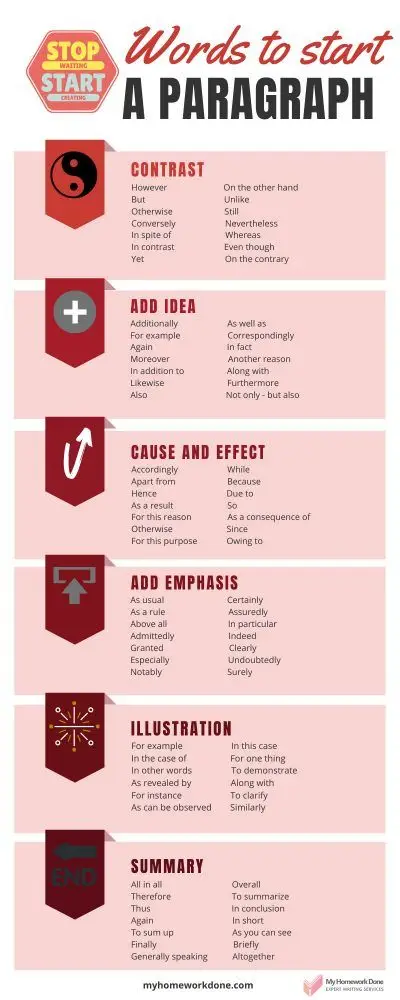
You’ll find some copywriting basics in this infographic.
Here’s a summary of what’s covered:
- Contrast
- Add Idea
- Cause and Effect
- Add Emphasis
- Illustration
- Summary
Check out the post below for more.
When visitors land on your website, their attention span is limited, and every word counts. One of the most overlooked elements in keeping readers engaged is the way you start your paragraphs. The first few words act as signposts, guiding your audience through the journey of your content. Choosing the right opening words can make the difference between a quick exit and a deeper interaction with your site.
By using carefully selected paragraph starters, you can create flow, build trust, and encourage readers to continue scrolling. These transitions not only improve readability but also shape the overall user experience. In this post, we’ll explore the importance of contrast, adding ideas, cause and effect, emphasis, illustration, and summaries to help your website content shine. Each approach offers unique benefits that will keep your visitors engaged for longer.
Contrast
Readers crave clarity, and contrast words provide exactly that. They show the relationship between competing ideas, offering balance and variety in your writing. Using contrast effectively prevents your content from sounding one-sided or repetitive. Instead, it demonstrates that you’ve thought about different perspectives, which builds credibility with your audience.
- Use words like “however” or “yet” to highlight an alternative point without disrupting flow.
- Introduce “on the other hand” to encourage readers to consider another angle.
- Apply “whereas” or “unlike” to compare features, services, or solutions.
- Balance pros and cons by using “even though” to acknowledge limitations fairly.
Add Idea
Sometimes, your readers need to see that one point naturally leads into another. Words that add ideas ensure your paragraphs flow smoothly and give a sense of progression. They help build momentum by showing that you’re not done making your case. This technique reassures your audience that they’re on a journey, not stuck in isolated statements.
- Use “additionally” or “moreover” to expand on a previous point with authority.
- Add “in addition” or “also” to connect closely related ideas without clutter.
- Include “furthermore” to strengthen an argument and provide extra weight.
- Start with “another reason” when building a persuasive case step by step.
Cause and Effect
Visitors stay longer when content makes logical sense, and cause-and-effect words are crucial here. They show readers why something matters and what outcomes to expect. By linking action with result, you create a more engaging narrative that feels practical and purposeful. This type of structure is especially powerful for marketing, tutorials, and case studies.
- Use “as a result” or “therefore” to link actions directly to outcomes.
- Introduce “due to” when explaining the reasons behind a change or decision.
- Apply “hence” or “so” to simplify the connection between cause and effect.
- Employ “for this reason” to highlight the importance of taking action.
Add Emphasis
Not all ideas deserve equal weight — some need to stand out. Emphasis words draw attention to your most important points and ensure they don’t get lost in the text. By signalling to readers that something matters, you guide them toward the core messages of your content. These cues improve retention and make your arguments more persuasive.
- Use “above all” or “especially” to highlight critical features or benefits.
- Add “indeed” or “clearly” to reinforce the strength of your point.
- Apply “undoubtedly” or “surely” to create a confident, trustworthy tone.
- Introduce “in particular” when drawing focus to specific examples.
Illustration
People absorb information better through examples, and illustration words provide the perfect setup. They help transition from abstract ideas to concrete demonstrations. This approach brings clarity and relatability to your content, ensuring readers understand not just what you mean but how it applies. Examples also make your writing feel more practical and less theoretical.
- Use “for example” or “for instance” to introduce real-world applications.
- Start with “in this case” to explain scenarios that mirror your audience’s needs.
- Add “to demonstrate” or “to clarify” when simplifying complex ideas.
- Employ “similarly” or “along with” to show comparisons that aid understanding.
Summary
Readers often skim content, so summaries help them grasp the big picture. Opening words that signal a summary ensure your audience can catch up quickly and see the value of what they’ve read. This not only increases comprehension but also keeps people engaged by showing them you respect their time. Summaries act as a bridge to your calls-to-action, making them essential for conversions.
- Use “all in all” or “overall” to wrap up your argument neatly.
- Start with “to summarise” or “in conclusion” to guide readers to the end.
- Apply “finally” or “thus” when leading into closing thoughts.
- Add “generally speaking” or “altogether” for broad, reflective statements.
Conclusion
Keeping visitors on your site longer is not just about flashy design or eye-catching visuals — it’s about how you guide them through your words. The opening phrases of each paragraph act as signals, helping readers understand the flow of your message. By carefully choosing words that highlight contrast, add ideas, explain cause and effect, add emphasis, illustrate, and summarise, you can transform your website content into an engaging, user-friendly experience.
When readers feel guided, understood, and valued, they are far more likely to stay with you until the very last line. The right opening words are subtle but powerful tools in shaping how people interact with your site. Mastering them is a small change that can deliver a big impact on engagement, conversions, and overall satisfaction.

Author:
Mark Ford