Are you looking for a clearer way to understand how social media contributes to real business results? Want to learn how to measure the impact of your content at every stage of the marketing funnel?
You’ll find a full breakdown of funnel metrics in this infographic.
Here’s a summary of what’s covered:
- Awareness
- Consideration
- Conversion
- Loyalty
- Advocacy
Check out the post below for more.
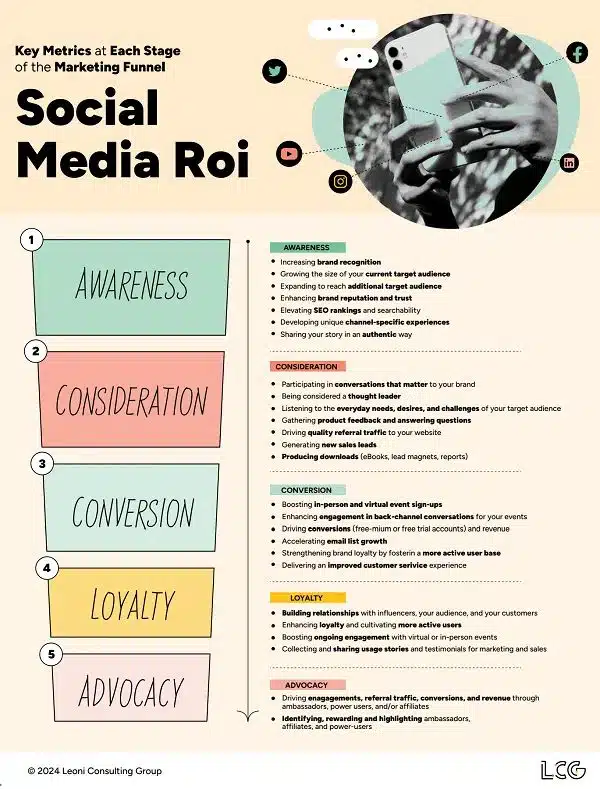
Measuring social media ROI requires more than simply checking follower numbers or counting how many likes a post receives. To understand the true value of your social activity, you need to look at how each platform supports the full customer journey, from the first moment of discovery to the point where loyal customers become vocal brand advocates. When you examine social media’s impact at every stage of the funnel, you gain a clearer picture of what drives real results and what needs improving. This approach transforms social media from a vague promotional tool into a measurable, predictable contributor to business growth.
By aligning your metrics with the marketing funnel, you can see exactly where your content succeeds, where it creates momentum, and where prospects may fall away. Each stage requires different types of content, different engagement strategies, and different performance indicators. Knowing how to monitor these stages gives you the ability to refine campaigns with confidence. In this guide, you’ll learn how to track ROI at every funnel stage using the core activities and signals that matter most.
Awareness
The awareness stage introduces your brand to new audiences and strengthens familiarity among those who already know you. This is where social media plays its most visible role, helping your message reach people at scale while shaping that all-important first impression. The goal is not to push for conversions but to ensure your brand becomes recognisable, discoverable, and trustworthy. Strong awareness makes every later stage more effective.
Tracking ROI during awareness involves monitoring the reach and visibility of your brand as it appears across platforms. Metrics here show how efficiently your content spreads and how clearly your audience understands who you are. Awareness is also heavily influenced by how effectively you create and personalise content for each platform. By watching these patterns, you can identify what performs well and which channels need a different approach.
- Track brand recognition growth by monitoring reach, impressions, profile views, and content visibility.
- Measure target audience growth, including increases in followers, viewers, and new unique visitors.
- Evaluate improvements in searchability through increases in SEO rankings, branded queries, and discoverability.
- Review performance of channel-specific strategies, assessing which formats deliver the strongest engagement.
Consideration
The consideration stage focuses on engagement, perception, and how your audience evaluates your relevance to their needs. People at this stage already know your brand exists, but now they want to learn more. Social media allows you to join meaningful conversations, answer questions, and present your expertise in ways that build credibility. This is where you demonstrate that you understand your audience’s challenges and can provide real value.
ROI at the consideration stage is revealed through the actions people take to explore your brand more deeply. These include asking questions, downloading resources, clicking through to your website, and displaying signs of active interest. Your social channels should help guide people into this exploratory behaviour. By measuring these signals, you can see whether your content is successfully nurturing prospects toward the next stage.
- Monitor engagement with conversation-driven posts to assess how well your brand participates in meaningful discussions.
- Track questions, feedback, and sentiment to understand your audience’s needs, concerns, and expectations.
- Measure referral traffic from social platforms to your website or landing pages to gauge research intent.
- Record downloads of resources such as eBooks, guides, lead magnets, and reports that show deeper interest.
Conversion
The conversion stage captures the moments when prospects take actions that move them closer to becoming customers. Social media can influence conversions even if the final action takes place elsewhere, such as on your website or at an in-person event. By providing targeted content, timely reminders, and supportive messaging, social platforms help remove barriers and encourage decisive action. This is where interest becomes commitment.
Measuring ROI here involves tracking actions that have clear commercial intent. These include trial sign-ups, event registrations, email list growth, and increased participation in conversion-focused conversations. Social platforms can accelerate this movement by reinforcing value and offering supportive service interactions. When monitored correctly, conversion metrics reveal exactly how social contributes to measurable outcomes.
- Track event sign-ups driven by posts, stories, promotional messages, and direct calls to action.
- Monitor private or back-channel engagement that supports conversion-focused conversations.
- Measure email list growth and trial account registrations resulting from social activity.
- Analyse customer service interactions to determine how support quality influences conversion outcomes.
Loyalty
The loyalty stage is about strengthening relationships with customers and maintaining ongoing engagement long after the initial purchase or commitment. Social media provides continual touchpoints that help customers feel connected, informed, and appreciated. Loyal audiences are more likely to interact with content regularly, attend events, and stay involved in your brand’s community. Building loyalty helps ensure consistent long-term value.
Tracking ROI during the loyalty stage involves observing how consistently customers continue engaging with your brand. Repeat interactions, ongoing participation, and willingness to share experiences are indicators of strong loyalty. Social media allows you to deepen these relationships by showcasing customer stories, involving your audience in initiatives, and creating spaces where people feel part of something meaningful.
- Measure recurring engagement from existing customers through comments, shares, and regular interactions.
- Track the activity levels of loyal users who frequently participate in brand discussions or events.
- Monitor attendance and involvement in both virtual and in-person events aimed at current customers.
- Collect and share customer stories and testimonials that reinforce positive long-term relationships.
Advocacy
Advocacy represents the highest level of social media ROI. This is when customers actively promote your brand through referrals, recommendations, reviews, and shared experiences. Advocates extend your reach far beyond what paid campaigns can achieve and provide social proof that is more influential than traditional marketing. Social media gives them a platform to amplify your message and encourage others to trust your brand.
Measuring ROI at the advocacy stage involves identifying your strongest supporters, tracking the impact of their promotion, and monitoring the traffic or conversions they generate. Advocates may include ambassadors, affiliate partners, power users, or highly satisfied customers. By recognising and rewarding them, you create a cycle of positive reinforcement that keeps advocacy strong and sustainable over time.
- Track referral traffic, conversions, and engagement generated by ambassadors, affiliates, and dedicated supporters.
- Identify your most active advocates by monitoring who consistently promotes or recommends your brand.
- Measure the reach and frequency of user-generated content that showcases authentic enthusiasm.
- Establish reward or recognition initiatives that motivate advocates to continue supporting your brand.
Conclusion
Tracking social media ROI across the entire marketing funnel gives you a far more accurate understanding of how your platforms contribute to business growth. Each stage of the funnel provides its own unique signals, and by monitoring these carefully, you can refine your strategy with clear purpose.
Instead of relying on surface-level metrics, this structured approach helps you allocate resources effectively, adjust campaigns intelligently, and demonstrate measurable value. When you understand social media’s role from awareness through advocacy, you gain the clarity needed to build a stronger, more effective, and more predictable marketing system.

Author:
Mark Ford