
Are you looking for proven ways to increase engagement and conversions from your email campaigns? Want to learn how A/B testing can help you optimise every element of your emails for better results?
You’ll find some email marketing basics in this infographic.
Here’s a summary of what’s covered:
- Have a Specific, Testable Hypothesis
- Write Down Your Hypothesis
- Create Two Almost Identical Versions, Differing in One Element
- Set the Right Size of Test Groups
- Define What Success Means
- Send Test Campaign and Monitor Results
- What Can Be Tested?
- Why A/B Testing Matters for Engagement and Revenue
Check out the post below for more.
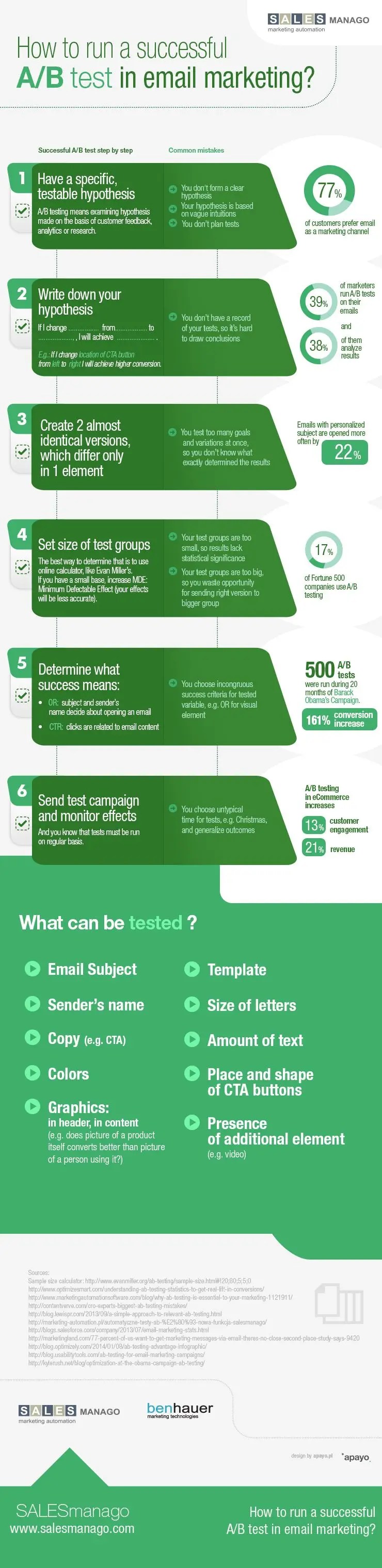
Email marketing remains one of the most effective ways to reach and convert customers, but success depends on more than simply hitting “send.” Audiences are diverse, and even small tweaks in subject lines, calls to action, or design can have a dramatic impact on results. This is where A/B testing comes in. By experimenting with different versions of your emails, you can identify what resonates best with your audience and continually optimise for engagement and revenue.
This guide will walk you step by step through the process of running a successful A/B test in email marketing. Each section focuses on a critical stage, from setting hypotheses to monitoring results, ensuring your campaigns deliver measurable improvements.
Have a Specific, Testable Hypothesis
Every A/B test should begin with a clear hypothesis. This isn’t guesswork or intuition—it’s about making predictions based on data, research, or customer behaviour. If your starting point is vague, your results will be inconclusive, and the test won’t add value to your email strategy. A strong hypothesis focuses on a single change and its expected impact on engagement.
- Base your hypothesis on analytics, customer feedback, or past performance rather than hunches.
- Frame your test as a cause-and-effect statement, e.g., “If I change X, Y will improve.”
- Keep the hypothesis specific and measurable, avoiding broad or undefined goals.
- Ensure the testable element links directly to engagement or revenue outcomes.
Write Down Your Hypothesis
Documenting your hypothesis is an often-overlooked step that adds rigour to the testing process. By writing it down, you commit to a defined change and a measurable result, which makes analysis more straightforward later. Without documentation, it’s easy to forget your original aim or misinterpret the results after the test concludes.
- Use a structured formula such as “If I change [X] from [A] to [B], I will achieve [Y].”
- Keep a record of all hypotheses in a shared document for future reference.
- Review and refine your hypotheses before launching tests to confirm clarity.
- Avoid vague notes—be precise about what will change and what you expect to achieve.
Create Two Almost Identical Versions, Differing in One Element
The key to accurate A/B testing lies in controlling variables. Both versions of your email should be nearly identical, except for the single element you want to test. If you introduce too many changes at once, you’ll never know which one influenced the outcome. Simplicity ensures reliability.
- Change only one element, such as a subject line, CTA button, or graphic.
- Avoid testing multiple variables in the same experiment to maintain clarity.
- Keep layouts, colours, and copy consistent across both versions.
- Prioritise testing high-impact elements that are most likely to influence engagement.
Set the Right Size of Test Groups
A/B tests are only meaningful if they are statistically significant. Sending to too few recipients makes your results unreliable, while overly large groups can waste valuable audience reach. Using a sample size calculator helps ensure your test groups are appropriately balanced and provide credible data.
- Use online calculators to determine the minimum sample size for accuracy.
- Avoid testing with very small groups, as they may not reflect overall audience behaviour.
- Ensure your groups are not excessively large, which could skew campaign performance.
- Match your test group sizes to your email list and campaign goals.
Define What Success Means
Before launching your test, you need to decide how you will measure success. Success criteria might include open rates, click-through rates, or conversions, depending on your business objectives. Without clear metrics, you risk drawing inaccurate or inconclusive conclusions from your test.
- Choose one primary metric that aligns with your goal, such as CTR or revenue.
- Avoid conflicting criteria—don’t measure open rates if the test focuses on CTAs.
- Set benchmarks so you know whether results represent meaningful improvement.
- Keep your definition of success consistent across tests for comparability.
Send Test Campaign and Monitor Results
With your hypothesis, test versions, and success criteria in place, it’s time to run your campaign. Monitoring results is essential not just for one-off tests but for building long-term insights. Remember, testing should be a regular part of your email marketing strategy, not something you do only occasionally.
- Run tests at typical times to ensure results reflect normal audience behaviour.
- Avoid testing during unusual events (e.g., holidays) that may distort engagement.
- Track results closely and compare them to your documented hypothesis.
- Record findings and apply them to future campaigns for continuous improvement.
What Can Be Tested?
Email marketing offers many opportunities for testing, but the key is to focus on areas most likely to influence engagement and revenue. From subject lines to design, every element of an email can affect how recipients respond. By testing systematically, you can uncover what drives your audience to open, click, and convert.
- Subject lines and sender names, which directly influence open rates.
- Copy, colours, and graphics that shape the overall impression and appeal.
- CTA buttons, including placement, size, and wording, which drive clicks.
- Additional elements like videos or personalised content, which can boost conversions.
Why A/B Testing Matters for Engagement and Revenue
The value of A/B testing lies in its measurable impact. Studies show that personalised subject lines can lift open rates significantly, while companies like Barack Obama’s 2008 campaign demonstrated how systematic testing can multiply conversions. In eCommerce, A/B testing often translates directly into higher engagement and increased revenue.
- 77% of customers prefer email as a communication channel, making optimisation crucial.
- Personalised subject lines can raise open rates by over 20%.
- Systematic testing has been proven to increase conversions by more than 160%.
- In eCommerce, testing improves customer engagement by 13% and revenue by 21%.
Conclusion
A/B testing transforms email marketing from guesswork into science. By creating clear hypotheses, running controlled experiments, and tracking meaningful success metrics, you can continually refine your campaigns to achieve stronger results. Whether your goal is higher open rates, improved click-throughs, or increased revenue, testing reveals what truly resonates with your audience.
Email marketing is one of the most powerful channels available to businesses today, and A/B testing ensures you maximise its potential. With consistent practice, you’ll build a data-driven process that not only boosts engagement but also drives measurable revenue growth. The path to email marketing success is not about luck—it’s about testing, learning, and improving every time.

Author:
Mark Ford