
Are you looking for a way to combine ChatGPT’s speed with the world’s most effective copywriting formulas? Want to learn how to use proven frameworks like AIDA, PAS, and FAB to create persuasive copy in minutes?
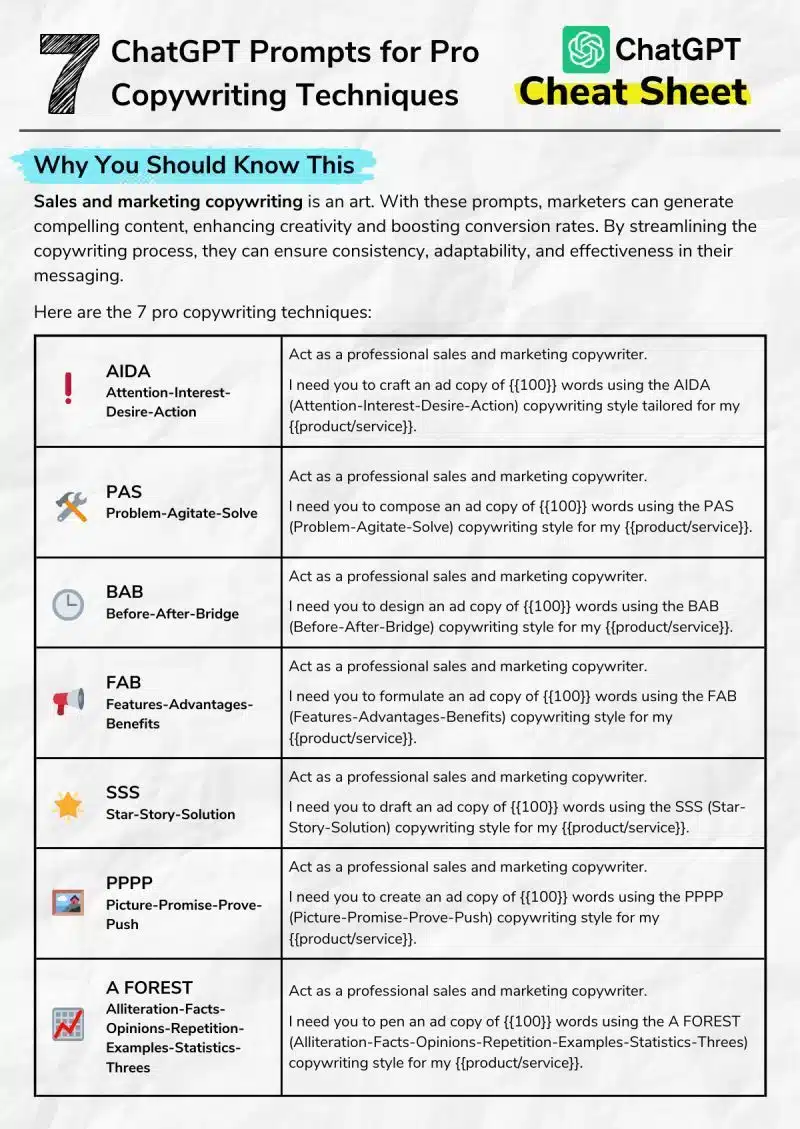
You’ll find some copywriting basics in this infographic.
Here’s a summary of what’s covered:
- AIDA (Attention–Interest–Desire–Action)
- PAS (Problem–Agitate–Solve)
- BAB (Before–After–Bridge)
- FAB (Features–Advantages–Benefits)
- SSS (Star–Story–Solution)
- PPPP (Picture–Promise–Prove–Push)
- A FOREST (Alliteration–Facts–Opinions–Repetition–Examples–Statistics–Threes)
Check out the post below for more.
Copywriting frameworks have stood the test of time because they tap into human psychology and proven persuasion principles. The challenge for many marketers is applying these formulas consistently and creatively without losing time or momentum. That’s where ChatGPT can become your secret weapon. By using carefully crafted prompts, you can guide ChatGPT to generate content that follows the most effective sales copywriting structures, saving you hours while boosting your output quality.
In this guide, we’ll explore seven of the world’s best copywriting frameworks and show you exactly how to use ChatGPT to bring them to life. For each one, you’ll learn the purpose of the formula, how it works, and the types of prompts that will help you achieve maximum results.
AIDA (Attention–Interest–Desire–Action)
The AIDA formula is one of the most widely recognised frameworks in copywriting. It starts by grabbing your audience’s attention, builds interest in what you’re offering, stirs desire for it, and finally drives them to take action. Using ChatGPT to create AIDA-based copy ensures your message follows this powerful flow from the first sentence to the final call-to-action.
- Begin your ChatGPT prompt by specifying the product or service and the tone of voice you want the ad to convey.
- Ask ChatGPT to produce four clear sections labelled Attention, Interest, Desire, and Action for easy editing.
- Include target audience details in your prompt so the messaging resonates with their needs and motivations.
- Request multiple variations of the same AIDA copy to test different angles and hooks for higher conversions.
PAS (Problem–Agitate–Solve)
PAS focuses on identifying a problem, intensifying the pain it causes, and then presenting your product or service as the ideal solution. This method works because it engages emotions and compels the reader to act to resolve discomfort. With ChatGPT, you can structure PAS copy that is both empathetic and persuasive.
- Clearly describe the problem your target audience faces when creating your ChatGPT prompt.
- Instruct ChatGPT to expand the “Agitate” stage with emotional language that makes the pain feel urgent.
- Ensure your prompt specifies a logical and convincing transition from the problem to the solution.
- Ask ChatGPT for alternative ways to phrase the “Solve” stage to keep your campaigns fresh and engaging.
BAB (Before–After–Bridge)
BAB is a storytelling-driven framework that paints a vivid picture of life before and after using your offering, then bridges the gap by showing how you make that transformation possible. ChatGPT can easily craft narratives that highlight the contrast and create a strong desire for change.
- In your prompt, describe the “Before” scenario in detail so ChatGPT can set the right emotional tone.
- Include specific benefits for the “After” stage so the future feels tangible and appealing.
- Ask ChatGPT to make the “Bridge” section clearly show how your product or service delivers the change.
- Request that ChatGPT provides both short-form and long-form BAB examples to suit different channels.
FAB (Features–Advantages–Benefits)
FAB helps you move beyond simply listing product features by explaining why they matter and how they directly help the customer. ChatGPT can help you break down technical details into customer-friendly language that’s easy to understand.
- Provide ChatGPT with a list of product features to form the foundation of the copy.
- Instruct it to explain the advantages each feature offers in a way that feels relevant to the reader.
- Ask ChatGPT to translate those advantages into clear, emotionally compelling benefits.
- Request examples of FAB copy formatted for different mediums, such as product pages, ads, and email.
SSS (Star–Story–Solution)
The SSS framework works by introducing a “star” or main character, telling their relatable story, and then presenting your product or service as the solution to their challenge. ChatGPT can bring these stories to life with engaging narratives that connect with your audience.
- Include details of your “star” in the prompt so ChatGPT can build a realistic, relatable character.
- Ask for a compelling story that reflects common experiences of your target audience.
- Ensure the “Solution” section clearly positions your offering as the key to resolving the problem.
- Request that ChatGPT writes the story in different tones, such as inspirational, emotional, or humorous.
PPPP (Picture–Promise–Prove–Push)
PPPP is designed to paint a vivid mental picture, make an enticing promise, prove you can deliver, and then push the reader to act. It blends emotional appeal with credibility and urgency, making it ideal for ChatGPT-generated marketing content.
- Ask ChatGPT to open with descriptive imagery that makes the “Picture” stage vivid and immersive.
- Specify the promise in your prompt so ChatGPT can make it bold and attractive to your audience.
- Include proof points, such as testimonials, statistics, or examples, for the “Prove” section.
- Direct ChatGPT to craft a strong “Push” with a clear and persuasive call-to-action.
A FOREST (Alliteration–Facts–Opinions–Repetition–Examples–Statistics–Threes)
A FOREST is a collection of persuasive writing tools designed to make messages more memorable and impactful. ChatGPT can apply this mix of techniques to create copy that is both creative and credible, giving your content extra punch.
- Tell ChatGPT to incorporate alliteration naturally so it enhances flow without feeling forced.
- Provide factual information or statistics for accuracy and authority.
- Ask it to weave in opinions or expert quotes to add perspective.
- Request examples and use of the “rule of three” for rhythmic, memorable phrasing.
Conclusion
Copywriting frameworks like AIDA, PAS, BAB, FAB, SSS, PPPP, and A FOREST have remained relevant for decades because they work across industries and audiences. ChatGPT can help you apply these methods quickly, consistently, and creatively, freeing you to focus on refining your brand’s voice and strategy.
By giving ChatGPT clear, detailed prompts, you’ll generate persuasive, high-quality copy that’s ready to test and optimise. Whether you need ad copy, sales pages, or email campaigns, combining proven formulas with AI support can transform your marketing results.

Author:
Mark Ford