
Are you struggling to create blog posts that attract readers and keep them engaged? Want to learn how to write content that not only ranks but also converts visitors into loyal customers?
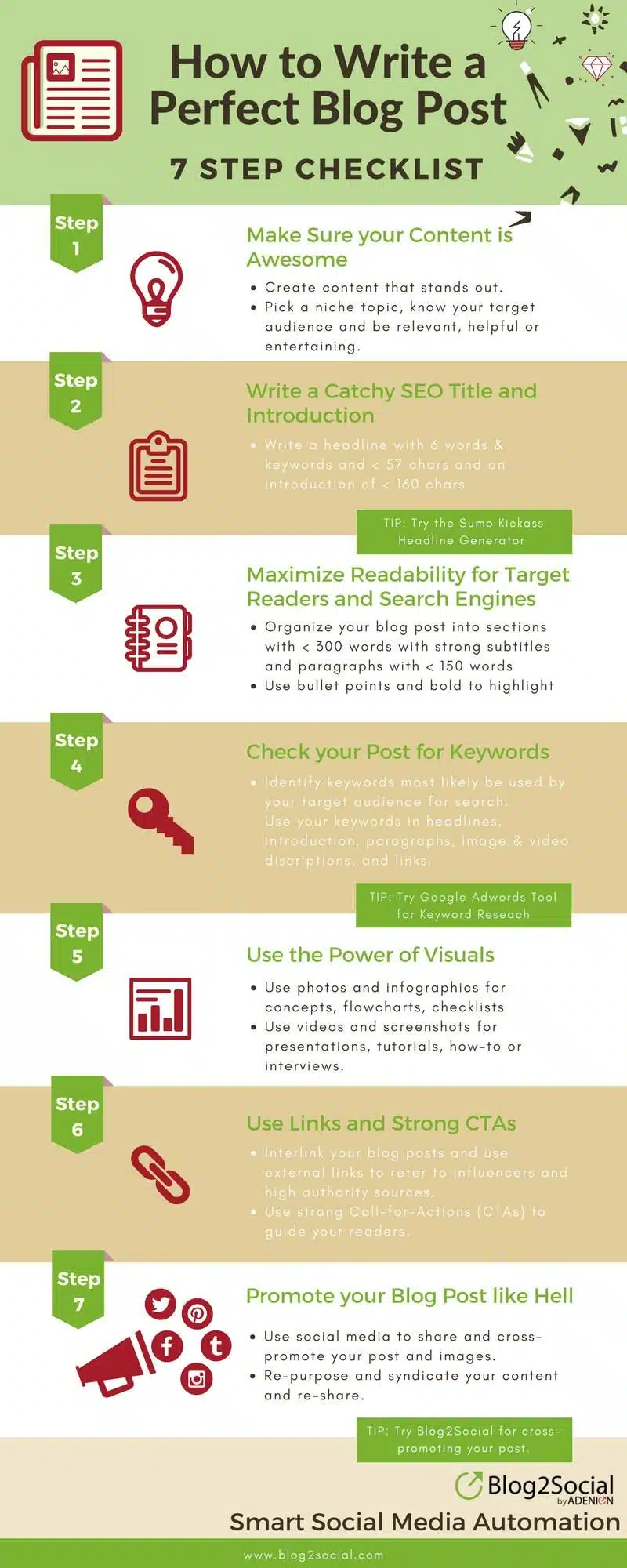
You’ll find a proven seven-step framework in this infographic to help your blogs deliver real traffic, engagement, and conversions.
Here’s a summary of what’s covered:
- Make Sure Your Content Is Awesome
- Write a Catchy SEO Title and Introduction
- Maximise Readability for Readers and Search Engines
- Check Your Post for Keywords
- Use the Power of Visuals
- Use Links and Strong CTAs
- Promote Your Blog Post
Check out the post below for more.
Creating a blog post that performs well isn’t just about putting words on a page. It’s about combining creativity, structure, and strategy to engage readers while satisfying search engines. The best-performing blog posts drive measurable results — attracting traffic, keeping readers hooked, and motivating them to take action.
In this guide, we’ll walk through seven key steps to help you write blog content that truly delivers.
Make Sure Your Content Is Awesome
Every successful blog post starts with content that stands out. Readers are drawn to writing that feels relevant, insightful, and valuable to their needs or interests. Whether you’re offering advice, analysis, or inspiration, the key is to produce something worth sharing and bookmarking. Focus on originality and usefulness from the very start.
- Choose a focused niche topic that your target audience genuinely cares about.
- Research existing content and find a unique angle that adds fresh value.
- Make your writing engaging through real examples, storytelling, and clear takeaways.
- Maintain a professional but approachable tone that builds trust and keeps readers interested.
Write a Catchy SEO Title and Introduction
Your headline and introduction are often the first — and sometimes only — parts of your blog that people read. A strong title should spark curiosity and make your audience want to click, while your introduction should quickly prove that it’s worth their time. SEO-friendly headlines attract traffic, but clarity and intrigue keep readers engaged.
- Keep your title around six words or fewer than 57 characters for maximum impact.
- Include relevant keywords naturally to boost visibility without sounding forced.
- Write an introduction of fewer than 160 characters that sums up the post’s value.
- Experiment with headline tools or formulas to test what drives the most clicks.
Maximise Readability for Readers and Search Engines
Even the best information can fall flat if it’s presented poorly. Readability determines how easy it is for people (and search engines) to digest your content. Structured sections, short paragraphs, and clean formatting make your post more appealing. The goal is to create a flow that guides readers smoothly from start to finish.
- Divide your content into clear sections, each covering one key idea or theme.
- Use short paragraphs under 150 words and keep sentences crisp and to the point.
- Incorporate bullet points and bold text to highlight main ideas and key phrases.
- Write descriptive subheadings that help readers and search engines understand the structure.
Check Your Post for Keywords
Keyword strategy connects your content to the people actively searching for it. By identifying what your audience types into Google, you can align your blog with their needs and improve its visibility. Effective keyword use isn’t about stuffing terms into text — it’s about integrating them naturally where they add the most value.
- Research target keywords using tools like Google Keyword Planner or Ahrefs.
- Include your main keyword in the title, introduction, and at least one subheading.
- Use related terms and variations throughout the post for semantic relevance.
- Add keywords to image alt text, meta descriptions, and internal links for SEO consistency.
Use the Power of Visuals
Visual content doesn’t just make your blog more attractive — it makes it more effective. Images, infographics, and videos break up text, clarify concepts, and help retain reader attention. A post with visuals tends to get more shares, longer reading time, and better overall engagement.
- Add relevant images that support your written message rather than distract from it.
- Use infographics to simplify data-heavy or complex sections for better comprehension.
- Embed videos or screenshots to provide tutorials, walkthroughs, or product demonstrations.
- Optimise all visual elements for fast loading speeds and include keyword-rich alt text.
Use Links and Strong CTAs
Links and calls to action (CTAs) give your blog direction and purpose. Internal links help readers explore more of your content, while external links to credible sources add authority. A strong CTA turns passive readers into active participants — whether that means signing up, downloading, or getting in touch.
- Add internal links to other relevant posts or key service pages to improve site structure.
- Include outbound links to reputable sources to enhance trust and SEO value.
- Write clear CTAs that tell readers exactly what to do next (“Download your free guide”).
- Place CTAs strategically — at the end of sections, within visuals, or as standout buttons.
Promote Your Blog Post
Great content won’t deliver results unless people know it exists. Promotion is what turns a well-written post into a high-performing one. By sharing across platforms and repurposing your content, you extend its reach, attract new readers, and reinforce your authority in your niche.
- Share your post on all major social media platforms, tailoring captions for each.
- Repackage your blog into shorter posts, threads, or video snippets to reach new audiences.
- Collaborate with influencers or industry partners to cross-promote your content.
- Schedule ongoing re-shares so your content continues to gain visibility over time.
Conclusion
Writing blog content that drives traffic, engagement, and conversions is about more than just hitting “publish.” It’s about creating something valuable, optimising it for visibility, and amplifying it through consistent promotion. When you blend quality writing with structure, SEO, visuals, and calls to action, you turn every post into a long-term asset.
The blogs that perform best aren’t accidents — they’re built with purpose, care, and strategy. Follow these seven steps, and your next post won’t just attract readers — it will convert them into loyal followers and customers.

Author:
Mark Ford